Students revise important topics using Class 7 Social Science Extra Questions and Class 7 SST Part 2 Chapter 5 India, a Home to Many Important Extra Questions before exams.
India, a Home to Many Class 7 Extra Question Answer
Extra Questions of India, a Home to Many Class 7 SST Chapter 5
India, a Home to Many Class 7 Very Short Question Answer
Question 1.
Why did Jews come to India?
Answer:
came to India to escape persecution in different countries. India gave them freedom to practise their faith.
Question 2.
Who were the Bene Israel?
Answer:
They were a Jewish community settling along the Konkan coast. They grew to become India’s largest Jewish group.

Question 3.
Why did Syriac Christians migrate to India?
Answer:
They faced persecution in West Asia. India allowed them to live and worship freely.
Question 4.
What is the sugar-in-milk story?
Answer:
A Parsi wise man dissolved sugar in milk to show they would blend into India without causing disturbance. It symbolised peaceful coexistence.
Question 5.
Who built India’s oldest mosque?
Answer:
Arab merchants helped build the Cheraman Juma Masjid. They came as peaceful traders.
Question 6.
Who are the Siddis?
Answer:
They are people of African origin brought to India through slave routes. Over time they blended African and Indian traditions.
Question 7.
Where did Armenians settle in India?
Answer:
They settled in Agra, Surat, Kolkata, and Chennai. They built churches and contributed to trade.
Question 8.
Why did Baha’is come to India?
Answer:
They were persecuted in Persia for their beliefs. India gave them safety and acceptance.
Question 9.
Who was Digvijaysinhji?
Answer:
He was the Maharaja of Nawanagar. He rescued over a thousand Polish children during World War II.
Question 10.
Why did Tibetans take refuge in India?
Answer:
Tibetans fled after China took control of Tibet. India granted asylum to the Dalai Lama and his people
India, a Home to Many Class 7 Short Question Answer
Question 1.
Why did Jews settle peacefully in India?
Answer:
Jews came to India in different waves after facing severe persecution in many countries. India offered them a safe place to practise their religion freely. Communities like the Bene Israel and Cochin Jews built synagogues and integrated into society. This reflects India’s long tradition of welcoming those in distress.
Question 2.
How did Syriac Christians become part of Indian society?
Answer:
Syriac Christians migrated from West Asia due to persecution. They reached Kerala through long-distance trade routes. Once in India, they freely practised their worship using the Syriac language. Their wedding customs and clothing adopted Indian cultural features over time.
Question 3.
Describe the significance of the Parsi “sugar in milk” legend.
Answer:
The legend explains how Parsis promised to blend into Indian society smoothly. Just like sugar dissolves in milk, they vowed to enrich the land without causing disruption. The gesture impressed Raja Jadi Rana, who granted them land. This story symbolizes harmonious coexistence.
Question 4.
How did Arab merchants influence Indian coastal regions?
Answer:
Arab merchants came as peaceful traders, not conquerors. They settled along the west coast and married local women. They helped build the Cheraman Juma Masjid, one of India’s oldest mosques. Their arrival contributed to cultural and economic exchanges.
Question 5.
What shows that Siddis have blended African and Indian cultures?
Answer:
Siddi dances still use African-style drumming. However, their clothing, languages, and religious practices have become Indian. They follow Hinduism, Islam, or Christianity depending on the region. This fusion shows deep cultural integration over centuries.
Question 6.
Why did Armenians settle successfully in India?
Answer:
Armenians came through ancient trade networks and found patronage under Mughal rulers. Akbar allowed them to build churches and practise their religion freely. They contributed to trade, administration, and cultural life in places like Agra and Kolkata. Their settlements still remain as historical landmarks.
Question 7.
What hardships brought Baha’is to India?
Answer:
Baha’is were persecuted in Persia for their religious beliefs. They were declared heretics and treated harshly. India offered them a safe homeland where they could practise their faith. Over time, many Indians also embraced the Baha’i teachings.
Question 8.
How did India help Polish children during World War II?
Answer:
Polish children were left homeless due to the war. The Maharaja of Nawanagar, Digvijaysinhji, rescued nearly 1,000 of them. He provided food, shelter, and safety in Jamnagar. A memorial in Poland honors his compassion.
Question 9.
Why did Tibetans rebuild monasteries in India?
Answer:
Tibetans fled after China annexed Tibet in 1959. India granted asylum to the Dalai Lama and thousands of refugees. To preserve their culture, new monasteries were established, especially in Karnataka. These monasteries became centers of learning and spiritual life.
Question 10.
What cultural values helped India welcome many communities?
Answer:
India has long believed in values like vasudhaiva kutumbakam—the world is one family. Teachings like sarve bhavantu sukhinah emphasize universal happiness. India respects diverse faiths and traditions. These values encouraged compassion and hospitality toward migrants.
India, a Home to Many Class 7 Long Question Answer
Question 1.
Describe the journey and settlement of the Bene Israel Jews in India.
Answer:
The Bene Israel Jews are believed to have arrived around 175 BCE after a shipwreck near the Konkan coast. They lost their holy books but preserved their belief in one God. Over centuries, they integrated into Indian society while keeping their Jewish identity. They became the largest Jewish community in India after independence. They practised freely because India allowed religious diversity. Their long history here shows the country’s welcoming nature.
Question 2.
Explain how Syriac Christians maintained their traditions while adopting Indian customs.
Answer:
Syriac Christians migrated from West Asia due to persecution by Roman and Persian authorities. They travelled along trade routes to reach Kerala. In India, they practised their religious rituals in the Syriac language. However, their weddings and clothing reflect strong Indian influence. They blended their faith with local cultural practices without losing their heritage. This demonstrates India’s capacity for peaceful cultural exchange.
Question 3.
Describe why Parsis fled Persia and how they adapted to India.
Answer:
Parsis left Persia after the Islamic conquest, which led to persecution, forced conversions, and destruction of fire temples. They crossed the Arabian Sea and reached Gujarat between the 8th and 10th centuries. Raja Jadi Rana agreed to shelter them after the symbolic “sugar in milk” demonstration. In India, they preserved fire worship and other rituals. They also adopted Indian dress, language, and customs. Today, they form a vibrant and influential community inlndia.
Question 4.
Discuss the influence of Arab merchants in India.
Answer:
Arab merchants came to India mainly for trade, not conquest. They settled along coastal regions in Kerala, Karnataka, and Gujarat. Marrying local women led to the formation of new communities like the Mappilas. They helped build the Cheraman Juma Masjid, India’s earliest mosque. Their arrival brought new ideas, culture, and religion. They enriched India’s long history of cultural exchange.
Question 5.
How did Siddis preserve African heritage while adapting to Indian life?
Answer:
Siddis arrived from Africa as slaves brought by Arab, Portuguese, and British traders. Over time, they adopted Indian languages and religions. Their dress and everyday lifestyle reflect Indian influence. However, their dance and drumming retain African cultural features. Some Siddis even rose to positions of power in Indian armies. Their blended culture shows the deep integration possible in India.
Question 6.
Explain the contributions of Armenians to India.
Answer:
Armenians first reached India as traders on
the Malabar coast. Under Akbar, they received patronage and built churches in Agra. They served in administration, trade, and even the Mughal army. Cities like Kolkata and Chennai became major Armeniancenters. Their legacy remains in Armenian churches, cemeteries, and schools. Their story highlights India’s openness to foreign groups.
Question 7.
Why did Baha’is migrate to India, and how did they flourish?
Answer:
Baha’is began in Persia under the leadership of Baha’uTlah. Their teachings emphasized unity and harmony among religions. However, Persian authorities labeled them heretics and persecuted them. Some Baha’is migrated to India seeking safety. In India, they found acceptance and built important centers like the Lotus Temple. Most Baha’is in India today are Indians who share the faith’s values.
Question 8.
Describe the humanitarian work of Maharaja Digvijaysinhji for Polish refugees.
Answer:
During World War II, many Polish children lost their families. The Maharaja of Nawanagar was touched
by their suffering. He arranged for their rescue and brought them to Jamnagar. He provided food, shelter, medical care, and education. Thousands of other Polish refugees were also permitted to stay safely in India. A memorial in Poland honors his compassion and generosity.
Question 9.
How did Tibetans rebuild their lives in India after 1959?
Answer:
The Chinese takeover of Tibet led to violence and suppression. The Dalai Lama fled to India, where he was granted asylum. India provided land for Tibetan settlements, especially in Karnataka. Monasteries were rebuilt to preserve spiritual traditions. Tibetan medicine like Sowa Rigpa also flourished in India. This allowed Tibetans to maintain identity while living peacefully.
Question 10.
What values made India a refuge for persecuted communities?
Answer:
India has ancient teachings emphasizing compassion and inclusion. Values like vasudhaiva kutumbakam view the world as one family. Atithi Devo Bhava encourages welcoming strangers with respect. India’s philosophical diversity encourages coexistence. These values helped persecuted groups feel safe here. They also allowed them to preserve traditions for centuries.
India, a Home to Many Class 7 Source Based Questions
Question 1.
Jews sought sanctuary in India in several waves. The persecution of Jews in various countries led to them having to flee their homes. India has proved to be a safe haven where they can practise their faith without fear. The Bene Israel are a Jewish community that lived on the Konkan coast, just south of Mumbai. According to some scholars, they came around 175 BCE from the ancient Kingdom of Israel.
Over time, the Bene Israel grew to become the largest Jewish community in India. Later groups arrived between the 12th and 19th centuries and settled in places like Cochin. The Raja of Kochi gave them land free of cost “as long as the world, sun, and moon endure”. They built synagogues and continued their traditions while becoming part of Indian society.
(i) Why did Jews come to India?
Answer:
They came to escape persecution and found safety in India.
(ii) Where did the Bene Israel settle?
Answer:
They settled on the Konkan coast near Mumbai.
(iii) What gift did the Raja of Kochi provide?
Answer:
He granted them land free of cost “as long as the world run, and moon endure.”
Question 2.
The Parsis came to India primarily to escape religious persecution in Persia after the Islamic conquest of the Sassanid Empire. They carried little with them except their sacred fire. According to a legend, when they approached Raja Jadi Rana of Gujarat, he showed them a jug full of milk, indicating his kingdom was full.
A wise Parsi dissolved sugar into the milk without spilling it, symbolizing that they would blend in peacefully and make the kingdom sweeter. Raja Jadi Rana granted them land. The Parsis preserved their ancient traditions but also adopted local Indian practices. They have since enriched various aspects of Indian society.
(i) Why did Parsis leave Persia?
Answer:
They fled religious persecution.
(ii) What did the jug of milk shown by Raja Jadi Rana represent?
Answer:
It represented that the kingdom was already full and could not easily accommodate more people.
(iii) Why did Raja Jadi Rana allow the Parsis to settle in his kingdom according to the legend?
Answer:
Raja Jadi Rana was pleased when the Parsi wise man showed that their community would blend smoothly with the local people without causing problems, and would add value to the kingdom.
Question 3.
Tibet became a center of Buddhism from the 7th century onward. After multiple invasions, Tibet eventually fell under Chinese control in the mid- 20th century. In 1959, a major uprising occurred in Lhasa, leading the 14th Dalai Lama to flee across the Himalayas to India. India granted him asylum and supported thousands of Tibetan refugees.
New monasteries were built in Tibetan settlements, especially in Karnataka. Tibetan medicine, known as Sowa Rigpa, was preserved and flourished in India. The Dalai Lama promotes compassion, religious harmony, and the preservation of Tibetan culture. India continues to be their second home.
(i) Why did Tibetans flee to India?
Answer:
They fled after China took control and suppressed their uprising.
(ii) Where did Tibetans establish new monasteries?
Answer:
Mostly in Karnataka.
(iii) What does the Dalai Lama promote?
Answer:
Compassion, religious harmony, and cultural preservation.
India, a Home to Many Class 7 Picture Based Questions
Question 1.

(i) What cultural blend is seen in Siddi dance?
Answer:
It shows African drumming fused with Indian dress and settings.
(ii) What does this reveal about their integration?
Answer:
They preserved African heritage while adopting Indian customs.
(iii) Why is this community unique?
Answer:
They represent centuries of African-Indian cultural fusion.
Question 2.
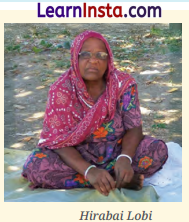
(i) Who is shown in the picture?
Answer: Hirabai Lobi, a Siddi woman from Gujarat.
(ii) What honour did she receive?
Answer:
She was awarded the Padma Shri in 2023.
(iii) Why was she recognized?
Answer:
She worked hard for the upliftment of the women of her community, connected them with banking services, educating them on organic farming and other livelihood options.
Class 7 India, a Home to Many Extra Questions for Practice
Multiple Choice Questions:
Question 1.
Which community is associated with the legend of milk and sugar symbolising peaceful coexistence?
(a) Jews
(b) Armenians
(c) Parsis
(d) Tibetans
Question 2.
The Bene Israel Jewish community mainly settled along which region of India?
(a) Eastern coastal plains
(b) Konkan coast
(c) Indo-Gangetic plains
(d) Deccan plateau
Question 3.
Which migrant community crossed the Himalayan mountain ranges to seek refuge in India?
(a) Armenians
(b) Arabs
(c) Tibetans
(d) Africans (Siddis)
Question 4.
Cheraman Jurna Masjid, one of the oldest mosques in India, is located in which state?
(a) Gujarat
(b) Karnataka
(c) Kerala
(d) Tamil Nadu
Question 5.
Assertion (A): India’s geography made it accessible through land and sea routes.
Reason (R): Mountains, seas, and trade routes connected India to many regions.
(a) Both (A) and (R) are true and (R) is the correct explanation of (A).
(b) Both (A) and (R) are true but (R) is not the correct explanation of (A).
(c) (A) is true but (R) is false. (d) (A) is false but (R) is true.
Very Short Answer Type Questions
Question 1.
Why did many communities migrate to India from other parts of the world?
Question 2.
Name any two values of Indian culture that encouraged acceptance of migrants.
Question 3.
Who were the Bene Israel and where did they settle in India?
Question 4.
Why did the Parsis leave Persia and come to India?
Question 5.
Mention two regions where Arab merchants settled in India.
Short Answer Type Questions
Question 1.
Describe the journey and settlement of the Jewish community in India.
Question 2.
Explain how the Syriac Christian community integrated into Indian society.
Question 3.
Who are the Siddis? Briefly describe their origin and cultural identity.
Question 4.
How did Armenians contribute to India’s trade and administration during the Mughal period?
Question 5.
Describe the circumstances that led Tibetan refugees to seek asylum in India.
Long Answer Type Questions
Question 1.
Explain how India’s cultural values made it a safe home for persecuted communities.
Question 2.
Discuss the story of the Parsis in India and the message conveyed by the legend of milk and sugar.
Question 3.
Describe the role of Arab merchants in shaping India’s trade and cultural exchange.
Question 4.
Analyse the contributions of migrant communities to India’s social, cultural, and economic
Question 5.
“Vasudhaiva Kutumbakam is not just a slogan but a way of life in India.” Justify this statement with examples from the chapter.