Students rely on Class 8 Science Extra Questions and Class 8th Curiosity Chapter 3 Health: The Ultimate Treasure Important Extra Question Answer to improve their grades.
Class 8 Science Chapter 3 Health: The Ultimate Treasure Extra Questions
Class 8 Science Chapter 3 Extra Questions on Health: The Ultimate Treasure
Health: The Ultimate Treasure Class 8 Very Short Question Answer
Question 1.
What do you mean by disease?
Answer:
A disease is a condition that affects the normal working of the body or mind.
Question 2.
Name two communicable diseases with their causal agents.
Answer:
Typhoid- Bacteria, Chickenpox- Virus

Question 3.
What is immunity?
Answer:
The body’s natural ability to fight diseases is known as immunity.
Question 4.
What are chronic diseases?
Answer:
The diseases that last for a long period of time (more than 3 months) are called chronic diseases. For example, cancer, diabetes and asthma.
Question 5.
What are pathogens?
Answer:
Disease-causing organisms like bacteria, viruses, fungi, or protozoa are called pathogens.
Question 6.
What are vectors?
Answer:
The organisms that spread or carry pathogens from one place to another, from an infected person to a healthy person are called vectors. For example, mosquito, housefly, etc.
Question 7.
What is the site of infection in Influenza?
Answer:
Respiratory tract
Question 8.
Name two non-communicable diseases.
Answer:
Diabetes and Obesity
Question 9.
What is antibiotic resistance?
Answer:
Antibiotic resistance is a condition in which bacteria are no longer killed by antibiotics. They survive and continue to multiply despite treatment with antibiotics.
Question 10.
What are the symptoms of chickenpox?
Answer:
Mild fever, itchy skin, rashes and blisters.
Health: The Ultimate Treasure Class 8 Short Question Answer
Question 1.
Explain the difference between communicable and non-communicable diseases.
Answer:
Communicable diseases are caused by pathogens and can spread from one person to another. Non-communicable diseases are not caused by pathogens and do not spread between people. They are usually linked to lifestyle, diet and environment.
Question 2.
Explain how does a vaccine works.
Answer:
A vaccine helps protect the body from diseases by training the immune system. It contains weakened or dead pathogens (such as viruses or bacteria), or harmless parts of the pathogen. These do not cause illness but help the immune system learn to recognise and fight the real pathogen. Later, if the person is exposed to the real pathogen, the immune system responds quickly and attacks the harmful germs before they cause illness. This protection is called acquired immunity.
Question 3.
What is acquired immunity?
Answer:
Acquired immunity is the protection that the body develops after being exposed to a disease-causing germ (pathogen) or after receiving a vaccine. When the immune system encounters a pathogen or a vaccine, it learns to recognise and remember it. This helps the body fight off the disease faster and more effectively if the same germ tries to infect the body again. Vaccines help build acquired immunity without causing illness.
Question 4.
How do pathogens spread from one person to another?
Answer:
Pathogens can spread through the air when an infected person coughs or sneezes. They may also spread by direct contact, such as touching or shaking hands, and by sharing personal items. Some pathogens also spread through contaminated food and water. Insects like mosquitoes and houseflies, called vectors, can also transmit diseases by spreading the pathogens.
Question 5.
What are antibiotics?
Answer:
Antibiotics are medicines that kill or stop the growth of bacteria that cause diseases. They work only against bacterial infections because they target parts of bacterial cells that are different from human or animal cells. Antibiotics do not work against viruses or diseases caused by protozoa.
Health: The Ultimate Treasure Class 8 Long Question Answer
Question 1.
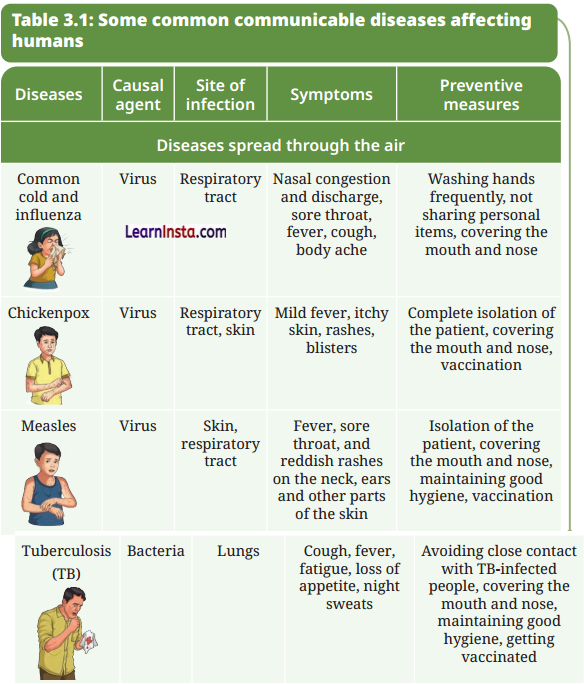
Explain any four communicable diseases that spread through air, mentioning their causal agents, site of infection, symptoms, and preventive measures.
Answer:
Question 2.
List some precautions to prevent the spread of diseases.
Answer:
We should follow these simple but important precautions to prevent the spread of diseases:
- Always keep your body and the place around you clean.
- Follow daily personal hygiene habits like brushing, bathing wearing clean clothes, etc.
- Use soap and water to wash your hands well, especially before eating and after using the toilet.
- Cover your mouth and nose with your elbow or a tissue when you cough or sneeze.
- Wear a mask in crowded areas to protect yourself and others.
- Do not share personal things like towels or handkerchiefs with others.
- Make sure your home is clean and keep your food and water safe to avoid germs.
- If you feel sick, stay home and rest, so you do not spread the illness to others.
Question 3.
What is the difference between vaccines and antibiotics?
Answer:
Vaccines and antibiotics are both used to fight diseases, but they work in very different ways and are used for different types of infections. A vaccine is given to a person to prevent certain diseases. It works by training the body’s immune system to recognise and fight pathogens like viruses or bacteria.
Vaccines are usually given before a person gets sick, to build acquired immunity. For example, vaccines protect us from diseases like polio, measles, tetanus, and rotavirus. On the other hand, antibiotics are medicines used to treat infections caused by bacteria. They kill the bacteria or stop them from growing. Antibiotics are not effective against viruses, so they cannot be used for illnesses like the flu or COVID-19.
Question 4.
What do you mean by disease symptoms? Explain giving two examples. (NCERT Exemplar)
Answer:
The abnormal signs from the body which indicate towards an underlying disease are called symptoms. Symptoms are like indications or signs that help identify the presence of a disease and that we should take necessary actions to fight that disease. Every disease have some specific symptoms which helps doctor to diagnose a disease. For example, fever, headache, body pain, diarrhoea, etc.
- Fever: This occurs because the body is trying to kill or slow down harmful microbes by creating a hotter environment (normal range 98.6°F or 37°C). It is a common symptom of many infections like malaria, flu, or typhoid.
- Cough: A cough helps remove mucus, irritants, or germs from the throat and lungs, but it also signals that something is wrong in the respiratory tract. It is a symptom seen in respiratory infections like tuberculosis, common cold, or COVID-19.
Question 5.
Why is immune system essential for our health? (NCERT Exemplar)
Answer:
Immune system is the special system of our body to fight against many diseases. It identifies and destroys harmful pathogens like bacteria, viruses, and fungi before they make us seriously ill. After encountering a disease once (or through vaccination), the immune system remembers the pathogen and fights it faster and stronger the next time.
Vaccines train the immune system to recognise specific germs and prepare a defense in advance, this is called acquired immunity, A weak immune system exposes the body to several diseases. It keeps us healthy by constantly protecting us from the unseen world of germs. This shows the importance of immune system for our health.
Health: The Ultimate Treasure Class 8 Skill-Based Questions
Question 1.
Look at the given image and answer the following question.
(a) What kind of disease is most likely being spread here?
(b) What simple
precautions should be taken to prevent its spread?
Answer:
(a) Dengue or malaria can be spread through mosquito bites.

(b)
- Avoid storing stagnant water.
- Use mosquito nets or repellents.
- Keep surroundings clean and dry.
Question 2.
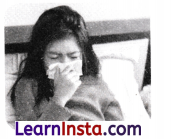
Observe the given image and answer the questions.
(a) Name the disease that can be spread this way.
(b) What steps can be taken to prevent such diseases?
Answer:
(a) A communicable disease like the common cold or flu.
(b)
- Cover mouth and nose while sneezing or coughing.
- Wear a mask.
- Wash hands regularly.
- Do not share personal items.
Health: The Ultimate Treasure Class 8 Quiz Questions
Question 1.
What is WHO?
Answer:
World Health Organisation
Question 2.
What does AQI stand for?
Answer:
Air Quality Index
Question 3.
Who developed the Rotavirus vaccine?
Answer:
Dr. Maharaj Kishan Bhan
Question 4.
Name one communicable disease.
Answer:
Chickenpox
Question 5.
Name one non-communicable disease.
Answer:
Cancer
Question 6.
Give one example of a vector.
Answer:
Housefly
Question 7.
Name one disease transmitted by an insect.
Answer:
Malaria
Question 8.
Name one deficiency disease.
Answer:
Anaemia
Question 9.
Which medicines only work against bacteria?
Answer:
Antibiotics
Question 10.
Who discovered the antibiotic penicillin?
Answer:
Alexander Fleming
Health: The Ultimate Treasure Class 8 Case Based Questions
Question 1.
Arjun is a 14-year-old student who spends most of his time playing video games, watching TV, and eating fast food. He does not exercise and also skips fruits and vegetables in his diet. Over time, Arjun started feeling tired easily, gained weight, and was diagnosed with early signs of diabetes. The doctor told him about lifestyle diseases and advised him to improve his lifestyle by eating a balanced diet, exercising regularly, and avoiding junk food.
I. What are lifestyle diseases?
II. Suggest any three lifestyle changes that can help prevent lifestyle diseases.
OR
What unhealthy habits in Arjun’s daily routine may have contributed to his early signs of diabetes?
Answer:
I. Lifestyle diseases are health problems that occur mainly due to unhealthy habits such as poor diet, lack of physical activity, and irregular routines.
II. To prevent lifestyle diseases, one should:
- Eat a balanced diet with fruits and vegetables
- Exercise or play outdoor games regularly
- Reduce screen time and follow a proper daily routine
OR
Unhealthy habits of Arjun:
- Too much screen time
- Eating junk or fast food regularly
- Skipping fruits and vegetables in his diet
- Lack of physical activities
Health: The Ultimate Treasure Extra Questions for Practice
Multiple Choice Questions
Question 1.
The Air Quality Index (AQI) tells us about the
(a) cleanliness of water
(b) Number of hospitals in an area
(c) cleanliness of air
(d) level of sound pollution.
Question 2.
Antibiotics are effective only against
(a) viruses
(b) bacteria
(c) fungi
(d) all microbes
Question 3.
Which organ is mainly affected by Hepatitis A?
(a) Intestine
(b) Lungs
(c) Liver
(d) Heart
Question 4.
Read the given statements and select the correct option.
Assertion (A): Diarrhoea and abdominal discomfort are common symptoms of typhoid.
Reason (R): Typhoid affects the lungs and causes cough and cold.
(a) Both A and R are true and R is the correct explanation of A.
(b) Both A and R are true but R is not the correct explanation of A .
(c) A is true but R is false.
(d) A is false but R is true.
Question 5.
Match the Column A with Column B.
Column A — Column B
(i) Smallpox — (p) Protozoa
(ii) Penicillin — (q) Blisters
(iii) Asthma — (r) Antibiotic
(iv) Malaria — (s) Chronic disease
(a) (i)-(q), (ii)-(r), (iii)-(s), (iv)-(p)
(b) (i)-(q), (ii)-(p), (iii)-(s), (iv)-(r)
(c) (i)-(p), (ii)-(q), (iii)-(r), (iu)-(s)
(d) (i)-(s), (ii)-(p), (iii)-(q), (iv)-(r)
Very Short Answer Type Questions
Question 1.
Define health.
Question 2.
Name a disease caused by protozoa.
Question 3.
Name two diseases spread by contaminated food and water.
Question 4.
Which disease affects the lungs?
Question 5.
Which disease is caused by worms?
Short Answer Type-I Questions
Question 1.
What is a parasite?
Question 2.
What does Ayurveda teach us?
Question 3.
What do you mean by symptom?
Question 4.
Define vaccination.
Question 5.
What do you mean by deficiency diseases?
Short Answer Type-II Questions
Question 1.
Write any three healthy habits for a healthy body.
Question 2.
Differentiate between a vaccine and immunity.
Question 3.
List the preventive measures for dengue fever.
Question 4.
What are the symptoms of cholera?
Question 5.
What is the difference between vector and pathogen?
Long Answer Type Questions
Question 1.
Explain how we can maintain a healthy lifestyle.
Question 2.
Describe three communicable diseases and three non-communicable diseases with their symptoms and examples.
Question 3.
Explain the common methods of transmission of diseases.
Suggested Projects And Activities
Question 1.
Find out the difference between malnutrition, under-nutrition, and over-nutrition. Make a collage on a chart paper. Paste the pictures under the right category. Label each picture clearly and write 1-2 lines explaining what each picture shows.
Question 2.
With the help of the Internet, find out how smallpox, was eradicated by vaccination. Make a report on it and share with your classmates.