These Class 8 Science Curiosity Worksheet and Class 8 Science Chapter 5 Exploring Forces Worksheet with Answers are excellent for board exam practice.
Class 8 Science Chapter 5 Exploring Forces Worksheet
Class 8 Exploring Forces Worksheet
Worksheet On Exploring Forces Class 8 – Exploring Forces Worksheet Class 8
Let’s Begin
A. Multiple-Choice Questions
Question 1.
What do you mean by force?
(a) A type of energy
(b) A kind of matter
(c) A push or pull on an object
(d) Mass of an object
Question 2.
Which of these is an example of a contact force?
(a) Gravitational force
(b) Magnetic force
(c) Frictional force
(d) Electrostatic force
Question 3.
What is the SI unit of weight?
(a) Gram
(b) Kilogram
(c) Newton
(d) Litre
Question 4.
Which force helps in digestion inside our body?
(a) Friction
(b) Muscular force
(c) Gravity
(d) Electrostatic force
Question 5.
What is used to measure weight of an object?
(a) Thermometer
(b) Barometer
(c) Spring balance
(d) Magnet
Question 6.
This question consists of an Assertion (A) and a Reason (R). Read the Assertion and Reason and choose the appropriate answer.
Assertion (A): Gravity works only when objects are dropped from a height.
Reason (R): Gravity acts in the downward direction.
(a) Both A and R are true and R is the correct explanation of A.
(b) Both A and R are true but R is not the correct explanation of A.
(c) A is true but R is false.
(d) A is false but R is true.
Question 7.
This question consists of an Assertion (A) and a Reason (R). Read the Assertion and Reason and choose the appropriate answer.
Assertion (A): A plastic scale rubbed with polythene attracts small paper pieces.
Reason (R): Rubbing the scale with polythene generates static charges on its surface.
(a) Both A and R are true and R is the correct explanation of A.
(b) Both A and R are true but R is not the correct explanation of A.
(c) A is true but R is false.
(d) A is false but R is true.

B. State True (T) or False (F).
1. The upward force exerted by a liquid on an object is called buoyant force or upthrust.
2. The direction of friction is opposite to the direction of motion of an object.
3. Weight and mass are exactly the same terms.
4. Pumice is a volcanic rock that can float on water.
5. Gravitational force is always an attractive force.
C. Fill in the blanks.
1. Like charges ____ each other while unlike charges ____ each other.
2. The force with which the Earth attracts objects towards itself is called ____.
3. A ____ force acts without touching the object.
4. ____ Principle explains why objects float or sink in liquids.
5. An object ____ in water when the buoyant force is equal to the gravitational force.
D. Assign one word to the following terms.
1. The SI unit of force. _____________
2. The force exerted by a charged object. _____________
3. The amount of matter in an object. _____________
4. The force exerted by a magnet. _____________
5. The force caused by the action of muscles. _____________
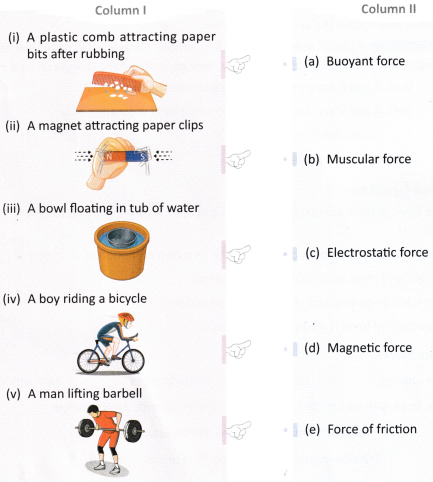
E. Match Column I with Column II.
Wonder Why?
A. Give reasons for the following.
1. A moving object eventually comes to rest even if no one stops it.
__________________________________________
__________________________________________
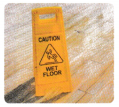
2. We tend to slip on a smooth or wet floor.
__________________________________________
__________________________________________
3. High-speed trains and aeroplanes have specific shapes.
__________________________________________
__________________________________________
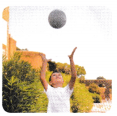
4. When an object is thrown vertically upward, it slows down, stops for a moment, and then falls back down
__________________________________________
__________________________________________
5. When different objects are hung from a spring, the spring stretches by different amounts.
__________________________________________
__________________________________________
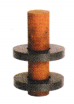
6. When two like poles of ring magnets are placed facing each other on a stick, the top magnet floats without touching the bottom one.
__________________________________________
__________________________________________
B. Read the paragraph and answer the following questions.
Ajay took an empty plastic bottle with its cap tightly closed and pushed it into a bucket of water. He immediately felt an upward push against his hand. When he removed his hand from the bottle, it bounced back to the surface and floated.
Question 1.
Which force is acting on an empty plastic bottle placed in water?
__________________________________________
Question 2.
Which force tries to pull the object downward?
__________________________________________
Question 3.
Why did the bottle float back to the surface after Ajay removed his hand?
__________________________________________
Question 4.
If Ajay replaces the empty plastic bottle with a pumice stone and pushes it into the bucket of water, will the pumice stone float or sink?
__________________________________________
Learn By Doing
A. Observe the given activities and identify the force involved in each activity. Then, state whether it is a Contact Force or a Non-Contact Force.
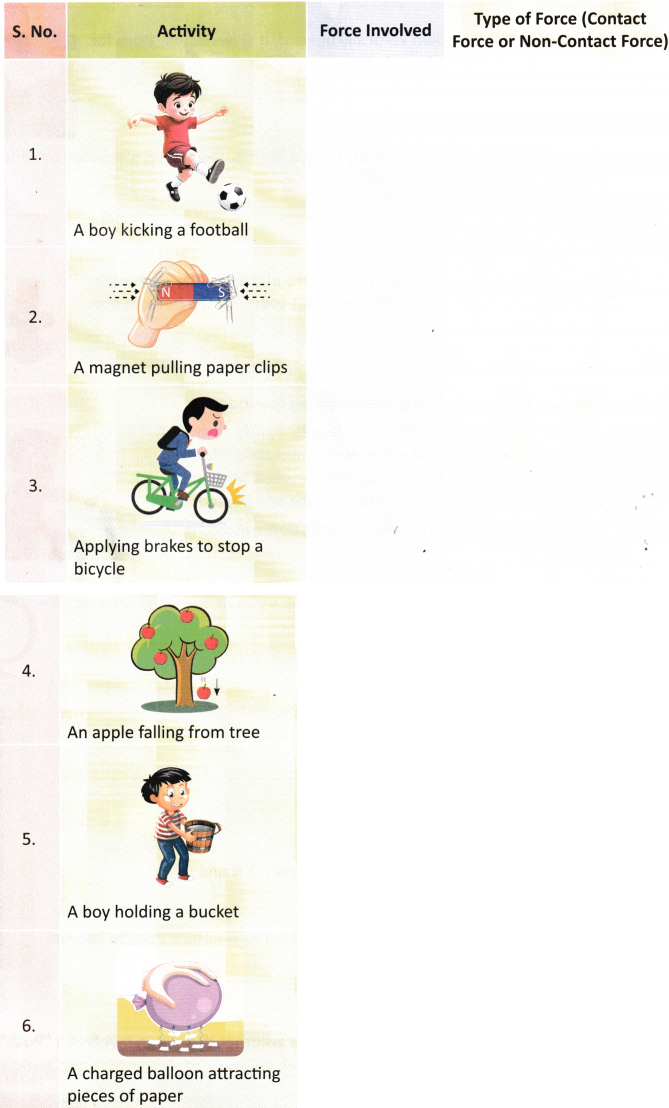
B. Different objects have been weighed using a spring balance. Observe the readings in the table below and answer the following questions with reference to the image of spring balance provide(d)
| Object | Mass | Weight (in N) |
| 1. Pencil box | 50 g | 0.5 N |
| 2. Small steel spoon | 20 g | 0.2 N |
| 3. Half-filled water bottle | 250 g | 2.5 N |
| 4. Small stone | 100 g | 1.0 N |
| 5. Hardcover book | 200 g | 2.0 N |
| 6. Packet of sugar | 550 g | 5.5 N |

Question 1.
How many small divisions are there between 0 N and 1 N on the spring balance?
__________________________________________
Question 2.
Write down the formula for calculating the value of one small division.
__________________________________________
Question 3.
What is the value of one small division?
__________________________________________
Question 4.
Which object has the maximum weight?
__________________________________________
Question 5.
Which object is the lightest?
__________________________________________
Question 6.
Name the objects that have weights between 1 N and 5 N.
__________________________________________
Question 7.
Why should this spring balance not be used to measure objects heavier than 10 N?
__________________________________________
C. Read each action carefully. Identify and write whether the action involves a “Push” or a “Pull” and describe its effect in the table given below.
| Action | Push/Pull | Effect |
| 1 Your father holding your moving bicycle from behind to stop it | ||
| 2. Hitting a moving ball with a hockey | ||
| 3. Pressing an yoga ball | ||
| 4. Opening a drawer using its handle | ||
| 5. Pressing the button on a doorbell | ||
| 6 Drawing water from a well using a rope | ||
| 7. Throwing a basketball into a hoop | ||
| 8 Lifting a bucket of water using the handle | ||
| 9. Closing a box lid by pressing it down | ||
| 10. Dragging a bag on the floor |
Explore With Curiosity
A. A spring balance has a maximum capacity of 10 N and there are two smaller divisions between each pair of bigger marks (For example, between 0 N and 1 N, and between 1 N and 2 N).
In the space provided below, draw a neat scale of this spring balance. Clearly mark the bigger divisions (0 N, 1 N, 2 N, et(c), up to 10 N) and show the two smaller divisions between each pair of bigger marks. Label all the divisions carefully.
Now, based on your drawing, answer the following questions.
Question 1.
What is the weight difference between two bigger marks?
__________________________________________
Question 2.
How many small divisions are there between 0 N and 10 N?
__________________________________________
Question 3.
What is the value of one small division?
__________________________________________
Question 4.
What is the smallest weight this spring balance can measure?
__________________________________________
Question 5.
If the pointer is on the first small division after 1 N, what is the total weight shown on the spring balance?
__________________________________________
B. A mango fell from a tree in two different situations. Observe these situations and answer the following questions.
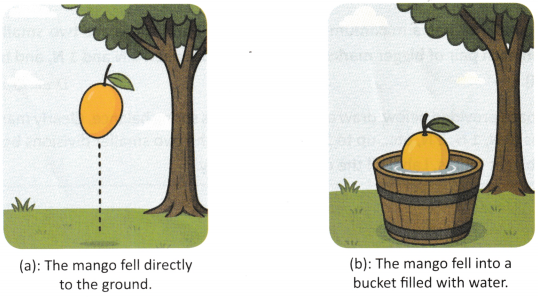
Question 1.
Name the non-contact force acting on the mango in both the situations.
__________________________________________
Question 2.
Which additional force acted on the mango in situation (b)?
__________________________________________
C. Rehan pushed a toy car on the floor in two different situations. Observe these situations and answer the following questions.
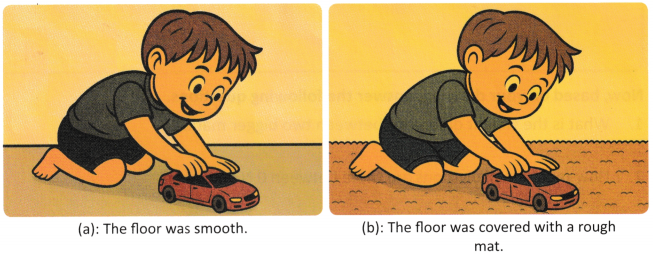
1. In which situation did the toy car travel a longer distance?
__________________________________________
2. Name the contact force responsible for the difference in distance.
__________________________________________
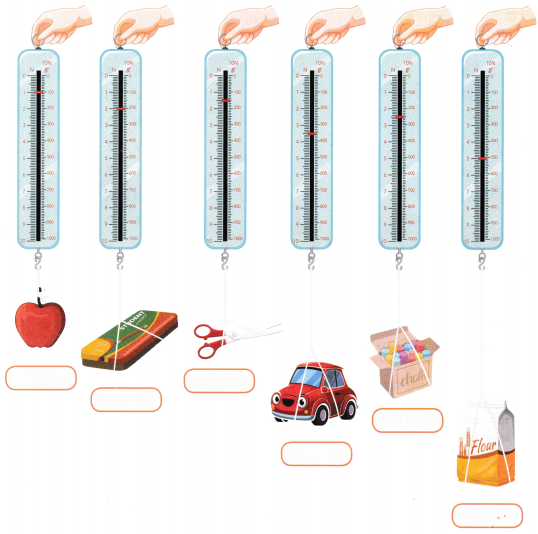
D. The spring balance shown below can measure weights up to 10 N. Bettween each bigger mark (such as 0 N and 1 N, or 1 N and 2 N), there are ten equal smaller divisions. Six different objects are hung one by one on the spring balance. Observe the position of the pointer carefully in each case, and write the weight of each object in the space provide(d)
Word Puzzle
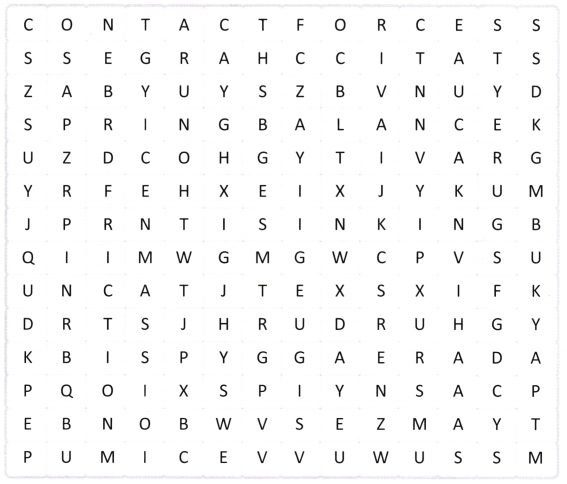
Find ten words related to the chapter in the word search puzzle.
Suggested Activities
A. With your teacher’s guidance, create a simple spring balance using a spring, a hook, and a marked scale. Use this device to find the weight of several small objects. Then calculate the ratio of weight to mass for each object. Record your findings and look for any patterns in your dat(a)
B. Under your teacher’s supervision, make a basic electroscope in class using everyday materials such as aluminium foil, a glass jar and copper wire. Use it to test whether different objects become electrically charged after being rubbe(d) Record your observations and compare how different materials behave.