These Class 7 Science Curiosity Worksheet and Class 7 Science Chapter 3 Electricity Circuits and Their Components Worksheet with Answers are excellent for board exam practice.
Class 7 Science Chapter 3 Electricity Circuits and Their Components Worksheet
Class 7 Electricity Circuits and Their Components Worksheet
Worksheet On Electricity Circuits and Their Components Class 7 – Electricity Circuits and Their Components Worksheet Class 7
A. Multiple-Choice Questions
Question 1.
Why is it recommended to use only batteries for experiments with electricity at home or school?
(a) They are cheaper than other sources of electricity.
(b) They are small and easy to handle.
(c) They are safer and do not carry the same risk of electric shock.
(d) They make experiments more enjoyable.
Question 2.
What is the function of a switch in a circuit?
(a) To store electric current.
(b) To allow or stop the flow of current in the circuit.
(c) To increase the electric current.
(d) To decrease the electric current.

Question 3.
Which of the following is the main source of energy for a simple circuit?
(a) Battery
(b) Switch
(c) Wire
(d) Bulb
Question 4.
This question consists of an Assertion (A) and a Reason (R). Read the Assertion and Reason and choose the appropriate answer.
Assertion (A): A lamp glows only when the electric circuit is complete.
Reason (R): A complete circuit allows electric current to flow from the negative to the positive terminal of the electric cell.
(a) Both A and R are true, and R is the correct explanation of A.
(b) Both A and R are true, but R is not the correct explanation of A.
(c) A is true but R is false.
(d) A is false, but R is true.
Question 5.
This question consists of an Assertion (A) and a Reason (R). Read the Assertion and Reason and choose the appropriate answer.
Assertion (A): Copper is the best electrical conductor.
Reason (R): Copper is used for making electrical wire due to its lower cost and abundant supply.
(a) Both A and R are true, and R is the correct explanation of A.
(b) Both A and R are true, but R is not the correct explanation of A.
(c) A is true but R is false.
(d) A is false, but R is true.
B. State True (T) or False (F).
1. A battery is a simple device that either completes or breaks a circuit.
2. A broken filament stops the flow of current, preventing the lamp from glowing.
3. In incandescent lamps, the filament stays cool and gives off light.
4. Connecting more than one cell provides energy to the circuit for a longer period.
5. Wood is an example of an electric conductor.
C. Fill in the blanks.
1. All electric cells have ______________ terminals.
2. The glowing thin wire is called the ______________ of the lamp.
3. The type of electric current that comes from power plants and is supplied to homes is called ______________
4. ______________ do not allow electric current to pass through them.
5. A combination of two or more cells is known as ______________
D. Assign one word to the following terms.
1. The short line in the symbolic representation of an electric cell represents. ______________
2. A representation of an electrical circuit using symbols. ______________
3. A material that allows electricity to flow through it. ______________
4. The power source used to generate electricity by using the energy of flowing or falling water. ______________
5. The type of current used in small devices powered by batteries. ______________
E. Match the Columns.
Question 1.
Match the electrical components given in Column I with the correct symbols given in Column II.

Question 2.
Match the terms given in Column I with their correct descriptions given in Column II.
| Column I | Column II |
| (i) LED | (a) The circuit is incomplete, and current does not flow. |
| (ii) Filament | (b) The circuit is complete and current flows. |
| (iii) Open Circuit | (c) The current flows in one direction only. |
| (iv) Closed Circuit | (d) A thin wire inside the lamp that heats up and glows when current flows through it. |
Wonder Why?
A. Give a reason for the following.
Question 1.
Imagine a torch that does not glow even after inserting new cells. Why does it not work if one of the cells is inserted incorrectly?

________________________________________________________
________________________________________________________
Question 2.
You connect a bulb to a battery using wires, and it glows. Why does the bulb stop glowing if the wire is cut?

________________________________________________________
________________________________________________________
Question 3.
You notice that some objects, like coins or keys, make the bulb glow in a simple circuit, while others, like rubber or wood, do not. Why is it so?

________________________________________________________
________________________________________________________
Question 4.
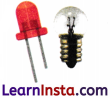
What is the difference between an incandescent lamp and an LED?
________________________________________________________
________________________________________________________
Question 5.
Look at an electric wire inside a wall socket or attached to a TV. Why is the metal wire always covered with a plastic or rubber coating on the outside?

________________________________________________________
________________________________________________________
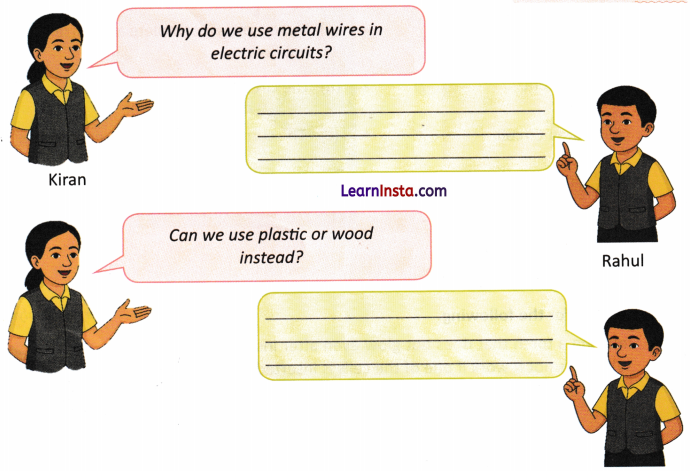
B. Complete the conversation by answering the following questions about conductors and insulators.
C. Observe the given image and answer the following questions.

Question 1.
What is an LED?
________________________________________________________
Question 2.
How do you know which side of the LED is positive and which is negative?
________________________________________________________
Question 3.
When does current flow through an LED, causing it to glow?
________________________________________________________
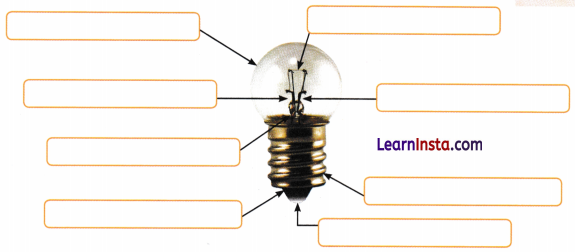
D. Look at the diagram of the incandescent lamp below. Label all the parts of the lamp and answer the following questions.
Question 1.
Which part of the lamp glows when the torch is switched on?
________________________________________________________
Question 2.
How is the filament fixed inside the bulb?
________________________________________________________
________________________________________________________
Question 3.
Why does the filament glow when an electric current passes through it?
________________________________________________________
________________________________________________________
Question 4.
Is the lamp still useful if the filament is broken? Why or why not?
________________________________________________________
________________________________________________________
Learn By Doing
A. Set up a conduction tester with a cell, lamp, and wires. Test each material by placing it between the wire ends. Write “Yes” if the lamp glows, “No” if it doesn’t. Identify the material as a Conductor or Insulator. One example has been done for you.

B. Design a simple electrical circuit using symbols for an electric cell, a switch, and a lamp. Ensure the switch is in the closed position so that the lamp glows. Label each component clearly.

Question 1.
What do you think will happen to the lamp when:
- The switch is ON? ______________
- The switch is OFF? ______________
Question 2.
Now replace the lamp with an LED.
What is the correct way to connect the terminals of an LED to a battery so that current flows and the LED glows?
________________________________________________________
________________________________________________________
C. Look carefully at the figures given below. Complete the table based on your observations. After that, answer the questions that follow using the information from both the figures and the table.
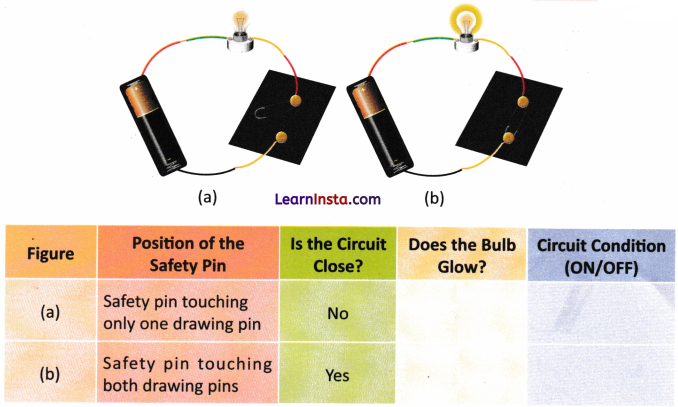
Question 1.
What role does the safety pin play in the circuit?
________________________________________________________
________________________________________________________
Question 2.
Which part of the setup works like the switch in your home?
________________________________________________________
________________________________________________________
D. Observe the different arrangements of the cell and lamp shown in the table below. Complete the table based on your observation.
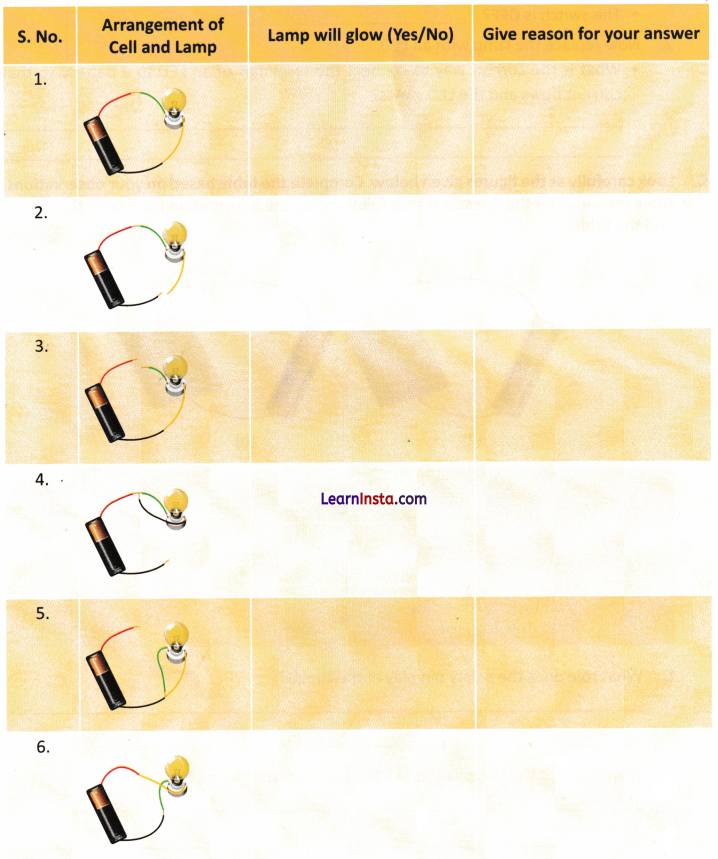
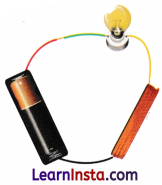
E. Look at the given picture showing a glowing lamp connected to an electric cell using wires. Based on this setup, answer the following questions.

Question 1.
What concept of electricity is being demonstrated in the picture?
________________________________________________________
________________________________________________________
Question 2.
Why does the lamp glow when connected to the cell?
________________________________________________________
________________________________________________________
Question 3.
Will the lamp still glow if the wires are connected to the opposite ends of the cell? Why or why not?
________________________________________________________
________________________________________________________
Explore With Curiosity
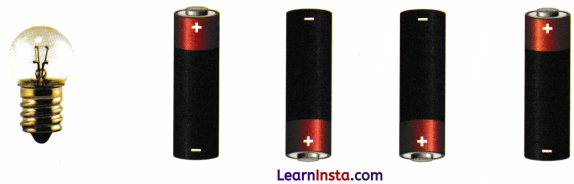
A. Imagine you have four electric cells in front of you. You want to connect them using wires to make a strong battery that can glow a bulb brightly.
Draw lines in the given diagram to show how you will connect the terminals of the four cells using wires to make a battery.
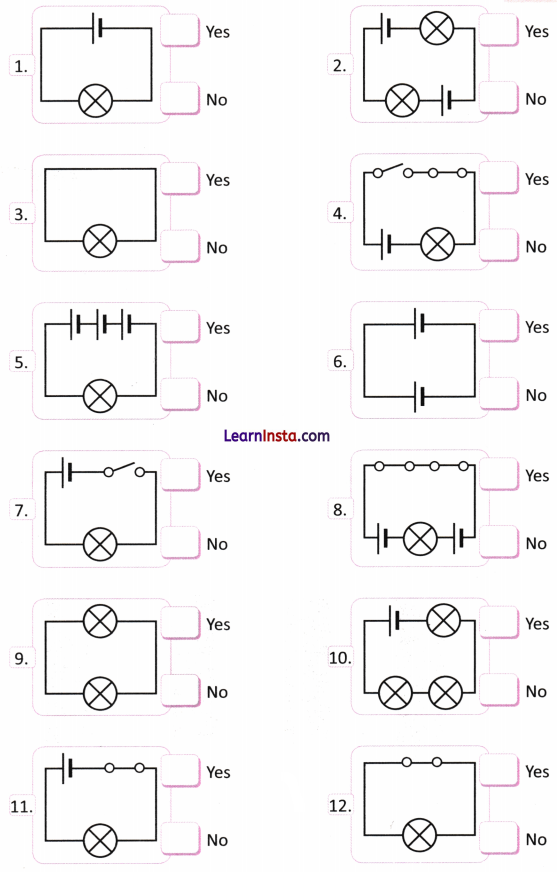
B. Look at the circuit images given below. For each circuit, tick (✓) ‘Yes’ if the bulb will glow, or ‘No’ if it will not glow.
Word Puzzle
Complete the crossword with the help of the given clues.
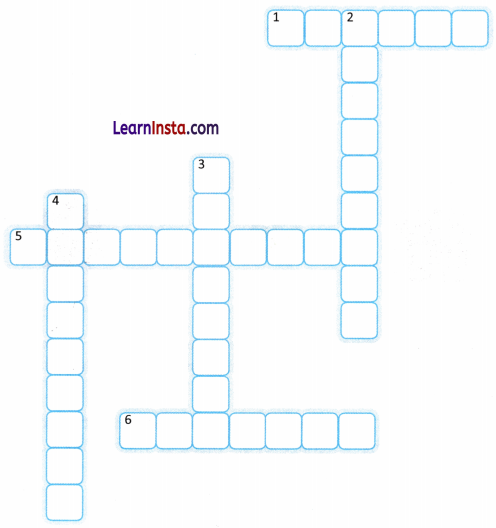
Across
1. A simple device that either completes or breaks a circuit.
5. A portable light source that runs on batteries.
6. Consists of two or more electric cells connected.
Down
2. A material that does not allow electric current to pass through it.
3. A thin wire inside the bulb, which glows.
4. A material that allows electric current to pass through it easily.
Activities
A. Suppose there is no electricity in your area for two days. Make a list of the daily activities you would not be able to perform during this time.
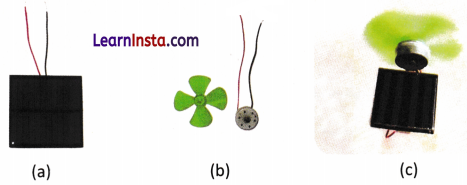
B. Using a solar panel as a source of electrical energy (a), make a simple circuit to run a toy fan (b). Connect the solar panel to the fan using wires, making sure the connections are secure. Place the solar panel under sunlight and observe how the energy from the sunlight helps run the fan (c).
C. Talk to a science teacher at your school’s science lab. Ask him or her to show you different types of electric cells they use. Note down the names of the cells and write a short report based on your discussion.
D. Look around your home and find objects made of metal, plastic, wood, or rubber. Sort these objects based on the material they are made of. Then, make a chart to show which materials are conductors and which are insulators.