These Our Wondrous World Class 5 Worksheet and Class 5 EVS Chapter 8 Clothes How Things are Made Worksheet with Answers Pdf are excellent for board exam practice.
Clothes How Things are Made Class 5 EVS Worksheet Chapter 8
Class 5 EVS Clothes How Things are Made Worksheet
Class 5 EVS Chapter 8 Worksheet – Class 5 Clothes How Things are Made Worksheet
This chapter is about weaving and stitching. It shows how birds and insects weave nests using natural materials. We also learn how people make cloth by spinning, weaving, and stitching, using natural fibres like cotton and silk, as well as synthetic fibres. Students also explore how many families earn a living through weaving. This chapter highlights the local traditions like handloom and embroidery, and the value of reuse, recycling, and creativity in everyday materials. We also learn fun activities that help us try weaving and stitching on our own using paper, cloth, and thread.
Multiple Choice Questions
Question 1.
What is the male baya weaver known for?
a. Singing songs
b. Eating cotton
c. Flying the fastest
d. Building nests from grass
Question 2.
What is the name of the fabric made using a spinning wheel during India’s freedom movement?
a. Silk
b. Polyester
c. Khadi
d. Nylon
Question 3.
Why is weaving important in India?
a. It uses machines only.
b. It is for recreation only.
c. It helps people earn a living and keeping traditions alive.
d. It is done for paper making.
Question 4.
What is common between the tailorbird and the weaverbird?
a. Both fly to other countries
b. Both use natural materials to build nests
c. Both stitch using a sewing machine
d. Both eat leaves
Question 5.
What do we call the process of twisting fibres to make thread?
a. Stitching
b. Spinning
c. Weaving
d. Cutting
Question 6.
Which of these would you most likely find in a textile mill?
a. A weaverbird
b. A charkha
c. Big machines for spinning and weaving
d. Leaves and twigs
Question 7.
Read the statements given below and choose the correct option.
Statement I: Synthetic fibres like nylon and polyester are made by humans.
Statement II: Natural fibres are made in factories.
a. Statement I is true.
b. Statement II is true.
c. Both statements I and II are true.
d. Both statements I and II are false.
Fill in the blanks.
1. The cloth made on a hand-operated loom is called ________ fabric.
2. The thread used to weave cloth is made from ________.
3. A ________ helps people weave cloth by hand.
4. Silk is made from the cocoon of the ________.
5. A ________ stitch is made by moving the needle up and down in a straight line through the fabric.
6. The ________ lays eggs in a soft and padded sleeve-like nest.
7. The embroidery called ________ comes from Punjab.
8. ________ is a famous handloom pattern of Kashmir.

State True (T) or False (F).
1. The tailorbird uses a needle and thread to sew its nest.
2. Cotton is a synthetic fibre made by humans.
3. A mat can be made by cutting paper into circles and pasting them.
4. Wool is a natural fibre obtained from sheep.
5. Ikat is a famous handloom weaving style from Gujarat and Odisha.
6. If one thread breaks in a stitched cloth, the rest will stay unaffected.
Circle the Odd One Out.
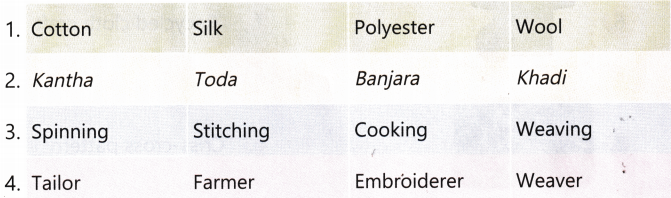
Match the following.

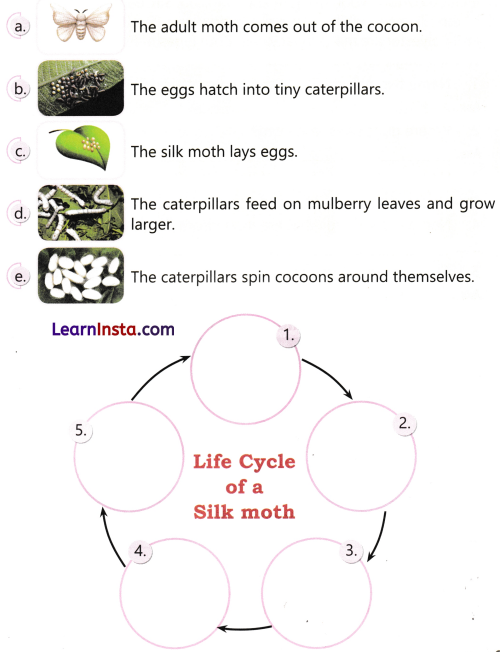
Complete the life cycle of a silk moth by arranging the steps (a-e) below in the correct order from 1 to 5.
Read the paragraph and answer the following questions.
We get fibres from both natural and man-made sources. Natural fibres include cotton, wool, silk, jute and bamboo. Silk comes from the cocoon of the silk moth, while cotton grows on plants. Synthetic fibres like nylon and polyester are made in factories. Both types of fibres are used to make clothes, bags, and other products.
Question 1.
Name two natural fibres and two synthetic fibres.
Answer:
_____________________________
Question 2.
Where does silk come from?
Answer:
_____________________________
Question 3.
How is polyester different from cotton?
Answer:
_____________________________
Question 4.
Name a few things that are made from fibres.
Answer:
_____________________________
Question 5.
Are synthetic fibres made by nature?
Answer:
_____________________________
Look at the picture and answer the following questions.
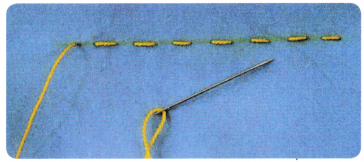
Question 1.
What do you see in the picture?
Answer:
_____________________________
Question 2.
What kind of stitch is being used?
Answer:
_____________________________
Question 3.
What tool is being used?
Answer:
_____________________________
Question 4.
Why do you think stitching is important?
Answer:
_____________________________
Question 5.
What can you make with stitched cloth?
Answer:
_____________________________
Answer the following questions.
Question 1.
What is a loom, and what is it used for?
Answer:
_____________________________
Question 2.
What natural things are used to make cloth or mats?
Answer:
_____________________________
Question 3.
How did Gandhi ji teach people to be self-sufficient?
Answer:
_____________________________
Question 4.
How do people in India recycle old clothes?
Answer:
_____________________________
Question 5.
What is embroidery, and how is it different from stitching?
Answer:
_____________________________
Question 6.
How does the baya weaverbird make its nest?
Answer:
_____________________________
Question 7.
What do you see when you look at cloth closely through a magnifying glass or camera?
Answer:
_____________________________
Question 8.
How can you make thread from a cotton ball?
Answer:
_____________________________
Question 9.
How does the tailorbird sew a leaf to build a nest?
Answer:
_____________________________
Question 10.
Out of cotton and jute, which one feels smooth and thin, and which one feels rough and thick?
Answer:
_____________________________
Learn With Fun
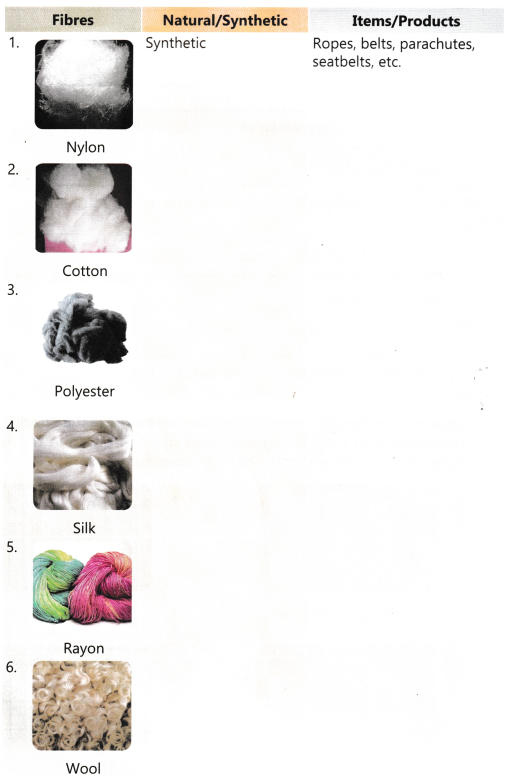
Observe the images of different fibres and complete the given table. (One example has been done for you.)
Take a piece of small cloth and thread a needle, tying a knot at one end. Start stitching on the cloth, marking Points A, B, C, and D on your own. Paste your fabric using fabric glue in the space given below. (To be done under adult supervision)
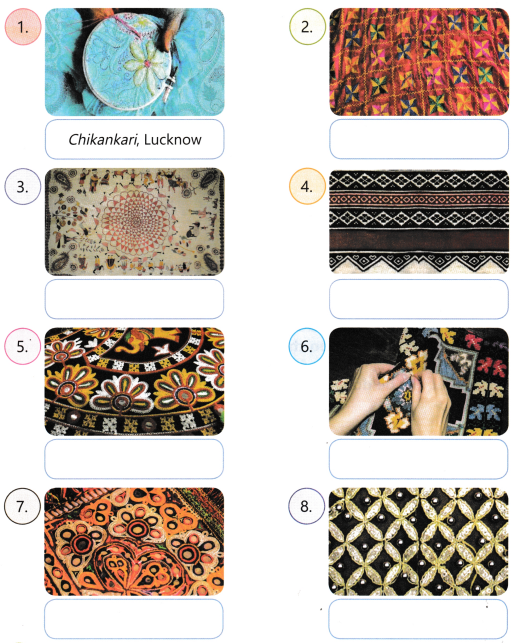
Observe the images and write the names of the traditional embroideries of India along with their place of origin in the space given below. (One example has been done for you.)
Word Puzzle
Complete the crossword with the help of the given clues.
Down
1. Using old materials again to make something new and useful.
2. A public display of work, like crafts, clothes or art
5. Twisting cotton fibres to make thread or yarn.

Across
3. Man-made fibre made from artificial materials.
4. It is the young stage of a silk moth.
5. Joining pieces of fabric together with thread using a needle.
6. A method of making fabric by crossing threads over and under each other.