Check the below Class 7 English MCQ Chapter 5 A Funny Man MCQ based on the latest exam pattern.
Class 7 English Chapter 5 MCQ Online Test A Funny Man
MCQ of A Funny Man Class 7
MCQ on A Funny Man
Question 1.
The speaker was ironically presented with a ‘rose’ that turned out to be
(a) a decorative rock in disguise
(b) a raisin bun masquerading as a flower
(c) a bottle of scent with no fragrance
(d) a disappearing trick ending in a bow
Answer:
(b) a raisin bun masquerading as a flower
Question 2.
The speaker’s recoil after the rose was presented can best be attributed to
(a) physical force from the eccentric man
(b) An intense dislike for dried fruit
(c) The overwhelming absurdity of the moment
(d) The sweet and cloying scent of the bun
Answer:
(c) The overwhelming absurdity of the moment
Question 3.
Which element sets a comic tone right at the poem’s onset?
(a) A sing-song rhyme scheme
(b) Reverse grammatical order for effect
(c) The man’s bizarre attire and illogical dress code
(d) The narrator’s overly dramatic response
Answer:
(c) The man’s bizarre attire and illogical dress code

Question 4.
The sound the man emitted while singing could best be described as
(a) fierce and thunderous, full of anger
(b) lullaby-like, calming, and slow
(c) ridiculously unique, bordering on nonsense
(d) a monotonous hum with no melody
Answer:
(c) ridiculously unique, bordering on nonsense
Question 5.
The phrase ‘funny sounding sight’ most nearly implies
(a) a visual that gave off musical notes
(b) a spectacle so peculiar it nearly produced its sound
(c) a poetic moment brimming with background noise
(d) An unusual image that lacked all clarity
Answer:
(b) a spectacle so peculiar it nearly produced its sound
Question 6.
Upon concluding his visit, the man’s method of departure included
(a) a froglike leap into the air
(b) a tuneful farewell by flight
(c) an upside-down hop that defied sense
(d) a choreographed routine without shoes
Answer:
(c) an upside-down hop that defied sense
Question 7.
What stylistic technique makes the poem delightfully illogical?
(a) Clever wordplay with factual characters
(b) Parodying traditional rhyme schemes
(c) The deliberate use of nonsensical actions for comic effect
(d) A serious tone disguised with jokes
Answer:
(c) The deliberate use of nonsensical actions for comic effect
Fill in the Blanks
1. The man wore a ___________ on his head and hats on his feet.
Answer: shoe
2. Instead of a flower, the funny man offered a ___________ to the poet.
Answer: currant bun
3. The poet was addressed by the man as ___________
Answer: Your Highness
4. The reaction ‘Well!’ showed the poet’s ___________
Answer: surprise
5. The funny man sat on the ground and began to ___________
Answer: sing
6. His song had a very ___________ feeling sound.
Answer: funny
7. The funny man left by hopping on his ___________
Answer: head
State True or False
1. The poet had seen someone like the funny man before.
Answer: False
2. The funny man acted politely.
Answer: True
3. The rose offered was a sweet bun.
Answer: True
4. The poet laughed loudly at the man’s actions.
Answer: False
5. The funny man had two shoes on his head.
Answer: False
6. The poem’s humour is created through nonsensical actions.
Answer: True
7. The man explained why he wore hats on his feet.
Answer: False
Extract-Based Questions
I. “He said, ‘Allow me to present
Your Highness with a rose.’
And taking out a currant bun
He held it to my nose.”
Question 1.
What does the word ‘present’ mean in the line “Allow me to present Your Highness with a rose”?
Answer:
In this context, ‘present’ means to offer something politely or formally.
Question 2.
Instead of giving a real rose, the man humorously offered a
Answer:
currant bun
Question 3.
What tone does this extract carry?
(a) Angry and serious
(b) Royal and respectful
(c) Humorous and absurd
(d) Sad and poetic
Answer:
(c) Humorous and absurd
Question 4.
Why does the poet say ‘Well!’?
Answer:
The poet says ‘Well!’ to express confusion and astonishment at the absurdity of the man’s gift.
II. “And then, before I could reply,
He turned and hopped onto his head
And danced a jig around the room
Then up the stairs he sped.”
Question 1.
What does ‘sped’ mean in the line “Then up the stairs he sped”?
Answer:
‘Sped’ is the past tense of ‘speed’, meaning he moved quickly.
Question 2.
The funny man surprised the speaker by hopping on his ___________ and dancing a jig.
Answer:
head
Question 3.
What makes this scene funny and visually striking to the reader?
Answer:
The absurd image of someone hopping on their head and dancing a jig around the room creates a surreal, humorous visual that defies normal behaviour, enhancing the poem’s comic tone.
Match the words in column A to their specifications in column B.
| Column A | Column B |
| (i) Funny man’s gift | (a) Humorous, nonsensical, and imaginative |
| (ii) Poet’s reaction | (b) A currant bun disguised as a rose |
| (iii) Funny man’s walk | (c) ‘Well!’ with astonishment |
| (iv) Funny man’s attire | (d) Surprised and confused |
| (v) Poet’s expression | (e) Hopped on his head |
| (vi) Tone of the poem | (f) Shoe on head, hats on feet |
Answer:
| Column A | Column B |
| (i) Funny man’s gift | (b) A currant bun disguised as a rose |
| (ii) Poet’s reaction | (d) Surprised and confused |
| (iii) Funny man’s walk | (e) Hopped on his head |
| (iv) Funny man’s attire | (f) Shoe on head, hats on feet |
| (v) Poet’s expression | (c) ‘Well!’ with astonishment |
| (vi) Tone of the poem | (a) Humorous, nonsensical, and imaginative |
Complete the paragraph using words from the given box.
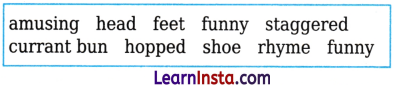
The poem tells the story of a (i) ___________ man who wore a (ii) ___________ on his head and hats on his (iii) ___________. He greeted the poet politely and offered a (iv) ___________ instead of a rose. The poet was so surprised that she (v) ___________ back. The man sang a song that sounded (vi) ___________. When asked about his strange attire, he turned and (vii) ___________ on his (viii) ___________. The poem uses humour, (ix) ___________, and nonsense to create a light and (x) ___________ tone.
Answer:
(i) funny
(ii) shoe
(iii) feet
(iv) currant bun
(v) staggered
(vi) funny
(vii) hopped
(viii) head
(ix) rhyme
(x) amusing
Rearrange the words in the given sentences to form a meaningful sentence.
1. man / shoe / wore / head / on / his / the / funny / a
Answer:
The funny man wore a shoe on his head.
2. raised / smiled / the / shoe / at / he / me / and
Answer:
He raised the shoe and smiled at me.
3. held / bun / the / to / nose / my / currant / he
Answer:
He held the currant bun to my nose.
4. I / wall / staggered / against / the / back
Answer:
I staggered back against the wall.
5. never / rose / such / a / I / smell / saw / funny / a / with
Answer:
I never saw a rose with such a funny smell.
6. song / began / to / he / sing / then / a
Answer:
He then began to sing a song.
7. home / on / his / head / hopped / he
Answer:
He hopped home on his head.
8. manners / polite / his / were
Answer:
His manners were polite.
Match the phrasal verb with its correct meaning based on the poem.
| Phrasal Verb | Meaning |
| (i) Turned about | (a) To begin doing something |
| (ii) Picked up | (b) Moved or changed direction quickly |
| (iii) Sat down | (c) To lift or gather something |
| (iv) Gave out | (d) To rest or settle in a seated position |
| (v) Sang out | (e) To present or distribute something |
Answer:
| Phrasal Verb | Meaning |
| (i) Turned about | (b) Moved or changed direction quickly |
| (ii) Picked up | (c) To lift or gather something |
| (iii) Sat down | (d) To rest or settle in a seated position |
| (iv) Gave out | (e) To present or distribute something |
| (v) Sang out | (a) To begin doing something |
Match the verbs from column A with the correct adverb or preposition from columns B and C to form a meaningful phrasal verb.
| Column A | Column B | Column C |
| (i) Walk | (a) up | (a) down |
| (ii) Turn | (b) out | (b) back |
| (iii) Hold | (c) away | (c) on |
| (iv) Sing | (d) in | (d) around |
| (v) Stagger | (e) through | (e) off |
Answer:
(i) Walk down – to move along a path or street
(ii) Turn around – to change direction or position
(iii) Hold up – to delay or stop momentarily
(iv) Sing out – to sing loudly or clearly
(v) Stagger back – to move backward unsteadily, often due to surprise or imbalance
Answer the following Questions
Question 1.
Why was the poet confused when the man offered a rose?
Answer:
The poet was confused when the man offered a rose because, instead of a flower, the man held out a currant bun to the poet’s nose. This unexpected and absurd gesture, where a bun was presented in place of a rose, left the poet bewildered.
Question 2.
What does the phrase ‘funny looking smell’ suggest?
Answer:
The phrase ‘funny looking smell’ suggests that the smell of the bun was strange or unusual. It is an example of playful language, as the poet describes something typically associated with sight (looking) to describe a smell, adding to the poem’s humorous tone.
Question 3.
Why did the man hop home on his head?
Answer:
The man hopped home on his head as part of his absurd and silly behaviour, which is a key feature of the poem’s humour.
Question 4.
What effect does the repeated use of ‘funny’ have in the poem?
Answer:
The repeated use of the word ‘funny’ in the poem emphasises the absurdity and humour of the situation. It highlights the strangeness of the man’s actions, appearance and the overall events. By using ‘funny’ repeatedly, the poet creates a lighthearted and playful tone, reinforcing the poem’s theme of nonsense and whimsy.
Question 5.
What literary devices are prominent in the poem?
Answer:
The poem uses several literary devices
- Repetition: The word ‘funny’ is repeated to emphasise the absurdity.
- Imagery: Vivid descriptions like the man wearing a shoe on his head create a quirky picture.
- Alliteration: Repetition of consonant sounds, like in ‘funny feeling sound’, adds rhythm.
- Personification: The rose is given a ‘funny looking smell’, attributing human qualities to it.
- Humor/Nonsense: The entire poem relies on absurd, playful situations for humor.
Question 6.
Imagine the funny man appeared in your class. Write what he would do and how students would react.
Question 7.
Research about limericks and create your nonsense poem using 5 lines and the AABBA rhyme scheme.
Question 8.
Read any tale of Tenali Raman or Birbal and note how humour is used.