Students prefer Class 5 English Santoor Solutions Unit 2 My Colourful World Chapter 4 The Wise Parrot Class 5 Questions and Answers that are written in simple and clear language.
Class 5 English Chapter 4 The Wise Parrot Question Answer
Class 5 English The Wise Parrot Question Answer
Class 5 The Wise Parrot Questions and Answers
Let us Think (Page 45)
A. Answer the following questions.
Question 1.
Why did the merchant keep the parrot in a cage of gold?
Answer:
The merchant kept the parrot in a golden cage because he loved it and wanted to give it a luxurious home. The golden cage showed how much he valued his pet.
Question 2.
What made the parrot a favourite pet of the merchant?
Answer:
The parrot was the merchant’s favourite because it was clever and entertaining. It told stories and sang songs that delighted the merchant.
Question 3.
What message did the parrot ask the merchant to convey to its friends?
Answer:
The parrot asked the merchant to tell its jungle friends, it sent greetings from its cage.
Question 4.
What happened after the merchant gave the message to the parrots?
Answer:
When the merchant delivered the message, one wild parrot immediately fell to the ground.
Question 5.
How did the parrot escape from the cage?
Answer:
The parrot escaped by pretending to die like its friend had. When the merchant put its “dead” body on the windowsill, it suddenly flew away.
B. Think and discuss
Question 1.
If you were the merchant, how would you respond to the parrot’s request for freedom?
Answer:
If I were the merchant, I would understand the parrot’s deep wish to fly freely and would let it go. True love means caring for someone’s happiness, not keeping them trapped, even in comfort.
Question 2.
Can you think of a real-life situation where intelligence is more useful than strength?
Answer:
In real life, intelligence often wins over strength. For example, when someone is lost, using a map or asking for directions helps more than just walking around without a plan.
Question 3.
Which parrot from the chapter was actually ‘wise’ according to you? Give reasons for your answer.
Answer:
The caged parrot was the wisest because it observed its friend’s trick, patiently waited for the right moment, and cleverly faked its death to gain freedom.

Let us Learn (Pages 46-48)
A. Fill in the blanks with suitable phrases given in the box to make a meaningful paragraph.

One winter morning, as I ……………………. of my home, I saw that the snow was ……………………. the place. While walking uphill towards my shop, I ……………………. a small puppy. Its leg was injured and it was ……………………. collapse. Being in pain it was unable to ……………………. . So, I decided to take it home and ……………………. it. With good care, all its pain ……………………. .
Answer:
One winter morning, as I stepped out of my home, I saw that the snow was all over the place. While walking uphill towards my shop, I came across a small puppy. Its leg was injured and it was about to collapse. Being in pain it was unable to stand upright. So, I decided to take it home and look after it. With good care, all its pain went away.
B. Complete the sentences. The first one has been done for you.
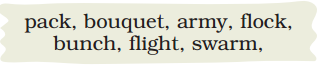
1. A ………………….. of parrots came to the forest.
2. I saw a ………………….. of sheep in the fields.
3. A ………………….. of wolves was howling loudly.
4. We gave a ………………….. of flowers to the chief guest.
5. A ………………….. of bees hovered around the flowers.
6. An ………………….. of ants is moving towards the anthill.
7. I helped my mother find a ………………….. of keys.
Answer:
1. A light of parrots came to the forest.
2. I saw a flock of sheep in the fields.
3. A pad of wolves was howling loudly.
4. We gave a bouquet of flowers to the chief guest.
5. A swarm of bees hovered around the flowers.
6. An army of ants is moving towards the anthill.
7. T helped my mother find a bunch of keys.
C. Read the following.
1. I have come from Jalandhar.
The underlined part tells us that the action of ‘coming from Jalandhar’ took place sometime in the recent past.
2. Rita has read all the poems written by Sarojini Naidu.
The underlined part tells us about an ‘experience of reading’, that took place in the past but is still relevant in the present.
The above sentences have used present perfect tense.
We use present perfect tense to talk about:
- Actions that were completed in the recent past.
- Actions or experiences that happened in the past but affect the present.
Rule 1
Subject + has/have + Verb + Object
Now complete the following sentences using present perfect tense.
a. I …………………. (visit) Delhi many times. It is a city with many historical sites.
b. My friend Onshangla is an artist. She …………………. (draw) pictures of ten monuments.
c. Mr. Joon …………………. (buy) a new car.
d. I …………………. (complete) my homework and my brother …………………. (revise) for his test.
e. They …………………. (write) letters to their friends.
Answer:
(a) I have visited (visit) Delhi many times. It is a city with many historical sites.
(b) My friend Onshangla is an artist. She has drawn (draw) pictures of ten monuments.
(c) Mr. Joon has bought (buy) a new car.
(d) I have completed (complete) my homework and my brother has revised (revise) for his test.
(e) They have written (write) letters to their friends.
Let us Listen (Page 48)
Your teacher will read the paragraph given below, listen to the paragraph carefully. Your teacher will ask you some questions, which you can try to answer.
Birds are beautiful creatures with feathers and wings.
Due to various reasons, many species of birds have become endangered. To protect these birds and their species, bird sanctuaries have been built. There are more than 70 bird sanctuaries in India. The Vedanthangal Bird Sanctuary, located in Tamil Nadu, is the oldest bird sanctuary in India. The Bharatpur Bird sanctuary, located | in Rajasthan, is the largest bird sanctuary in our country. 1
Answer:
(Class Activity) Students should do it themselves.
Let us Speak (Page 49)
A. Listen and repeat
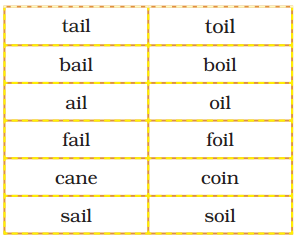
Answer:
Students should do it themselves.
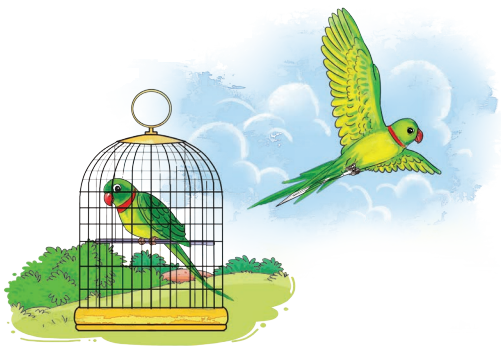
B. Look at the pictures below. There are two birds. Which bird would you want to be and why? Share your views with the class.
Answer:
I would choose to be the wild parrot because freedom is priceless. Flying in the open skies and living close to nature is far better than being trapped in a cage, even if it is made of gold.
Let us Write (Page 50)
In the story, you read how the parrot tricked the merchant into releasing it but the story does not end here. Use your imagination to complete the parrot’s story.
After escaping from the golden cage, the parrot decided to fly away…
Answer:
After escaping from the golden cage, the parrot decided to fly away into the sky, feeling the wind beneath its wings for the first time in years. It soared with joy, finally free. Soon, it reunited with its jungle friends and shared tales of its life with the merchant —how even a golden cage couldn’t replace the joy of freedom. The parrot warned them about cages disguised as gifts and became a wise leader in the forest. It taught young birds how to stay safe, how to recognise and avoid traps while still enjoying safe interactions with kind humans.
Let us do (Pages 50-51)
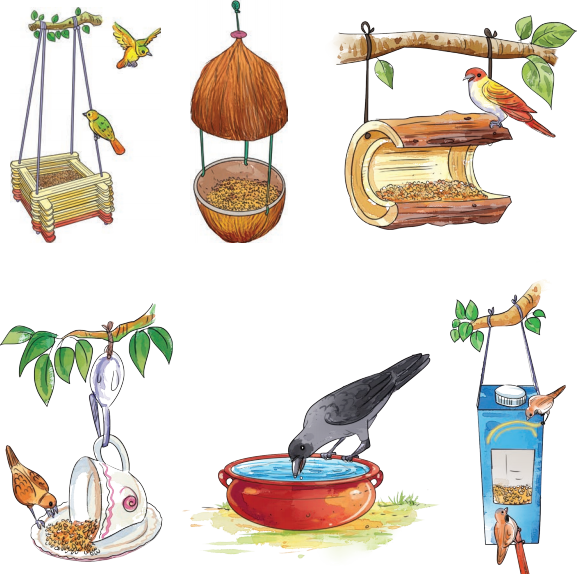
A bird feeder is an object used to keep food for birds. You might have seen bird feeders placed outdoors in balconies, gardens, or parks to attract and feed birds. They are filled with seeds, grains, or nuts and placed in safe locations to help birds find food easily.
1. Look at the pictures of bird feeders given below and try to identify the material used to make them.

These materials are easily available in our homes.
Answer:
The materials used to make the bird feeders in the pictures are simple, creative, and eco-friendly. One feeder is made from a bottle that holds seeds for the birds. Another feeder is a bowl tied with a rope so birds can sit and eat. There is also a feeder made by sticking ice cream sticks together to make a small place for food. One feeder uses a coconut shell to hold bird food. Another feeder has a C-shaped piece of wood with seeds inside for the birds. There is a cup hanging from twigs with a wire, and a plate is kept below to catch falling seeds. There is also a big bowl full of water for the birds to drink. The last feeder is made from a milk carton and has seeds for the birds. These feeders show how we can use simple things to help and feed birds.
2. Make a bird feeder with the material of your choice. Fill it up with water, seeds, and grains like millets. With the help of your parents, place it at an appropriate location outside your house.
Happy feeding!
Answer:
Students, do as directed.
Let us Explore (Page 52)
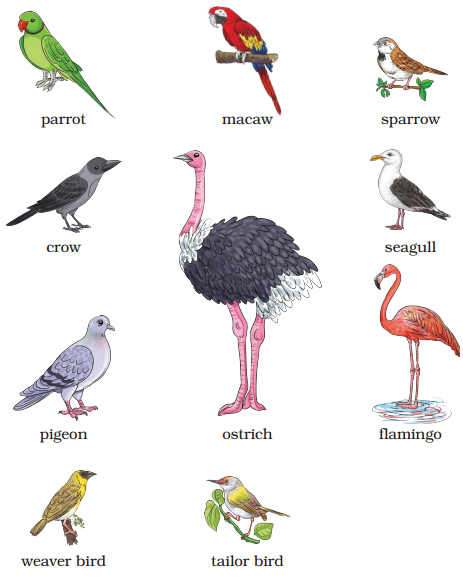
Choose any two of the above and find out a few interesting facts about them.
Answer:
(This answer is a reference. Students can choose any two birds from the list above and write interesting facts about them).
1. Parrot
- Parrots are known for their ability to mimic human speech.
- They have strong, curved beaks perfect for cracking nuts and seeds.
- Some parrot species can live for over 80 years.
2. Macaw
- Macaws are large, colourful parrots native to Central and South America.
- They have powerful beaks that can even crack open hard coconut shells.
- Macaws often mate for life and are very social birds.
3. Sparrow
- Sparrows are small, common birds found in urban and rural areas.
- They primarily eat seeds but also consume insects.
- Sparrows are known for their cheerful chirping sounds.
4. Crow
- Crows are highly intelligent and can use tools to solve problems.
- They have excellent memory and can recognise human faces.
- Crows are omnivorous and eat almost anything, from fruits to small animals.
5. Seagull
- Seagulls are coastal birds often seen near oceans and lakes.
- They are skilled fliers and can drink both fresh and saltwater.
- Seagulls are opportunistic feeders and scavenge for food.
6. Pigeon
- Pigeons are known for their homing ability and were used as messengers in the past.
- They can recognise themselves in mirrors, a sign of intelligence.
- Pigeons are very loyal to their partners.
7. Ostrich
- Ostriches are the largest birds in the world and cannot fly.
- They have powerful legs and can run up to 70 km/h (43 mph).
- Ostriches lay the largest eggs of any living bird.
8. Flamingo
- Flamingos are known for their bright pink feathers, which come from their diet of shrimp and algae.
- They often stand on one leg to conserve body heat.
- Flamingos live in large groups called colonies.
9. Weaver Bird
- Weaver birds are famous for their intricately woven nests.
- Male weavers build nests to attract females.
- They are social birds and often nest in large colonies.
10. Tailor Bird
- Tailor birds “sew” leaves together using spider silk or plant fibres to create nests.
- They are small, active birds with distinctive calls.
- Tailor birds are commonly found in gardens and forests.