Students revise important topics using Class 8 SST Extra Questions and Class 8th SST Chapter 6 The Parliamentary System: Legislature and Executive Important Extra Question Answer before exams.
Class 8 SST Chapter 6 The Parliamentary System: Legislature and Executive Extra Questions
NCERT Class 8 Social Science Chapter 6 Extra Questions on The Parliamentary System: Legislature and Executive
The Parliamentary System: Legislature and Executive Class 8 Very Short Question Answer
Question 1.
Who is the head of the Indian state?
Answer:
The President is the head of the Indian state.
Question 2.
What is the upper house of Parliament called? Answer: The upper house of Parliament is called the Rajya Sabha.
Question 3.
Who presides over the Lok Sabha meetings?
Answer:
The Speaker presides over the meetings of the Lok Sabha.
Question 4.
On whose recommendation is a Money Bill introduced in Lok Sabha?
Answer:
A Money Bill is introduced in the Lok Sabha on the recommendation of the President.
Question 5.
How are members of the Lok Sabha chosen?
Answer:
Members of the Lok Sabha are chosen through direct elections by the people.

Question 6.
Which organ implements laws in India?
Answer:
The Executive is the organ responsible for implementing laws in India.
Question 7.
Who leads the Council of Ministers?
Answer:
The Prime Minister leads the Council of Ministers.
Question 8.
When was the Right to Education Act passed?
Answer:
The Right to Education Act was passed in the year 2009.
Question 9.
What is a bill?
Answer:
A bill is a draft of a proposed law that needs approval before becoming an act.
Question 10.
How many houses does the Parliament of India have?
Answer:
The Parliament of India has two houses – the Lok Sabha and the Rajya Sabha.
The Parliamentary System: Legislature and Executive Class 8 Short Question Answer
Question 1.
What is the composition of the Indian Parliament? Answer: The Indian Parliament is bicameral, consisting of the President, the Lok Sabha (House of the People), and the Rajya Sabha (Council of States). While the President is a part of Parliament, the Lok Sabha’s members are directly elected by the people, and Rajya Sabha members are indirectly elected by state legislatures. This structure was adopted to ensure representation of both the people and the states. All three together are responsible for making laws and guiding the nation’s policy.
Question 2.
How are members of the Lok Sabha and Rajya Sabha chosen?
Answer:
Lok Sabha members are elected directly by Indian citizens through general elections based on universal adult suffrage. This means every adult citizen has one vote, regardless of social or economic status. In contrast, Rajya Sabha members are elected indirectly by the legislative assemblies of the states through a proportional representation system. This difference ensures that both individual voices and states’ interests are reflected in Parliament.
Question 3.
Describe the significance of the Sengol in the new Parliament building.
Answer:
The Sengol, a gold-plated silver sceptre, symbolizes the just and righteous rule expected in a democracy. It was handed over to Jawaharlal Nehru on the eve of independence, signifying the transfer of power from British rule to Indian self-rule. In the new Parliament building, the Sengol is placed next to the Speaker’s chair, serving as a reminder that power must be exercised according to dharma and for the welfare of all. The Sengol’s place in Parliament honors both historical tradition and democratic values.
Question 4.
Why did India’s Constitution makers choose a bicameral system?
Answer:
The framers believed a single directly elected house might not be enough for a diverse, federal country like India. The Rajya Sabha was established to represent the interests of states and provide a second review of legislation. This helps balance the need for national unity with the importance of local and regional voices. Thus, having two houses slows lawmaking, encouraging more reflection and protection of minority interests.
Question 5.
How does Parliament make laws?
Answer:
The process begins when a Bill (a draft law) is introduced in either house, followed by readings, clause-wise discussion, and possible reference to a committee. Both houses debate and vote on the bill. Once both houses pass it, the Bill goes to the President for assent. After the President’s assent, it becomes an Act and is enforced by the government.
Question 6.
What is the role of Parliamentary committees?
Answer:
Parliamentary committees, especially standing
committees, consist of members from various parties and scrutinize proposed laws and government actions in detail. They may call ministers or officials to answer questions, making the government more accountable. Committees can recommend changes, but their findings aren’t binding. Their work ensures laws are thoroughly examined before passage.
Question 7.
How does Parliament ensure executive accountability?
Answer:
Parliament holds the executive accountable through mechanisms like Question Hour, where MPs directly question ministers about their actions and decisions. Debates, motions, and special committees also check government power. If the Lok Sabha loses faith in the government, it can even remove the Council of Ministers through a vote of no confidence. These checks are a core democratic safeguard.
Question 8.
What steps led to the Right to Education (RTE) Act becoming a law?
Answer:
The push for RTE can be traced to the Directive Principles of the Constitution and a Supreme Court judgment in the 1990s linking education to the Right to Life. The 86th Constitutional Amendment made education a fundamental right for children aged 6-14. The RTE Bill was first tabled in Rajya Sabha, revised by a committee, debated in both houses, and finally passed and signed by the President in 2009. The Act changed millions of children’s lives by making education free and compulsory.
Question 9.
How does the structure of Parliament reflect Indian democracy’s values?
Answer:
Parliament’s chambers house symbols from across Indian history and culture—such as carvings, peacocks, and tribal art-representing the country’s diversity and inclusivity. The three-sided building signifies balance and purpose. Multilingual translation facilities make it accessible for all MPs, supporting the principle of equality. Parliament embodies the union of tradition, diversity, and forward-looking democracy.
Question 10.
Why is regular functioning of Parliament important for democracy?
Answer:
Parliament’s regular sessions allow for lawmaking, scrutiny of government actions, and public debates, which are all critical for good governance. When Parliament meets less often or sessions are disrupted, important issues may go unaddressed and laws may be passed hurriedly, reducing their quality. Healthy debate and committee work improve laws and public trust. Parliament’s functioning is therefore at the heart of a living democracy.
The Parliamentary System: Legislature and Executive Class 8 Long Question Answer
Question 1.
Explain the main functions of the Indian Parliament.
Answer:
The Indian Parliament has four main functions: Constitutional functions, Lawmaking, Executive accountability, and Financial control. Constitutional functions include amending the Constitution and electing the President and Vice President. Lawmaking is perhaps the most visible role: bills are introduced, debated, revised, and passed to become laws. Parliament ensures the executive, or government, is answerable for its actions through debates, question hour, and committees. Financial control refers to passing the Union Budget and approving government expenditure; the executive cannot spend money without Parliamentary approval. Together, these roles ensure that government acts within the will of the people and upholds constitutional values.
Question 2.
Describe the step-by-step process by which a bill becomes a law in India.
Answer:
First, a bill is introduced in either the Lok Sabha or Rajya Sabha (except Money Bills, only introduced in Lok Sabha). The bill is read for the first time, and the house decides if it should be considered further. It may then be sent to a Standing Committee for detailed examination and recommendations. The house then debates and votes on each clause before passing the full bill. The bill then moves to the other house, often repeating the same process. Finally, if both houses pass the bill, it is sent to the President for assent. With Presidential approval, it becomes an Act and is implemented by the executive.
Question 3.
How does the Parliament safeguard federalism in India?
Answer:
Federalism means distribution of power between the centre and the states. Parliament’s bicameral structure supports this: the Rajya Sabha represents the interests of states, while Lok Sabha represents the people directly. Rajya Sabha’s consent is required for most legislation that affects states, ensuring their voices are heard. Parliament cannot unilaterally change state boundaries or powers without involvement of Rajya Sabha. This system prevents central overreach and maintains the balance between unity and regional diversity. The chapter highlights how debates about federalism influenced the choice of a bicameral system for India. .
Question 4.
Discuss the significance of Parliamentary committees and their impact on governance.
Answer:
Parliamentary committees allow detailed examination of legislation and government actions, which would not be possible during regular debates given time constraints. Committees can summon ministers and officials, demand reports, and recommend changes to bills or policies. Their work helps improve legislation by incorporating expert and crossparty inputs. While their recommendations are1 not binding, governments usually take them seriously. Committees also help train MPs in scrutiny and diplomacy. Overall, they make lawmaking more thorough and administration more accountable.
Question 5.
Why is the executive answerable to Parliament? Give examples.
Answer:
In India’s parliamentary system, the executive headed by the Prime Minister and Council of Ministersderives its authority from the legislative majority and must maintain its confidence. This creates “executive accountability,” meaning ministers answer questions during Parliament sessions and are bound to justify their decisions. For example, during Question Hour, MPs can probe delays or errors in government programs. If the Lok Sabha is dissatisfied, it can move a vote of no confidence and remove the government. Committees also review government performance. This answerability keeps executive power checked and aligned with people’s interests.
Question 6.
How does India’s parliamentary system draw upon both ancient traditions and British influence?
Answer:
India’s system borrows the concept of parliamentary democracy from Britain, including bicameralism, roles like Speaker, and the process of lawmaking through bills and readings. At the same time, the Constituent Assembly drew inspiration from ancient Indian republican traditions like the Mahajanapadas, and local governance practices in Panchayats where elders made consensus decisions. The new Parliament building’s design and symbols blend these heritages, with art and architecture from across India. This synthesis makes the Indian Parliament deeply rooted in both global democratic practice and indigenous custom.
Question 7.
Explain the debate and process behind the Right to Education (RTE) Act becoming law.
Answer:
The idea behind the RTE Act traces back to the Constitution’s Directive Principles. Efforts to make education a fundamental right were renewed in the 1990s, after court cases argued its importance under the Right to Life. The 86th Amendment made free and compulsory education for children a constitutional mandate. The Bill faced many debates in Parliament, especially over funding and practical challenges. The Bill was first tabled in Rajya Sabha, reviewed by a standing committee, and passed by both houses before receiving the President’s assent in 2009. The RTE Act marked a major step in guaranteeing universal access to education in India.
Question 8.
Why are disruptions in Parliament a problem for democracy?
Answer:
Frequent disruptions reduce the effective working days of Parliament, as recent data on Lok Sabha and Rajya Sabha productivity shows. When members stall proceedings through walkouts, protests, or disorder, laws may be passed hurriedly or with little debate. Important policies and public issues go undiscussed, reducing Parliament’s ability to scrutinize the government and serve as the people’s voice. This can erode public trust and may result in poorly crafted laws. The chapter reports both historical declines in sessions and statements from Parliamentary leaders about these risks.
Question 9.
How does Parliament represent the diversity of India?
Answer:
Through direct elections to the Lok Sabha and indirect elections to the Rajya Sabha, Parliament brings in voices from all over India. MPs come from different regions, castes, religions, language groups, and political parties. Parliament’s proceedings are translated into many Indian languages—currently 18 and growing—so all representatives can participate fully. The physical spaces of Parliament also showcase India’s cultures, with carvings, symbols, and art from around the country. This ensures that no group is left unheard in the national conversation.
Question 10.
What lessons can be learned from the enactment of the RTE Act for future lawmaking in India?
Answer:
The journey of the RTE Act demonstrates that consensus-building, committee scrutiny, and public debate are crucial for good laws. The Act required years of advocacy, judicial support, and multiple Parliamentary steps before coming into force. Engagement with stakeholders and transparent discussions improved the Act’s provisions and implementation plan. The process shows that large social changes need time, persistence, and dialogue. Similar thoroughness could improve other important laws. It also highlights the significance of constitutional amendments and Parliament’s role in expanding critical rights.
The Parliamentary System: Legislature and Executive Class 8 Source Based Questions
Question 1.
Read the below passages and answer the following questions:
“Inside, they saw walls decorated with carvings peacocks, lotuses, tribal art, temple patterns, and freedom fighters. The three-sided design reflects balance, inclusivity, and purpose. The new building houses so many ancient symbols! It also uses green construction, cutting electricity use by 30 percent.
(i) What do the carvings and symbols inside the new Parliament building represent?
Answer:
They represent the diversity, inclusiveness, and cultural heritage of India, honoring contributions from all parts of society and reflecting the nation’s unity in diversity.
(ii) Why is the use of “green construction” significant x in the context of Parliament?
Answer:
It shows that Parliament is setting an example for the nation by adopting forward-looking, sustainable practices, ensuring environmental responsibility for future generations.
(iii) What does the three-sided design of the new building symbolize?
Answer:
The design stands for balance, inclusivity, and purpose-core values of Indian democracy and nationhood represented in its architecture.
Question 2.
Most people call me RTE. I came into existence in August 2009, though the idea began almost a century before.
My roots lie in the Directive .Principles of State Policy of the Indian Constitution. Though the Constitution makers wanted me implemented within a decade after Independence, this didn’t happen, leaving countless children without access to education.
In the early 1990s, someone argued in court that I was inherently part of the Fundamental Rights in the Constitution, namely, the Right to Life- as education is important to lead a meaningful life. Parliamentary action began some years later with the introduction of the 86th Constitutional Amendment Act, 2002, which mandated-as Article 21A of the Constitution-that the state shall provide free and compulsory education to all children between the ages of 6 and 14 years.
Six years later, 1 was tabled as a bill in the Rajya Sabha. A committee studied me thoroughly and suggested modifications.
The major debate concerned funding – new schools, infrastructure, and teachers for millions of children would be costly. By 2008, the MPs determined it was time.
After the 2009 elections, the new government pursued the matter, and in August 2009, 1 was passed in the Lok Sabha and received the President’s assent, becoming an Act. Today, I’ve enabled the creation of legal pathways for children to attend school, facilitated new school construction, and ensured free books and uniforms for children.
(i) What constitutional principle provided the foundation for the RTE Act?
Answer:
The Directive Principles of State Policy and the later inclusion in Fundamental Rights after the 86th Amendment provided the legal foundation for the RTE Act.
(ii) Why was there a major debate about funding during the process of making the RTE Act?
Answer:
Implementing free and compulsory education for millions of children required building new schools, hiring teachers, and providing infrastructure-all of which needed significant financial investment.
(iii) What was the final step before the RTE bill became an Act?
Answer:
After being passed by both houses of Parliament, the bill received the President’s assent, after which it became law.
The Parliamentary System: Legislature and Executive Class 8 Picture Based Questions
Observe the picture below and answer the questions that follow:
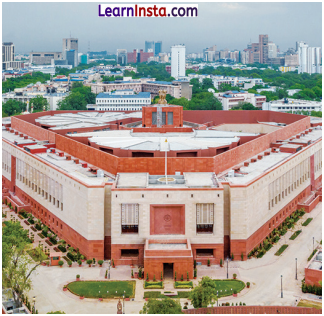
Question 1.
What architectural shape is chosen for the new Parliament building, and why?
Answer:
The building is triangular, symbolizing balance and the harmonious interaction of different parts of government.
Question 2.
What do the decorative carvings and art in the building represent?
Answer:
They represent India’s unity in diversity, with motifs from across different cultures, regions, and eras.
Question 3.
How does building design relate to the values of Indian democracy?
Answer:
The inclusive design turns the Parliament into a “house of the people” in both spirit and form, reflecting national integration.
Class 8 The Parliamentary System: Legislature and Executive Extra Questions for Practice
I. Multiple Choice Questions
Question 1.
Which of the following is a financial function of the Parliament?
(a) Granting titles of honour
(b) Conducting by-elections
(c) Passing the annual budget
(d) Reviewing judicial decisions
Question 2.
Who assists the President in day-to-day decision-making?
(a) The Chief Justice of India
(b) The Prime Minister and Council of Ministers
(c) The Governor
(d) The Speaker of Lok Sabha
Question 3.
Which part of the Constitution deals with the Executive?
(a) Part IV
(b) Part V
(c) Part VI
(d) Part I
Question 4.
What does the Standing Committee mainly do?
(a) Enforce laws
(b) Make judicial appointments
(c) Examine the details of bills and policies
(d) Control defence forces
Question 5.
Assertion (A): The Lok Sabha has more powers than the Rajya Sabha in financial matters.
Reason (R): A Money Bill can only be introduced in the Lok Sabha.
(a) Both A and R are true, and R is the correct explanation of A.
(b) Both A and R are true, but R is not the correct explanation of A.
(c) A is true, but R is false.
(d) A is false, but R is true.
II. Very Short Answer Type Questions
Question 1.
What is meant by a ‘bicameral’ legislature?
Question 2.
Name the presiding officer of the Rajya Sabha.
Question 3.
Which house of Parliament is a permanent body?
Question 4.
What is the main role of civil servants?
Question 5.
Which symbol placed in the Lok Sabha represents just rule?
III. Short Answer Type Questions
Question 1.
Explain the significance of the Question Hour in ensuring Executive accountability.
Question 2.
Why are Standing Committees considered essential in the working of Parliament?
Question 3.
How does the Parliament ensure financial accountability of the Executive?
Question 4.
What is the constitutional basis of the Right to Education Act?
Question 5.
Why does the Parliament require translation services in multiple languages?
IV. Long Answer Type Questions
Question 1.
Explain how Parliament reflects the diversity of India. Why is it important for different regions, languages, and communities to be represented in the legislative process?
Question 2.
What is the significance of the civil services in implementing laws and policies? Discuss how civil servants carry forward the work of the Executive at various levels.
Question 3.
Describe the importance of discussions and debates in the Indian Parliament. How do they contribute to transparency and accountability in governance?
Question 4.
Why is it necessary for the Executive to work within the framework of laws made by the Legislature? Illustrate how this relationship ensures democratic functioning.
Question 5.
Parliament is not merely a law-making body; it is also a platform for public voice. Explain this statement with examples from the chapter.