Each of our Maths Mela Class 5 Worksheet and Class 5 Maths Chapter 7 Shapes and Patterns Worksheet with Answers Pdf focuses on conceptual clarity.
Class 5 Maths Chapter 7 Shapes and Patterns Worksheet with Answers Pdf
Shapes and Patterns Class 5 Maths Worksheet
Class 5 Maths Chapter 7 Worksheet with Answers – Class 5 Shapes and Patterns Worksheet
Anaya’s Basket Patterns
Anaya is helping her mother weave a small bamboo basket for keeping fruits. She uses two coloured bamboo strips and creates designs by passing one strip over and another under in a fixed order. She follows the same order in each row, but sometimes changes how she starts the next row. Slowly, a beautiful pattern begins to appear on the basket.
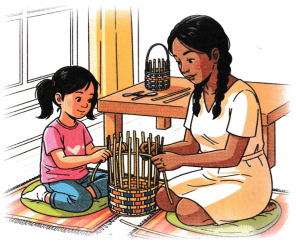
1. If Anaya uses one coloured strip and weaves two over, one under in Row 1, and in Row 2 starts with one under, two over, then repeats Row 1’s pattern in Row 3, Row 2’s in Row 4, and so on, draw the design in the space below.
_________________________________
_________________________________
2. Next, she weaves one over, two under in Row 1. In Row 2, she starts with two under, one over, then repeats the rows as before. Draw this design in the space below.
_________________________________
_________________________________
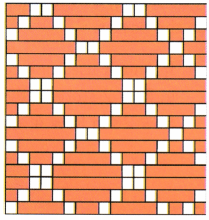
3. For each pattern given below, write the over—under for each row until the pattern starts repeating.
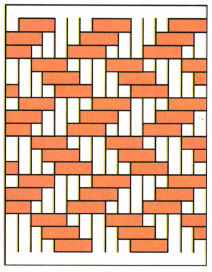
(a) _________________________________
(b) _________________________________
Tiling and Tessellation
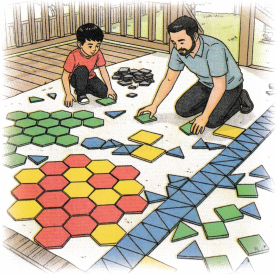
RLSKL is helping his father design a new floor for their porch. He tries tiles of different shapes of — regular pentagons, equilateral triangles, squares, and regular hexagons — to see which ones fit together without leaving any gaps. Some shapes Fit perfectly around a point, while others leave empty spaces. Rishi makes a note so he may choose the best design for the porch.
Question 4.
If Rishi uses regular pentagon tiles, will they fit together around a point without leaving any gaps? (Yes/No)
_________________________________
Question 5.
How many equilateral triangles can fit together around a point without any gaps or overlaps?
_________________________________
Question 6.
Can eight squares fit together around a point without any gaps or overlaps? How many squares fit together around a point without any gaps?
_________________________________
Question 7.
How many regular hexagons can fit together around a point without leaving any gaps?
_________________________________

Question 8.
Here is a tessellating pattern with more than one shape. Which shapes have been used in this pattern?

_________________________________,
_________________________________,
_________________________________.
Question 9.
Continue the pattern given below and colour it appropriately.

Kites
Question 10.
Look at the shape of the kite given, alongside and answer the following questions:

(a) What different shapes can you see in a kite shape?
_________________________________
(b) How many pairs of equal sides are there?
_________________________________
(c) Are all the angles of a kite equal? (Yes/No)
_________________________________
(d) Number of diagonal(s) in a kite is ___________.
(e) Diagonals of kite intersect at a angle.
_________________________________
Mehul’s Triangle Challenge
Mehul has a box of triangular cardboards. He begins by joining triangles in different ways. In one arrangement, he makes a quadrilateral with two pairs of equal sides. In another arrangement, he makes a shape with all jour sides equal. Excited, Mehul keeps experimenting, wondering what other shapes he can create by joining the triangles and how their sides and angles might differ.

Question 11.
Fill in the blanks with the correct word of Isosceles, Square, Rectangle, Equilateral, Rhombus, Parallelogram, Scalene, Kite.
(a) A ___________ has all angles as right angles, but all sides are not equal.
(b) A ___________ has all sides equal, but all angles are not right angles.
(c) In a ___________, opposite angles are equal, but the sides do not make a right angle.
(d) A ___________ has two pairs of equal adjacent sides, but no right angles,
(e) A ___________ has all sides equal and all angles as right angles.
(f) In a ___________ , opposite angles are equal and opposite sides are equal,
(g) A ___________ has equal opposite angles and all sides make right angles,
(h) An ___________ triangle has all the sides equal.
(i) A ___________ triangle has no equal sides,
(j) A ___________ triangle has two equal sides.
Question 12.
Match the shapes to their correct names.

Question 13.
In the grid given below, draw two different squares and two different rhombuses.

Play with Circles
For the school art fair, Riya decides to make a rangoli using only circles and straight lines. She first draws a big circle and adds two diameters, joining their endpoints to see what shape appears. She measures the sides of the shape and finds them all to be equal. Curious to explore more, she draws another set of diameters at different angles and notices that new shapes and patterns begin to form inside the circle. Excited, Riya continues experimenting, creating a variety of colourful designs for her rangoli.

Question 14.
If Riya joins the endpoints of the diameters and forms a quadrilateral in which all sides are equal, write the name of shape has has made.
_________________________________
Question 15.
If the quadrilateral formed by Riya does not have all sides equal, but has opposite sides equal, what shape is it?
_________________________________
Question 16.
Can you draw quadrilaterals other than a square or a rectangle by joining the endpoints of diameters in Riya’s Rangoli? (Yes/No.)
_________________________________
Circle Designs
Question 17.
Riya remembers a special design her grandmother taught her, numbering points around the circLe arid joining them in a set order to create beautiful patterns. She tries the sequence in to 11, 11 to 2, 2 to 12, and so on, until she reaches back at 1. Slowly, a colourful rangoli design appears inside the circle.

Complete the design by following the sequence, and colour it neatly.
Cube Connections
Kabir loves building with small wooden cubes. One day, he glues 27 cubes together to make a large cube. After painting the outside of the cube red, he dismantles it and observes the small cubes. He notices that some have three faces painted, some have two, some only one, and some have no paint at all.

Question 18.
If Kabir’s large cube is made of 8 small cubes and the whole cube is painted red on the outside:
(a) How many small cubes have three faces painted?
_________________________________
(b) How many small cubes have two faces painted?
_________________________________
(c) How many small cubes have one face painted?
_________________________________
(d) How many small cubes have no faces painted?
_________________________________
Question 19.
Kabr is making a cube by folding its net as shown below.’

Which coloured face will be opposite to the yellow-coloured face?
_________________________________
Question 20.
The following are some big solid frames made of small cubes. Count the number of small cubes In each frame and fill In the blanks.

Question 21.
The Images on the left shows the original solid made by small cubes, and the Images on the right shows the solid after some small cubes have been removed. How many small cubes have been removed from each of the following solids?

Icosahedron and Dodecahedron
Meera is fascinated by unusual 3-D shapes. At the maths club, she sees many models of solid shapes. Among them, she finds one with 12 faces, which her teacher tells her is called a dodecahedron, and another with 20 faces, called an icosahedron. She wonders how many faces, edges, and corners each shape has, and whether all the faces are of the same shape.

Excited, Meera picks them up and begins counting and comparing their features.

Question 22.
Which of the two shapes has more faces, the icosahedron or the dodecahedron? By how many?
_________________________________
_________________________________
Question 23.
Draw the shapes of the faces in an icosahedron and a dodecahedron. Which one has triangular faces? Which one has pentagonal faces?
Question 24.
If each edge of a regular dodecahedron is 4 cm long, what will be the total length of all its edges?
_________________________________
_________________________________
Question 25.
If each vertex of an icosahedron is marked with a bead, how many beads will you need to mark all the vertices?
_________________________________
_________________________________
Think and Answer
1. How many corners does a dodecahedron have?
_________________________________
_________________________________
2. How many corners does an icosahedron have?
_________________________________
_________________________________
Activity
Make Your Own Tangram
Take a 1-inch square grid paper and draw a 4 × 4 square. Then follow the steps shown in the images to draw the lines. When all lines are complete, you will have 7 shapes — 5 triangles, 1 square, and 1 parallelogram. Number them 1 to 7, colour each in a different colour, and cut them out to make your tangram set.
