Experts have designed these Class 8 Science Notes Chapter 13 Our Home: Earth, a Unique Life Sustaining Planet Class 8 Notes for effective learning.
Class 8 Science Chapter 13 Our Home: Earth, a Unique Life Sustaining Planet Notes
Class 8 Our Home: Earth, a Unique Life Sustaining Planet Notes
Class 8 Science Chapter 13 Notes – Our Home: Earth, a Unique Life Sustaining Planet Notes Class 8
→ Earth is not just a planet orbiting the Sun. But, it is the only known planet that supports life in all its forms. It has a wide variety of landscapes like mountains, oceans, forests, and deserts that support different life forms.
→ Indian Space Research Organisation (ISRO): This is the space agency of India. Earth Observation Satellite takes images of the Earth with the help of ISRO. These images help us study plants on land and tiny organisms in the ocean, and can even detect things like ocean temperature, oil spills, and wind direction.

→ Structure of the Earth: The Earth is structured in layers: the crust, mantle (upper and lower), the core (outer and inner). All life exists on a very thin layer of the Earth’s surface called the crust. If size of the Earth were compared to an apple, this crust is extremely thin like the skin of an apple, making it truly special.
→ Unique Conditions for Life: The Earth has the right temperature, water, atmosphere, and gases to support life. It gives us air to breathe, water to drink, soil to grow crops, and materials like rocks and timber to build homes, roads, and other structures. These features make Earth a unique and life-supporting planet.
→ Our Solar System: There are eight planets in our solar system: Mercury, Venus, Earth, Mars, Jupiter, Saturn, Uranus, and Neptune.
→ Mercury, Venus, Earth, and Mars, are smaller, rocky planets, while Jupiter, Saturn, Uranus, and Neptune are much larger, and mostly made of gases.
→ All planets in the solar system get their energy from the Sun. Even though Mercury is closest to the Sun but Venus is the hottest planet because its thick atmosphere is entirely made of carbon dioxide gas, which does not let the heat escape. This is called the greenhouse effect and it makes Venus even hotter than Mercury.
→ Greenhouse Effect on the Earth: Gases like carbon dioxide in Earth’s atmosphere trap heat. These gases absorb heat radiation that Earth gives off after being warmed by the Sun. This greenhouse effect keeps Earth’s temperature balanced and suitable for life.

→ A plant greenhouse is a closed space, usually made of glass, that traps warm air inside. It heats up from sunlight during the day, and the glass prevents the warm air from escaping.

→ Position of the Earth:
- The Earth is at the right distance from the Sun, not too close and not too far.
- This distance allows water to remain in liquid form, which is essential for life.
- If the Earth were closer, it would be too hot and water would evaporate.
- If it were farther, it would be too cold and water would freeze.
→ The Habitable Zone (Goldilocks Zone): The region around the Sun (or another star) where water can remain in liquid form. The Earth lies perfectly in this zone, which is why it can support such a rich biodiversity.
→ The Blue Planet (Earth): A large portion of the Earth’s surface is covered with water, making it appear blue from space. This is why the Earth is often called the Blue Planet.
→ Mars-Our Neighbour Planet: Mars is at the edge of the Sun’s habitable zone. No life has been found there yet. Scientists think Mars had water and could support simple life long ago.
→ Earth’s orbit around the Sun is almost circular, which keeps sunlight and heat steady throughout the year. This steady sunlight prevents extreme temperatures, avoiding very hot summers or very cold winters at most places.
→ Perfect Size of the Earth:
- The Earth has the right size to hold an atmosphere because its gravity is strong enough to keep gases from escaping into space.
- If the Earth were much smaller, then its gravity would be too weak to hold the atmosphere, and gases would escape into space.
- If the Earth were much larger, its stronger gravity might crush the living beings.
→ Atmosphere: The layer of gases that surrounds the Earth. The atmosphere contains oxygen, essential for almost all living things to breathe. Atmosphere of Mars is 100 times thinner than the Earth’s. Mercury has no atmosphere.
→ Ozone Layer: The atmosphere contains oxygen, essential for almost all living things to breathe. Some oxygen in the atmosphere forms ozone (a molecule made of three oxygen atoms), which creates a layer that protects the Earth by blocking harmful ultraviolet (UV) rays from the Sun.

→ Mangalyaan, launched by ISRO in 2013, is India’s Mars Orbiter Mission. It was designed to explore Mars’ atmosphere, surface, and signs of past water. The mission helps scientists study whether Mars could have supported life in the past.
→ Magnetic Field of the Earth: Earth behaves like a giant magnet due to the movement of molten iron in its core. This creates Earth’s magnetic field, similar to the field around a regular magnet. Earth’s magnetic field acts as a protective shield, pushing many harmful particles (cosmic rays and solar wind) away.
→ Together, Earth’s stable orbit, size, gravity, oxygen, ozone layer, atmosphere and magnetic field create conditions suitable for life.
→ Elements that Support Life: The atmosphere contains oxygen, which humans, animals, and plants use for respiration. Plants take in carbon dioxide from the air and water from the soil to prepare food through photosynthesis, releasing oxygen in the process.
→ Hydrosphere: Water covers about 70 percent of the Earth’s surface and is found in various forms such as ponds, lakes, rivers, seas, oceans, and underground sources, collectively called the hydrosphere.
→ Water is a good solvent and helps transport nutrients in plants and regulate body temperature, digestion, and hydration in animals.
→ Water vapour in the air forms clouds, which bring rain and snow, replenishing freshwater sources. Moving air also shapes weather and rainfall which influence farming, water supply, and life on land.
→ Geosphere: The solid parts of the Earth, such as rocks, soil, and minerals, make up the geosphere. This layer forms the foundation that supports all life on Earth.
→ Soil contains vital nutrients (nitrogen and potassium) which come from the slow breakdown of rocks and remains of dead plants and animals, making it fertile and supportive of plant growth.
→ Geodiversity: There are various types of landforms, rocks, soils, etc., on Earth. This variety along with the processes that shape and alter them is called geodiversity. It influences where and how plants and animals can live.
→ Biosphere: The biosphere includes all living beings on Earth-plants, animals, and microorganisms-and the places where they live, such as land, water, and air. It is where life interacts with its environment to survive and grow.
→ Importance of Balance: Earth functions as a vast, interconnected system where land, air, water, and living things support and influence each other. Even small changes, like cutting down a forest, can affect rainfall, air quality, soil, and wildlife. Maintaining this balance is essential to keep the planet healthy and habitable for the future.
→ Reproduction is essential for the survival of plants and animals and helps maintain life on Earth.
- Offspring usually resemble their parents because genetic material, called genes, is passed down to guide development.
- Genes act like instructions inside every cell, directing how an organism grows and functions.
- Reproduction not only ensures the continuation of each species but also allows life to adapt, and exist in new forms.
→ Two Types of Reproduction:
- Asexual reproduction: A single parent produces offspring identical to itself.
- Sexual reproduction: Offspring inherit a mix of genes from two parents, resulting in similarities and differences.
→ Vegetative Propagation: It is a type of asexual reproduction. The process where plants reproduce from other parts of the plant such as leaf, stem or root. For example, ginger, potato.
→ Some plants, microbes, and simple animals reproduce asexually by dividing or regrowing from parts. Examples include bacteria, hydra, and planaria.
→ Sexual Reproduction in Plants:
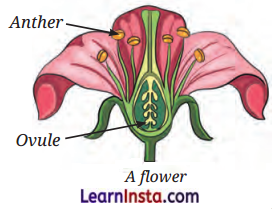
- Male gametes (special reproductive cells) are pollen grains in the anther, and female gametes are ovules inside the flower.
- Fertilisation occurs when these gametes unite to form a zygote that develops into a sped.
- The fleshy part of the flower around the ovule develops into fruit, and animals help disperse them. Seeds germinate using stored nutrients when watered.
- Pollination: The process where pollen is transferred to the female part of the flower by wind, insects, or animals.
Sexual Reproduction in Animals:
- In animals, the male gametes are called sperm, and the female gametes are called eggs.
- After fertilisation zygote forms which develops into embryo.
- Pollination: The process where pollen is transferred to the female part of the flower by wind, insects, or animals.
Sexual Reproduction in Animals:
- In animals, the male gametes are called sperm, and the female gametes are called eggs.
- After fertilisation zygote forms which develops into embryo.

→ In aquatic animals like fish and frogs, both sperm and eggs are released into the water, where fertilisation happens outside the body. The zygote then develops into an embryo in the water.
→ In birds and mammals, in humans, fertilisation occurs inside the female body when sperm meet the egg. All the birds and mammals follow different processes for further development.
→ Birds lay fertilised eggs, and the embryo develops outside the mother during hatching, nourished by stored food. The female bird packs enough food inside the egg so the baby bird (embryo) can grow and develop after the egg is laid, until it hatches.
→ Mammals develop the embryo inside the mother’s body, where she provides food and oxygen until birth. This internal development provides continuous nutrition and protection to the embryo, differing from egg-laying animals like birds.
→ Life on Earth depends on a delicate balance in nature, which is being disrupted by human activities such as burning fossil fuels. This process releases greenhouse gases like carbon dioxide and methane, leading to global warming. As a result, the planet experiences long-term changes in temperature, rainfall, and weather patterns-known as climate change. Climate change, biodiversity loss, and pollution together form the triple planetary crisis, which threatens life on Earth through rising sea levels, melting ice caps, and extreme weather conditions.
Air pollution can cause breathing problems, damage crops, smog and acid rain. Protecting Earth requires reducing pollution, using cleaner energy, and making responsible choices.
→ Global agreements like the Montreal Protocol and Paris Agreement aim to protect the environment and reduce climate change. However, much more action is needed to meet these goals and prevent serious effects.
→ Air pollution from factories, vehicles, and burning fuels harms both people and the nature. It can cause breathing problems, damage crops, and lead to smog and acid rain.
→ Water and soil pollution harm life and reduce crop yields, spreading toxins through the food chain. Earth’s interconnected systems mean damage to one affects all others, so protecting climate and biodiversity is crucial.
→ Everyone can help by reducing waste, saving energy and water, and promoting sustainable practices.