Each of our Maths Mela Class 5 Worksheet and Class 5 Maths Chapter 2 Fractions Worksheet with Answers Pdf focuses on conceptual clarity.
Class 5 Maths Chapter 2 Fractions Worksheet with Answers Pdf
Fractions Class 5 Maths Worksheet
Class 5 Maths Chapter 2 Worksheet with Answers – Class 5 Fractions Worksheet
Meera was excited as all the Ker cousins were visiting. Grandma welcomed them with a warm hug and asked, “What should I cook?”
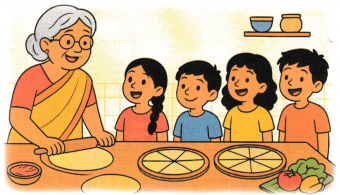
Before Meera could answer, Kabir said, “Grandma, we love pizza, but Mumma rarely lets us have it.”
Smiling, Grandma replied, “Then I will make a healthy one — with organic veggies, fresh cheese, and a whole-grain base.”
Fractions with the Same Wholes
In the kitchen, Grandma rolled out two equally sized pizza bases.
“This one,” she said, pointing to the first base, “I will cut into 5 big slices.”
“And this one,” she continued, patting the second base, “will be cut into 8 smaller slices.” Kabir’s eyes lit up, “Eight slices mean more pizzas, right?”
Grandma smiled, “Not so just! Remember, both pizzas are of the same size.”
Question 1.
Grandma sliced the first pizza into 5 equal parts, and Kabir took 2 slices. She sliced the second pizza into 8 equal parts, and Meera took 3 slices. Who got more pizza?
__________________________________________________
__________________________________________________
__________________________________________________
Question 2.
Draw both pizzas, shade the portions eaten by Kabir and Meera.
Question 3.
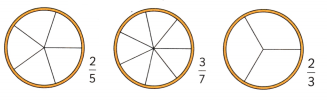
Meera saw KabLr was not very comfortable with the above resuLts, so she asked Kabir to shade \(\frac{2}{5}\), \(\frac {3}{7}\) and \(\frac {2}{3}\) of the given figure. Check which is shaded the most.
__________________________________________________
__________________________________________________
Question 4.
On another table, Pizza A was cut into 9 slices and Pizza B into 6 slices. Kabir ate \(\frac{4}{9}\) of Pizza A, and Meera ate \(\frac{3}{6}\) of Pizza B. Who ate the larger portion of pizza?
__________________________________________________
__________________________________________________
Question 5.
The twins, Ritu and Rohit, started arguing. Ritu said, “Eating \(\frac {2}{7}\) of a pizza is less than eating \(\frac{3}{10}\) of another pizza of the same size.” Was Ritu correct? Give reason.
__________________________________________________
__________________________________________________
Question 6.
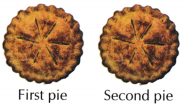
Two pies of the same-sized were served. Sweta received \(\frac {5}{12}\) of the first pie, and \(\frac {7}{16}\) of the second pie. Which portion is larger?
__________________________________________________
__________________________________________________
Question 7.
If two pizzas are of different sizes, can we still compare fractions directly? Explain why or why not.
__________________________________________________
__________________________________________________

Think and Answer
Is \(\frac {4}{8}\) always greater than \(\frac {3}{7}\) when the whole is of the same size? Explain why or why not.
Question 8.
Meera took \(\frac {6}{11}\) of a pizza, and Kabir took \(\frac {5}{11}\) of another pizza of the same size. Who had more?
__________________________________________________
__________________________________________________
Question 9.
“Sometimes you can have more slices but still get less pizza.” Give an example from your own experience to show how this can happen.
__________________________________________________
__________________________________________________
Playing with a Grid
Three rectangular boards were placed on a desk, each divided into equal squares.
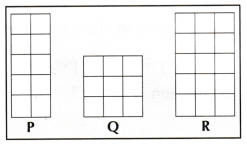
- Board P contains 10 squares
- Board Q contains 9 squares
- Board R contains 15 squares
Each student received a different decorative item and was told to decorate only a specified number of squares.
Question 10.
Kabir decorated 3 squares on Board P with button squares. Out of how many total squares did Kabir decorate?”
__________________________________________________
__________________________________________________
Question 11.
Meera decorated 4 of the 9 squares on Board Q with rhinestone gems. What fraction of the board has she decorated?
__________________________________________________
__________________________________________________
Question 12.
Ritu decorated 5 of the 15 squares on Board R using glass beads. Write this as a fraction.
__________________________________________________
__________________________________________________
Question 13.
One of tKese boards is exactly one-third decorated. Which board shows exactly one- third covered?
__________________________________________________
__________________________________________________
Think and Answer
Can two boards with different number of parts show the same fraction? Give an example.
__________________________________________________
__________________________________________________
Question 14.
One student covered 6 out of 15 squares. Write this fraction in the simplest form.
__________________________________________________
__________________________________________________
Making Equivalent Fractions
Three cousins Alok, Megha and Ritu were served three pizzas of the same size.
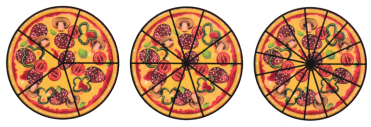
One was cut into fifths, another into tenths, and the last into fifteenths.
“See,” someone said, “the same quantity can look different depending on how we cut it.”
Question 15.
Alok pointed to \(\frac {2}{5}\) and says it is the same as \(\frac {4}{10}\). Is he correct? Show with a drawing.
__________________________________________________
__________________________________________________
Question 16.
If \(\frac{2}{5}=\frac{4}{10}\), what would it be out of 20 slices? And out of 25 slices?
__________________________________________________
__________________________________________________
Question 17.
If \(\frac{3}{8}=\frac{6}{16}\), so it must also be
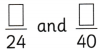
Fill in the blanks. Write your calculations also.
__________________________________________________
__________________________________________________
Question 18.
Ritu ate 6 out of 12 slices. If tbe pizza were cut into 4 slices instead, kow many would that be?
__________________________________________________
__________________________________________________
Think and Answer
Can you find a fraction equal to \(\frac {5}{7}\) that kas 21 as tke denominator?
Question 20.
A pizza is cut into 20 slices, and 8 are eaten. Write two fractions tkat represent tke same amount.
__________________________________________________
__________________________________________________
Question 21.
Find two fractions tkat are equal to \(\frac {9}{18}\), but you cannot use 18 as tke denominator.
__________________________________________________
__________________________________________________
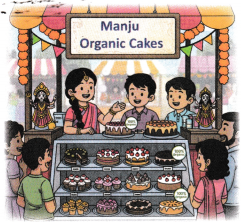
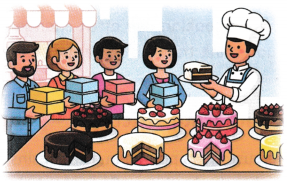
During the vibrant Durga Puja mela in the village, Manju and her cousins set up a cheerful stall serving freshly baked, healthy and home made cake topped with nuts and chocochip. The sweet aroma attracted many visitors, making their stall one of the highlights of the event.
Question 22.
Manju served 12 out of 20 pieces of cake to customers. Can you write that with the denominator 10 so it is easier for the menu board?
__________________________________________________
__________________________________________________
Question 23.
A pie had 8 out of 16 slices taken. Write this fraction in its simplest form.
__________________________________________________
__________________________________________________
Think and Answer
When cooking, we often change fractions into simpler or equivalent forms. Why do you think that makes recipes easier to follow? Give one example.
Comparing Fractions — Same Denominator
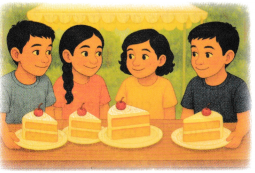
As customers poured in, the cousins started comparing each other’s plates. Some had the same number of total slices (same denominator), while others had the same number of slices eaten (same numerator).
Question 24.
Aman has eaten \(\frac {9}{14}\) of his cake, while Swena has eaten \(\frac{10}{14}\). If each slice is of the same size, who 14 ate less, and by how much of a cake?
__________________________________________________
__________________________________________________
Question 25.
Cake A has \(\frac {11}{15}\) eaten, and cake B has \(\frac {8}{15}\) eaten. Explain which portion is larger and by how many fifteenths?
__________________________________________________
__________________________________________________
Comparing Fractions — Same Numerator
Question 26.
If Aman’s plate has \(\frac{7}{9}\). of the cake eaten, while Verna’s has \(\frac{7}{12}\)?. If the cakes are of same size, who ate more?
__________________________________________________
__________________________________________________
Question 27.
Compare the fraction using <, > or = sign.

Fractions Greater Than 1
The cake stall was busier than ever. Some customers were so hungry, that they ordered more than one whole cake each. The cousins used these orders to practice fractions greater than 1.
Question 28.
A customer ate 1 whole cake and then 3 out of 5 slices from another cake. How can we write this as a fraction?
__________________________________________________
__________________________________________________
Question 29.
Another customer ate 2 whole cakes and 3 out of 4 slices from another cake. Write this as one fraction. Use the number line to find the answer.
__________________________________________________
__________________________________________________
Think and Answer
Samantha guessed, “I think 1 whole pizza and \(\frac{3}{4}\) is more than 1 whole pizza and \(\frac{2}{3}\).” Do you agree? Explain how.
Comparing Fractions with Reference to 1 and \(\frac{1}{2}\)
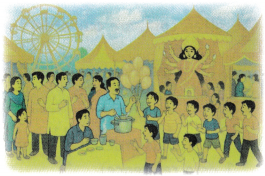
It was a busy evening at the fair. The food stall had a long queue, and the cousins were helping to serve the customers.
Question 30.
A customer ordered 1 whole item and 1 extra slice out of 9, while another ordered 1 whole item and 1 extra slice out of 7. Who got more than 1 whole item, and who got the bigger order?
__________________________________________________
__________________________________________________
Question 31.
Two regular customers placed orders. The first ordered \(\frac{7}{12}\) of a pizza, and the second ordered \(\frac{5}{11}\) of a pizza. Which order is greater than half of the whole?
__________________________________________________
__________________________________________________
Question 32.
The cousins wrote four fractions on the stall’s blackboard menu:

Circle the fractions that are greater than. 1 (whole).
Question 33.
Some customer orders were listed: \(\frac{5}{9}, \frac{4}{7}, \frac{3}{10}, \frac{6}{13}\) of a pizza each.
Which of these are more than haLf a pizza?
__________________________________________________
__________________________________________________
Think and Answer
We often compare our orders with \(\frac{1}{2}\) to estimate portion sizes quickly. Why do you think \(\frac{1}{2}\) is such a useful benchmark when comparing fractions?
Question 34.
Two friends ordered \(\frac{11}{20}\) and \(\frac{9}{18}\) of an item. Whose order is smaller? (Compare using 1 as a reference)
__________________________________________________
__________________________________________________
Question 35.
Manju served \(\frac{5}{8}\) of a pizza to one customer and \(\frac{1}{2}\) of a pizza to another. Which order is bigger? (Compare using 1 as a reference)
__________________________________________________
__________________________________________________
Question 36.
Two kids each ordered a share close to half of an item. One got \(\frac{7}{14}\), the other got \(\frac{7}{9}\). Whose share is actually closer to half?
__________________________________________________
__________________________________________________
It was a quiet moment at the food stall in the meta, so Kabir carne up with a fun challenge for the waiting customers.
He drew a big number Line on a cardboard sheet, marking 0 at one end and 2 at the other.

Question 37.
Kabir said, “If 1 whole is at the mark T, can you show where \(\frac{1}{2}\) would be? What about \(\frac{3}{2}\) ?”
__________________________________________________
__________________________________________________
Question 38.
Meera placed order cards: \(\frac{1}{4}, \frac{3}{4}, \frac{5}{4}\) and \(\frac{7}{4}\).
Place these correctly on the number line between 0 and 2.
__________________________________________________
__________________________________________________
Question 39.
Draw your own number line from 0 to 3 in your notebook.
- Mark \(\frac{1}{2}\), 1, 1\(\frac{1}{2}\), 2, 2\(\frac{1}{2}\)
- Shade the parts that show more than 1 whole.
Question 40.
If 0 is nothing and 2 means two wholes, where would \(\frac{7}{6}\) go — Closer to 1 or closer to 2?
__________________________________________________
__________________________________________________
Question 41.
Between \(\frac{23}{32}\) and \(\frac{18}{32}\), which fraction is qreater?
Now, imagine both cakes are doubled in size, will your answer change? Explain why or why not.
__________________________________________________
__________________________________________________