Students can use Curiosity Class 8 Science Book Solutions Chapter 5 Exploring Forces Class 8 Question and Answer as a quick reference guide.
Class 8 Science Chapter 5 Exploring Forces Question Answer
Science Class 8 Chapter 5 Question Answer Exploring Forces
Exploring Forces Class 8 Question Answer (InText)
Question 1.
Probe and ponder (Page 62)
- Why does it feel harder to pedal a bicycle when going uphill than on flat ground?
- Why is it casier to slip on a wet surface?
- Why do we feel ‘light’ or like we are ‘floating’ just after our swing reaches its highest point and begins to come down?
- Share your questions
Answer:
(Questions may vary)
- If gravity pulls everything down, why does not a flying bird fall?
- What could happen if you use a spring balance to measure something heavier than its range?

Question 2.
Is there any other contact force? (Apart from friction and muscular force) (Page 67)
Answer:
Apart from friction and muscular force, spring force, tension force, and drag force are also examples of contact forces.
Question 3.
Does this mean that the force of friction will be greater if the surfaces are rough? (Page 68)
Answer:
Yes, the force of friction is greater on rough surfaces. Rough surfaces have more irregularities that interlock with each other, increasing friction, and making it harder for objects to move.
Question 4.
Is it essential for an object applying force on another object to always be in contact with it? (Page 69)
Answer:
No, it is not necessary for an object to be in contact with another object to apply force. Non-contact forces such as magnetic, electrostatic, and gravitational forces can act from a distance without being in contact.
Question 5.
Does it mean that there are two kinds of electrical charges? (Page 71)
Answer:
Yes, there are two kinds electrical charges positive and negative.
Question 6.
Why do all the objects fall towards the Earth? (Page 72)
Answer:
All objects fall towards the Earth because it pulls them down with a force called gravity. This force always acts in a downward direction, towards the centre of the Earth.
Question 7.
Is there any force which acts on them (objects that falls towards Earth)? What exerts this force? (Page 72)
Answer:
Yes, the gravitational force acts on them. It is exerted by the Earth, which pulls all objects towards its surface. Gravitational force is an attractive force.
Question 8.
Does the Earth pull every object with equal force? (Page 72)
Answer:
No, the gravitational force depends on the mass of the object-heavier objects experience a stronger pull.
Question 9.
What is the difference between weight and mass? (Page 75)
Answer:
Mass is the amount of matter in an object, while weight is the gravitational force with which the Earth pulls the object. Mass remains the same at all places, but weight can vary depending on the gravitational pull.
Question 10.
If we place some objects on water, some of them float, while others fall to the bottom. The gravitational force of the Earth is acting on all objects, then why do not all objects fall to the bottom? (Page 76)
Answer:
All objects are pulled down by Earth’s gravitational force. When placed in water, they also experience an upward buoyant force. If the buoyant force is equal to object’s weight, it floats; otherwise, it sinks. That is why all objects do not fall to the bottom.
NCERT Class 8 Science Chapter 5 Question Answer Exploring Forces (Exercise)
Keep the curiosity alive(Pages 77-79)
Question 1.
Match items in Column A with the items in Column B.
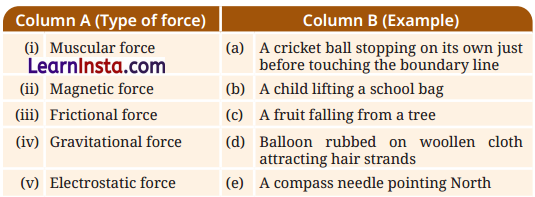
Answer:
| Column A | Column B |
| (i) Muscular force | (b) A child lifting a school bag |
| (ii) Magnetic force | (e) A compass needle pointing North |
| (iii) Frictional force | (a) A cricket ball stopping on its own just before touching the boundary line |
| (iv) Gravitational force | (c) A fruit falling from a tree |
| (v) Electrostatic force | (d) Balloon rubbed on woollen cloth attracting hair strands |
Question 2.
State whether the following statements are True or False.
(i) A force is always required to change the speed of motion of an object.
(ii) Due to friction, the speed of the ball rolling on a flat ground increases.
(iii) There is no force between two charged objects placed at a small distance apart.
Answer:
(i) True
(ii) False
(iii) False
Question 3.
Two balloons rubbed with a woollen cloth are brought near each other. What would happen and why?
Answer:
After rubbing with a woollen cloth, both balloons get the same type of charge and move away from each other because like charges repel.
Question 4.
When you drop a coin in a glass of water, it sinks, but when you place a bigger wooden block in water, it floats. Explain.
Answer:
A coin sinks in water because the gravitational force acting on it is greater than buoyant force. A wooden block floats because it is less dense, and the buoyant force acting on it is equal to the gravitational force.
Question 5.
If a ball is thrown upwards, it slows down, stops momentarily, and then falls back to the ground. Name the forces acting on the ball and specify their directions.
(i) During its upward motion
(ii) During its downward motion
(iii) At its topmost position
Answer:
(i) Gravitational force acts on the ball in downward direction and slows down its speed during upward motion.
(ii) Gravitational force acts in the downward direction and increases the speed of the ball during downward motion.
(iii) At the topmost position, the ball momentarily stops, but gravity still acts on it and pulls it downward.
Question 6.
A ball is released from the point P and moves along an inclined plane and then along a horizontal surface as shown in the Fig. 5.16. It comes to stop at the point A on the horizontal surface. Think of a way so that when the ball is released from the same point P, it stops (i) before the point A (ii) after crossing the point A.

Answer:
(i) To stop the ball before point A on the horizontal surface, increase the roughness of the surface. This increases the frictional force, causing the ball to slow down faster and stop earlier.

(ii) To stop the ball after point A , reduce the friction on horizontal surface by making it smoother. This decreases the frictional force, allowing the ball to travel a longer distance before stopping, thus crossing point A.
Question 7.
Why do we sometimes slip on smooth surfaces like ice or polished floors? Explain.
Answer:
On smooth surfaces such as ice or a polished floor, friction is less. Frictional force helps us grip the ground firmly, but when friction is reduced, our feet cannot hold the surface well, causing us to lose balance and slip.
Question 8.
Is any force being applied to an object in a non-uniform motion?
Answer:
Yes, a force is being applied to an object in non-uniform motion. In non-uniform motion speed and direction of an object change. Such changes are not possible without applying force.
Question 9.
The weight of an object on the Moon becomes one-sixth of its weight on the Earth. What causes this change? Does the mass of the object also become one-sixth of its mass on the Earth?
Answer:
Gravitational force on the Moon is one-sixth that of Earth. So, the weight of an object on Moon becomes one-sixth of its weight on the Earth. However, the mass of the object remains same, as mass is the amount of matter in an object.
Question 10.
Three objects 1,2 , and 3 of the same size and shape but made of different materials are placed in the water. They dip to different depths as shown in Fig. 5.17. If the weights of the three objects 1,2 and 3 are w1, w2, and w3, respectively, then
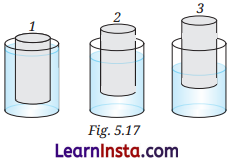
(i) \(w1=w2=w3\)
(ii) \(w1>w2>w3\)
(iii) \(w2>w3w1\)
(iv) \(w3>w1>w2\)
Answer:
(ii) The correct order of weight is \(w1=w2=w3\) because the more an object sinks, the greater its weight.
Class 8 Exploring Forces Question Answer (Activities)
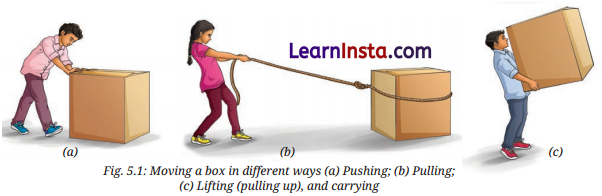
Activity 5.1: let us explore (page 63)
Aim: To observe different ways of moving an object and understand that a push or pull is required to change its position.
Observation:
- Box can be moved by pushing, pulling and lifting.
- It can be moved by different ways-by dragging, rolling and tilting.
Conclusion:
- To move an object, we need to apply a push or a pull on the object.
Activity 5.2: Let Us Analyse (Page 64)
Aim: To identify the effects of different types of forces such as push and pull on the motion and shape of objects.
Observation:
- Box can be moved by pushing, pulling and lifting.
- It can be moved by different ways-by dragging, rolling and tilting.
Conclusion:
To move an object, we need to apply a push or a pull on the object.
Activity 5.2: Let Us Analyse (Page 64)
Aim: To identify the effects of different types of forces such as push and pull on the motion and shape of objects.
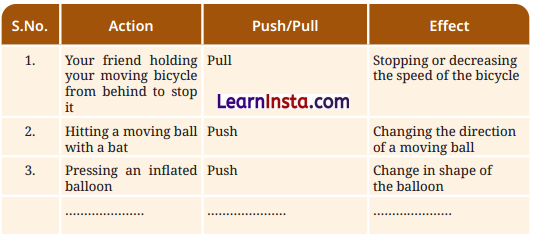
Answer:
Observation:
Table 5.1: Different actions and their effects
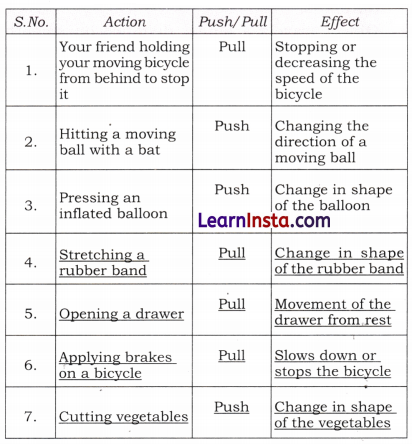
Conclusion:
- Force can stop a moving object, start the motion of an object, and change the speed, direction, or shape of an object.
Activity 5.3: Let Us Investigate (Pages 67-68)
Aim: To understand how friction acts between two surfaces and understand that it opposes the motion of a sliding object.

Observation:
When flat objects such as empty lunch box, geometry box, or notebook are slide on a floor or table they come to rest after moving a certain distance.
Activity 5.4: Let Us Explore (Page 68)
Aim: To observe how the nature of different surfaces affects the force of friction and the distance travelled by a moving object.
Observations:
- When objects are placed on different surfaces such as glass, cloth, ceramic tile, sand, etc., on each surface object stops after moving certain distances.
- Object travels a longer distance on smooth surfaces (like glass or ceramic tile) and a shorter distance on rough surfaces (like sand or cloth).
Conclusion:
- Force of friction depends on nature of surfaces. It is greater for rough surface and less on smooth surface.
Activity 5.5: Let Us Test (Page 69)
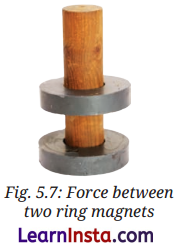
Aim: To demonstrate the magnetic force between two magnets and observe how like poles repel and unlike poles attract without direct contact.
Observations:
- When two ring magnets are placed vertically with like poles facing each other, the second magnet floats above the first one without touching.
- An opposing force is observed on gently pushing down the second magnet.
- When the poles are reversed, the magnets attract and do not float apart.
Conclusion:
When the similar poles of the magnets face each other, they repel: But when the opposite poles face each other, they attract each other. This shows that magnets can pull or push each other even without touching and this force is known as magnetic force.
Activity 5.6: Let Us Experiment (Page 70)
Aim: To observe the effect of static charge by rubbing materials and demonstrating how a charged object can attract small, uncharged objects.
Observation:
When a plastic scale or straw is rubbed with polythene and brought near small pieces of paper (without touching), the paper pieces get attracted and stick to it.

Conclusion:
- Rubbing certain materials together creates static charges on their surfaces.
- A charged object can attract uncharged objects made of certain materials.
Activity 5.7: Let Us Experiment (Page 70)
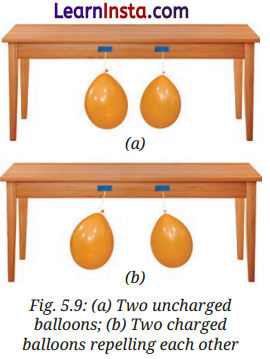
Aim: To find out that like charges repel and unlike charges attract using balloons and a woollen cloth.
Observations:
- When balloons are rubbed with a woollen cloth and hung without touching, they move away from each other, showing repulsion.
- When the woollen cloth is brought near one of the balloons, it moves towards the cloth, showing attraction.
Conclusion:
- The balloons move apart because they have similar charges, and similar charges repel each other.
- The balloon and the woollen cloth attract each other because they have opposite charges.
- Similar charges repel each other, opposite charges attract each other.
Activity 5.8: let us observe (pages 71-72)
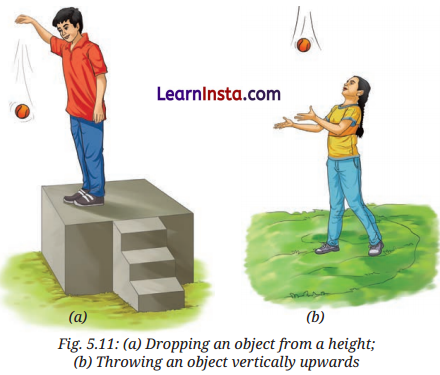
Aim: To observe the effect of gravitational force on objects thrown upwards or dropped from a height and understand how gravity pulls objects towards the Earth.
Observations:
- When a ball is thrown vertically upwards, it slows down, stops briefly, and then falls back to the ground.
- If the ball is thrown with more force, it goes higher but still comes down.
- Objects thrown or dropped from a height always move downward towards the Earth.
Conclusion:
- Objects always fall back to the ground because the Earth pulls them downward.
- The gravitational force acts from a distance and always works in the downward direction.
- When an object moves upward, its speed decreases. After stopping briefly, it starts moving downward and its speed increases.
Activity 5.9: Let Us Explore (Page 73)
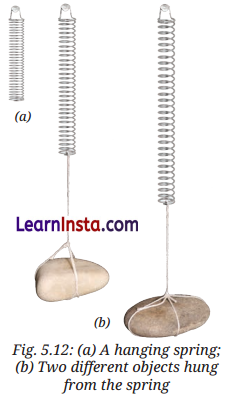
Aim: To observe how different objects stretch a spring and understand that gravitational force depends on the weight of the object.
Observations:
When different objects (like a pencil box, tiffin box, and small stone) are hung from a spring, the spring stretches each time.
Conclusion:
- The Earth pulls different object with different amounts of force depending on their weight.
- Heavier object stretch more because they experience greater gravitational force.
Activity 5.10: let us observe (pages 73-74)
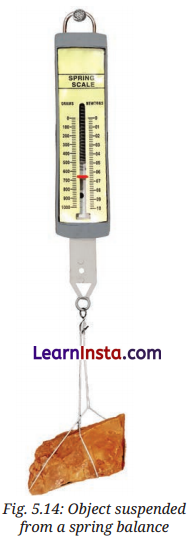
Aim: To understand the measuring range of a spring balance and determine the maximum weight it can measure.

Observations:
- The spring balance shown in figure has a range from 0 to 10 N
- The maximum weight this spring balance can measure is 10 N
Conclusion:
The maximum weight a spring balance can measure is equal to its maximum range.
Activity 5.11: let us calculate (page 74)
Aim: To determine the least count of a spring balance by calculating the value of each small division between two major markings.
Observations:
- The weight difference between two bigger marks, i.e. 0 and 01 N is 1 N
- There are 5 smaller divisions between two bigger marks.
- One small division can indicate 0.2 N of weight.
Conclusion:
The smallest value of weight that can be measured by spring balance is calculated by finding the weight difference between two bigger marks and then dividing it by the number of smaller divisions between them.
Activity 5.12: let us measure (pages 74-75)
Aim: To measure the weight of different objects using a spring balance without exceeding its maximum capacity.
Observations: Do it yourself.
Activity 5.13: let us investigate (page 76)
Aim: To observe the upward force (buoyant force) exerted by water on an object and understand the conditions under which an object floats or sinks.
Observations:
- When an empty plastic bottle is pushed into bucket of water, an upward push is felt.
- On removing the force applied on the bottle, it bounces back to the surface of water.

Conclusion:
Water pushes the bottle upward with a force, which makes it float and this upward force is known as buoyant force. If the buoyant force is more than the gravitational force then object floats but if buoyant force is less than gravitational force, the object sinks.