Each of our Maths Mela Class 5 Worksheet and Class 5 Maths Chapter 8 Weight and Capacity Worksheet with Answers Pdf focuses on conceptual clarity.
Class 5 Maths Chapter 8 Weight and Capacity Worksheet with Answers Pdf
Weight and Capacity Class 5 Maths Worksheet
Class 5 Maths Chapter 8 Worksheet with Answers – Class 5 Weight and Capacity Worksheet
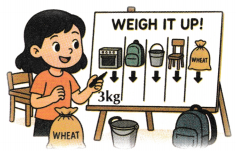
Riya was curious to know how much the things in her house weighed. She wanted to make a chart for her school project titled “Weigh It Up!”. So, she started noting down the weights of different items and prepared a list.
Question 1.
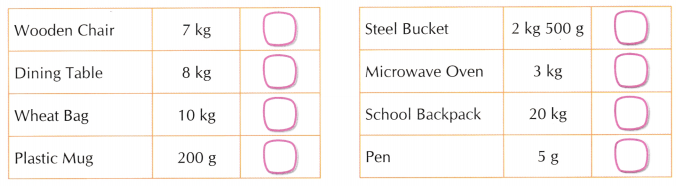
Review her list and tick all the items that appear to be recorded correctly. Here is what she has recorded in her list.
Question 2.
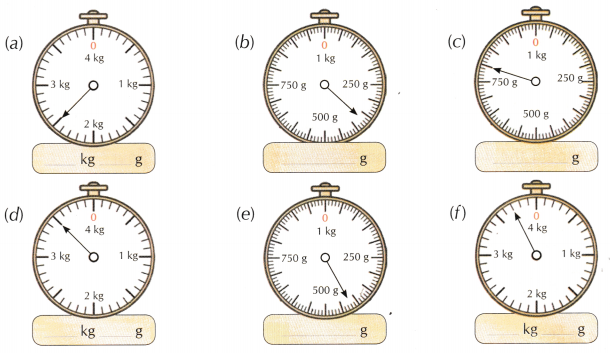
Now Riya reads the scales 9iven. below and wants to write the correct weight in the blanks.
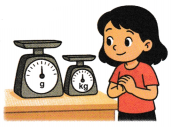
After some time, while helping her mother arrange groceries and household items, she came across two old weighing balances in the storeroom. One showed weights in kilograms (kg) and the other in grams (g).

Question 3.
Her mother gave her a fun task:
“Use these balances to weigh the bags correctly and verify that the weights are same—even if they are written in different units.”
Riya excitedly began weighing the bags one by one. She carefully recorded what each weighing balance showed. Here’s what she found:
| Item | Weight on kilogram balance | Weight on gram balance |
| Bag of flour | 5 kg | __________ g |
| Sack of potatoes | 10 kg | __________ g |
| Rice bag | ___________ kg | 20,000 g |
| Sugar pack | 3 kg | __________ g |
| Large pet food bag | 25 kg | __________ g |
| Bag of pulse | ___________ kg | 5,000 g |
Look over her list and fill in all the blanks.
Question 4.
Riya drew a double number line to verify the following conversions easily. Fill in the blanks to help her check her observations.

Question 5.
After some time, her mother said, “Riya, I need exactly 3 kilograms and 500 grams of flour to bake a cake. Can you measure it using the gram weighing machine?” What should the weighting balance show for 3 kg 500 g of flour?
________________________________________________
________________________________________________
Question 6.
Convert the following weights into grains.
(a) 6 kg 39 g ________________________________________________
(b) 9 kg 648 g ________________________________________________
(c) 52 kg 580 g ________________________________________________
Question 7.
The weight of Kunal’s science project model is 1 kg 750 g that of Reerna’s model is 2 kg 600 g. Express the weights of both models in grams.
Also, write which model is heavier and by how much.
________________________________________________
________________________________________________
Question 8.
Fill in the blanks to complete the conversions using the double number Line provided, where some numbers are marked.

Question 9.
Kavya and her family were off to the Forest Breeze Campsite for a weekend of fun! Before they zipped up their tent, Kavya’s dad packed some tasty treats for the trip.
Here’s what went into the camping basket:

- A jumbo box of chocolate bars weighing 2 kg 500 g.
- A tin of cookies weighing 1 kg 200 g.
- A packet of trail mix weighing 1 kg 850 g.
- A can of baked beans weighing 3 kg.
As they reached the campsite, Kavya’s Little brother Neel said, “Let’s find out the following:”
(a) Which item has the highest weight?
________________________________________________
(b) Which one has the least weight?
________________________________________________
(c) Write the name of the items in descending order of their weight.
________________________________________________
(d) Write the name of items in ascending order of their weight.
________________________________________________
Question 10.
Compare the weights using < =, > signs
(a) 2 kg 300 g ___________ 2,350 g
(b) 3 kg 450 g ___________ 3 kg 45 g
(c) 8kg 120g ___________ 8120g
(d) 4kg 750g ___________ 5kg200g
(e) 6 kg 25 g ___________ 5 kg 950 g
(f) 1,200g + 6,800 g ___________ 7kg + 1,000 g
(g) 9 kg 500 g ___________ 9,050 g
Question 11.
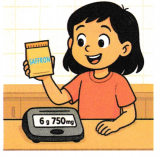
Riya is standing beside a kitchen counter with a digital weighing scale. She is holding a small packet labelled “SAFFRON.” The digital scale displays the weight of that
packet as “6 g 750 mg. What is its weight in milligrams?
________________________________________________
________________________________________________
________________________________________________
Question 12.
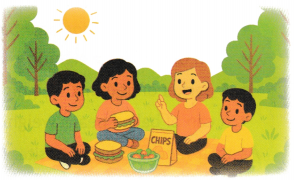
On a beautful day, Rta and her friends went on a picnic to Butterfly Park. They brought their favourite snacks to share: sandwiches, chips, and a healthy veggie salad. But before eating, their teacher, Miss Maya, gave them a fun math challenge!
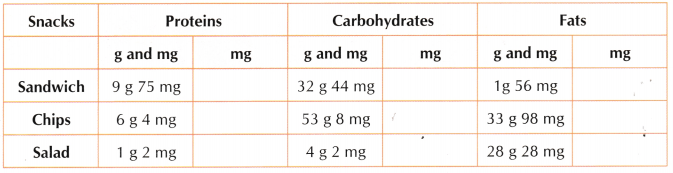
She said, “Each snack contains different nutrients—proteins, carbohydrates, and fats. I have listed the amounts in grams and milligrams. Your mission is to carefulLy observe and record the amounts in milligrams.
Here is what Miss Maya gave them:
Question 13.
One day, Ria and Her brother Arjun went to the fruit market with their mother. The market was jail of colorful fruits, and their mother gave them a task to solve while she shopped. She said, “I have written down the weights of some fruits in grams and milligrams.
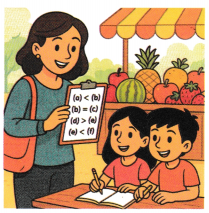
Compare the weights of these fruits using the symbols <, =, or >. Let’s see who can solve it faster!
| Weight 1 | <, =, or > | Weight 2 |
| 15 g | 1,500 mg | |
| 25 g 200 mg | 30 g 50 mg | |
| 3,010 mg | 3 g 10 mg | |
| 10,000 mg | 100 g | |
| 5,500 g | 6,000 g | |
| 900 mg + 100 mg | 1,000 mg – 50 mg |
Question 14.
Observe the pictures given below and fill in the blanks
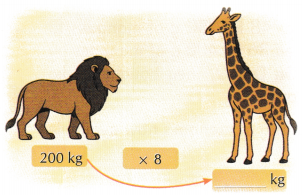
Question 15.
Fill in the blanks to convert the following correctly:
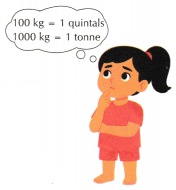
(a) 400 kg = ___________ quintals
(b) 7,000 kg = ___________ quintals = ___________ tonnes
(c) ___________ kg = 9 tonnes
Question 16.
Riya’s mother purchased 2 kg 300 g of vegetables in the morning and 3 kg 400 g in the evening. How much did she purchase in all?
________________________________________________
________________________________________________
________________________________________________
Question 17.
A toolbox weighed 11 kg 500 g with all the tools. After removing the tools, it weighed 6 kg 750 g. How much did the removed tools weigh altogether?
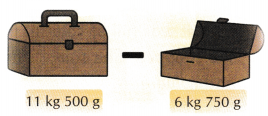
________________________________________________
________________________________________________
________________________________________________
Question 18.
A suitcase packed with clothes weighs 22 kg 800 g. After removing a few jackets, it now weighs 17 kg 500 g. What is the weight of the jackets removed?
________________________________________________
________________________________________________
Question 19.
At a village fair, Meera and her friends set up a juice and snacks stall.
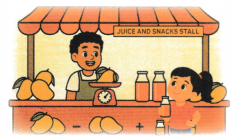
On Dag 1, they bought 48 kg 250 g of mangoes to prepare juice. They used 36 kg 400 g of mangoes by the end of the day. On Day 2, they bought 15 kg 750 g of mangoes more.
What is the total quantity of mangoes now available at Meera’s stall?
________________________________________________
________________________________________________
Question 20.
At a pet supply store, Riya receives a delivery of birdseed packed in a large sack. The sack weighs 6 kg 360 g. She decides to divide the birdseed equally into 6 smaller containers to sell individually. What is the weight of birdseed in each small container in grams?
________________________________________________
________________________________________________
Question 21.
At a fruit market, Rohart is helping his father calculate the total cost of the fruits they bought for their shop.
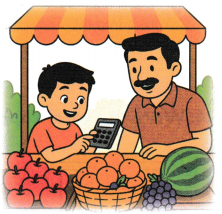
The details of the fruits are as follows:
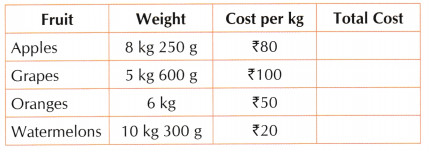
Help Rohan calculate the total cost of each fruit. Write your answers in rupees.
Question 22.
Rehana collected various types of waste materials and sold them for recycling.

(a) She sold 18 kg of cardboard boxes and got ₹ 6 per kg. How much money did she receive?
________________________________________________
________________________________________________
(b) She also sold 15 kg of broken glass pieces, receiving ₹ 150 for every 5 kg. How much money did she make from selling the glasses?
________________________________________________
________________________________________________
(c) Lastly, she sold 12 kg of aluminium cans, getting ₹ 40 for every 4 kg. How much did she earn for the cans?
________________________________________________
________________________________________________
Question 23.
Convert the following:
(а) 16 L into mL ________________________________________________
(б) 7028 mL into L and mL ________________________________________________
(c) 24 L 2 mL into mL ________________________________________________
Question 24.
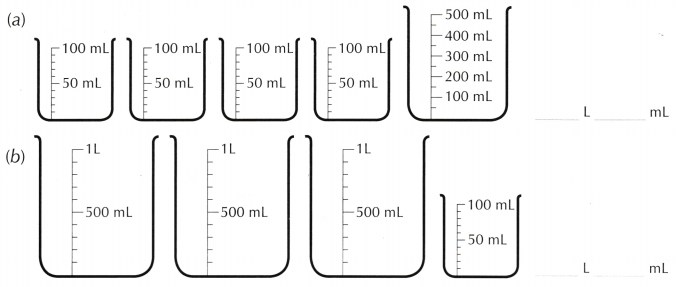
Write the total capacity of the container in each row.
Question 25.
Compare the following quantities using the symbols <, =, >.
(a) 6 L 800 mL ___________ 6,200 mL
(b)12L120mL ___________ 3 L 800 mL
(c) 165 mL +135 mL ___________156mL + 20mL
(cO 2 L 300 mL ___________ 2300 mL
(e) 3 L 50 mL ___________ 3 L 500 mL
Question 26.
Riya’s uncle runs a honey delivery service in his village. Each week, he delivers different quantities erf honey to various families. The honey is measured in litres and millilitres.
Below is the record erf the quantity erf honey he delivered last week:
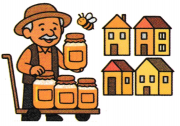
Fill in the blanks to complete Riya’s uncle’s record.
| Family | Honey Delivered in a Week (in litres) | Quantity in millilitres |
| Sharmas | 5 | |
| Guptas | 12 | |
| Mehras | 18,000 | |
| Vermas | 25,000 | |
| Singhs | 30 |
Question 27.
Rita owns a water supply service in her town. She records the details of the water supplied to different types of buildings in a day.
The details are as follows:
| Building Type | Number of Buildings | Quantity of Water Supplied to Each Building (in litres) | Total Quantity of Water Supplied (in litres) |
| Appartment | 4 | 1000 | |
| School | 3 | 2000 | |
| Office | 5 | 500 | |
| Shop | 10 | 200 | |
| Small house | 20 | 100 |
(a) How much more water is supplied to schools than to apartments?
________________________________________________
________________________________________________
(b) What is the total quantity of water supplied to all types of buildings in a day?
________________________________________________
________________________________________________
(c) How many litres of water are supplied to shops and small houses altogether?
________________________________________________
________________________________________________
Question 28.
Aman and Priya are preparing for a long road trip on their scooters. Before starting their journey, they stop at a petrol pump to fill fuel. Prlya fills 3 litres 200 millilitres of petrol in her scooter. Aman fills 1 litre 500 millilitres more petrol than Prlya.
(a) How much petrol did Aman fill in his scooter?
________________________________________________
________________________________________________
(b) What is the total quantity of petrol filled by both Aman and Priya combined?
________________________________________________
________________________________________________
Question 29.
Meera is preparing Lemonade for a party. She pours 3 litres of water into a large jug and adds 1 litre 500 millilitres of water from another container. Her brother, Kabir, is helping her by filling smaller bottles. Kabir fills five bottles, each containing 750 millilitres of water.
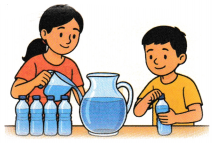
(a) How much water did Meera pour in total?
________________________________________________
________________________________________________
(b) How much water did Kabir fill in total?
________________________________________________
________________________________________________
(c) Who used more water, Meera or Kabir, and by how much?
________________________________________________
________________________________________________
(d) If Meera decides to add 2 litres more water to the jug, what will be the total amount of water in the jug?
________________________________________________
________________________________________________
(e) If Kabir fills two more bottles of 750 millilitres each, how much water will he have filled in total?
________________________________________________
________________________________________________
Question 30.
Ananya is making buttermilk for her family. She uses 5 containers, each holding 1 litre 250 millilitres of buttermilk. Her brother, Arjun, uses 3 containers, each holding 2 litres 500 millilitres of buttermilk. (Use the double number line whenever needed to solve such problems.)
(a) How much buttermilk did Ananya prepare in total?
Also convert the amount in millimetres.
________________________________________________
________________________________________________
(b) How much buttermilk did Arjun prepare in total?
Also convert the amount in millimetres.
________________________________________________
________________________________________________
(c) Who prepared more buttermilk, Ananya or Arjun, and by how much?
________________________________________________
________________________________________________
Activity
To estimate the weight and capacity of everyday objects as accurately as possible using standard metric units.
In this activity, students work in small teams to guess the weight and capacity of everyday objects. The teacher shows items like lunchboxes, juice boxes, water bottles, and cookie packets. Two teams take turns to play.
In each team, one student tries to guess how heavy things like rice bags or cookie packets are. They make their guesses using grams, rounding to the nearest ten. Another student guesses how much liquid items like juice boxes or water bottles can hold, using millilitres, also to the nearest ten. A third student writes all the guesses in a table. Later, another team uses real tools like weighing scales and measuring cups to find out the exact weight and capacity. They write the actual numbers in the same table. This activity helps students learn to make close guesses and understand how we measure weight and volume using metric units.
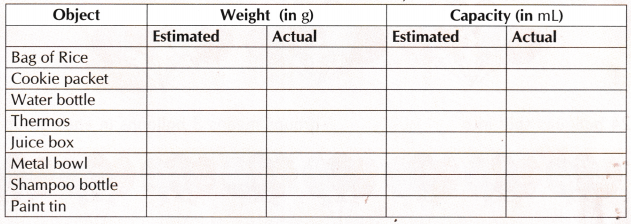
The team with the guesses that are closest to the actual measurements gets points.