Students can use Our Wondrous World Class 5 Solutions Chapter 1 Water The Essence of Life Class 5 Questions and Answers as a quick reference guide.
Class 5 EVS Chapter 1 Water The Essence of Life Question Answer
Water The Essence of Life Class 5 EVS Question Answer
Our Wondrous World Class 5 EVS Chapter 1 Question Answer – Class 5 EVS Water The Essence of Life Question Answer
Discuss (Page 4)
Question 1.
Do you think we can drink the water present in the oceans?
Answer:
No, we cannot drink ocean water because it is salty. The high salt content makes it unsuitable for drinking or for use in most of the daily activities like cooking or bathing.
Question 2.
What can ocean water be used for?
Answer:
Ocean water can be used for:
- Producing salt (e.g., through salt pans like in Gujarat).
- Supporting marine life (fish, corals, etc.).
- Transportation (shipping and navigation).
- Tourism and Recreation (swimming, surfing).
- Fishing and other sea food.
- Energy production through tidal energy.

Activity 1 (Page 5)
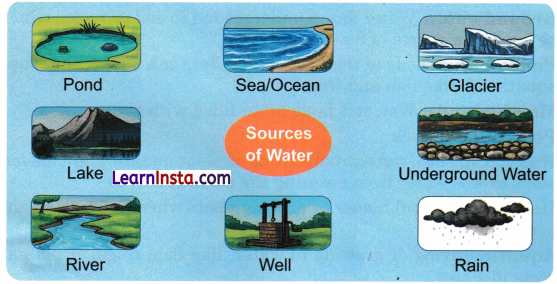
Where can we find freshwater? Identify the different freshwater sources from the images given below and write their names.

Answer:
We can find freshwater in all these water sources except sea/ocean.
Activity 2 (Page 6)
Take a steel glass. Put some ice cubes in it. Observe the small water droplets forming on the glass.

(a) Where do these water droplets come from?
Answer:
Water droplets form from water vapour present in the air. When the cold glass cools the surrounding air, the water vapour condenses into liquid droplets on the glass surface.
(b) What happens to the ice cubes after they are left in the glass for some time?
Answer:
The ice cubes melt and turn into liquid water because they absorb heat from their surroundings, changing from a solid to a liquid state.
(c) If we heat water, what will happen to it?

Answer:
When water is heated, it will turn into steam or water vapour, changing from a liquid to a gaseous state through evaporation.
In the above activity, what forms of water do you see?
Answer:
In the above activity, the forms of water observed are solid (ice cubes), liquid (melted water and droplets on the glass), and gas (water vapour in the air that condenses).
Observing Changes:

Answer:
| Activity | I Observe |
| Ice melting | Ice cubes in a glass turn into liquid water as they absorb heat from their surroundings. |
| Water boiling | When water is heated, it turns into steam or water vapour, rising as bubbles and escaping into the air as gas. The water level in the container decreases. |
| Water in sunlight for three days | Water in an open container slowly disappears as it evaporates into vapour due to the sun’s heat. Some water may remain if not fully evaporated. |
Activity 3 (Page 7)
- Take a transparent bag.
- Use a marker to draw the sun, clouds, trees and arrows on it as shown in the picture.
- Fill one-third of it with coloured water.

Tip: You can use blue paint or food dye for this.
- Seal the bag tightly to prevent any leaks.
- Place it in the sunlight.
- After a few hours, observe the changes inside the bag.

Answer:
| Activity | I Observe |
| Ice melting | Ice cubes in a glass turn into liquid water as they absorb heat from their surroundings. |
| Water boiling | When water is heated, it turns into steam or water vapour, rising as bubbles and escaping into the air as gas. The water level in the container decreases. |
| Water in sunlight for three days | Water in an open container slowly disappears as it evaporates into vapour due to the sun’s heat. Some water may remain if not fully evaporated. |
Activity 4 (Page 9)
- Take a transparent glass.
- Fill half of it with soil.
- Slowly pour water into the soil using a spoon.
- Observe what happens.

Answer:
My Observations:
- When water is poured into the soil, some water is absorbed by the soil, making it wet.
- Some water may pool on the surface if the soil pores are compact or saturated (completely full).
- Excess water may sink through the soil layers, mimicking how rainwater infiltrates the ground to become groundwater.
Activity 5 (Page 9)
Tick the image that will help in groundwater recharge.

Answer:

Activity 6 (Pages 10-11)

Question 1.
What did you observe about the mustard seeds?
Answer:
The mustard seeds roll down from the highest point of the slope, following the path of the folds, similar to how water flows downhill in a river.
Question 2.
Are they moving in a straight line, or do they spread out in different directions?
Answer:
The mustard seeds do not move in a straight line; they spread out in different directions, following the slopes and folds of the newspaper, just as water in a river follows the shape of the land.
Question 3.
Are they collecting in some areas? Do they gather like water gathers in lakes, rivers, and so on?
Answer:
Yes, the mustard seeds collect in lower areas or dips in the newspaper, similar to how water gathers in lakes, ponds, or rivers in low-lying land areas.
Discuss (Page 11)
On the basis of Activity 6 with mustard seeds, discuss how some rivers flow towards the Arabian Sea while some flow towards the Bay of Bengal.
Answer:
Rivers flow based on the slope and shape of the land, as shown by the mustard seeds moving down slopes. In India, the land slopes in different directions: rivers like the Narmada flow west toward the Arabian Sea because the land slopes westward, while rivers like the Ganges flow east toward the Bay of Bengal due to the eastward slope of the land.
Activity 7 (Page 13)
Follow the Flow!
In the map, you can see the rivers flowing in different directions. Some flow into the Bay of Bengal and some into the Arabian Sea.

Observe and fill in the table.

Answer:
| Name of the River | Moves towards the Bay of Bengal | Moves towards the Arabian Sea |
| Godavari | Yes | No |
| Narmada | No | Yes |
| Ganga | Yes | No |
| Kaveri | Yes | No |
| Krishna | Yes | No |
| Tapti | No | Yes |
Life in Water (Pages 14-15)
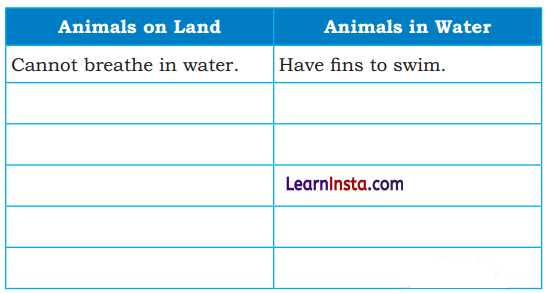
Complete the following table discussing with peers about the characteristics of animals on land and animals in water.
Answer:
| Animals on Land | Animals in Water |
| Cannot breathe in water. | Have fins to swim. |
| Have lungs to breathe. | Have gills to breathe. |
| Eat plants or other land animals. | Eat plants or other aquatic animals. |
| Have fur or mostly covered with hair. | Have smooth and shiny skin. |
| Have legs to walk. | Have tails to help them swim in water. |
| Birds build nests to lay eggs. | Lay eggs in coral reefs. |
Activity 8 (Pages 17-18)
Visit a local water body like a pond, lake or an aquarium with your teacher or parents, and observe life in and around the water body.
Question 1.
Based on your observations, complete the following table.

Answer:

Question 2.
Draw the plants that you saw during the visit and label them with their local name.

Answer:
| Types | Names | Local Name |
| Plants floating (above water) | Lily Hyacinth | Kumudini, Gulabi Pani Phool |
| Plants under water | Hydrilla,
Hornwart |
Jhanjhi, Jal Kaner |
| Plants whose roots are in the waterbed, but are seen above the water | Lotus, Arrowhead | Kamal, Teer- patra |
Activity 9 (Page 18)
1. Take a piece of paper and put a drop of water on it. Observe.
2. Colour the paper with a wax crayon. Now, put a drop of water on it. Do you observe any change?

Write your observation.
Answer:
1. The water drop is absorbed by the paper, causing it to spread and making the paper wet.
2. The water drops do not spread or get absorbed on the waxed paper. It stays as droplets on the surface because the wax creates a water repellent coating.
Activity 10 (Page 19)
Question 1.
Who Eats Whom? – A River Food Chain Game
- Distribute slips of paper to students. Each student writes what they choose to be (for example, small fish, big fish, frog, bird, human, crocodile, otter, etc.)
- Ask the students to think about what they eat, and who eats them.
- Use a string to connect the students who depend on each other for food.
- Discuss what would happen if one animal disappears (for example, what if all the fish are gone?).
Answer:
Students would do this activity in the class under the guidance of their teacher by following the given instructions.
What we eat, and who eats us: Small fish (e.g., mally, zebra fish) eat aquatic plants, big fish (e.g., Tuna, Shark) eat small fish, birds or crocodiles eat big fish, and humans may eat fish or other animals.
Question 2.
What happens if one animal disappears (e.g., all fish)?
Answer:
If all fish disappear, animals like birds, crocodiles, or otters that depend on fish for food would starve or need to find other food sources. This could disrupt the balance of the ecosystem, affecting other animals and plants, as some plants may overgrow without fish to eat them.
Let us reflect (Page 20)
Question 1.
Match the following:

Answer:
| Column A | Column B | ||
| (i) | Ocean water | (c) | Not fit for drinking |
| (ii) | Snow | (a) | Solid form of water |
| (iii) | Steam | (b) | Vapour form of water |
| (iv) | Rainwater | (d) | Freshwater |
Question 2.
Why do you think most of the water on Earth cannot be used for drinking or farming?
Answer:
Most of the water on Earth is ocean water, which is salty and not suitable for drinking or farming. Only a small amount of water, like rainwater or water in rivers and lakes, is freshwater and can be used for these purposes.
Question 3.
Large number of living beings live near water bodies. Why?
Answer:
Living beings live near water bodies because they need water to survive. Plants and animals depend on water for drinking, growth, and other life processes, and water bodies like ponds and rivers provide a habitat for aquatic life.
Question 4.
What would happen if it did not rain in your region for two years?
Answer:
If it did not rain for two years, there would be a drought, causing water shortages for drinking, farming, and other uses. Plants and animals would die, and people might face difficulties in getting enough food and water for their survival.
Question 5.
What do you think happens to rainwater in a forest compared to a city?
Answer:
In a forest, rainwater is absorbed by the soil and plants, helping them grow and recharging groundwater. In a city, rainwater often runs off cemented surfaces like roads and buildings, causing water logging or wastage instead of soaking into the ground.
Question 6.
Can you design a house or school that conserves water wisely? What would it include?
Answer:
A water-conserving house or school could include a rainwater harvesting system to collect and store rainwater, low-flow taps and toilets to reduce water use, and a garden with plants that need less water. It could also have a system to reuse waste water from washing clothes and utensils for flushing toilets and watering plants.
Question 7.
Let us make a fish by folding a piece of paper.

Answer:
Students to do it themselves by following the steps, shown in the images above.