These Class 7 Science Curiosity Worksheet and Class 7 Science Chapter 4 The World of Metals and Non metals Worksheet with Answers are excellent for board exam practice.
Class 7 Science Chapter 4 The World of Metals and Non metals Worksheet
Class 7 The World of Metals and Non metals Worksheet
Worksheet On The World of Metals and Non metals Class 7 – The World of Metals and Non metals Worksheet Class 7
A. Multiple-Choice Questions
Question 1.
Which of these is not a property of non-metals?
(a) Poor conductor
(b) Brittle
(c) Shiny
(d) Dull
Question 2.
Which of the following pairs contains only metals?
(a) Iron and Carbon
(b) Copper and Aluminium
(c) Sulphur and Mercury
(d) Oxygen and Zinc
Question 3.
Which non-metal is essential for life and found in proteins?
(a) Nitrogen
(b) Oxygen
(c) Carbon
(d) Sulphur

Question 4.
The question consists of an Assertion (A) and a Reason (R). Read the Assertion and Reason and choose the appropriate answer.
Assertion (A): Sulphur is used to make electric wires.
Reason (R): Sulphur is a poor conductor of electricity.
(a) Both A and R are true, and R is the correct explanation of A.
(b) Both A and R are true, but R is not the correct explanation of A.
(c) A is true but R is false.
(d) A is false, but R is true.
Question 5.
The question consists of an Assertion (A) and a Reason (R). Read the Assertion and Reason and choose the appropriate answer.
Assertion (A): Copper can be drawn into thin wires.
Reason (R): Copper is ductile.
(a) Both A and R are true, and R is the correct explanation of A.
(b) Both A and R are true, but R is not the correct explanation of A.
(c) A is true but R is false.
(d) A is false, but R is true.
B. State True (T) or False (F).
1. All metals are poor conductors of electricity.
2. Non-metals are usually soft and brittle.
3. Iron is a non-metal.
4. Copper and aluminium are used in electrical wiring.
5. Non-metals are sonorous and make a ringing sound when hit.
C. Fill in the blanks.
1. Non-metals are usually ____________ conductors of electricity.
2. ____________ is a metal that is liquid at room temperature.
3. The ability of a metal to be drawn into wires is called ____________
4. ____________ is a non-metal used in the production of fertilisers.
5. Non-metals are generally ____________ in appearance.
D. Assign one word to the following terms.
1. The property of metals that enables them to produce a ringing sound. ____________
2. A non-metal used to disinfect drinking water. ____________
3. The property of a material that allows it to be hammered into thin sheets. ____________
4. The ability of a material to allow heat or electricity to pass through it. ____________
5. A substance that cannot be broken down into simpler substances. ____________
E. Match the Columns.
Question 1.
Match the pictures given in Column I with their correct descriptions given in Column II.
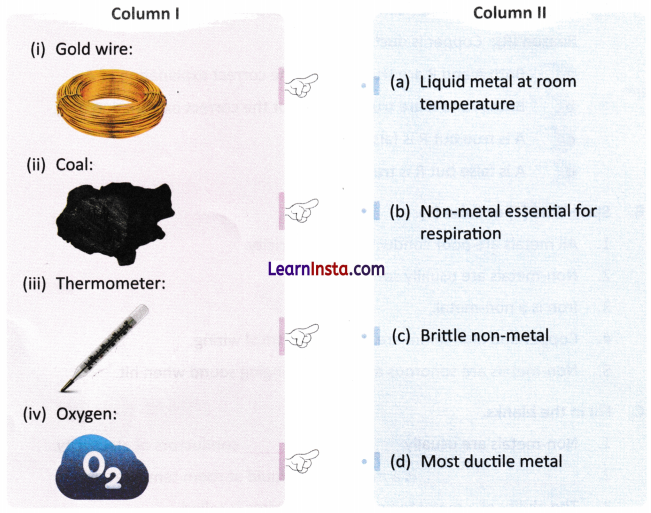
Question 2.
Match the properties given in Column I with their correct statements given in Column II.
| Column I | Column II |
| (i) Malleability | (a) Property of being drawn into wires |
| (ii) Brittle | (b) Property of being beaten into sheets |
| (iii) Lustre | (c) Property of being broken into pieces |
| (iv) Sonority | (d) Shiny appearance |
| (v) Ductility | (e) Produces a ringing sound when struck |
Wonder Why?
A. Give a reason for the following.
Question 1.
Coal is considered a non-metal.
___________________________________________________
___________________________________________________
Question 2.
Nitrogen is useful in our daily lives.
___________________________________________________
___________________________________________________
Question 3.
Only certain metals are suitable for making jewellery.
___________________________________________________
___________________________________________________
Question 4.
Materials like plastic, glass, wood, and rubber are not classified as metals or non-metals.
___________________________________________________
___________________________________________________
Question 5.
Sodium metal is stored in kerosene instead of being exposed to water or air.
___________________________________________________
___________________________________________________
B. Read the paragraph and answer the following questions.
After the rainy season, Aryan noticed that the iron fence around his garden had developed brown patches. His science teacher explained that this happens when iron reacts with both air and water, a process called rusting. Aryan wondered if painting the fence would help.
Question 1.
What are the two essential conditions needed for rusting?
___________________________________________________
Question 2.
What is the brown substance forming on the fence called?
___________________________________________________
Question 3.
How can Aryan prevent the fence from rusting in the future?
___________________________________________________
Question 4.
Would a gold or silver fence rust the same way as iron? Explain.
___________________________________________________
C. Look at the given properties and put them into the correct columns in the table.
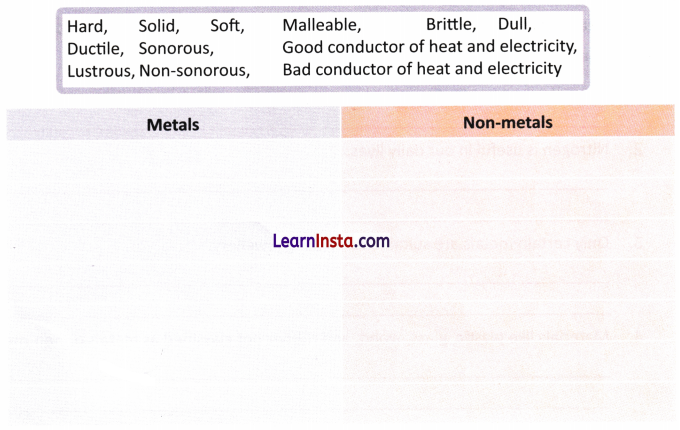
Learn By Doing
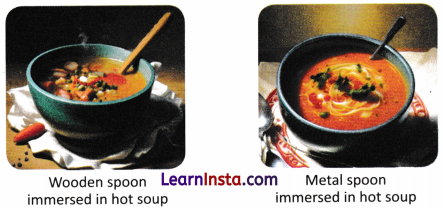
A. Two children, Riya and Arjun, are excited to have hot soup on a chilly evening. Riya picks up her soup with a metal spoon, and Arjun uses a wooden spoon. They both leave their spoons resting in the soup for a few minutes while talking. After a few minutes, they both reach to grab their spoons.
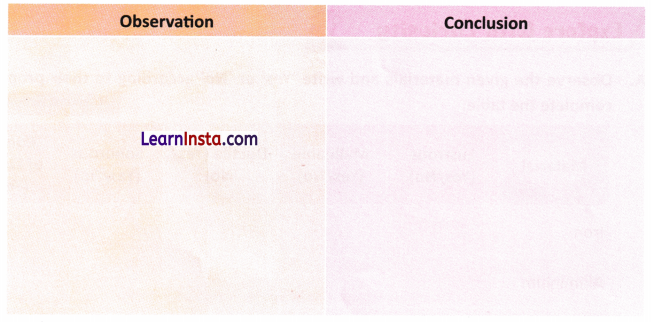
Observe and record your findings in the table provided.
- Which spoon feels hotter?
- What does this tell you about the transfer of heat in metal and wood?
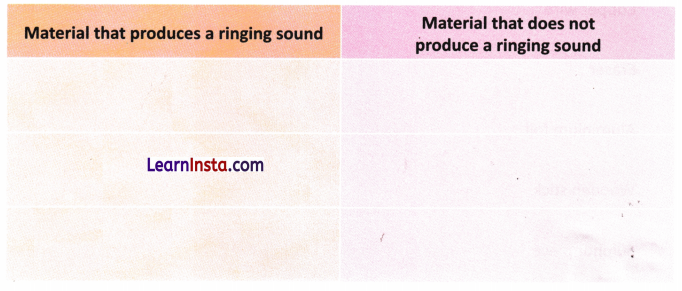
B. The following activity describes an experiment to test the sound-producing ability of different materials. The required materials for this activity are listed below. Follow the steps carefully and record your observations in the table provided.
Materials: Metal spoon, pencil, coin, piece of chalk, eraser, etc.
Steps to follow:
- Drop each item gently on the floor, one at a time.
- Observe and analyse:
- Which materials produce a ringing sound?
- What do we call the property that allows some materials to make ringing sounds?
Observation:
Explore With Curiosity
A. Observe the given materials and write ‘Yes’ or ‘No’ according to their properties to complete the table.
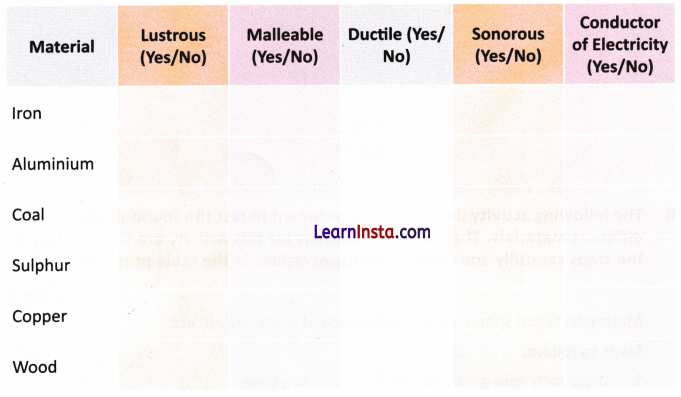
B. Observe the given materials and write ‘Yes’ or ‘No’ according to their properties to complete the table.
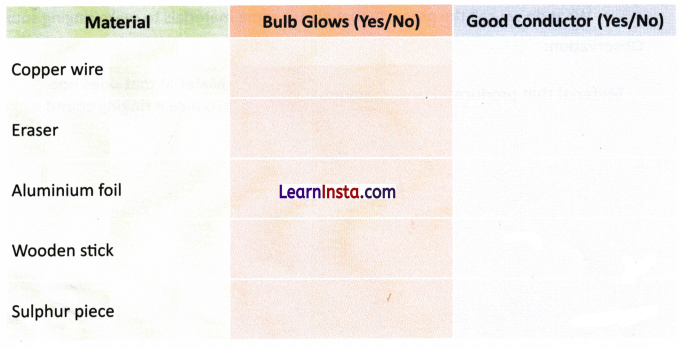
C. Which of the following materials would you choose to make electrical wires and why?

___________________________________________________
___________________________________________________
___________________________________________________
D. An electrician is repairing a switchboard without gloves and gets a shock. What mistake did he make, and how could it have been avoided?
___________________________________________________
___________________________________________________
___________________________________________________
E. What happens when magnesium and sulphur are burned in air? How do the products formed by their reaction with oxygen differ in nature?
___________________________________________________
___________________________________________________
___________________________________________________
F. Three iron nails are placed separately in containers filled with cooking oil, tap water, and lemon juice. Which of these nails is least likely to rust, and what is the reason?
___________________________________________________
___________________________________________________
___________________________________________________
G. Iron pipes are often protected from rusting by applying a coating of paint. Since clay also forms a dry, solid layer, can it be used to protect iron from rusting in the same way? Justify your answer.
___________________________________________________
___________________________________________________
___________________________________________________
Word Puzzle
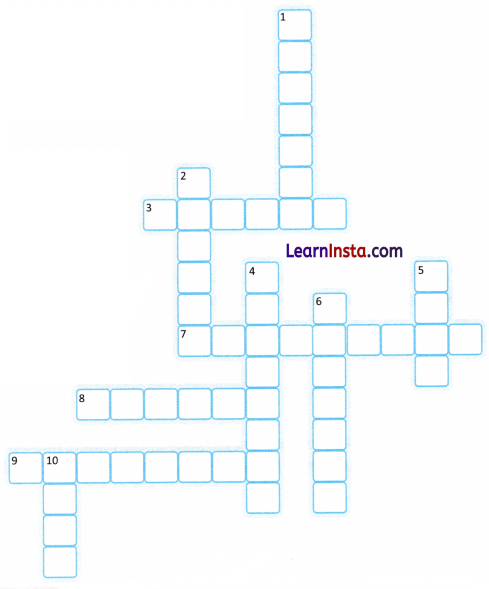
Complete the crossword with the help of the given clues.
ACROSS
3. A metal used in making electrical wires
7. A substance that can be hammered into thin sheets
8. A metal that is used for decorating sweets
9. A non-metal that is used in making fertilisers
DOWN
1. A substance that can be drawn into wires
2. A metal that is highly reactive and kept in kerosene
4. A non-metal that is used in water purification
5. A metal that is used in making jewellery
6. A metal that is liquid at room temperature
10. A metal that rusts when exposed to moist air
Activities
A. Take a map to explore metal-producing areas and traditional crafts. Mark regions where important metals are found, such as iron in Jharkhand, and bauxite in Odisha. Also, show metal art forms like Dhokra in Chhattisgarh, Bidri in Karnataka, and Tanjore in Tamil Nadu.
B. Divide the class into two teams to have a fun debate to learn about metals and non-metals. Each student will act as an element like copper, iron, oxygen, or sulphur. One by one, students will talk about their uses and their properties.