Students often prefer our concise Class 5 English Santoor Worksheet and Class 5 English Chapter 3 The Rainbow Worksheet with Answers Pdf for quick practice.
Class 5 English Chapter 3 The Rainbow Worksheet with Answers
Class 5 English The Rainbow Worksheet
Class 5 English Chapter 3 Worksheet – Class 5 The Rainbow Worksheet
Word Castle
- Sail – To move on water
- Bow – Here, it refers to the rainbow
- Overtops – Rises above or goes over the top of something
- Bridges – Structures built to cross over rivers, roads, or other obstacles
- Prettier – More beautiful
- Heaven – The sky or the place above the earth
Let us Start
A. Answer the following.
Question 1.
What is the nature of the poem, The Rainbow’?
_____________________________________
Question 2.
Why does the poet appreciate the rainbow?
_____________________________________
Question 3.
Why does the poet refer to the rainbow as a ‘road to heaven’?
_____________________________________
Question 4.
What does the poet try to explore in the poem?
_____________________________________
Question 5.
State whether the following are True or False.
(a) The rainbow is a natural wonder.
(b) Boats sail on the river.
(c) The rainbow can overtop man-made bridges.
(d) The poet likes only man-made things.
(e) The rainbow like a bow bridges heaven.
B. Think and discuss.
Question 1.
What would people use to cross rivers if there were no bridges over them?
_____________________________________
Question 2.
Why do you think the rainbow is an exciting thing for children?
_____________________________________
Question 3.
How does a rainbow influence children’s view?
_____________________________________
Question 4.
What happens when you walk towards a rainbow?
_____________________________________
Question 5.
Why do you think the poet compares a rainbow to a bridge only?
_____________________________________

Word Power
A. Jumbled letters
Rearrange the jumbled letters of each word given in the table to form a meaningful word.
| Jumbled words | Meaningful words |
| 1. Nomth | |
| 2. Tobms | |
| 3. Logfs | |
| 4. Tirwl | |
| 5. Flower | |
| 6. Matel | |
| 7. Boeny | |
| 8. Byoned | |
| 9. Msicu | |
| 10. Sootd |
B. Match the following correctly.
| 1. A ranged weapon system consisting | (i) a ship |
| 2. a structure built across a river | (ii) clouds |
| 3. the visible mass of water droplets | (iii) a boat |
| 4. a large vessel that travels around | (iv) a bridge |
| 5. a vehicle used to travel on water | (v) a bow |
Learn Grammar
Common Simile
The use of ‘as ……………. as’.
The structure ‘as …………… as’ is used to make comparisons, specifically
when we state that two things are equal in some way. We can say to indicate similarity between two things. The blank space is filled with an adjective or adverb, and the two “as” parts act as comparators.
Structure: as + adjective/ adverb+ as
For example:
1. As pretty as a flower
2. As white as ice.
Now, complete the blanks with suitable comparators given in the box.
| butterfly, wool, peacock, baby, hare, silk, honey, bell, grass, clock |
1. As proud as a
2. As regular as a
3. As beautiful as a _____________
4. As sweet as _____________
5. As weak as a _____________
6. As warm as _____________
7. As sound as a _____________
8. As smooth as _____________
9. As timid as a _____________
10. As soft as _____________
Let us Speak
Recite the poem given below in three ways:
(a) In a happy voice
(b) In an angry voice
(c) In a surprised voice
Flowers
Some men never think of it,
You did, you’d come along
And say you’d nearly brought me flowers
But something had gone wrong.
The shop was closed. Or you had doubts—
The sort that minds like ours
Dream up incessantly. You thought
I might not want your flowers.
It made me smile and hug you then.
Now I can only smile.
But, look, the flowers you nearly brought
Have lasted all this while. – Wendy Cope
Let us Listen
Read aloud the following words. Give three rhyming words for each word as indicated.
| Height Float Taller Laugh Rent Cave Jump Weight High Bake |
Bite Wrote Dollar Graph Spent Gave Pump Late Why Cake |
Let us Write
Simple Past Tense
Simple Past Tense describes actions or states that were completed in the past. It is formed by adding ‘-ed’ to the base form of regular verbs (like ‘walk’ becoming ‘walked’), but irregular verbs have unique past tense forms that need to be memorized (like ‘go’ becomes ’went’, ‘see’ becomes ‘saw’, etc.).
Uses:
- To talk about actions that happened at a specific time in the past.
Example: I ate breakfast this morning. - To describe past routines or habits.
Example: He lived in Paris for five years.
Negative sentences:
Use ‘did not’ (or the contraction ‘didn’t’) + the base form of the verb. Example: I didn’t go to the party.
Questions:
Use ’Did’ + subject + the base form of the verb.
Example: Did you see the movie?
Write a short paragraph of 80-100 words about your experiences with your classmates and teacher in class 4.
_____________________________________
_____________________________________
_____________________________________
_____________________________________
B. Compound Nouns
Compound nouns are nouns made of two or more nouns. These nouns have individual meanings, but when they are combined to form compound nouns, their meaning get changed.
For example:
Electric + shock = electric shock
Door + locker = door locker
Now, complete the blanks to form new words. You may take help from the words given in the box.
| Cloth, paper, way, store, office, watch, cover, top, word, stroke |
1. sun + _____________ = _____________
2. book + _____________ = _____________
3. wrist + _____________ = _____________
4. post + _____________ = _____________
5. table + _____________ = _____________
6. tree + _____________ = _____________
7. high + _____________ = _____________
8. news + _____________ = _____________
9. pass + _____________ = _____________
10. pen + _____________ = _____________
Now, use all the new words you have formed in your own sentences.
1. _____________________________________
2. _____________________________________
3. _____________________________________
4. _____________________________________
5. _____________________________________
6. _____________________________________
7. _____________________________________
8. _____________________________________
9. _____________________________________
10. _____________________________________
C. Many words in the English language function as both nouns and verbs.
For example:
| Word | Noun | Verb |
| Walk | I went for a walk. | I will walk to the store. |
| Jump | He made a jump for the ball. | The frog will jump into the pond. |
Use the following words first as a noun and then as a verb.
1. set
2. help
3. work
4. beat
5. dance
6. cook
7. paint
8. drink
9. rise
10. cut
Sentences:
1. Set (Noun) _____________________________________
(Verb) _____________________________________
2. Help (Noun) _____________________________________
(Verb) _____________________________________
3. Work (Noun) _____________________________________
(Verb) _____________________________________
4. Beat (Noun) _____________________________________
(Verb) _____________________________________
5. Dance (Noun) _____________________________________
(Verb) _____________________________________
6. Cook (Noun) _____________________________________
(Verb) _____________________________________
7. Paint (Noun) _____________________________________
(Verb) _____________________________________
8. Drink (Noun) _____________________________________
(Verb) _____________________________________
9. Rise (Noun) _____________________________________
(Verb) _____________________________________
10. Cut (Noun) _____________________________________
(Verb) _____________________________________
D. Write the opposites of the following words. Your answer must begin with a ‘B’.
1. girl × _____________
2. good × _____________
3. end × _____________
4. front × _____________
5. small × _____________
6. above × _____________
7. sweet × _____________
8. foreground × _____________
9. forward × _____________
10. after × _____________
Now, make sentences using the words that you have written in the blanks.
1. _____________________________________
2. _____________________________________
3. _____________________________________
4. _____________________________________
5. _____________________________________
6. _____________________________________
7. _____________________________________
8. _____________________________________
9. _____________________________________
10. _____________________________________
E. You might have eaten or seen these food items. What colours are they? Write them in the column. What do you call them in your mother tongue?
| Items | Colours | Names in mother tongue |
| 1. Peach | ||
| 2. Pomelo | ||
| 3. Acai berry | ||
| 4. Muskmelon | ||
| 5. pear | ||
| 6. Kiwi | ||
| 7. Dates | ||
| 8. Walnut | ||
| 9. Plum | ||
| 10. Tamarind |
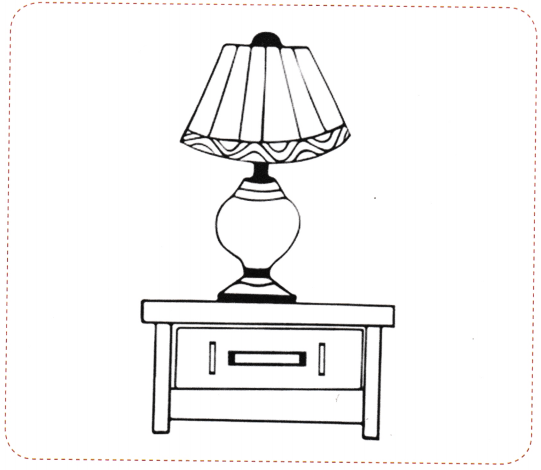
F. Design and Colour a table lamp.
Let us Practise
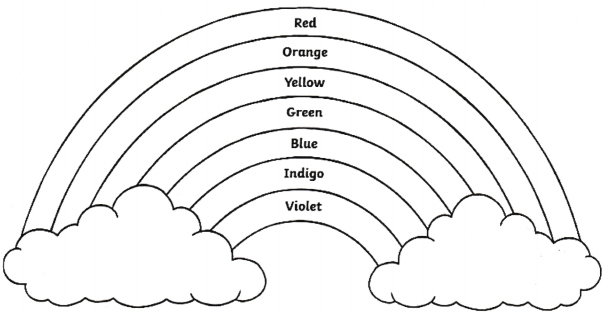
Colour the picture of a rainbow with different colours as given.
Learn with Fun
A. Make a list of different types of trees. Collect pictures and information about the listed types of trees. Make a presentation to depict the differences among them.
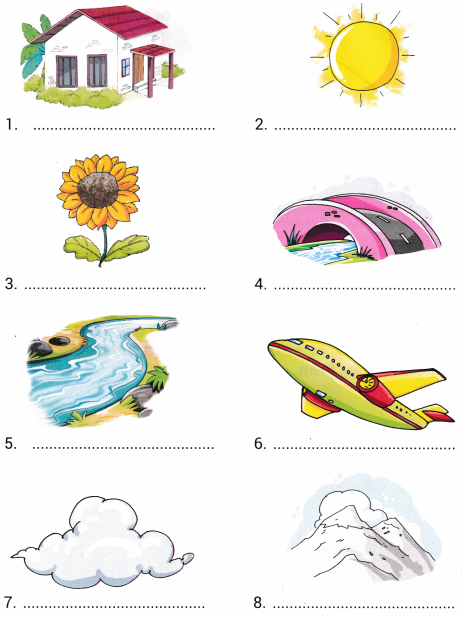
B. Write whether the following things are man-made or natural things.