The Kites Class 6 Questions and Answers
The Kites Question Answer Class 6 English Poorvi Chapter 14
Let us do these activities before we read (Page 141)
Question 1.
Answer the following questions and share
them with your teacher and classmates.
(a) Have you ever flown a kite or seen someone fly it? Where? When?
(b) Describe the kite—colour(s), shape, design of tail, any other detail.
(c) What did you think when you saw the kite up in the sky?
Answer:
Classroom activity.
Question 2.
Search the internet for videos on Kite Festivals and watch them with your teacher and classmates.
(a) Share the things with your teacher that you saw and what the people were doing.
(b) Would you like to participate in this kind of festival? Why?
(c) What kind of kite would you like to fly?
Answer:
Classroom activity.

Question 3.
Look at the picture and complete the sentences. Share your responses with your teacher.
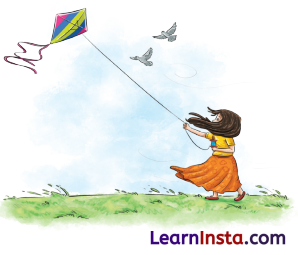

(a) I can see ____, ____ and ___ in the picture.
(b) The weather in the picture is ___.
(c) The kite is ___ high in the sky.
(d) The child is ___ from below.
(e) The tail of the kite ____.
Answer:
(a) sky, kite, birds
(b) windy
(c) flying
(d) looking
(e) has ribbons
Question 4.
Now, think and answer.
(a) List two more things that you want to add to the picture.
(b) If I were the child, I would ……….
(c) If I were the kite, I would ………
Answer:
Do it yourself.
Let us discuss (Page 143)
Question 1.
Read the poem silently. As you read, mark the given statements as True or False.
| Statements | T/F |
| (a) The child is looking at the kites. | |
| (b) The kites look like birds of different colours. | |
| (c) It was a rainy day. | |
| (d) The child wants to be like a kite. | |
| (e) The child wishes to climb on a kite. | |
| (f) The kite is made of cloth and plastic. | |
| (g) The child wants to ride the kite. | |
| (h) The child knows they would have fun. , | |
| (i) The child wants to look at the kite from a rooftop. | |
| (j) The child would like to look at people down below. | |
| (k) The child knows that the people would stare. |
Answer:
(a) – True
(b) – True
(c) – False
(d) – True
(e) – True
(f) – False
(g) – True
(h) – True
(i) – True
(j) – True
(k) – True
Question 2.
Complete the following sentences.
(a) The poet says that the kites are like coloured birds –
See the kites fly/Like coloured birds in the sky.
The kites have been compared to b __ ___ __ __
because they ____.
(b) The child wishes to be like air -I wish I were small/And as light as air. ‘
The child wishes to be as l __ ___ ___ t as __ ___ ___. The child wishes this to be able to c __ ___ m _ on a kite and fly.
Answer:
(a) The kites have been compared to -birds- because they fly like- colourful birds – in the sky.
(b) The child wishes to be as -light- as air. The child wishes this to be able to -climb- on a kite and fly.
The poet uses simile in (a) and (b) to compare the kites with coloured birds and the quality of being light as air. The poet uses like’ and ‘as’ to compare.
Do you think that the use of simile in this poem helps us imagine better when we read the poem? Share your thoughts with your teacher and classmates.
Answer:
Classroom activity.
Question 3.
Find a set of words from the poem that begin with the same consonant sound.
Stanza 1
(a) Which consonant sound do both words begin with?
Answer:
The words, Wind and whipped’ begin with the same consonant sound.
Stanza 3
(b) Which consonant sound do both words begin with?
Answer:
The words, “wish and were’ begin with the same consonant sound.
This is called alliteration. For example, big bright blue bag, funny fan, etc.
Create 4 other sets of words using alliteration.
Answer:
Do it yourself.
Question 4.
In the last stanza, the two words that-the poet repeats are ___, ___ to tell us that the kite is flying __ ___ ___ y high.
Answer:
In the last stanza, the two words the poet repeats are – high and high- to tell us that the kite is flying -very- high.
Question 5.
Study each stanza and underline the rhyming words from’the end of each line. Also, circle the end words in the stanzas that do not rhyme.
Answer:

Let us Think and reflect (Page 144)
Question 1.
Read the given lines from the poem and answer the following questions.
What fun it would be
To look right down,
Over the park
And the rooftops of town.
(a) Circle the word that does not share the same feeling as ‘fun’: joy, excitement, care, happiness.
Answer:

(b) Which line tells us that the poet was somewhere above?
Answer:
The line, ‘to look right down’, tells us that the poet was somewhere above.
(c) Choose the scene the child saw.

Answer:
(ii)
Question 2.
Answer the following questions.
(a) How does the poet describe the kites in the first two lines?
Answer:
In the first two lines, the poet likes the kites very much. They are flying high in the windy sky. The poet compares the kites with the colourful birds. He desires if he would be small and light as air. Then, he would climb on one of the kites and walk in the sky.
(b) Why does the child say that they have to climb a tree first to get onto the kite?
Answer:
The child is small. He could not reach the kite. If he climbs a tree, he could get onto the kite. Thus, the tree would help the child to get onto the kite.
(c) What are the songs that the child hears when flying atop the kite?
Answer:
When flying atop the kite, the child hears the songs that the wild sings. These songs are full of joy and happiness.
(d) Why did the people look up at the child and stare? If you looked up and saw that, what feelings would you have?
Answer:
People looked up at the child and stared because the child was flying with the kite above the ground. I would wish if I were the child.
(e) If you were the kite carrying the child high up in the air, what would you tell them?
Answer:
If I were the kite carrying the child high up in the air, I would tell them that freedom is the greatest gift of God. We should face the challenges of life with courage and determination. Our success lies in fighting with the hardships.
Let us learn (Page 146)
Question 1.
Look at the picture of the kite and read what some of its parts are named. Now, use some of these words to complete the paragraph given below.

Now, complete the given conversation by filling the blanks with some ‘parts of a kite’ words from above.
Bina : I love the long yellow t __ __ ___ at the end of my kite. What colour is your kite?
Saroj : My kite’s c __ __ ___ ___ is pink. The s __ __ __ __ e is black.
Bina : Oh wonderful! My kite l __ __ __ is red. The r __ __ l that wraps it is green. I really like it.
Saroj : My kite line is red too. The tip of my kite has a blue __ __ ___ e.
Bina : Beautiful! Let’s go and fly our pretty kite.
Answer:
-tail, cover, spine, line, reel, nose
Question 2.
Let us create a poem using words in a kite!
| The first line is the subject. Keep this to one word. Use a noun | kite |
| The second line is two describing words for the noun. | pretty, colourful |
| Line three includes three action words. | flying, floating, soaring |
| Line four uses two words that describe the action words. | quickly, happily |
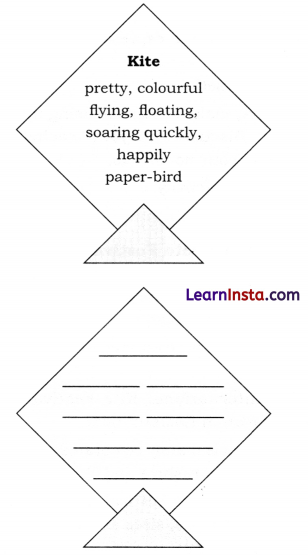
This is called a cinquain poem. It is a five line poem that describes a person, a place or a thing.
Now, create a cinquain poem yourself on anything you like.
Answer:
Do it yourself.
Question 3.
The poet uses the word ‘fly’ and ‘drift’ to tell us about the kite’s movement.
(a) Circle the words that match with the ‘drift’ movement. You can choose more than one word.

Answer:
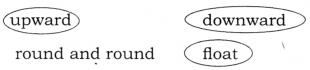
(b) Study some other words about the kite’s movement and share what type of movement they show. You can look at (a) for the type of movement.

Answer:
upward- soar, round and round- circle, downward- dive, float- glide
Question 4.
The poet had used expressions like—
up in the air; look right down; stay up there; stand and stare
(a) Read how these expressions are used in the poem.
Answer:
Do it yourself.
(b) In pairs, make sentences using these expressions. Discuss with your teacher and then write in your notebooks.
Answer:
Classroom activity.
Let us listen (Page 148)
Listen about the Kite Festival in India. As you listen, circle the words that are not correct. Then, listen again and write the correct words. (refer to page 163 for transcript)
(a) Kite Festival is celebrated during the month of June.
(b) The International Kite Festival is named Uttarayan in Eastern India.
(c) Uttarayan is mainly celebrated in Gujarat, but also in Maharashtra and Telangana.
(d) During the Kite Festival, we can see kites of different shapes, sizes and colours.
(e) In Karnataka, the Tourism Department organises the kite festival every year.
(j) The Punjab region celebrates Basant Panchami and Baisakhi by flying kites.
(g) People of India also enjoy flying kites on Earth Day.
Answer:
Circled words- June, Eastern, Maharashtra, Earth
Correct words-January, Western, Rajasthan, Independence
Let us speak (Page 149)
Share a kite-flying experience with your classmates. If you have not flown a kite yet, share an experience of watching kites fly. Give details- where? When? Why? How? Speak in complete sentences.
Answer:
Do it yourself.
Let us write (Page 149)
Question 1.
Imagine yourself as a kite. In pairs, first discuss all the following hints.
- What shape of kite are you? What colours do you have? What other parts of yourself are you happy about?
- Where are you? Who do you belong to? What activities do you do? Who are your friends?
- Do you have any message for humans?
Answer:
Do it yourself.
Question 2.
Now, write a paragraph of about 100 words, with the title – I am a kite.
Answer:
I am a kite. I am found in different shapes, sizes and colours. I fly high in the sky. People fly me on different occasions. It is a joy flying like birds in the open sky. Like you, I have different parts such as nose, spine, cover, tail, kite line, etc. Like me, your goals in life must be on your topmost priority and you must be focused towards your goal in life.
Let us explore (Page 149)
Question 1.
The mention of kites exists in ancient Indian texts. It can be found in the poetry of the thirteenth-century Marathi saint and poet, Namadeva. In his poems or gathas, he called a kite a gudi, and there is a mention that the kites were made from kaagad (paper).
Question 2.
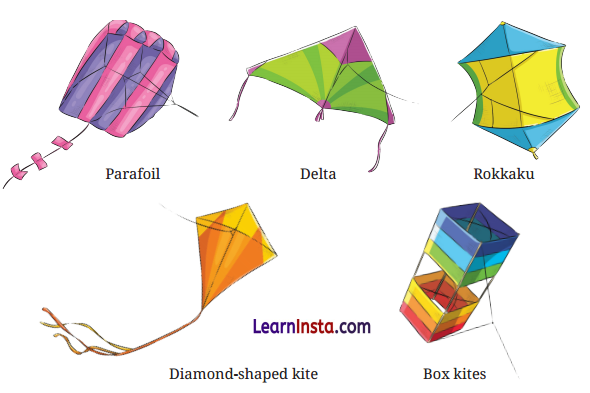
Have a look at some or the different types of kites. Choose which one is commonly seen.
Answer:
The steps to make a kite:
- Gather materials like paper, gum, thread and 2 or 3 strings.
- Fold the paper in half widthways.
- Bend the front comer of the top layer down so that it may touch the crease. Reapeat on the back layer and staple it.
- Make a hole near the front of the crease.
- Thread the string through the hole and tie it off.
- go and fly your kite!
(b) Follow the steps and create your own kite. Get it to school to show your teacher and classmates.
Answer:
Do it yourself.
(c) Write a message on the kite. For example: Happy Independence Day!
Answer:
You can write the message like- Everybody likes freedom.