Experts have designed these Class 8 Science Notes Chapter 2 The Invisible Living World: Beyond Our Naked Eye Class 8 Notes for effective learning.
Class 8 Science Chapter 2 The Invisible Living World: Beyond Our Naked Eye Notes
Class 8 The Invisible Living World: Beyond Our Naked Eye Notes
Class 8 Science Chapter 2 Notes – The Invisible Living World: Beyond Our Naked Eye Notes Class 8
→ The human eye can only see objects that are larger than a certain size.
→ Lens: A lens is a curved piece of glass or plastic that bends light to make objects appear larger or clearer. It was named after a lentil seed because of its shape that is thicker in the middle and thinner at the edges.

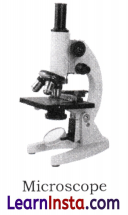
→ Microscope: A microscope is a tool that uses lenses to magnify tiny objects, allowing us to see details not visible to the naked eye.
→ Organisms: All living things, whether plants or animals, are known as organisms.
→ Microbiology: The study of tiny organism that are invisible to the unaided eye, is called microbiology. Antonie van Leeuwenhoek is called the Father of Microbiology. He was the first person to clearly see and describe tiny living things like bacteria and blood cells.
→ Cell: All living beings are made up of cells. These have three main parts:
- Cell Membrane: The cell membrane is a thin, porous layer that surrounds the cell. It encloses the cytoplasm and nucleus, and separates one cell from another. It controls the entry of essential materials and the exit of waste.
- Nucleus: It is a round structure located in the middle of the cell. It regulates all activities that occur within the cell. It also regulates growth.
- Cytoplasm: It contains other components of the cell and compounds, such as carbohydrates, proteins, fats, and mineral salts. Most life processes take place in the cytoplasm.
→ Cell Wall: It is a strong, outer covering found only in plant cells. It provides rigidity and strength to plants.
→ Difference between Plant and Animal Cells:
- Plant Cells: These have rigid cell wall with a rectangular shape. They have plastids likechloroplast, contain chlorophyll. Vacuole present in plant cells helps them store important substances, get rid of waste, and maintain cell shape.
- Animal Cells: The cell wall and plastids are absent. The shape is usually round. Vacuoles are either absent or small to store certain substances dissolved in water.
→ Variation in Shape and Structure of Cells: The unique shape, size, and structure of cells help them carry out their specific functions.
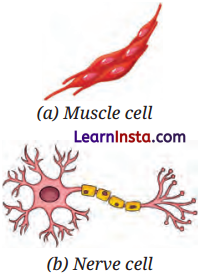
- Muscle Cell: A muscle cell is shaped like a spindle. Muscle cells present in the food pipe contract and relax in a wave-like motion, which helps the food push down the food pipe (oesophagus) to the stomach. Muscle cells in the stomach wall help churn the food.
- Nerve Cells (Neurons): They have elongated shape and branched structure that help them reach different parts of the body and pass on messages quickly.
→ Levels of Organisation: Living organisms are made in a step-by-step structure, from the smallest part (cell) to the entire body (organism). This is called the levels of organisation.
Cell → Tissue → Organ → Organ system → Organism
→ The yolk of an ostrich egg is the largest single cell in the world. The egg has a shell for protection and white liquid that feeds the yolk.
→ Microorganisms/Microbes: Tiny living organisms that are too small to be seen with the naked eye are known as microorganisms or microbes. They are of two types on the basis the of cellular structure:
- Unicellular Organisms: They are made up of a single cell that performs all life functions (e.g., Amoeba, bacteria).
- Multicellular Organisms: They consist of many cells with specialised functions (e.g., humans, fungi, some algae).
→ Pond water consist of many microorganisms such as Amoeba, Paramecium, Algae, etc.
→ Soil suspension are full of microorganisms such as fungi, bacteria, algae, etc.
→ Virus: Viruses are microscopic and acellular, but are not considered microorganism. A virus always multiplies in a host cell, either of a plant or an animal. They may infect plants, animals, or bacterial cells and may cause a disease.
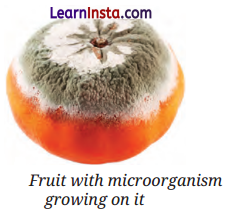
→ Microbes such as bacteria and fungi spoil raw or cooked food.
→ Pickles and murabbas are prepared with spices, sugar and salt, which act as preservatives. The high concentration of salt or sugar do not allow these organisms to grow.
→ Microbes as Environment Cleaner: Some microorganisms, like fungi and bacteria, act on the plant waste and slowly break it down into simpler, nutrient-rich manure. It is added to the soil to help plants grow better. Microorganisms also decompose bodies of dead animals. So, microbes help recycle the waste and return important nutrients to nature.
→ Our Scientific Heritage: Ancient Indian texts, especially the Vedas, mention the word ‘Krimi’, which means tiny creatures-both visible (Drishya) and invisible (Adrishya). These texts describe their good and bad effects. The Atharvaveda also refers to ‘Krimi’.
→ Microbes as a Source of Biogas: Many microorganisms, like bacteria and fungi, live in oxygen-free environments. They decompose plant and animal waste, releasing a mixture of gases like carbon dioxide and a high amount of methane. Methane is used as a fuel for cooking, heating, generating electricity, and run vehicles.
→ Patent: A patent is a copyright given to an inventor for a new idea, product, or invention. It means no one else can make, use, or sell that invention without the inventor’s permission.
→ Microbes and Food:
- Yeasts: This is a type of unicellular microorganism called fungi, that is used to make bread and cakes. It grows well in warm conditions. Yeast respires and breaks down food to get energy. This process releases carbon dioxide, which forms bubbles and makes the dough soft and fluffy.
- Lactobacillus: This bacterium also grow well in warm conditions. It is used in the curd formation at home and fermentation of batter for making idli and dosa, and dough for making bhatura.
→ Microbes as Natural Fertiliser: Bacteria like Rhizobium help increase soil fertility by trapping nitrogen from the air and making it useful for the plants which reduces the use of chemical fertilisers.
→ Tiny Helpers in Water: Microalgae are tiny, plant-like organisms found in water, soil, air, and on trees. They make food by using sunlight and release oxygen, contributing over half of Earth’s supply. For example, Spirulina, Chlorella, and Diatoms, serve as food for aquatic animals and are used by humans in as health supplements, medicines, water purification, and biofuel.
→ Cell-The Basic Unit of Life: The body of all living organisms are made up of tiny building blocks called cells. A single cell contains various components that help organisms perform various functions.
→ Cells of microorganisms are surrounded by a cell membrane. Fungal cells also have a cell wall but lack chloroplasts, so they cannot make their own food through photosynthesis.
Unlike other cells, bacteria do not have a well-defined nucleus and nuclear membrane. They consist of nucleoid. This feature distinguishes bacteria from cells of yeast, protozoa, algae, fungi, plants, and animals.
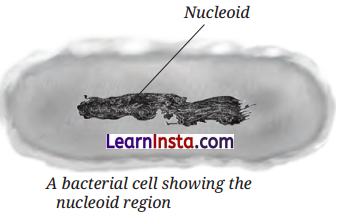
→ Electron Microscope: An electron microscope is a powerful scientific tool that uses electrons instead of light to view very tiny objects. It magnifies the cell about 10,00,000 times, where we can see more structures present in a cell.