Students rely on Class 8 Science Extra Questions and Class 8th Curiosity Chapter 2 The Invisible Living World: Beyond Our Naked Eye Important Extra Question Answer to improve their grades.
Class 8 Science Chapter 2 The Invisible Living World: Beyond Our Naked Eye Extra Questions
Class 8 Science Chapter 2 Extra Questions on The Invisible Living World: Beyond Our Naked Eye
The Invisible Living World: Beyond Our Naked Eye Class 8 Very Short Question Answer
Question 1.
Can microorganisms be seen with the unaided eye? If not, how can they be seen?
Answer:
Microorganisms cannot be seen with the unaided eye. They can be seen with the help of a microscope.
Question 2.
What are the different categories of microorganisms?
Answer:
Microorganism can be categorised into protozoa, fungi, bacteria, some algae, and more.

Question 3.
Which bacteria trap nitrogen from the air and make it useful for the plants?
Answer:
Rhizobium bacteria trap nitrogen from the air and convert it into a form that plants can use.
Question 4.
Name two habitats of microorganisms.
Answer:
- Soil
- Water
Question 5.
What do you understand by viruses?
Answer:
Viruses are microscopic and acellular organisms that reproduce only inside the cells of host organisms.
Question 6.
Name any two microorganism that are found in pond water.
Answer:
- Amoeba
- Paramecium
Question 7.
Why do microorganisms not infect pickles?
Answer:
Microorganisms do not infect pickles because spices, salt, and sugar added to pickles act as preservatives. The high concentration of salt or sugar prevents the growth of these microorganisms.
Question 8.
Name one commercial use of yeast. (NCERT Exemplar)
Answer:
Yeast is used in the baking industry to make bread soft and spongy.
Question 9.
What is yeast?
Answer:
Yeast is a single-celled fungus that helps in the process of fermentation.
Question 10.
I saw that my mother added a little curd to warm milk to set curd for the next day. Why does she do so?
Answer:
Curd contains a bacterium called Lactobacillus, which feeds on the sugar in the milk (lactose), multiplies, and ferments the milk to form curd.
The Invisible Living World: Beyond Our Naked Eye Class 8 Short Question Answer
Question 1.
List the usefulness of microorganisms in our lives.
Answer:
The uses of microorganisms in our lives are:
- Microorganisms like Lactobacillus bacteria help in the preparation of curd, while yeasts are used in making bread and cake.
- Yeasts are also used for the commercial production of wine and alcohol.
- Some microorganisms act as a natural cleaning agents and decompose the waste products into manure.
- They break down the dead plants and animals bodies by decomposing them.
- They increase soil fertility by capturing nitrogen from the air and converting it into a form that plants can use.
Question 2.
Why do farmers grow legumes in crop rotation?
Answer:
Farmers grow legumes in crop rotation to increase nitrogen naturally in the soil and keep the soil healthy for the next crop.
Question 3.
How do microorganisms act as a cleaning agent of nature?
Answer:
Microorganisms help clean the environment by decomposing organic wastes such as vegetable peels, dead plants, and animal remains. They break down them into harmless and useful substances, which return nutrients to the soil.
Question 4.
Explain the formation of curd from the milk.
Answer:
The Lactobacillus bacterium causes the formation of curd. When a small amount of curd is added to warm milk, these bacteria begin to multiply. They convert the milk sugar (lactose) into lactic acid. The lactic acid causes the milk proteins to thicken and curdle, turning the milk into curd. Warm temperature speeds up this process, which is why curd forms faster in warmer conditions.
Question 5.
What is the role of yeast in the baking industry?
Answer:
Yeast plays an important role in the baking industry. Yeast reproduces rapidly and produces carbon dioxide during respiration. Bubbles of the gas makes the dough soft, fluffy and increase its volume. This is the basis of the use of yeast in the baking industry for making breads, pastries and cakes.

Question 6.
What will happen to ‘pooris’ and ‘unused kneaded flour’ if they are left in the open for a day or two? (NCERT Exemplar)
Answer:
If the unused kneaded flour is left in open for a day or two, it will get spoiled by the microbes causing fermentation. Due to spoilage they may develop greyish white patches on the surface. Whereas the deeply fried pooris do not possess any microbes as deep frying kills all the microorganisms in the pooris. Due to this reason the pooris will remain in good condition.
The Invisible Living World: Beyond Our Naked Eye Class 8 Long Question Answer
Question 1.
What are microorganisms? Explain the different types of microorganisms with examples.
Answer:
Microorganisms are tiny living beings that cannot be seen with the naked eye and can only be seen under a microscope. They are classified as:
Bacteria: Single-celled organism, e.g., Lactobacillus.
Protozoa: Single-celled organism, e.g., Amoeba, Paramecium.
Fungi: Can be unicellular or multicellular organism, e.g., Yeast, Mould.
Algae: Plant-like organisms, e.g., Chlorella, Spirulina.
Question 2.
Draw the diagrams of a plant cell and an animal cell. Explain the functions of the nucleus, cell membrane, and cytoplasm in both.
Answer:
The diagram of plant and animal cell are:

Nucleus: Acts as the control centre of the cell. It regulates all the cellular activities and also regulates growth.
Cell Membrane: A thin, flexible layer that surrounds the cell. It protects the cell and controls the movement of substances in and out of the cell.
Cytoplasm: A jelly-like fluid inside the cell where most cellular activities occur. It contains nutrients and other cell organelles.
Question 3.
How does temperature affect the growth of microorganisms? Support your answer with examples from curd-making and bread dough fermentation activities.
Answer:
Temperature plays a key role in the growth and activity of microorganisms. Microbes, especially those involved in food processes, grow best at warm temperatures. If the temperature is too low, their growth slows down or stops. If it is too high, it may kill them or prevent their normal functioning.
Example 1: Curd formation
Lactobacillus bacteria present in curd multiplies in warm milk and ferments it into curd by producing lactic acid. In cold conditions, this process slows down or does not occur.
Example 2: Bread dough fermentation
Yeast grows well in warm conditions. Therefore, the bread dough is kept in a warm place with a damp cloth on it. During this process, carbon dioxide is released, which forms bubbles that make the dough soft and fluffy. In cold places, yeast remains inactive, and the dough does not rise.
Question 4.
Observe figure and answer the following questions. (NCERT Exemplar)

(a) Name the microorganism and the group to which it belongs.
(b) Name the food item on which the organism grows.
(c) Does it grow well in dry or in moist conditions?
(d) Is it safe to eat infected bread?
Answer:
(a) It is bread mould that belongs to the group of fungi.
(b) It grows on food items that are moist and stable, like bread.
(c) It grows well in moist conditions.
(d) No, the fungus leads to the spoilage of the bread by producing poisonous substances. Hence, it is not safe to eat infected bread.
The Invisible Living World: Beyond Our Naked Eye Class 8 Skill-Based Questions
Question 1.
Draw a diagram of the roots of a legume plant with root nodules. Name the bacteria that live in these roots.
Answer:
The diagram of the roots of a legume plant with root nodules is as follows:
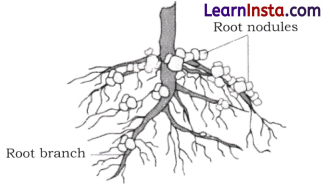
The bacteria that live in these roots are Rhizobium.
Question 2.
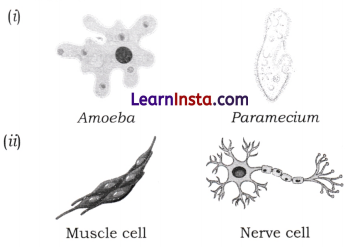
Draw the following:
(i) Any two protozoa and write their names.
(ii) Any two human cells, and write their names
Answer:
The Invisible Living World: Beyond Our Naked Eye Class 8 Quiz Questions
Question 1.
Name a multicellular microorganism.
Answer:
Bread mould
Question 2.
Who was the first person to see blood cells?
Answer:
Antonie van Leeuwenhoek
Question 3.
What essential vitamin does Spirulina provide to the human body?
Answer:
Vitamin B12
Question 4.
Which microorganism reproduces only inside the host organism?
Answer:
Virus
Question 5.
Which instrument opened the door to explore the world of microorganisms?
Answer:
Microscope
Question 6.
Which structure in plant cells stores water and maintains shape?
Answer:
Vacuole
Question 7.
Which part of an animal cell also regulates growth?
Answer:
Nucleus
Question 8.
What is the largest known single cell in nature?
Answer:
Ostrich egg yolk
Question 9.
What is the basic unit of life?
Answer:
Cell
Question 10.
What is manure made from?
Answer:
Decomposed plant and animal waste
The Invisible Living World: Beyond Our Naked Eye Class 8 Case Based Questions
Question 1.
Microorganisms are used for various purposes. They are used in cleaning up the environment. For example, the organic wastes (fruit and vegetable peels, dried leaves of plants etc.) are broken down into harmless and usable substances by bacteria. This is called manure. Curd contains several microorganisms. Of these, the bacterium Lactobacillus promotes the formation of curd. The use of yeast and sugar into the flour causes the flour to rise and double in size. Yeast reproduces rapidly and produces carbon dioxide during respiration. Yeast is used for the commercial production of alcohol and wine. It converts sugar into alcohol and carbon dioxide in the absence of oxygen. This process is known as fermentation, and it gives out a characteristic smell of alcohol.
I. What is fermentation?
II. Name the bacterium that converts milk into curd.
III. What is manure?
OR
Name one microorganism that is used in the production of alcohol.
Answer:
I. The process of converting sugar into alcohol is known as fermentation.
II. Lactobacillus
III. Microorganisms in the soil like fungi and bacteria act on the plant waste and slowly break it down into simpler, nutrient-rich substance called manure. It helps increase the fertility of the soil.
OR
Yeast
The Invisible Living World: Beyond Our Naked Eye Extra Questions for Practice
Multiple Choice Questions
Question 1.
The structure that protects plant cells and gives them shape is
(a) nucleus
(b) cell wall
(c) cytoplasm
(d) vacuole.
Question 2.
Which gas is released in high proportion by bacteria in biogas production?
(a) Nitrogen
(b) Oxygen
(c) Methane
(d) Carbon monoxide
Question 3.
Which cell is long and branched to carry messages in our body?
(a) Muscle cell
(b) Cheek cell
(c) Nerve cell
(d) Blood cell
Question 4.
Read the given statements and select the correct option.
Assertion (A): Farmers grow legumes in rotation with other crops.
Reason (R): Rotation of crop naturally increases the nitrogen in the soil.
(a) Both A and R are true and R is the correct explanation of A .
(b) Both A and R are true but R is not the correct explanation of A .
(c) A is true but R is false.
(d) A is false but R is true.
Question 5.
Match the items in Column A to those in Column B.
Column A — Column B
(i) Cell membrane — (p) Control cell activities
(ii) Cell wall — (q) Allows movement of materials in and out
(iii) Cytoplasm — (r) Present only in plant cells
(iv) Nucleus — (s) Jelly-like substance inside the cell
(a) (i)-(q), (ii)-(r), (iii)-(s), (iv)-(p)
(b) (i)-(q), (ii)-(p), (iii)-(s), (iv)-(r)
(c) (i)-(p),(i i)-(q),(i i i)-(r),(i v)-(s)
(d) (i)-(s), (ii)-(p), (iii)-(q), (iv)-(r)
Very Short Answer Type Questions
Question 1.
What is the role of Lactobacillus bacteria?
Question 2.
What is the importance of Rhizobium bacteria in agriculture?
Question 3.
Why do nerve cells have a long, branched shape?
Question 4.
What are microalgae and how are they useful?
Question 5.
Name any two harmful effects of microorganisms.
Short Answer Type-I Questions
Question 1.
What are protozoa? Name two examples.
Question 2.
How do muscle and nerve cells differ in shape and function?
Question 3.
What is the function of vacuoles in plant cells?
Question 4.
What is the curdling of milk?
Question 5.
Why do we use glycerin while preparing a slide?
Short Answer Type-II Questions
Question 1.
What are the key structural differences between plant and animal cells?
Question 2.
What is Spirulina? Mention two of its uses.
Question 3.
Explain the difference between unicellular and multicellular organisms with examples.
Question 4.
Why do microorganisms grow faster in warm and moist conditions?
Question 5.
Explain the difference between onion peel cell and human cheek cell.
Long Answer Type Questions
Question 1.
Define the following
(i) Cell
(ii) Foldscope
(iii) Manure
(iv) Plastids
(v) Virus
Question 2.
Describe the role of microorganisms in agriculture and waste management.
Question 3.
Explain how bread, curd, and cake are made with the help of microorganisms.
Suggested Projects And Activities
Question 1.
Ask your family members, neighbours, or elders about any traditional fermented food they prepare or eat at home. Collect the details for each food item, note them down in your notebook. Share it with your classmates.
Question 2.
Place two pieces of fruit (an apple or a banana) in separate containers. Sprinkle salt or sugar on one and leave the other plain. After 2-3 days, observe which one spoils faster. Note down your observations and discuss them with your classmates.
Question 3.
Visit the school garden and gently uproot a legume plant (like pea or bean). Wash its roots and observe small round swellings, these are root nodules housing Rhizobium bacteria. With the help of a senior or teacher, carefully slice one nodule open and view it under a foldscope. Learn how the plant and bacteria help each other.