Each of our Maths Mela Class 5 Worksheet and Class 5 Maths Chapter 6 The Dairy Farm Worksheet with Answers Pdf focuses on conceptual clarity.
Class 5 Maths Chapter 6 The Dairy Farm Worksheet with Answers Pdf
The Dairy Farm Class 5 Maths Worksheet
Class 5 Maths Chapter 6 Worksheet with Answers – Class 5 The Dairy Farm Worksheet
In a small town, a Dairy Farm was run by Rani and her family. They had 12 cows, each giving 8 litres of milk every day. Rani’s brother, Amit helped her to calculate how much milk they collected.

To calculate total amount of milk, Rani added:
(8 + 8 + 8 + 8 + 8 + 8 + 8 + 8 + 8 + 8 + 8 + 8) litres = __________
Amit said, “Instead of adding 8 twelve times, we can multiply.”
He quickly worked it out: as 12 × 8 = 96 litres.
In the evening, Amit and Rani are solving the puzzle based on shapes and number and the mathematical operation “multiplication”.
Amit: The given shapes stand for numbers between 1 and 24. The same shape denotes the same number across all problems. Find the numbers hiding in all the shapes.

Rani: It’s so difficult, please help me solve this.
Amit: Since, from (a) and (e)

Now, from (c) by substituting the green square we have,
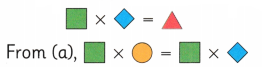
So, othe range circle is equal to the blue diamond.
Now, you can express all the shapes in the form of a Green Square
Question 1.
(a) Help Rani in solving the puzzle based on multiplication has been done for you.
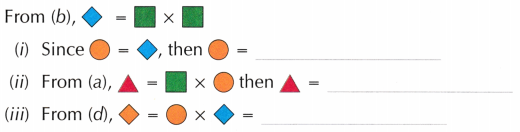
(b) Amit: Now, we need to find a single integer value for the green square |j| that makes the values of all other shapes fall between 1 and 24.


Question 2.
Rani: Now let’s play another game.
(a) Place the digits 2, 4 and 5 appropriately to get a product equal to 100.
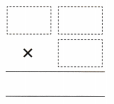
(b) Place the digits 3, 4 and 5 appropriately to get a product closer to 200.
(c) Place the digits 4, 5 and 6 appropriately to get a product greater than 300.
Question 3.
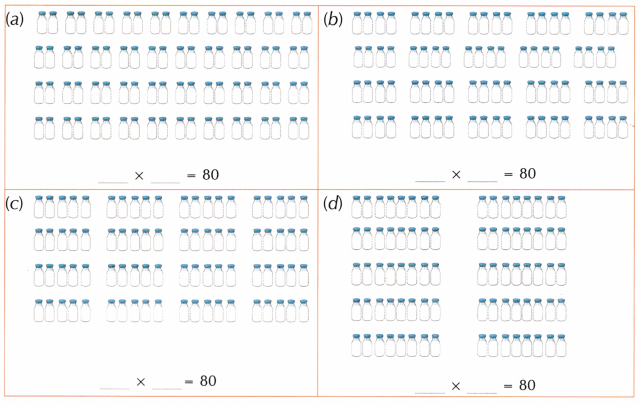
Rani and her brother pack the milk in bottles of equal size for distribution. Find the number of bottles kept in each arrangement.
Question 4.
Solve the following puzzles:
(a) I am a two-digit number. Find me with the help of the following clues:
- I am a multiple of 5, but not a multiple of 10.
- I am an odd number greater than 30, but less than 80.
- My tens digit is a prime number.
- I am a multiple of 3.
(b) I am a two-digit number. Figure out who I am.
- I am an even number, greater than 60.
- I am a multiple of 6 but not a multiple of 4.
- My tens digit is odd but my ones digit is not 0.
- My digits add up to an odd number, but I am less than 80.
Question 5.
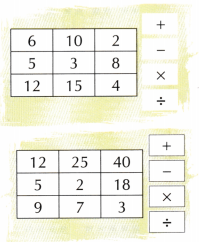
Choose two numbers and one operation from the grid given alongside. Try to make all the numbers from 1 to 20.
(a) ____________________________________
(b) ____________________________________
Order of Numbers in Multiplication
Question 6.
Sanjay, a carpenter, organises his collection of wooden blocks to keep track of his inventory. He decides to arrange them in the following ways. Find the number of wooden. blocks in each case:
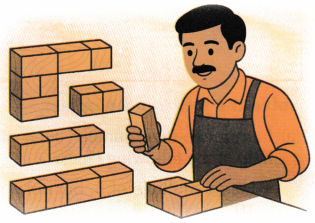
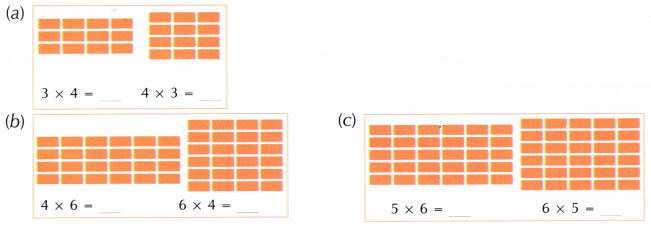
Does the number of wooden blocks remain the same if groups and group size are interchanged in each case? __________
Question 7.
Multiply the following:
(a) 12 × 5 = __________
5 × 12 = __________
(b) 13 × 6 = __________
6 × 13 = __________
(c) 15 × 8 = __________
8 × 15 = __________
(d) 20 × 10 = __________
10 × 20 = __________
(e) 25 × 0 = __________
0 × 25 = __________
(f) 14 × 7 = __________
7 × 14 = __________
What do you observe from each of above multiplication:
____________________________________
Patterns in Multiplication by 10s and 100s
Question 8.
Find the product of the following:
(a) 5 × 10 = __________
(b) 11 × 10 = __________
(c) 5 × 100 = __________
(d) 15 × 10 = __________
(e) 55 × 10 = __________
(f) 11 × 100 = __________
(g) 100 × 10 = __________
(h) 105 × 10 = __________
(f) 100 × 100 = __________
Question 9.
Ankit helps Rani in her studies. He explains that we can multiply numbers in any order. For example, 50 × 200 = 25 × 2 × 100 × 2 = 25 × 4 × 100= 10,000 and so on.
Based on this, write three more different ways to get the same product 10,000.
____________________________________
Question 10.
Fill in the table and observe the patterns:

____________________________________
____________________________________
Many Ways to Multiply
We can multiply two numbers in many ways. Let us multiply 22 × 6 in different ways as follows:
Way 1: Since half of 22 is 11.
So, we can find 22 × 6 as (11 × 6 = 66) + (11 × 6 = 66) = 132
Way 2 : We can divide 6 into parts three parts 2, 2 and 2 and multiply each by 22,
so 22 × 6 = 22 × 2 + 22 × 2 + 22 × 2 = 44 + 44 + 44 = 132
Way 3 : We can also divide 22 into parts 12 and 10, and multiply each by 6,
so 22 × 6 = 10 × 6 + 12 × 6 = 60 + 72 = 132
Way 4: We can half the number 22 and double the number 6,
so 22 × 6 = 11 × 12 = 132
Way 5: We can divide 22 into 20 and 2 and multiply each number by 6,
so 22 × 6 = 20 × 6 + 2 × 6 = 120 + 12 = 132.
Question 11.
Write 2 different ways to multiply the given numbers.
(a) 16 × 20
(i) ____________________________________
(ii) ____________________________________
(b) 30 × 50
(i) ____________________________________
(ii) ____________________________________
Doubling and Halving
Question 12.
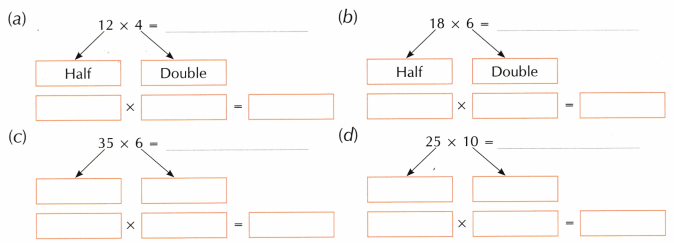
Solve the following problems by doubling and halving:
Question 13.
Find the product by halving and doubling either the multiplier or the multiplicand.
(a) 6 × 15
(b) 8 × 45
(c) 16 × 25
(d) 13 × 50
Question 14.
Write 4 examples of multiplication problems where using the halving and doubling method makes the calculation easier. Also, solve them to find the products.
____________________________________
Nearest Multiple
Question 15.
Write 4 examples of multiplication problems where you can use the nearest multiple to find the product easily. Also, find the products.
____________________________________
Question 16.
Find the products of the following numbers by finding the nearest multiple.
(a) 8 × 51
(b) 9 × 26
(c) 85 × 31
(d) 99 × 17
Question 17.
Use strategies flexibly to answer the following questions.
(a) A farmer plants 27 rows of maize, with 35 stalks in each row. How many maize stalks are there in total?

____________________________________
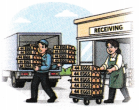
(b) A store received 15 cartons of eggs, with 44 eggs in each carton. How many total eggs did the store receive?
____________________________________
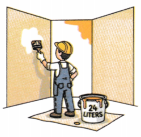
(c) It takes 24 litres of paint to cover 3 walls. How many litres of paint would be needed to cover 9 walls?
____________________________________
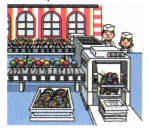
(d) A candy factory produces 75 bags of lollipops in a day. Each bag contains 25 lollipops. How many lollipops did the factory produce in total in day each?
____________________________________
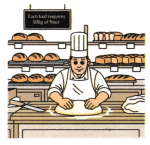
(e) A bakery makes 150 loaves of bread every day. Each loaf requires 500 g of flour. How much total flour is needed to make the bread each day?
____________________________________
(f) A bakery makes 150 loaves of bread every day. Each loaf requires 500 g of flour. How much total flour is needed to make the bread each day?
____________________________________
Waste and Composting
Question 18.
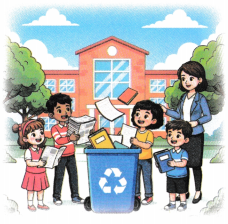
A school collects 38 kg of waste paper every month for recycling. How much waste will the school collect in a year?
Question 19.
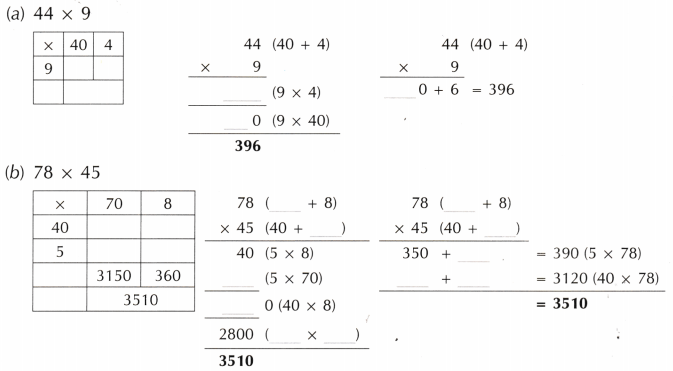
Multiply the following numbers as instructed and Fill in the blanks: (a) 44 x 9
Question 20.
Solve the following problems like Nida did. (Refer to NCERT Textbook page 77)
(a) 79 × 5
(b) 85 × 9
(c) 65 × 38
(d) 67 × 72
Question 21.
Solve the following problems like Kanti did. (Refer to NCERT Textbook page 78)
(a) 85 × 6
(b) 94 × 7
(c) 85 × 15
(d) 95 × 42
Question 22.
Solve the following problems like John did. (Refer to NCERT Textbook page 78)
(a) 99 × 5
(b) 77 × 9
(c) 69 × 27
(d) 88 × 44
Think and Answer
A school has 9 classrooms, and each classroom has 24 two seater desks. If one-third of the desks are empty, how many students are in the school? If 4 more classrooms are filled to capacity, how many total students will be there?
Question 23.
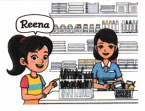
Reena buys 8 packs of pencils and 6 packs of pens from a stationery store. Each pack of pencils costs ₹ 45 and each pack of pens costs ₹ 60. How much money should Reena give to the shopkeeper?
Poultry farming (Dairy Cooperative)
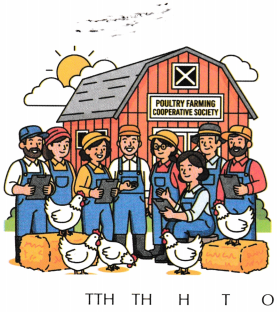
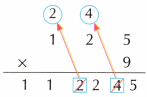
A poultry farming cooperative society has 125 farmers each owning at least 9 hens. Mini, the daughter of a farmer, calculates the minimum number of hens the cooperative society gets its egg from.
Since 1 farmer has at least 9 hens, so, 125 farmers have 125 × 9 = __________ hens.
Since, the poultry farming society sells one dozen eggs for ₹ 112. The farm produce around 452 dozen eggs in a week. Mini calculates the total earning by selling eggs in a week as shown alongside.
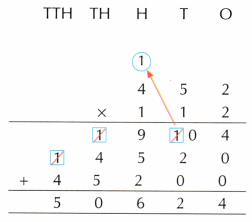
Hence, the society earns ₹ __________ per week by selling the eggs.
Question 24.
Solve tke following problems like Mini:
(a) 889 × 5
(b) 599 × 46
(c) 324 × 123
Question 25.
Find the possible values to fill the rectangles, circles and squares, in each of the following problems. The same shape indicates the same number in a problem. Some problems can have more than one answer.

Question 26.
Find the possible values to fill in the blanks in the given problems.

Question 27.
Estimate the products on the lejt and match them with the correct numbers given on the right.
| Column I | Column II |
| (a) 11 × 31 | (i) 10000 |
| (b) 14 × 48 | (ii) 300 |
| (c) 105 × 12 | (iii) 6000 |
| (d) 349 × 19 | (iv) 500 |
| (e) 999 × 10 | (v) 1000 |
The Queen’s Reward
Question 28.
Once upon a time, a Queen wanted to thank her three most loyal knights for their bravery. She summoned them and offered them a choice of three magical treasures. “Choose wisely,” she said, “for one of these will bring you the greatest fortune.”
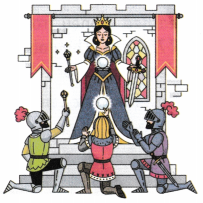
Choice 1: Take 4 gems and double the number of gems every day for 5 days.
Choice 2: Take 2 gems and triple the number of gems every day for 5 days.
Choice 3: Take 1 gem and multiply the number of gems by 4 every day for 5 days.
Knight 1 chose the first option, Knight 2 chose the second, and Knight 3 chose the third.
A week later, all three knights were amazed by their final reward.
Calculate how many gems each knight received to find out who made the best choice.
Multiplication Patterns
Question 29.
Observe and complete the following patterns:
(a) 4 × 25 =100
8 × 25 = 200
12 × 25 = 300
16 × 25 = __________
20 × 25 = __________
(c) 9 × 9 + 7 = 88
98 × 9 + 6 = 888
987 × 9 + 5 = 8,888
9,876 × 9 + 4 = __________
98,765 × 9 + 3 = __________
(d) 9 × 9 + 1 = 82
99 × 9 + 1 = 892
999 × 9 + 1 = 8,992
9,999 × 9 + 1 = __________
99,999 × 9 + 1 = __________
(e) 2 × 8 + 2 = 18
23 × 8 + 3 = 187
234 × 8 + 4 = 1,876
2,345 × 8 + 5 = __________
23,456 × 8 + 6 = __________
Question 30.
A local library is holding a book drive to raise money for new books. The library earned money from donations and by selling old books. They sold 85 books for ₹ 75 each. They also received 4 donations of ₹ 500 each. The library spent ₹ 450 on decorations for the event and ₹ 150 on refreshments.
(a) How much money did the library collect in total from book sales and donations?
(b) What were the total expenses for the event?
Question 31.
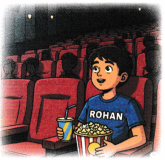
Rohan is sitting in a movie theatre watching a show. There are 9 rows of seats in front of him and 15 rows behind him. There are 12 seats to his right and 14 seats to his left.
(a) How many rows of seats are there in total?
(b) How many seats are there in Rohan’s row?
(c) What is the total number of seats in the theatre?