Students revise important topics using Class 8 SST Extra Questions and Class 8th SST Chapter 4 The Colonial Era in India Important Extra Question Answer before exams.
Class 8 SST Chapter 4 The Colonial Era in India Extra Questions
NCERT Class 8 Social Science Chapter 4 Extra Questions on The Colonial Era in India
The Colonial Era in India Class 8 Very Short Question Answer
Question 1.
What was the Doctrine of Lapse?
Answer:
The Doctrine of Lapse was a British policy to annex Indian princely states that lacked a male heir. Introduced by Lord Dalhousie, it was used to justify taking control of several regions, including Jhansi, which led to resentment and resistance.
Question 2.
Who was Rani Lakshmibai?
Answer: R
ani Lakshmibai was the queen of Jhansi and a key leader during the Revolt of 1857. She fought bravely against British forces when they tried to annex her kingdom under the Doctrine of Lapse, becoming a symbol of resistance.
Question 3.
What is meant by the term “drain of wealth”?
Answer:
The “drain of wealth” theory, proposed by Dadabhai Naoroji, described how Britain extracted India’s resources and wealth without fair compensation. This included profits from trade, taxes, and salaries paid to British officials in India.
Question 4.
What was the Santhal Rebellion?
Answer:
The Santhal Rebellion ( 1855-56) was a tribal uprising against British colonial authorities and exploitative moneylenders. Led by Sidhu and Kanhu Murmu, the Santhals fought to reclaim their land and freedom from outsiders.

Question 5.
How did the British benefit from India’s railways?
Answer:
The British used railways in India to transport raw materials to ports and import British goods inland. It also allowed easier troop movement to suppress revolts. Though modernizing, the system primarily served British economic and military interests.
Question 6.
What were the major causes of the 1857 Revolt?
Answer:
The 1857 Revolt was caused by multiple factors: political annexations, economic exploitation, social reforms, and the use of greased cartridges in Enfield rifles, which offended religious sentiments of Hindu and Muslim soldiers.
Question 7.
What is the significance of Macaulay’s Minute on Education?
Answer:
Macaulay’s Minute (1835) aimed to introduce English education in India. It promoted Western knowledge over Indian traditions, intending to create a class of Indians loyal to British ideals, influencing India’s education system for decades.
Question 8.
How did British rule affect Indian agriculture?
Answer:
British rule altered Indian agriculture by promoting cash crops like cotton and indigo for British industries. This led to food shortages and famines as subsistence farming declined. Revenue systems like Permanent Settlement worsened rural poverty.
The Colonial Era in India Class 8 Short Question Answer
Question 1.
How did British colonization impact Indian education?
Answer:
British colonization shifted Indian education towards English and Western subjects. Traditional systems like gurukuls and madrasas declined. The British wanted to create a class of Indians who were “English in taste, in morals, and intellect.” Though it introduced modern subjects, it sidelined India’s rich heritage, promoting British cultural superiority and shaping the minds of future Indian clerks and bureaucrats.
Question 2.
What were the goals of early resistance movements like the Santhal Rebellion?
Answer:
Early resistance movements such as the Santhal Rebellion aimed to end British exploitation and reclaim control over local lands. The Santhals revolted against oppressive landlords, British officials, and moneylenders. Their demands were simple: removal of outsiders, freedom from exploitation, and preservation of their traditional way of life. Though unsuccessful, such uprisings inspired future resistance efforts across India.
Question 3.
Describe the role of the British East India Company in colonising India.
Answer:
The British East India Company started as a trading body but soon became a political power in India. Through military force and diplomatic strategies like “divide and rule,” it took over large territories. It imposed taxes, controlled trade, and governed major regions. After the 1857 Revolt, the British Crown took direct control, ending the Company’s rule.
Question 4.
What were the consequences of the Permanent Settlement on Indian peasants?
Answer:
The Permanent Settlement, introduced in Bengal in 1793, fixed land revenue with zamindars, who became tax collectors. Peasants had to pay high rents regardless of crop failure. This led to debt, landlessness, and rural poverty. Zamindars prioritized revenue over farmers’ well-being. The system benefitted the British with steady income but harmed the agrarian economy and social structure.
Question 5.
How was India affected by British industrial interests?
Answer:
British industries relied on Indian raw materials like cotton, indigo, and jute. Indian artisans and weavers were pushed out of business as British manufactured goods flooded the market. Traditional industries declined, and India became a supplier of raw materials and a market for British products. This deindustrialization led to mass unemployment and economic dependency.
The Colonial Era in India Class 8 Long Question Answer
Question 1.
Analyze the contribution of early resistance movements to India’s freedom struggle.
Answer:
Early resistance movements like the Santhal Rebellion and tribal uprisings played a foundational role in India’s freedom struggle. Though local and scattered, they revealed deep resentment against colonial exploitation. These uprisings highlighted the impact of land policies, forced labour, and social injustice. Leaders like Sidhu and Kanhu Murmu inspired future generations to resist foreign domination. These movements exposed the brutal response of colonial authorities and emphasized the need for collective action. They laid the groundwork for broader, more organized struggles like the 1857 Revolt and, later, the Indian National Movement.
Question 2.
How did the British use cartography and surveys to control India?
Answer:
The British conducted detailed surveys and created maps to better understand and control India. They mapped land, resources, ethnic groups, and natural features to extract maximum revenue and maintain order. Surveys helped in implementing land settlements and identifying tax zones. Mapping also allowed better military planning and infrastructure development. However, these processes often ignored local knowledge and imposed rigid classifications. By documenting and categorizing India, the British reinforced their dominance. The use of cartography turned geography into a tool of power and surveillance, central to colonial governance.
Question 3.
Explain the role of Dadabhai Naoroji in critiquing colonial economic policies.
Answer:
Dadabhai Naoroji was a pioneer in exposing the economic exploitation under British mle. His “Drain of Wealth” theory argued that Britain extracted resources and profits from India without adequate returns. He used statistical data to show how Indian revenues funded British administration and wars. Naoroji was also the first Indian elected to the British Parliament, where he raised Indian concerns. His writings, especially “Poverty and Un-British Rule in India,” influenced future nationalists. He bridged the gap between
early moderate politics and later radical demands, becoming a key figure in India’s struggle for economic justice.
Question 4.
How did the British exploit religious and social divisions in India?
Answer:
The British exploited India’s religious and caste divisions to strengthen their control. They introduced separate electorates for Hindus and Muslims, promoting communal identities. Census classifications reinforced rigid caste hierarchies. During the 1857 Revolt, they used loyalty from certain communities against rebels. Missionary activities and reforms like the abolition of sati, though progressive, were viewed as cultural interference. These policies sowed mistrust and disunity, preventing collective resistance. The divide-and-rule strategy helped maintain British power but laid the seeds for future communal tensions, including those that led to Partition in 1947.
Question 5.
Describe how the 1857 Revolt inspired later nationalist movements.
Answer:
Although the 1857 Revolt failed, it became a symbol of resistance and inspired later nationalists. Leaders like Rani Lakshmibai and Bahadur Shah Zafar became legends. The revolt showed that people from different regions, religions, and classes could unite against colonial rule. Nationalist leaders in the late 19th and early 20th centuries drew lessons from its failures—the need for unity, planning, and ideology. It also instilled pride and a sense of shared struggle. Songs, stories, and commemorations of 1857 kept the spirit alive, becoming a foundation for the broader independence movement.
The Colonial Era in India Class 8 Source Based Questions
Question 1.
Read the below passages and answer the following questions:
The British claimed to bring progress and civilization to India. They introduced railways, telegraphs, and rpodern education. However, most of these developments served British economic and strategic interests.
(i) What was the main reason for introducing railways and telegraphs in India?
Answer:
They were mainly introduced to strengthen British control—facilitating troop movement, efficient communication, and transporting raw materials to ports.
(ii) How did the introduction of modern education benefit the British?
Answer:
It created a class of English-educated Indians who could work as clerks and administrators, helping the British run the colony cheaply.
(iii) In what ways did these ‘developments’ not benefit Indians?
Answer:
These systems disrupted traditional economies, prioritized British needs, and failed to uplift the majority of Indians who remained poor and exploited.
Question 2.
The Santhal Rebellion of 1855 was a bold tribal uprising against British policies and local oppressors. Led by Sidhu and Kanhu Murmu, the Santhals rose to reclaim their land and dignity.
(i) Who were the main leaders of the Santhal Rebellion and what did they aim to achieve?
Answer:
Sidhu and Kanhu Murmu led the rebellion aiming to end exploitation and regain control over their ancestral lands.
(ii) What-were the causes behind the Santhal uprising?
Answer:
Exploitative landlords, moneylenders, and British revenue officials displaced the Santhals from their lands and imposed heavy taxes.
(iii) What was the outcome of the Santhal Rebellion?
Answer:
The rebellion was brutally crushed by the British, but it marked one of the earliest large-scale resistances and inspired future movements.
The Colonial Era in India Class 8 Picture Based Questions
Observe the below picture and answer the questions that follow:
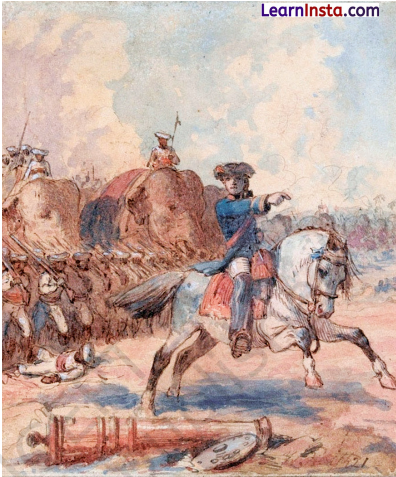
(i) What does the image of Robert Clive on horseback at the Battle of Plassey represent?
Answer:
The image depicts Robert Clive leading the East India Company’s troops at the Battle of Plassey (1757), symbolizing the Company’s transformation from traders to military and political power through manipulation and strategic alliances.
(ii) How did the British use the strategy of‘divide and rule’ to gain power in India?
Answer:
The British exploited rivalries between local rulers and succession disputes, offering military support to some against others. This allowed them to gain influence and power without appearing as outright invaders.
(iii) What was the Doctrine of Lapse, and how did it help the British expand their control?
Answer:
The Doctrine of Lapse allowed the British to annex any princely state where the ruler died without a natural male heir, ignoring the Indian tradition of adoption, thus enabling further territorial expansion.
Class 8 The Colonial Era in India Extra Questions for Practice
I. Multiple Choice Questions
Question 1.
Which European power first established a trading post in India?
(a) British
(b) Dutch
(c) Portuguese
(d) French
Question 2.
The statement “a single shelf of a good European library was worth the whole native literature of India and Arabia” was made by:
(a) Lord Ripon
(b) T.B. Macaulay
(c) John Stuart Mill
(d) James Mill
Question 3.
The British often used the strategy of to maintain their control over India.
(a) Aggressive trade
(b) Divide and rule
(c) Import taxes
(d) Local elections
Question 4.
Which of the following is not true about the legacy of colonialism in India?
(a) Looting of cultural heritage.
(b) Creation of modern infrastructure.
(c) Promotion of indigenous industries.
(d) Racial hierarchy and exploitation.
Question 5.
What does the phrase “the sun never sets on the British Empire” imply?
(a) Continuous daylight in Britain.
(b) Vast global presence of the British Empire.
(c) Peaceful rule of the British.
(d) No resistance to British authority.
II. Very Short Answer Type Questions
Question 1.
What is meant by “civilising mission”?
Question 2.
What was the role of the East India Company in shaping India’s colonial experience?
Question 3.
Why was the Enfield rifle controversial during the 1857 Revolt?
Question 4.
What changes did colonial land revenue systems bring to India?
Question 5.
Who were Sidhu and Kanhu Murmu?
III. Short Answer Type Questions
Question 1.
How did colonial land policies change Indian village life?
Question 2.
What was the role of Indian sepoys in the 1857 Revolt?
Question 3.
How did British colonialism affect Indian art and heritage?
Question 4.
Explain the concept of ‘divide and rule’ with examples.
Question 5.
Why did the 1857 Revolt fail despite wide participation?
IV. Long Answer Type Questions
Question 1.
Evaluate the long-term impact of colonial rule on India’s economy.
Question 2.
How did colonialism change India’s social and cultural landscape?
Question 3.
Describe the causes and consequences of the Great Revolt of 1857.
Question 4.
How did the British justify their rule in India and how valid were these claims?
Question 5.
Discuss how India funded its own colonization through British infrastructure projects.