Students often prefer our concise Class 8 English Poorvi Worksheet and Class 8 English Chapter 10 The Cherry Tree Worksheet with Answers Pdf for quick practice.
Class 8 English Chapter 10 The Cherry Tree Worksheet with Answers
Class 8 English The Cherry Tree Worksheet
Class 8 English Chapter 10 Worksheet – Class 8 The Cherry Tree Worksheet
Let us do these activities before we read
I. Work in pairs and answer the following questions. Share your answers with your classmates and teacher.
Question 1.
Have you ever visited a nursery or garden center? What did you see there?
_______________________________________________
Question 2.
Did you ever gift a plant to someone? What was their reaction?
_______________________________________________
Question 3.
What changes did you observe in a plant over a few weeks or months?
_______________________________________________
II. What do people do to protect the trees and plants around them? Why is it important to protect them?
_______________________________________________
III. Name a tree that is commonly found near your school or home. What are its uses and how does it benefit the environment?
_______________________________________________
Let us discuss
I. Rearrange the sequence of the steps in plantation of cherry trees. First and the last step have been marked.
| 1. Use a tree guard or fence to protect the sapling from animals. Watch for pests and diseases and treat them promptly. | |
| 2. Cherry trees need full sunlight-at least 6 to 8 hours daily. | |
| 3. Decide whether you want sweet cherries or sour cherries. Select a variety that suits your climate. | 1 |
| 4. Place the sapling gently in the hole. Fill the hole with soil and press it down firmly. | |
| 5. Water the tree thoroughly after planting. Keep the soil moist (but not soggy), especially during the first year. | |
| 6. Choose a location with well-drained soil and good air circulation. Dig a hole twice as wide and as deep as the root ball. | |
| 7. Enjoy the beautiful spring blossoms and delicious cherries when they arrive! | 9 |
| 8. Cherry trees usually start producing fruit after 3-5 years. | |
| 9. Mix compost or organic matter into the soil to improve fertility. |
II. Which type of climate and soil are best suited to cultivate cherry trees?
_______________________________________________
III. Complete the table given below based on your understanding of the story. One example has been done for you.
| Cause | Effect |
| 1 Rakesh planted a cherry seed. | (i) The seed slowly grew into a small plant. |
| 2. A goat ate the leaves of the cherry tree. | (ii) ____________________________ |
| 3. ___________________ | (iii) Rakesh was surprised to see the tree had survived. |
| 4. ___________________ | (iv) Rakesh and Grandfather gazed at the tree as though it had performed a miracle. |
| 5. The cherry tree grew flowers and fruits. | (v) ____________________________ |
Think beyond
I. Read the given extracts and answer the questions that follow.
1. That year the monsoon rains came early and Rakesh plodded to and from school in raincoat and chappals. Ferns sprang from the trunks of trees, strange-looking lilies came up in the long grass, and even when it wasn’t raining the trees dripped and mist came curling up the valley. The cherry tree grew quickly in this season.
It was about two feet high when a goat entered the garden and ate all the leaves. Only the main stem and two thin branches remained.
‘Never mind,’ said Grandfather, seeing that Rakesh was upset.
‘It will grow again, cherry trees are tough.
Questions:
(i) “Ferns sprang from the trunks of trees, strange-looking lilies came up in the long grass…”
What does the word sprang most likely mean in this context?
(a) Jumped quickly
(b) Grew suddenly
(c) Fell down
(d) Flew away
(ii) What does Grandfather’s reaction to the damaged cherry tree tell us about his character?
(a) He was careless and indifferent.
(b) He believed in giving up easily.
(iii) Complete the following sentence with a suitable reason.
The cherry tree grew quickly during the monsoon because ______________
(iv) What might happen to the cherry tree after being eaten by the goat, according to Grandfather?
_______________________________________________

2. He was still lying beneath the tree when the evening shadows crept across the garden. Grandfather came back and sat down beside Rakesh, and they waited in silence until the stars came out and the nightjar began to call. In the forest below, the crickets and cicadas began tuning up; and suddenly the trees were full of the sound of insects.
‘There are so many trees in the forest,’ said Rakesh. ‘What’s so special about this tree? Why do we like it so much?’
‘We planted it ourselves,’ said Grandfather. ‘That’s why it’s special.’
‘Just one small seed,’ said Rakesh, and he touched the smooth bark of the tree that he had grown. He ran his hand along the trunk of the tree and put his finger to the tip of a leaf. 7 wonder,’ he whispered. ‘Is this what it feels to be God?’
Questions:
(i) What theme is most evident in the conversation between Rakesh and Grandfather?
(a) Conflict between man and nature
(b) Value of self-effort and nurturing
(c) Adventure and discovery
(d) Fear of the unknown
(ii) Fill in the blank correctly.
The forest was filled with the sound of insects like ______________ and cicadas as night approached.
(iii) Select the option that is correct for both Assertion (A) and Reason (R).
Assertion (A): Rakesh felt a deep connection to the tree.
Reason (R): Fie had bought the tree from the market.
(a) Both A and R are true, and R is the correct explanation of A.
(b) Both A and R are true, but R is not the correct explanation of A.
(c) A is true, but R is false. (d) A is false, but R is true.
(iv) Match the senses with the descriptions from the passage.
| Senses | Descriptions from the passage |
| (i) Sight | (a) Trees full of insect sounds |
| (ii) Sound | (b) Evening shadows across the garden |
| (iii) Touch | (c) Smooth bark and leaf tip |
II. Answer the following questions.
Question 1.
What caused Rakesh to feel proud and happy at the end of the story, and what effect did this have on his understanding of nature?
_______________________________________________
_______________________________________________
Question 2.
What made Rakesh utter these words: “Is this what it feels to be God”?
_______________________________________________
_______________________________________________
Question 3.
Why did the cherry tree become so special to Rakesh and his grandfather?
_______________________________________________
_______________________________________________
Question 4.
How does Ruskin Bond use nature as a symbol in the story? Give examples.
_______________________________________________
_______________________________________________
Question 5.
Describe the challenges faced by the cherry tree and how it overcame them. What do these struggles symbolize?
_______________________________________________
_______________________________________________
Question 6.
What do you understand from Rakesh’s final question: “Is this what it feels to be God?”
_______________________________________________
_______________________________________________
Question 7.
How does the relationship between Rakesh and Grandfather contribute to the story’s message?
_______________________________________________
_______________________________________________
Let us learn
I. Identify the odd one out.
1. Hoe, Spade, Caterpillar, Shovel
2. Growing, Pruning, Withering ,Watering
3. Pruning knife, Spade, Caterpillar, Rocket
4. Care, Nurture, Neglect, Protection
5. Watching stars, Listening to the nightjar, Talking to the tree, Waiting in silence
II. Match the food item with the taste word it is associated with.
| Food items | Taste words |
| 1. Cherry | (i) Spicy |
| 2. Dark chocolate | (ii) Sour |
| 3. Lemon | (iii) Bland |
| 4. Mushrooms | (iv) Bitter |
| 5. Vinegar | (v) Sweet |
| 6. Grass | (vi) Tangy |
| 7. Chilli Pepper | (vii) Earthy |
III. Choose the correct antonyms for the textual words given below from the box. There are two extra words that you will not need.
| Noisy, Stiff, Shrub, Neglect, Clear sky, Loud,
Trees, Light, Shout, Tender, Cut down, Fussy |
1. Sapling
2. Monsoon
3. Nourish
4. Prune
5. Twisted
6. Silence
7. Creepers
8. Shadows
9. Whisper
10. Grow
IV. Simple Past Tense, Past Progressive Tense and Past Perfect Tense
1. Simple Past Tense: Used to describe completed actions or events that happened at a specific time in the past. For example: They visited the museum.
2. Past Progressive Tense: Used to describe an ongoing action or state of being in the past, often providing background information or setting the scene. For example: They were playing football.
3. Past Perfect Tense: Used to describe an action or event that happened before another action or event in the past. For example: I had finished my work before I went to bed.
A. Fill in the blanks with the correct past tense form of the verb in brackets.
1. Rakesh ______________ (plant) the cherry seed near the garden wall.
2. When Grandfather arrived, Rakesh ______________ (wait) under the tree.
3. The goat ______________ (eat) the young leaves before Rakesh could stop it.
4. By the time Rakesh came back from school, the cherry tree ______________ (grow) a little taller.
5. The woman ______________ (cut) the grass when she accidentally chopped the cherry plant.
6. While the wind ______________ (blow), the tree bent but didn’t break.
7. Rakesh ______________ (see) a small pink blossom on the tree.
8. The caterpillar ______________ (crawl) on the leaves all morning.
9. The tree ______________ (face) many dangers, but it survived.
10. Rakesh and Grandfather ______________ (watch) the stars when the nightjar began to call.
B. Identify the tense used and rewrite the sentence using another past tense form.
1. The cherry tree had survived many dangers.
Tense: ______________
Rewrite (Simple Past): _______________________________________________
2. Rakesh was sitting under the tree in the evening.
Tense:______________
Rewrite (Simple Past): _______________________________________________
3. Grandfather planted many trees in his life.
Tense: ______________
Rewrite (Past Perfect): _______________________________________________
4. Rakesh had watered the plant before he went to school.
Tense: ______________
Rewrite (Past Progressive):
5. The wind was blowing when the blossom fell.
Tense: ______________
Rewrite (Simple Past): _______________________________________________
6. A goat ate the tender leaves of the plant.
Tense: ______________
Rewrite (Past Perfect): _______________________________________________
7. He ran his hand along the trunk of the tree.
Tense: ______________
Rewrite: (Past Perfect): _______________________________________________
8. He had never seen such a lovely flower before.
Tense: ______________
Rewrite (Simple Past): _______________________________________________
9. The woman was cutting grass when she chopped the cherry tree.
Tense: ______________
Rewrite (Simple Past): _______________________________________________
10. Rakesh saw the first cherry on the tree.
Tense: ______________
Rewrite (Past Perfect): _______________________________________________
C. Punctuation Marks
Punctuation refers to the symbols used in writing to clarify meaning and separate sentences and their components. Proper punctuation ensures the clarity and flow of a text, guiding readers through its structure.
Punctuate the following paragraph appropriately.
rakesh was only six years old when he planted the cherry seed in the corner of the garden it was not a big garden just a narrow strip of land behind the cottage but it was enough for rakesh to plant the seed he pressed it into the soil with his finger and looked at it every day to see if it was growing nothing happened for weeks but rakesh did not give up one morning he noticed a small green shoot coming out of the ground he ran to tell grandfather who smiled and said that now the real work would begin they watered it regularly but many dangers lay ahead a goat nibbled the leaves a woman cutting grass chopped it in half but the cherry tree survived the seasons passed and the tree grew taller with each year one day when rakesh returned from school he saw something pink among the green leaves it was a blossom the first cherry blossom of the tree he had planted himself he called grandfather and they sat beneath the tree in silence as the sun set and the stars came out they listened to the sounds of the garden and the forest and rakesh felt a quiet happiness grow inside him
Let us listen
Request your friend/brother/sister to read out the transcript. As you listen to the transcript, answer the following questions. (Read the Transcript at the end of this book Pg. No. 154)
Questions:
1. What did Rakesh do with the cherry seed?
_______________________________________________
2. How did Rakesh feel when nothing appeared for a long time?
_______________________________________________
3. Who helped Rakesh take care of the plant?
_______________________________________________
4. Name one danger the plant had to face.
_______________________________________________
5. What did Rakesh see on the tree that made him feel happy?
_______________________________________________
Let us Speak
A syllable is a single, unbroken vowel sound in a word. Some words have only one syllable. Some have two and some more than two. For example, the word ‘tree’ has one syllable. The word ‘cherry’ has two syllables-che-rry. (Here the hyphen is used to mark the gap between the two syllables.)
I. Students will pronounce each word aloud and count the number of syllables by clapping, tapping, or using fingers.
| Cherry, Garden, Grandfather, Blossom, Tree, Watered, Beautiful, Dangerous, Mountains, Nightjar, Afternoon |
II. Each student picks any 2 words from the list and says:
- The word
- The number of syllables
- A short sentence using the word
Example:
Word: Grandfather
Syllables: 3
Sentence: My grandfather helped me plant a cherry tree.
III. Cauvery Calling is a movement to support farmers to plant 242 crore trees and revitalize Cauvery. Speak about the movement and its significance. Before you speak in the class or assembly, prepare yourself on the following points:
- When did it start?
- Why did it start?
- How is this movement carried out?
- What is the message it conveys?
Let us write
An article is a piece of writing on a specific topic. It showcases independent opinions expressed by a writer. Articles are published in newspapers, newsletters, magazines, journals, and online portals.
Complete the article for a magazine on ‘Chipko Movement’. Use the words and phrases given in the box below to complete the article.
| deforestation, to stick, protect, trees, non-violent, to cling, peaceful, hugged, environmental, logging, awareness |
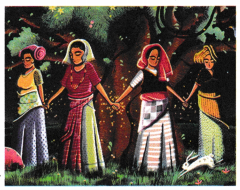
The Chipko Movement was a (i) ______________ movement that started in the 1970s. It began in the state of Uttarakhand in India to protect forests from (ii) ______________ The word “Chipko” means (iii) “______________.” or (iv) ” ______________. In this movement, people literally (v) ______________ the (vi) ______________ to stop them from being cut down. The movement was led by local villagers, especially women, who wanted to (vii) ______________ the forests from being destroyed by commercial (viii) ______________ Their main goal was to save the trees and promote (ix) ______________ about the importance of trees. This (x) ______________ and awareness protest inspired many people across India to protect nature. The Chipko Movement is now remembered as a powerful example of how ordinary citizens can stand up for the (xi) ______________ cause.
Let us explore
Explore more about theses environmentalists and their contributions in protecting the environment.
1. Sunderlal Bahuguna — Protector of Trees (Chipko Movement)
- Born: 1927 | State: Uttarakhand
- He was a Gandhian environmentalist who led the famous Chipko Movement in the 1970s, where villagers (especially women) hugged trees to stop them from being cut down.
- He promoted the idea of non-violent resistance to save Himalayan forests.
- Also worked against the construction of the Tehri Dam to protect the environment.
- His slogan: “Ecology is permanent economy.”
2. Valmik Thapar – Tiger Conservationist
- Born: 1956 | Field: Wildlife Conservation
- He is one of India’s leading experts on tigers and has spent decades working in Ranthambore National Park.
- He has written books, made documentaries, and advised on policies to protect tigers and their habitats.
- Strongly supports Project Tiger launched in 1973 to prevent tiger extinction.
3. Rajendra Singh – Waterman of India
- Born: 1959 | Work Area: Rajasthan
- He revived traditional water harvesting systems in Rajasthan’s drought-prone areas.
- He helped bring dead rivers like Arvari back to life using local methods.
- His work earned him the Stockholm Water Prize (201 5).
- He believes that community participation is key to water conservation.
4. Dr. Salim AM – Birdman of India
- Born: 1896 – Died 1987 | Field: Ornithology (study of birds)
- He wrote books on Indian birds and helped people understand the importance of bird conservation.
- Played a major role in protecting Bharatpur Bird Sanctuary (Keoladeo National Park).
- Helped lay the foundation for modern wildlife protection laws in India.