Class 6 Social Science Chapter 6 Notes The Beginnings of Indian Civilisation
→ Civilisation is characterized by government and administration, urbanism, a variety of crafts, internal and external trade, writing, cultural ideas, and productive agriculture.
→ Civilisation began at different times globally. In Mesopotamia, it started about 6,000 years ago, and ancient Egypt followed shortly after.
→ The Indian Subcontinent saw the rise of Indus Valley Civilisation around 3500 BCE, with significant urban development by 2600 BCE in the Indus Valley.
→ This civilisation is also known as the Indus, Harappan, Indus-SarasvatT, or Sindhu-Sarasvati civilisation, its people are called Harappans, named after the city of Harappa which was first excavated.
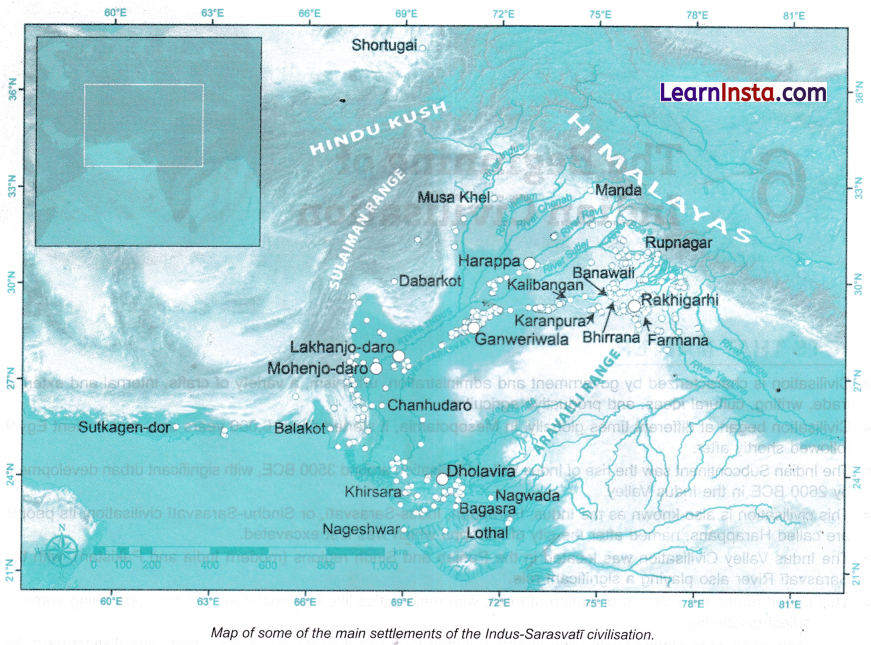
→ The Indus Valley Civilisation was located in the Punjab and Sindh regions (modem India and Pakistan), with the Sarasvati River also playing a significant role.
→ This period marks the First Urbanisation of India, with major cities like Mohenjo-daro and Harappa being some of the earliest discovered.

→ Harappan cities were planned with wide streets oriented to cardinal directions, fortifications, and distinct parts for elites and commoners.
→ Buildings were made from bricks, with consistent quality across different sizes of houses.
→ The ‘Great Bath’ in Mohenjo-daro, an elaborate tank with waterproofing and a drainage system, might have served public, royal, or religious purposes.
→ Harappans emphasized water management with individual bathrooms, underground drainage systems, and reservoirs.
→ They practiced productive agriculture growing cereals (barley, wheat, millet, rice), pulses, vegetables, and were the first in Eurasia to grow cotton.
→ The Harappans used various farming tools, including the plough, some of which are still in use today.
→ They domesticated animals for meat and fished in rivers and seas.
→ Their diet included dairy products and various plants like turmeric, ginger, and bananas, indicating a diverse diet.
→ The Harappans engaged in internal and external trade, exporting items like ornaments and cotton, and possibly gold and food items.
→ They imported copper and used it to make bronze tools, pots, and figurines. Trade routes included land, river, and sea.
→ Lothal had a large dockyard indicating early maritime activity in India.
→ Thousands of small seals, depicting animal figures and writing, were used for trade and identification, though their full meaning remains unclear.
→ The Harappan civilisation Hkely declined due to climatic changes causing reduced rainfall and drought, impacting agriculture and leading to the abandonment of cities.
→ Despite the decline, much of Harappan culture and technology influenced subsequent Indian civilisations. B Indus Valley Civilisation is one of the world’s oldest, known for its planned cities, efficient water management, diverse crafts, and productive agriculture.
→ The Harappan decline highlights the dependency on climate and environment for civilisation stability.
→ Civilisation : An advanced stage of human society characterized by features such as government, urbanism, crafts, trade, writing, cultural ideas, and productive agriculture.
→ Government and Administration : Systems to manage a complex society and its activities.
→ Urbanism : The development of towns and cities, including their planning, growth, and management.
→ Crafts : The creation of goods from raw materials, including tools and ornaments.
→ Trade : The exchange of goods both within a region and with distant regions.
→ Writing : A system of recording information and communicating.
→ Cultural Ideas : Expressions of life and worldview through art, architecture, literature, oral traditions, or social customs.
→ Agriculture : Farming activities, including the cultivation of crops and raising of animals.
→ Mesopotamia : An ancient region in modern Iraq and Syria where early civilisations developed around 6,000 years ago.
→ Indus River : A major river in the Indian Subcontinent that supported early civilisations.
→ Saraswati River : An ancient river mentioned in the Rig Veda, flowing through what is now Haryana, Punjab, and parts of Rajasthan and Gujarat.
→ Harappan : Refers to the people and civilisation associated with the city of Harappa and the broader Indus Valley region.
→ Indus valley Civilisation : An early civilisation that developed in the Indus Valley region, known for its advanced urban planning and trade.
→ Harappa : An ancient city in modern-day Pakistan, one of the first to be excavated from the Indus Valley Civilisation.
→ Mohenjo-daro : An important city of the Indus Valley Civilisation, notable for its urban planning and the Great Bath.
→ Great Bath : A large tank in Mohenjo-daro, with various proposed uses including religious rituals or public bathing.
→ Dholavira : A major city of the Indus Valley Civilisation located in Gujarat.
→ Rakhigarhi : A significant site of the Indus Valley Civilisation in Haryana.
→ Ganweriwala : A major site of the Indus Valley Civilisation located in the Cholistan desert of Pakistan.
→ Lothal : A coastal settlement in Gujarat with a large dockyard for maritime trade.
→ Ghaggar-Hakra River : A river system that was significant to the Harappan civilisation, now seasonal.
→ Plough : A farming tool used for tilling soil, developed by the Harappans.
→ Cotton : A crop first grown by the Harappans, used in textile production.
→ Bronze : A metal alloy of copper and tin, usted by the Harappans for tools and figurines.
→ Steatite : A soft stone used to make seals in the Harappan civilisation.
→ Seals : Small, engraved objects used for trade, depicting animal figures and writing.
→ Climatic change : A significant alteration in climate, which contributed to the decline of the Harappan civilisation.
→ Rural Life Style : A way of life focused on agriculture and living in smaller communities, adopted after the decline of the cities.
→ Trade Routes : Paths used for exchanging goods, including land routes, rivers, and maritime routes.
→ Maritime Activity : Sea-based trade and transportation, significant in the Harappan civilisation.
→ Artisan : A skilled worker who creates crafted goods, such as those found in Harappan trade.
→ Beads of carnelian : Semi-precious stones used in ornaments, traded by the Harappans.
→ Conch Shells : Marine shells worked into bangles, illustrating Harappan craftsmanship.
→ Indus-saraswati Civilisation : Another name for the Indus Valley Civilisation, reflecting its connection to the Sarasvati River.
→ Harappan Cities : Urban centers of the Indus Valley Civilisation, known for their advanced planning and infrastructure.
→ Water Management : The system of managing water resources, including wells and drainage, crucial for Harappan cities.
→ Agricultural Produce : Crops and goods produced through farming, essential for city sustenance.
→ Domestic Animals : Animals kept for food and other purposes by the Harappans.
→ Fisheries : The practice of fishing, utilized by the Harappans for food.
→ Seals and Inscription : Small, engraved items used for trade and potentially communication, with undeciphered writing.