These Class 6 Science Curiosity Worksheet and Class 6 Science Chapter 7 Temperature and its Measurement Worksheet with Answers are excellent for board exam practice.
Class 6 Science Chapter 7 Temperature and its Measurement Worksheet
Class 6 Temperature and its Measurement Worksheet
Worksheet On Temperature and its Measurement Class 6 – Temperature and its Measurement Worksheet Class 6
A. Objective Type Questions
Multiple Choice Questions
Question 1.
Paheli and Boojho measured their body temperature. Paheli found her’s to be 98.6 °F, and Boojho recorded 37°C. Which of the following statement is true?
(a) Paheli has a higher body temperature than Boojho
(b) Paheli has a lower body temperature than Boojho
(c) Both have a normal body temperature
(d) Both are suffering from fever
Answer:
(c) Both have a normal body temperature
Question 2.
Boojho has three thermometers as shown in figure. He wants to measure the temperature of his body and that of boiling water. Which thermometer(s) should he choose?

(a) Thermometer (i) or (iii) for measuring body temperature and (ii) for measuring the temperature of boiling water.
(b) Thermometer (i) for measuring the temperature of both.
(c) Thermometer (ii) for measuring the temperature of both.
(d) Thermometer (iii) for measuring the temperature of both.
Answer:
(a) Thermometer (i) or (iii) for measuring body temperature and (ii) for measuring the temperature of boiling water.

Question 3.
Four arrangements to measure the temperature of the ice in a beaker with laboratory thermometer are shown in figure. Which one of them shows the correct arrangement for accurate measurement of temperature?
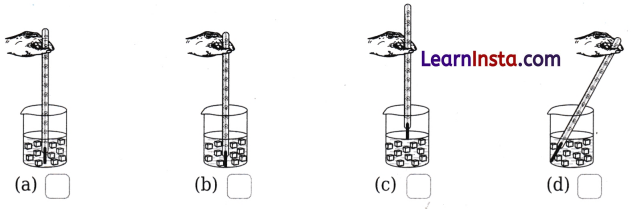
Answer:
Question 4.
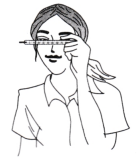
Figure shows a student reading a doctor’s thermometer. Which of the figure indicates the correct method of reading temperature?

Answer:
(a)
Question 5.
Figure shows the readings on four different thermometers. Indicate which of the reading shows the normal human body temperature.

Answer:
(c)

Question 6.
SI unit of temperature is ______
(a) Metre
(b) Centimeter
(c) Celsius
(d) Kelvin
Answer:
(d) Kelvin
Question 7.
According to the Fahrenheit scale, the steaming point of water is _____
(a) 212°F
(b) 312°F
(c) 100°F
(d) 102°F
Answer:
(a) 212°F
Question 8.
According to the Celsius scale, the frozen point of water is ____
(a) 2°C
(b) 1°C
(c) 0°C
(d) 3°C
Answer:
(c) 0°C
Question 9.
According to the Celsius scale, the steaming point of water is
(a) 200°C
(b) 100°C
(c) 0°C
(d) 3°C
Answer:
(b) 100°C
Question 10.
Conversion of temperature from Celsius to Kelvin is, K = _____.
(a) C + 273.15
(b) C – 273.15
(c) C × 273.15
(d) C ÷ 273.15
Answer:
(a) C + 273.15
Question 11.
Which of the following is not a method of measuring temperature?
(a) Using a digital thermometer
(b) Using a glass of water
(c) Using a mercury thermometer
(d) Using an infrared thermometer
Answer:
(b) Using a glass of water
Question 12.
Heat from the measuring instrument can cause a temperature
(a) loss
(b) high
(c) gradient
(d) volume
Answer:
(c) gradient
Question 13.
Heat energy flows from one body to another body due to the ____ in temperature.
(a) sum
(b) difference
(c) divison
(d) None of these
Answer:
(b) difference
Question 14.
Which material is typically used in a clinical thermometer for measuring body temperature?
(a) Water
(b) Mercury
(c) Alcohol
(d) Gas
Answer:
(b) Mercury
Question 15.
Which thermometer is used to measure temperature of different things and places?
(a) Laboratory thermometer
(b) Clinical thermometer
(c) Minimum and maximum thermometer
(d) None of the above
Answer:
(c) Minimum and maximum thermometer
Question 16.
10°C is equal to
(a) 173 K
(b) 273 K
(c) 283 K
(d) 183 K
Answer:
(c) 283 K
Fill in the Blanks
While going through the notebook of your friend, you find that he has written incomplete statements. Complete them using your knowledge of temperature measurement.
Question 1.
____ determines the degree of hotness or coldness of a body.
Answer:
Temperature
Question 2.
On heating a body, its temperature _____.
Answer:
increases
Question 3.
We use a ____ for measuring the temperature of a human body.
Answer:
clinical thermometer
Question 4.
The SI unit of temperature is ____.
Answer:
Kelvin
Question 5.
A person is said to have fever if his temperature is above ____ °C.
Answer:
37°C
Question 6.
The temperature of boiling water is ____ °C.
Answer:
100°C
True/False
Shubham was going through below statements while reading the notes of chapter. He found that some statements are incorrect. He has to mark the incorrect statement with a star.
Question 1.
If a thermometer shows a temperature of 100°C, it indicates that the surrounding environment is much hotter than water’s boiling point.
Answer:
False
Question 2.
The names of temperature scales-Celsius scale, Fahrenheit scale and Kelvin scale.
Answer:
True
Question 3.
For measuring the body temperature of small children or old people, the digital thermometer cannot be placed in the armpit.
Answer:
True
Question 4.
The normal temperature of a healthy human body is taken to be 37.0 °C.
Answer:
True
Question 5.
Digital thermometers pose risk and also the numbers in its display are not easier to rea
Answer:
True
Question 6.
There are two types of thermometers that you are likely to come across-clinical thermometers and laboratory thermometers.
Answer:
False
Assertion-Reason Questions
The question below consists of two statements- one is labelled as Assertion (A) and the other is labelled as Reason (R). Use the following key to choose the appropriate answer.
(a) Both A and R are true and R is the correct explanation of A.
(b) Both A and R are true, but R is not the correct explanation of A.
(c) A is true, but R is false.
(d) A is false, but R is true.
Question 1.
Assertion (A) The thermometer which measures our body temperature is called clinical thermometer.
Answer:
(c) A is true, but R is false.
R can be corrected as
A thermometer is typically a narrow and long glass tube containing a liquid (such as mercury)
that expands or contracts with temperature changes.
Question 2.
Assertion (A) The normal temperature of human body is 37 degree celcius.
Reason (R) The room temperature is 37 degree Celsius.
Answer:
(c) A is true, but R is false.
Room temperature do not always remains constant it varies according to the environmental
condition.
Question 3.
Assertion (A) Laboratory thermometer cannot be used to measure the temperature of the human body.
Reason (R) The laboratory thermometer has no kinks to prevent the mercury from falling back into the bulb after temperature measurement.
Answer:
(a) Both A and R are true and R is the correct explanation of A.
Question 4.
Assertion (A) We use a clinical thermometer to measure the degree of hotness of our body.
Reason (R) Temperature is a measure of degree of hotness of our body.
Answer:
(b) Both A and R are true, but R is not the correct explanation of A.
Question 5.
Assertion (A) Mercury is used in making thermometer.
Reason (R) The material through which heat is passed are used in making thermometers.
Answer:
(c) The correct reason for using mercury in the thermometer is its high boiling point and low
freezing point.
B. Subjective Type Questions
Define the following terms
Question 1.
Thermometer
Question 2.
Temperature
Question 3.
Clinical thermometer
Question 4.
Room thermometer
Question 5.
Kelvin scale
Very Short Answer Type Questions
Question 1.
What is the best way to clean a thermometer?
Question 2.
What is clinical thermometer?
Question 3.
What is the use of maximum-minimum thermometer?
Question 4.
Why does the mercury not fall or rise in a clinical thermometer when taken out of the mouth?
Question 5.
Why clinical thermometer cannot be used to measure high temperatures?
Question 6.
What is the concern associated with the use of mercury thermometer?
Question 7.
Do old people, even when healthy, generally have lower body temperatures than young adults?
Question 8.
Can it always be correctly judged, that a person has fever, only by touching the person?
Short Answer Type Questions
Question 1.
A laboratory thermometer A is kept 7 cm away on the side of the flame while a similar thermometer B is kept 7 cm above the flame of a candle, as shown in figure. Whose temperature is high and why?

Question 2.
In a mercury thermometer, the level of mercury rises when its bulb comes in contact with a hot object. What is the reason for this rise in the level of mercury?
Question 3.
Why clinical thermometers range from 35°C to 42°C?
Question 4.
Describe a situation where the reading of a thermometer might be misleading, and explain why that happens?
Question 5.
Why is it important for a thermometer to have a scale marked clearly, and how does this aid in understanding temperature readings?
Question 6.
You may have noticed that a few sharp jerks are given to clinical thermometer before using it. Why is it done so?
Question 7.
Why is it advised not to hold the thermometer by its bulb while reading it?
Question 8.
A laboratory thermometer has 50 divisions between 0 °C and 100 °C. What does each division of this thermometer measure?
Question 9.
Do small children generally have slightly higher body temperatures as compared to adults?
Question 10.
If a clinical thermometer reads 37°C, what does this indicate about a person’s health and why is this reading important?
Long Answer Type Questions
Question 1.
State the similarities and differences between the laboratory thermometer and the clinical thermometer.
Question 2.
What are the precautions that need to be observed while reading a clinical thermometer?
Question 3.
Why can’t we use a laboratory thermometer to measure human body temperature?
Question 4.
Describe how the use of alcohol in thermometers can be advantageous compared to using mercury?
Question 5.
If you have to measure the temperature 22.5 °C, which of the following three thermometers will you use, Explain.

Case Based Questions
Question 1.
A family goes on a picnic on a warm day when the temperature is 30°C. They pack sandwiches, fruits, and juice. As they enjoy their time outdoors, they notice that the juice has become warm and the sandwiches are sweating. They forgot to bring a cooler to keep the food at a safe temperature. Concerned about food safety, they discuss what to do next.
(i) Why should the family be careful about how long they leave their sandwiches and juice in the warm Sun?
(ii) If the family had used a thermometer, what temperature should they have checked to make sure their food was safe?
(iii) What are some simple things the family could do next time to keep their food cold during a picnic?
Question 2.
Vaishnavi has not gone to school as she is ill. Her mother has kept a record of her body temperature for three days as shown in table.
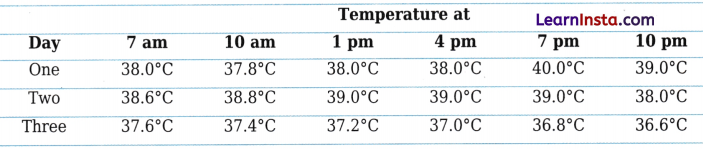
(i) What was Vaishnavi’s highest recorded temperature?
(ii) On which day and at what time was Vaishnavi’s highest temperature recorded?
(iii) On which day did Vaishnavi’s temperature return to normal?
Question 3.
A teacher conducts a class experiment to teach students about temperature measurement. She has three thermometers: one is a clinical thermometer for measuring body temperature, another is a maximum-minimum thermometer for measuring outdoor temperatures and the third is a liquid-in-glass thermometer for measuring the temperature of water. The students take turns measuring the temperature of their classroom, water and their own body.
(a) What is the purpose of using different types of thermometers in this experiment?
(b) Why is it important to read the thermometer at eye level when taking a temperature measurement?
(c) How can the students use a maximum-minimum thermometer to learn about temperature changes throughout the day?
Skill Based Activities
Question 1.
Riddle: I freeze at zero and boil at one hundred, my measurements help scientists feel quite grounded. What am I?
Question 2.
Air temperature is an important weather parameter and is monitored at weather stations all over the world. What are the different techniques used to measure Air temperature?
Question 3.
Gather information from the Internet and find out how the body temperature of animals, such as a cat, dog, horse, camel, cow and buffalo, is measured. If there is any veterinary hospital in your vicinity, you may visit to see the body temperature of animals being measured.
Question 4.
Find out which places in India are usually regarded to be the coldest and hottest. Also, find out the minimum and the maximum temperatures recorded for these places.
Question 5.
Various planets in our Solar System are at different distances from the Sun. Search the Internet and make a table with the planets, their distances from the Sun (in increasing order) and their temperatures written. Does the average temperature of planets decrease as their distance from the Sun increases? If it is not true for any planet, find out for which planet and why?
Question 6.
The temperature at the core of the Sun reaches as high as 15 million degrees Celsius. Are there objects in the sky that have even higher temperature?