Students can use Poorvi Book Class 7 Solutions Unit 2 Wit and Humour Chapter 6 Say the Right Thing Questions and Answers as a quick reference guide.
Say the Right Thing Class 7 Questions and Answers
Say the Right Thing Class 7 Question Answer
NCERT Class 7 English Poorvi Chapter 6 Say the Right Thing Question Answer
Say the Right Thing Question Answer – Let us do these activities before we read (Page 70)
I. Work in pairs and discuss.
Question 1.
What does ‘Atithi Deuo Bhava’ mean?
Answer:
‘Atithi Devo Bhava’ is a Sanskrit phrase that means “The guest is God.” It reflects the Indian tradition of treating guests with the highest respect and hospitality.
Question 2.
Why is it important to be polite to guests?
Answer:
Being polite to guests ‘shows respect, kindness, and appreciation for their presence. It creates a welcoming and comfortable atmosphere, which helps
strengthen relationships and shows good manners.
II. Choose the statements that display polite behaviour when you have guests at home.
1. Offer the guests a glass of water.
2. Enquire about the well-being of the guests.
3. Ask the guests when they would leave.
4. Comment critically about the habits of guests.
5. Accompany the guests to the door when they leave.
Answer:
The statements 1, 2 and 5 desplay polite behaviour.
III. Sometimes you find that a few friends in class are rude while disagreeing with each other on certain issues. Work in groups. How would you deal with such a situation? Share at least three ways in which you can do this.
Answer:
1. Request calm and respectful dialogue: Request your friends to listen to each other’s points of view without interrupting or raising their voices. This can help in resolving the disagreement peacefully.
2. Suggest finding common ground: Help them identify areas of agreement and focus on those, rather than the points of disagreement, to foster understanding.
3. Stay neutral and be a mediator: If needed, act as a neutral mediator, ensuring both sides express themselves without being rude or disrespectful.

Say the Right Thing Class 7 Question Answer – Let us discuss (Page 74)
I. Complete the table given below based on Scene I of the play. An example has been done for you. Share your answers with your classmates and the teacher.
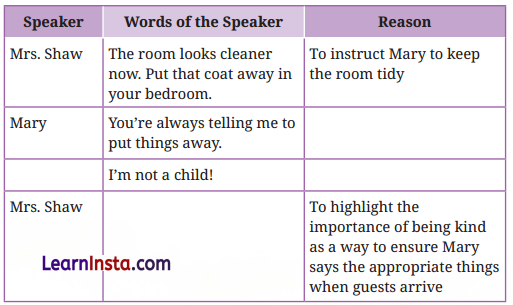
Answer:
| Speaker | Words of the Speaker | Reason |
| Mrs. Shaw | The room looks cleaner now. Put that coat away in vour bedroom. | To instruct Maiy to keep the room tidy and prepare for the guests. |
| Mary | You’re always telling me to put things away. I’m not a child! | To express her frustration with her mother’s constant instructions. |
| Mrs. Shaw |
I can’t tell you everything but you 11 always be right if you’re kind to people. | To highlight the importance of being kind as a way to ensure Mary says the appropriate things when guests arrive |
II. Do you think Mary will be able to follow her mother’s advice successfully when Mrs. Harding and Mrs. Lee visit? Why or why not?
Answer:
No, Mary will likely not be able to follow her mother’s advice successfully. While she expresses confidence in being able to talk and interact, she shows a lack of understanding about the nuances of polite conversation and social etiquette. Throughout the scene, she makes several blunders, such as referring to Mrs. Harding as a mother with children, criticizing others inappropriately^ and making insensitive comments about people she doesn’t know well. Her forgetfulness and tendency to speak without considering the impact of her words suggest that she will have difficulty following her mother’s guidance and will likely embarrass herself during the visit.
Class 7 English Say the Right Thing Question Answer – Let us discuss (Page 77)
I. Rectify the false statements given below from Scene II of the play. An example has been done for you. Share your answers with your classmates and the teacher.
1. Mrs. Harding states that they do not like London as it is not the same as Lanfield. Rectification: Mrs. Harding states that they like Lanfield veiy much even though it is not the same as London.
2. Mrs. Harding was pleased to know that Mary was familiar with her children.
3. Mrs. Shaw shared that she liked Mrs. Best as she read a lot of newspapers.
4. Mrs. Harding and Mrs. Shaw agree that wearing a blue dress with a red coat is unfashionable.
5. Mary shares that she finds the dog outside the window cute.
Answer:
The corrections for the false statements based on Scene II of the play:
1. Mrs. Harding states that they do not like London as it is not the same as Lanfield.
Rectification: Mrs. Harding states that they like Lanfield very much even though it is not the same as London.
2. Mrs. Harding was pleased to know that Maiy was familiar with her children.
Rectification: Mrs. Harding was unhappy to learn that Mary was unaware that she did not have any children.
3. Mrs. Shaw shared that she liked Mrs. Best as she read a lot of newspapers.
Rectification: Mrs. Shaw shared that she liked Mrs. Best because she had a pleasant and engaging personality, not because of her newspaper reading.
4. Mrs. Harding and Mrs. Shaw agree that wearing a blue dress with a red coat is unfashionable.
Rectification: Mrs. Harding and Mrs. Shaw agree that wearing a blue dress with a red coat is a bold fashion choice, but not necessarily unfashionable.
5. Mary shares that she finds the dog outside the window cute.
Rectification: Mary shares that she finds the dog outside the window a bit annoying and not particularly cute.
Say the Right Thing Class 7 Questions and Answers – Let us think and reflect (Pages 78-79)
I. Read the extracts given below and answer the questions that follow.
Question 1.
MARY: What are you going to talk about? MRS. SHAW: I don’t know. All kinds of things. One day you’ll have to go to some of these houses yourself and talk to the people there. MARY: I can talk now. I’ve been able to talk for a long time.
MRS. SHAW: Yes, that’s true. You always talk too much. But does anyone want to hear the things that you say?
MARY: I can talk very well when I like. I’ll stay with you today and talk to them when they come.
MRS. SHAW: Oh, I don’t think so. You can go out for a walk. It will be better if you do that.
(i) What does Mrs. Shaw imply when she says, “One day you 11 have to go to some of these houses yourself and talk to the people there”?
(a) She believes Mary should start learning about hosting guests then.
(b) She thinks Maiy is ready to visit these houses independently.
(c) She wants Mary to develop social skills for the future.
(d) She hopes Mary will avoid these social interactions entirely.
Answer:
(c) She wants Mary to develop social skills for the future.
(ii) Complete the following sentence with the correct option from the brackets: Mrs. Shaw and Mary are discussing how to __________.
(have a polite conversation/get to know people better)
Answer:
Mrs. Shaw and Mary are discussing how to get to know people better.
(iii) Why did Mary insist on staying with her mother when the guests arrived?
Answer:
Mary insisted on staying with her mother when the guests arrived because she felt confident in her ability to talk and wanted to prove that she could interact well with others, even though her mother thought it would be better for her to go for a walk.
(iv) Match the following character traits to the characters in the extract:
A. eager
B. inexperienced
C. cautious
Mary
Mrs. Shaw
Answer:
- A. eager → Mary
- B. inexperienced → Mary
- C. cautious → Mrs. Shaw
Question 2.
MARY: I saw Mrs. Cotter this afternoon. I met her in the street. No one sees her in the morning because she always stays in bed then. And she’s always asking the doctor to go to see her. I can’t understand women who stay in bed in the morning. And why must she always ask for the doctor? I’ve never been to a doctor in my life. MRS. HARDING: I stay in bed in the morning myself.
(i) Complete the following sentence suitably.
Mary could spot Mrs. Cotter in the street because __________
Answer:
No one sees her in the morning since she always stays in bed, then.
(ii) What does Mary’s comment about Mrs. Cotter staying in bed and calling the doctor suggest about her understanding?
(a) She is worried about why Mrs. Cotter stays in bed all morning.
(b) She is unable to understand why people need medical help.
(c) She thinks Mrs. Cotter is scared and lonely for staying in bed.
(d) She believes Mrs. Cotter is right to rest and take care of herself.
Answer:
(b) She is unable to understand why people need medical help.
(iii) How can we say that Maiy enjoyed good health?
Answer:
Mary enjoyed good health because she mentions that she has never been to a doctor in her life, indicating that she had no need for medical attention, suggesting she was physically well.
(iv) Identify whether the following statement is true or false.
Mary might have unintentionally offended Mrs. Harding.
Answer:
True
(Mary’s comment about not needing a doctor and not understanding why someone would stay in bed could have unintentionally offended Mrs. Harding, who admits that she stays in bed in the morning herself.)
II. Answer the following questions.
Question 1.
What does Mary’s comment about Mr. Best’s routine and profession reveal about her viewpoint on bankers and their way of life?
Answer:
Mary’s comment reveals her limited understanding of professions like banking. She sees Mr. Best’s routine and profession as monotonous or unremarkable because she fails to grasp the significance of a banker’s role and the demands of the job. She might see it as a life focused solely on routine without excitement.
Question 2.
What can we infer about Mary’s understanding of polite conversation based on her interactions with the guests?
Answer:
Mary’s understanding of polite conversation is minimal, as she often speaks without considering social norms or the interests of others. Her insistence on staying with her mother and speaking freely may indicate that she doesn’t fully grasp the importance of listening, tone, and context in
conversations, especially in formal or social settings.
Question 3.
What do you think the repeated stage direction ‘no one speaks’ indicates about the atmosphere in the room when Mary speaks?
Answer:
The repeated stage direction “no one speaks” suggests tension or discomfort. It indicates that Mary’s words have caused an awkward silence, and her comments are not well-received by the guests. This moment highlights how her lack of social etiquette and her inappropriate comments lead to a break in the flow of conversation, making the atmosphere uncomfortable.
Question 4.
How does Mary’s attitude towards the guests change throughout the play?
Answer:
At first, Mary is eager and perhaps a bit overconfident about her ability to interact with the guests. However, as the play progresses, she becomes more aware of the challenges of polite conversation and begins to realize that her previous, approach was inappropriate. Her attitude shifts from confident to somewhat embarrassed or self- aware as she recognizes her blunders.
Question 5.
What do Mrs. Harding’s and Mrs. Lee’s responses to Mary’s blunders during their visit reveal about their characters?
Answer:
Mrs. Harding and Mrs. Lee show patience and understanding towards Maiy’s blunders. Mrs. Harding is likely more protective, trying to guide Mary subtly, while Mrs. Lee may be more direct or even critical. Both women, however, reveal a concern for social propriety and their roles as older, more experienced figures trying to impart proper behavior to Maiy, albeit in different ways.
Question 6.
In what way does the play show the importance of knowing how to engage in polite conversation?
Answer:
The play demonstrates the importance of knowing how to engage in polite conversation through Mary’s failures and the discomfort they cause. As Mary struggles with her interactions with the guests, it becomes clear that a lack of social understanding and the inability to converse politely can lead to awkwardness and social alienation. The play highlights that polite conversation is not just about speaking but also about listening, respecting others’ interests, and knowing when to speak or remain silent.
Say the Right Thing Question Answer Class 7 – Let us learn (Pages 80-84)
I. Study the following words taken from the text. humorous, hilariously, coming, beautiful
The given words are made by adding word
endings like -ous, -ly, -ing, and -ful to the root
words humour, hilarious, come, and beauty.
Such word endings are called suffixes.
- humour + -ous
- hilarious + -ly
- come + -ing
- beauty + -ful
Now, divide the following words from the text as root words and suffixes.
Check your answer with the teacher.

Answer:
Here are the words and their breakdown into root words and suffixes:
gladly
- Root word: glad
- Suffix: -ly (adverb)
banker
- Root word: bank
- Suffix: -er (noun, indicating a person)
guidance
- Root word: guide
- Suffix: -ance (noun, indicating action or process)
quietly
- Root word: quiet
- Suffix: -ly (adverb)
Question 1.
Study the words in Column 1. Match the suffixes in Column 2 with their meanings or purpose in Column 3. Write a few examples for each in Column 4. Share your answers with the teacher.

Answer:
| Column 1 | Column 2 (Suffix) | Column 3 (Meaning/ Purpose) | Column 4 (Examples) |
| Biology | (i) -logy | C. a study of | Ecology, Sociology, Geology |
| tolerance | (ii) -ance | F. change to a noun | Acceptance, Endurance, Importance |
| stopped | (in) -ed | E. change to oast tense | Played, Talked, Stopped |
| backward | (iv) -ward | G. in a certain direction | Forward, Upward, Downward |
| courageous | (n)-ous | H. change to adjective | Ambitious, Adventurous, Advantageous |
| quietly | M-iy | A. change to adverb | Happily, Slowly, Speedily |
| toughest | (vii)-e st | D. change to superlative | Fastest, Smallest, Largest |
| Tomatoes | (viii)-es | B. change to plural | Mangoes, Heroes, Potatoes |
Suffixes and Their Functions:
- -ance: Turns a verb into a noun, indicating a state or quality (e.g., tolerance → the state of tolerating).
- -ed: Changes a verb to the past tense (e.g., stopped → past action).
- -ward: Indicates direction or movement (e.g., backward → in the direction of the back).
- -ous: Changes a noun to an adjective, indicating possessing qualities (e.g., courageous → full of courage). ,
- -ly: Changes an adjective to an adverb (e.g., quietly → in a quiet manner).
- -est: Forms the superlative degree of an adjective or adverb (e.g., toughest → the most tough).
- -es: Makes a noun plural (e.g., tomatoes → more than one tomato).
Question 2.
Fill in the blanks using words given in the brackets by adding suitable suffixes.
To communicate (i) ___________ (effective), choose your words and topics (ii) ___________ (wise). Avoid (iii) ___________ (discuss) things you don’t know much about or that could upset someone. Remember to be (iv) ___________ (respect) towards others, including yourself, and express your (v) ___________ (appreciate). Finally, always be (vi) ___________ (response) by replying promptly to communicate.
Answer:
(i) effectively
(ii) wisely
(iii) discussing
(iv) respectful
(v) appreciation
(vi) responsible
II. Read the highlighted words in the following sentences from the text.
- But does anyone want to hear the things that you say?
- I can’t tell you everything.
Select the correct answer.
Is there a difference in the meanings of ‘say’ and ‘tell? (Yes/No)
- ‘Say’ focuses on the message and does not always require a listener.
- ‘Tell’ focuses on who receives the message and always needs a listener.
Answer:
Yes, there is a difference.
1. Fill in the blanks with suitable words from the sets of words given in the box below.
Make changes in the verb forms (tense), if necessary.
- fetch : go somewhere to get something and bring it back
- bring : take something with you to the place you are going
- see : something that we view, whether or not we pay attention
- look : focus your eyes in a certain direction by paying attention
- live : permanent place of residence
- stay : temporary presence in a location as a guest or visitor
- study : spend time learning something as part of formal education
- learn : gain knowledge or skill through study or experience
- speak: express thoughts or ideas aloud, often in formal situations talk : engage in informal conversation with someone
- hear : perceive sounds unintentionally through the ears
- listen : pay attention to sounds or speech intentionally
(i) I _________ at the photo, but I didn’t _________ anyone familiar.
(ii) I’d better go and _________ my mother from the station, and then _________ her home.
(iii) I need to _________ for my mathematics exam this weekend, so I hope to _________ new concepts along the way.
(iv) I can _________ the music from my neighbour’s house, but I need to _________ to it carefully to understand the lyrics.
(v) “Could I _________ to Mrs. Kalpana, who is going to _________ to us about gardening,” said Ritu.
(vi) I _________ in a small town, but I often _________ with my relatives in the city.
Answer:
(i) looked, see
(ii) fetch, bring
(iii) study, learn
(iv) hear, listen
(v) speak, talk
(vi) live, stay
III. Read the following sentences from the text and underline the verbs.
They lived in London before.
I met her in a shop and asked her to come.
Answer:
- They lived in London before.
- I met her in a shop and asked her to come. As you know, the verbs you have underlined are in simple past tense (actions that happened in the past or distant past)
Read the following sentence from the text and underline the verb.
She has been staying with them for a while. The verb you have underlined is in present perfect continuous tense.
Answer:
She has been staving with them for a while.
We use present perfect continuous (has/have + been + verb + -ing) to indicate:
The duration of an action that started in the past and continues up to the present moment.
- Mrs. Shaw has been preparing the room since the morning for Mrs. Harding and Mrs. Lee’s visit.
An action that was ongoing in the recent past, with its results evident now. The focus is on the ongoing activity rather than its completion. - Mrs. Shaw has been cleaning the room since the morning. (The room looks spotless now.)
- The students have been practising a play about the story. (They are rehearsed and ready.)
Question 1.
Fill in the blanks using the verbs given in brackets in present continuous or present perfect continuous tense. ,
The students (i) ______________ (organise) a play and setting up the stage. They (ii) ______________ (prepare) for weeks to make everything perfect. The performers (iii) ______________ (rehearse) every day, and their excitement (iv) ______________ (grow). The sound in-charge (v) ______________ (test) the microphones to check the sound quality. Everyone (vi) ______________ (work) hard, and now the place (vii) ______________ (buzz) with energy and excitement.
Answer:
(i) are organising
(ii) have been preparing
(iii) have been rehearsing
(iv) are growing
(v) are testing
(vi) has been working
(vii) is buzzing
IV. Read the explanation about the kinds of sentences given in the table below.

Question 1.
Identify the kinds of sentences and punctuate them appropriately.
(i) the meeting starts at 10.00 a.m. in the conference room
(ii) what an exciting adventure it was
(iii) how did you solve the problem so quickly
(iv) what is the weather forecast today
(v) how beautiful is the rainbow
(vi) clean up your room before dinner
(vii) the children are planning a surprise party for their mom
(viii) turn off the music
Answer:
(i) Declarative: The meeting starts at 10:00 a.m. in the conference room.
(ii) Exclamatory: What an exciting adventure it was!
(iii) Interrogative: How did you solve the problem so quickly?
(iy) Interrogative: What is the weather forecast today?
(v) Exclamatory: How beautiful is the rainbow!
(vi) Imperative: Clean up your room before dinner.
(vii) Declarative: The children are planning a surprise party for their mom.
(viii) Imperative: Turn off the music.
Class 7 English Chapter 6 Question Answer – Let us listen (Page 84)
I. Mrs. Shaw wanted Mary to learn to say the right thing. You will listen to a conversation between a mother and her son about basic manners. As you listen, fill in the blanks given below by selecting the correct option. (Refer to the NCERT textbook page-89 for transcript)
Question 1.
How did the son behave in the grocery queue?
(i) strangely
(ii) impatiently
(iii) politely
Answer:
(ii) impatiently
Question 2.
The mother finally refers to her son as a
(i) polite young man
(ii) responsible son
(iii) grateful person
Answer:
(i) polite young man
II. You will once again listen to the conversation. As you listen, select four true statements from 1-7 given below.
1. The mother uses th6 grocery store incident as an opportunity to teach her son about patience and fairness.
2. The son recognises the value of apologising and understands that it shows he notices others.
3. The son is gradually learning the importance of polite words and actions from his mother’s guidance.
4. The mother discourages her son from speaking softly in public, suggesting that people should adjust to his voice level.
5. The son feels that covering his mouth when coughing is only important when he’s at home.
6. The son receives all advice readily while understanding its importance.
7. The mother uses praise to support the polite behaviours she wants her son to continue practising.
Answer:
Statements 1,2,3, and 7 are TRUE statements.
NCERT Class 7 English Poorvi Chapter 6 Question Answer – Let us speak (Pages 84-86)
As you know
• Intonation is the rise and fall of the pitch of tone while speaking.
Let us learn about sentence stress.
Sentence stress is laying emphasis on certain word(s) in a sentence.
- The emphasis on particular words helps to convey the meaning and importance of the sentence.
- Content words like book, run, beautiful, quickly, etc., are mostly stressed instead of function words like she, in, is, etc., in a sentence.
I. Speak the given declarative sentence aloud.
I saw Mrs. Cotter this afternoon.
- Use falling intonation towards end of the sentence as declarative sentences usually have falling intonation.
Stress the words ‘Mrs. Cotter’.
Remember, stress does not mean to say the word louder than others. It means to say a word with more emphasis than others.
Answer:
Do it yourself.
II. Speak the following declarative sentences with falling intonation and stress the highlighted words.
1. The room looks cleaner now.
2. You always talk too much.
3. You leave your clothes all over the house.
Answer:
Do it yourself.
III. Work in pairs and speak the following sentences 1-5 aloud, as Mary. Apply stress and falling intonation.
Match each of the sentences to the meaning they convey in
(i)-(v).
Sentences
1. I didn’t hurt anyone today.
2. I didn’t hurt anyone today.
3. I didn’t hurt anyone today.
4. I didn’t hurt anyone today.
5. I didn’t hurt anyone today.
Meaning conveyed
(i) I might have done other things but did not hurt anyone.
(ii) I might cause hurt usually, but not anyone on this day.
(iii) The action of hurting anyone did not occur.
(iv) I, specifically, did not hurt anyone, possibly implying someone else might have.
(v) I may have spoken a lot many things but not a single person was hurt.
Answer:
1. (ii), 2. (i), 3. (iii), 4. (v), 5. (ii)
IV. Now, speak the given declarative sentence with rising intonation towards the end of sentence and stress the highlighted words. I saw Mrs. Cotter this afternoon.
The rising intonation makes it sound like a question. It asks whether I was the person who actually saw Mrs. Cotter: Did I see Mrs. Cotter this afternoon?
Remember
The way we use stress and intonation in a sentence can change the meaning of what we wish to say if we are not careful.
Answer:
Do it yourself.
Class 7th English Chapter 6 Say the Right Thing Question Answer – Let us write (Page 86)
Rewrite the play ‘Say the Right Thing’ as a short story, focusing on Mary’s interactions with her mother and the guests.
- Ensure the story captures the main events, character emotions, and humorous moments effectively.
- Use paragraphs to organise your story and include descriptive language to bring the characters and events to life.
You may refer to the following hints:
- Begin with an introduction: describe Mary and Mrs. Shaw, their relationship and the setting of the story.
- Explain Mrs. Shaw’s instructions to Mary before the guests arrive and Mary’s confidence in handling the situation.
- Narrate the events when Mrs. Harding and Mrs. Lee visit, highlighting Mary’s remarks and the guests’ reactions.
- Include key moments of humour and awkwardness to maintain the tone of the play.
- Conclude by commenting on how the visit ended and Mary’s impact on the situation.
Answer:
Mary Shaw was a lively young girl with a strong sense of curiosity. She loved spending time with her mother. Mrs. Shaw was kind but also very particular about teaching her daughter the importance of politeness and good manners. One day the guests—Mrs. Harding and Mrs. Lee—arrived, and despite her mother’s thorough coaching, Mary forgot everything she was taught, leading to a series of comical and awkward situations. For instance, she mistakenly referred to Mrs. Harding as a mother with children when Mrs. Harding didn’t have any. Mary also awkwardly remarked about a neighbor, Mr. Best, suggesting that he lived in trains and read newspapers constantly, making an unflattering observation about his job as a banker. Mary continued to make blunders as the conversation unfolds. When the guests prepared to leave, Mary; in a final moment of forgetfulness, tried to say the polite thing but mistakenly said, “Oh, must you stay? Can’t you go?” instead of asking them to stay longer.
Say the Right Thing Class 7 NCERT Solutions – Let us explore (Pages 86-87)
I. Work in groups. Enact your favourite part of the play.
Points to remember:
- Allot a specific role to each member in the group. For example: director, narrator, and characters
- Include the actions and expressions as indicated in brackets in the play.
Answer:
In this group activity, your group can select a part of the play “Say the Right Thing” that you enjoy the most and then perform it with actions and expressions. Here’s how you can break it down:
1. Assign Roles:
- Director: Responsible for overseeing the performance and guiding the actors.
- Narrator: The narrator will introduce the scene, provide transitions, and describe actions and emotions when needed.
- Characters: The characters involved in the scene. For example, you can choose Mary, Mrs. Shaw, Mrs. Harding, and Mrs. Lee.
2. Prepare the Script: Choose a favorite scene and write a brief script based on the play.
For example:
- Mary greeting the guests, or the awkward moment when Mary speaks about food at the dinner table.
- Include the actions and expressions as indicated in the play.
For example:
- (Mary’s expression is bright when she greets the guests).
- (Mrs. Shaw looks embarrassed when Mary says something inappropriate).
3. Practice and Perform:
- Rehearse the scene, practicing the lines, body language, and expressions.
- As the director, ensure everyone follows the script and performs the actions appropriately.
- The narrator can help with context if needed (for example, explaining why a certain scene is funny or awkward).
4. Perform the Scene:
Have each member perform their part in front of the class, paying attention to voice tone, expressions, and timing.
II. Find out how people greet guests who visit their homes in different languages. Share it with your classmates and the teacher.
Answer:
Greeting Guests in Different Languages
In this task, you will find out how people greet guests in different languages and share it with your classmates.
1. Examples of Greetings in Different Languages:
- English: “Hello! Welcome to our home!”
- Hindi: “नमस्ते! हमारे घर में आपका स्वागत है!” (Namaste! Hamare ghar mein aapka swagat hai!)
- Spanish: “¡Hola! ¡Bienvenidos a nuestra casa!”
- French: “Bonjour ! Bienvenue chez nous !”
- German: “Hallo! Willkommen in unserem Haus!”
- Japanese: 「こんにちは!我が家へようこそ!」(Konnichiwa! Watashitachi no ie e youkoso!)
- Arabic: “مرحبا! مرحبا بكم في منزلنا!” (Marhaban! Ahlan wa sahlan fi baytina!)
- Russian: “«Привет! Добро пожаловать в наш дом!»” (Zdravstvuyte! Dobro pozhalovat v nash dom!)
2. Sharing with Classmates:
- In your group, take turns sharing how to greet someone in a language you’ve researched.
- Discuss the cultural significance behind these greetings if possible.
- Share the greeting with your classmates, encouraging them to practice saying the greetings in those languages.
III. ‘Vasudhaiva Kutumbakam’ (वसुधैव कुटुम्बकम) is a Sanskrit phrase which means the world is one family. Vasudha (वसुधा) means Earth; eva (एव) translates to ‘is thus’ and Kutumbakam (कुटुम्बकम) means ‘family’. The phrase originates from ancient Indian texts like the Maha Upanishad and the Hitopadesha.
This saying highlights the interconnectedness of all people, suggesting that humanity is part of a single global family. It encourages unity, cooperation, and treating others with kindness and empathy, regardless of differences in nationality, race, or religion. The message is often used to promote global peace and mutual understanding among diverse cultures and nations.
‘Vasudhaiva Kutumbakam’ was chosen as the theme for the G20 Summit which captured the essence of global unity, common bonds, and shared aspirations for a better future.
Answer:
Do it yourself.