Experts have designed these Class 8 Science Notes Chapter 6 Pressure, Winds, Storms, and Cyclones Class 8 Notes for effective learning.
Class 8 Science Chapter 6 Pressure, Winds, Storms, and Cyclones Notes
Class 8 Pressure, Winds, Storms, and Cyclones Notes
Class 8 Science Chapter 6 Notes – Pressure, Winds, Storms, and Cyclones Notes Class 8
→ Pressure: The force applied perpendicular on a surface per unit area.
The formula for pressure is:
Pressure =\(\frac{\text { Force }}{\text { Area }}\)
→ The SI unit of force is newton and that of area is metre2. Therefore, SI unit of pressure is newton metre2 (N/m2). This unit is also called a pascal, denoted by Pa.

Smaller the area of the object, larger the pressure, whereas larger the area of the object, smaller the pressure. For example, the pointed end of a nail has a much smaller surface area, so the same force applied by a hammer results in large pressure, allowing the nail to penetrate the wooden block more easily. In contrast, the flat head has a larger surface area, so the force is spread over a wider area, resulting in less pressure, making it harder to insert. Similarly, cutting an apple is easier with the sharp edge of a knife because it applies larger pressure than the blunt edge.
→ A bag with broad straps feels more comfortable than one with narrow straps because its weight is spread over a larger area, reducing pressure on the shoulders.
→ Similarly, it is easier to carry a water-filled bucket with broad handle as compared to a bucket with narrow handle.
→ Liquids exert pressure, and this pressure increases with the height of the liquid column, not its weight or container width. That’s why overhead tanks are placed at a height-to ensure higher water pressure in taps. In a building, lower floors receive stronger water flow due to greater pressure from the taller water column above them.
→ Liquids exert pressure not only at the bottom of the container but also on its sides and in all directions. This can be observed by making holes at the same height around a water-filled bottle; water flows out equally from all holes, showing that liquid pressure acts sideways as well as downward.
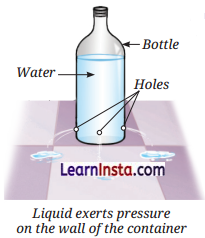
→ Water Pressure and Dams: A broad base not only supports the dam’s structure but also withstands the intense horizontal water pressure near the bottom. Stored water exerts vertical pressure on the floor due to its height, and horizontal pressure on the side walls. To resist this pressure, the dam’s is made wider.
→ Atmosphere: The envelope of air surrounding the Earth is called the atmosphere. It contains nitrogen, oxygen, argon, carbon dioxide, and other gases. The atmosphere extends many kilometres above the Earth’s surface.
→ Atmospheric Pressure: Air exerts pressure on all objects and in all directions. This pressure is known as atmospheric pressure. We can feel air pressure in many ways, such as when blowing a balloon, which inflates due to air pressure inside it pushing outwards. In the paper plate activity, lifting is harder with a larger chart paper because air pressure increases with area.
→ Sucker: A sucker is a rubber tool that sticks to smooth surfaces like glass. When pressed, the air inside is pushed out, and the outside air pressure holds it tightly to the surface.
→ Magnitude of Atmospheric Pressure: The force exerted by atmospheric air column over an area of 15 cm × 15cm is almost equal to the force of gravity on an object of mass 225 kg (about 2250 N ). We do not get crushed under this weight because pressure inside our body balances the outside atmospheric pressure.
→ Practical Unit of Air Pressure: Air pressure is often measured in millibar (mb) or hectopascal (hPa), where 1mb=100 Pa and 1hPa=100 Pa.
→ Formation of Wind: The moving air is caused by differences in air pressure. It moves from high-pressure areas to low-pressure areas. These pressure differences happen due to uneven heating of land and water.
→ Sea Breeze: During the day, land heats up faster than the sea. The air over land rises, creating a low-pressure area. Cool air from the sea rushes in to take its place. This moving air from sea to land is called a sea breeze.

→ Land Breeze: At night, the land cools down faster than the sea. Warm air over the sea rises, and cooler air from the land moves in to replace it. This is called a land breeze.
→ High-Speed Wind: Fast-moving air reduces pressure. When wind blows very fast, it can lift rooftops or move large objects because the pressure above the object becomes lower than the pressure below them.
→ High-Pressure Area: A region where the air is cooler and heavier, creating more atmospheric pressure. Air tends to flow out of high-pressure areas toward low-pressure areas.
→ Low-Pressure Area: A region where the air is warmer, lighter, and rises upward. This area pulls in air from surrounding high-pressure zones, causing wind.
→ Wind Circulation: This refers to the continuous movement of air caused by differences in temperature and pressure. Warm air rises, cool air moves in, creating a circular pattern of air movement.
→ Clouds: As warm, moist air rises, it expands and cools. The moisture it carries condenses into water droplets, which gather in the atmosphere and appear as clouds.
→ Rain, Hail, or Snow: These are forms of precipitation that fall from clouds. Rain is liquid water, hail is frozen balls of ice, and snow is soft ice crystals.
→ Storm: A weather condition with strong winds and usually heavy rain. Storms are more frequent in tropical, hot, and humid regions like India.
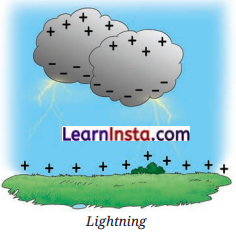
→ Static Electric Charges: When two objects gets rubbed against each other, they get charged. Here the strong winds blowing upwards and downwards rubbing with each other causes static electric charge to develop within the clouds.
→ Charge Separation: In clouds, lighter particles like ice carry positive charge and move to the top, while heavier water droplets carry negative charge and stay at the bottom. Thus a charge separation in clouds takes place. Also, when the negatively charged lower part of the cloud moves closer to the ground, it causes the ground and nearby objects, such as trees or buildings, to become positively charged.
→ Electrical Insulator: A material that does not allow electric current to flow easily. Normally, air acts as an insulator, and does not let opposite charges meet. But when the build up of charges becomes very large, the insulation property of air breaks down.
→ Lightning: A bright flash of light in the sky. It occurs when opposite charges collide within a cloud, between clouds or between clouds and the ground.
→ Thunder: The loud sound we hear after lightning. It is caused by the rapid heating and expansion of air around due to lightning.
→ Thunderstorm: A storm with thunder, lightning, and heavy rain.
→ Kalboishakhi: A local name for thunderstorms in West Bengal, Bihar, and Jharkhand. These storms occur before the monsoon and are helpful for kharif crops.
→ Bordoisila: A local name for pre-monsoon thunderstorms in Assam. They help in weather change and are part of seasonal patterns.
→ Mango Showers: Thunderstorms that occur in Kerala, Karnataka, and Tamil Nadu before the monsoon. They help in ripening mangoes and are also important for agriculture.
→ Precautions during Lightning: Safety steps to protect ourselves from lightning. These include:
- Staying away from tall objects
- Crouching in a low-lying area
- Not lying flat on the ground
- Avoiding metallic objects like umbrella with metallic rod
- Getting out of the water
- Staying inside vehicles
→ Lightning Conductor: A metal rod fixed along the wall of buildings. It directs the electric charges into the ground and prevents damage to the building.

→ Cyclone: A large, spinning system of clouds, winds and rain that forms over warm oceans. It has a very low-pressure centre and brings strong winds and heavy rain. Air rushes inward and begins to rotate due to the Earth’s rotation.
→ Eye of a Cyclone: In a cyclone, the region of lowest pressure is at the centre, known as the eye of the cyclone. At the eye of the cyclone, the wind is calm, but the surrounding region experiences strong winds and heavy rainfall. As a cyclone moves from the ocean towards the land, it generates higher wind speeds compared to the wind speeds produced by regular thunderstorms. Once the cyclone reaches land, the source of moist air is cut off and it gradually loses its strength.

→ Impact of Cyclones:
- Storm Surge: Cyclone winds push ocean water toward shore, creating a high wall of water (3-12 meters) that floods coastal and inland areas.
- Heavy Rainfall: Can cause rivers to overflow, leading to flash floods and landslides.
- Seawater Intrusion: Contaminates drinking water sources, damages farmland, reduces soil fertility due to salt content and affecting crop growth.
- Infrastructure Damage: Roads blocked by fallen trees and debris and delayed emergency response due to accessibility issues.
- Power Disruptions: Long-lasting outages affect daily life and critical services.
→ Precautions during Thunderstorms and Cyclones: Stay indoors and away from metal, water, and tall objects during thunderstorms. In case of a cyclone, evacuate to safe shelters, store drinking water, and avoid flooded areas.
→ India Meteorological Department (IMD): The IMD is the official weather agency of India. It warns people about approaching cyclones, thunderstorms, and other weather events. Its updates help save lives and reduce damage.