Each of our Ganita Prakash Class 6 Worksheet and Class 6 Maths Chapter 1 Patterns in Mathematics Worksheet with Answers Pdf focuses on conceptual clarity.
Class 6 Maths Chapter 1 Patterns in Mathematics Worksheet with Answers Pdf
Patterns in Mathematics Class 6 Maths Worksheet
Class 6 Maths Chapter 1 Worksheet with Answers – Class 6 Patterns in Mathematics Worksheet
Choose the correct option.
Question 1.
Which of the following numbers is a square number?
(a) 2
(b) 8
(c) 12
(d) 16
Answer:
(d) 16
Question 2.
Which of the following numbers is a triangular number?
(a) 4
(b) 7
(c) 10
(d) 13
Answer:
(c) 10
Question 3.
The next number in the number sequence 1, 4, q, 16, 25 is
(a) 31
(b) 33
(c) 35
(d) 36
Answer:
(d) 36

Question 4.
What number should replace the question mark?
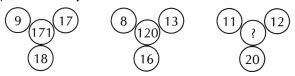
(a) 151
(b) 152
(c) 150
(d) 154
Answer:
(b) 1 52
Question 5.
Which number continues this sequence?

(a) 30
(b) 32
(c) 33
(d) 35
Answer:
(d) 35
Question 6.
What are the next three terms in the sequence 32, 38, 44, 50, 56, ………..?
(a) 112, 224, 448
(b) 62, 68, 74
(c) 62, 74, 92
(d) 50, 44, 38
Answer:
(b) 62, 68, 74
Question 7.
Which sequence do you get by adding up triangular numbers?
(a) Squares
(b) Cubes
(c) Hexagonal numbers
(d) Tetrahedral numbers
Answer:
(d) Tetrahedral numbers
Question 8.
The missing terms in the given number sequence are:
1, 5, 13, ______, 41, ______ 85, …
(a) 21, 64
(b) 25, 61
(c) 24, 64
(d) 21, 61
Answer:
(b) 25, 61
Assertion (A) & Reason (R) Questions.
Directions.: In the following questions, a statement of Assertion (A) is followed by a statement of Reason (R). Choose the correct option as:
(a) Both Assertion (A) and Reason (R) are true and Reason (R) is the correct explanation of Assertion (A).
(b) Both Assertion (A) and Reason (R) are true but Reason (R) is not the correct explanation of Assertion (A).
(c) Assertion (A) is true but Reason (R) is false.
(d) Assertion (A) is false but Reason (R) is true.
Question 1.
Assertion (A): 1 + 3 + 5 + 7 + 9 = 25isa square number.
Reason (R): The sum of consecutive odd numbers is a square number.
Answer:
(a) Both Assertion (A) and Reason (R) are true and Reason (R) is the correct explanation of Assertion (A).
Question 2.
Assertion (A): The next number in the number sequence 1,3, 6, 10, 15, … is 21.
Reason (R): In the sequence, each term is the sum of n consecutive counting numbers.
Answer:
(a) Both Assertion (A) and Reason (R) are true and Reason (R) is the correct explanation of Assertion (A).
B. Fill in the blanks.
1. ______ and ______ are the only cubic numbers that are also Fibonacci numbers
Answer:
1 and 8
2. Virahanka numbers are also known as ______
Answer:
Fibonacci numbers
3. 1 + 2 + 3 + 4 + 3 + 2 + 1 = ______ is a ______ number.
Answer:
16, Square
4. 1 and 36 are triangular numbers as well as ______.
Answer:
Square numbers
5. The sum of consecutive odd numbers gives the number sequence of ______ numbers.
Answer:
Square
6. 1, 7, 19, ______, 61, ______ are centered hexagonal numbers.
Answer:
37
C. Match the following.
Question 1.
| Column A | Column B |
| 1. 1,4, 13, ______, 121 | (a) 54 |
| 2. 1, 3, 6, 10, ______, 21, 28 | (b) 43 |
| 3. 2, 6, 18, ______, 162 | (c) 40 |
| 4. 5, 12, 18, ______, 27, 30 | (d) 15 |
| 5. 1, 8, 22, ______, 71, 106 | (e) 23 |
Answer:
| Column A | Column B |
| 1. 1,4, 13, ______, 121 | (c) 40 |
| 2. 1, 3, 6, 10, ______, 21, 28 | (d) 15 |
| 3. 2, 6, 18, ______, 162 | (a) 54 |
| 4. 5, 12, 18, ______, 27, 30 | (e) 23 |
| 5. 1, 8, 22, ______, 71, 106 | (b) 43 |
D. Solve the following.
Question 1.
Count the vertices of each of the regular polygons given on page 13. Which number sequence do you get? Write it.
_____________________________________
_____________________________________
Answer:
3, 4, 5, 6, 7, 8…………
Question 2.
Write the rule for the given number pattern 58, 52, 46, 40, 34 What number should come next?
_____________________________________
_____________________________________
Answer:
Each next number is obtained by subtracting 6 from the previous number starting from 58. Next number is 28
Question 3.
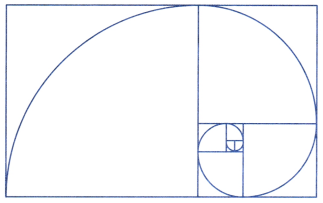
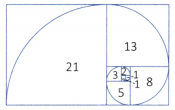
The Fibonacci sequence is a series of numbers where each number is the sum of the two preceding numbers. For example: 1, 1, 2, 3, 5, 8, 13, 21, 34,
Take the help of the internet to explore the Fibonacci spiral. Fill the Fibonacci numbers in the given Fibonacci spiral.
_____________________________________
_____________________________________
Answer:
Question 4.
Complete the following number patterns.
(a) 1 × 1 = ______
11 × 11= ______
111 × 111 = ______
1111 × 1111 = ______
11111 × 11111 = ______
111111 × 111111 = ______
1111111 × 1111111 = ______
Also, write the rule for each of the patterns in your words.
(a) Rule: ______
_____________________________________
(b) Rule: ______
_____________________________________
Answer:
(a) 1
121
12321
1234321
123454321
12345654321
1234567654321
(b) 9
98
987
9876
98765
987654
9876543
Question 5.
What is the smallest number that can be written as the sum of two square numbers in two distinct ways?
Answer:
The smallest number is 50, which can be written as, 1 + 49 = 50, 25 + 25 = 50
Ruby and Dolly are siblings. They bought some colourful bindis to make their school project based on patterns.
Ruby starts arranging a particular colour bindis by pasting them on a paper sheet in square shapes and Dolly starts arranging another colour bindis by pasting them on the paper sheet in triangular shapes.
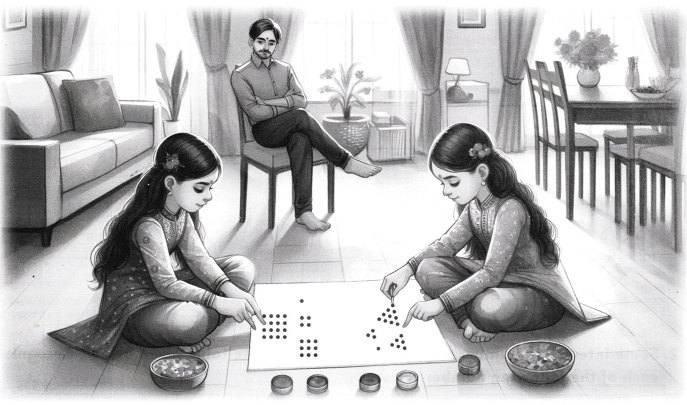
Father: Hey girls! What are you doing?
Ruby: We are trying to make some interesting dot patterns to complete our school project.
Father: Do you know these dot arrangements represent special number patterns?
Dolly: Number patterns! How can these arrangements show number patterns?
Father: Patterns are everywhere. They are present in nature, in rhythmic beats of music, in the motion of stars and planets, and also in numbers, shapes, etc.
The branch of Mathematics that studies patterns in numbers is called number theory.
Number sequences are the most basic and the most fascinating types among the patterns that mathematicians study.
Question 1.
Following are some matchstick arrangements that are showing some patterns. Can you Identify the patterns? Write the respective number pattern for each. Also, make the next two arrangements by following the patterns.
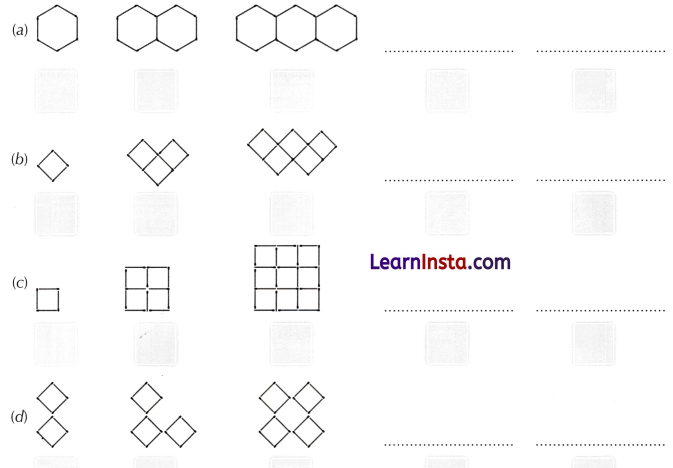
Answer:
(a) 6, 11, 16, 21, 26
(b) 4, 10, 16, 22, 28
(c) 4, 12, 24, 40, 60
(d) 8, 12,16, 20, 24
Question 2.
Some interesting number sequences are shown in the table given below. Recognise each of the following number sequences.
| Number sequence | Recognised name of the sequence |
| 1,2, 3, 4, 5, 6, … | |
| 1,3, 5, 7, 9, 11, … | |
| 8, 10, 12, … | |
| 1, 3, 6, 10, 15, 21, … | |
| 1,4, 9, 16, 25, 36, … | |
| 1,8, 27, 64, 125, … | |
| 1,4, 10, 20, 35, … |
Answer:
| Number sequence | Recognised name of the sequence |
| 1,2, 3, 4, 5, 6, … | (a) Counting numbers |
| 1,3, 5, 7, 9, 11, … | (b) Odd numbers |
| 8, 10, 12, … | (c) Even numbers |
| 1, 3, 6, 10, 15, 21, … | (d) Triangular numbers |
| 1,4, 9, 16, 25, 36, … | (e) Square numbers |
| 1,8, 27, 64, 125, … | (f) Cubic numbers |
| 1,4, 10, 20, 35, … | (g) Tetrahedral numbers |
Question 3.
Can you identify the rule that helps you to write the next numbers in the number sequences given in the table in Q. 2? Write them. Also, write the next three numbers in each of the given number sequences.
| Rule | Next three numbers in the sequence |
| (a) | _____________, _____________, _____________ |
| (b) | _____________, _____________, _____________ |
| (c) | _____________, _____________, _____________ |
| (d) | _____________, _____________, _____________ |
| (e) | _____________, _____________, _____________ |
| (f) | _____________, _____________, _____________ |
| (g) | _____________, _____________, _____________ |
Answer:
| Rule | Next three numbers in the sequence |
| Adding 1 to the previous number to get the next number of the sequence, as 1, 1 + 1 = 2, 2 + 1 = 3, 3 + 1 = 4,… | 7, 8,9 |
| Adding 2 to the previous number to get the next number of the sequence, as 1, 1 + 2 = 3, 3 + 2 = 5, 5 + 2 = 7, 7 + 2 = 9, 9 + 2 = 11,… | 13, 15, 17 |
| Adding 2 to the previous number to get the next number of the sequence, as 2, 2 + 2 = 4, 4 + 2 = 6, 6 + 2 = 8, 8 + 2 = 10,… | 14,16, 18 |
| In the sequence, each n”’ number is the sum of first n consecutive counting numbers, as 1 = 1; 1 + 2 = 3; 1 + 2 + 3 = 6; 1 + 2 + 3 + 4 = 10; 1 + 2 + 3 + 4 + 5 = 15; 1 + 2 + 3 + 4 + 5 + 6 = 21,… | 28, 36, 45 |
| In the sequence, each number is the product of counting number by itself starting from 1, as 1 × 1 = 1, 2 × 2 = 4, 3 × 3 = 9, 4 × 4 = 16, 5 × 5 = 25,… | 49, 64, 81 |
| In the sequence, each number is the product of counting number by itself thrice starting from 1, as 1 × 1 × 1 = 1, 2 × 2 × 2 = 8, 3 × 3 × 3 = 27, 4 × 4 × 4 = 64, 5 × 5 × 5 = 125,… | 216, 343, 512 |
| In the sequence, each number is the sum of first n consecutive triangular numbers starting from 1, as 1, 1 + 3 =4, 1 + 3+ 6 = 10, 1 + 3 + 6 + 10 = 20, … | 56, 84, 120 |
Question 4.
The number sequence ‘1, 2, 3, 5, 8, 13, 21, …’ are the Virahanka numbers. What is the mathematical rule that applies in the sequence? Write the 10th and 11th numbers of the sequence.
_____________________________________
_____________________________________
Answer:
In the sequence, each number (starting from 3rd number) is the sum of previous two numbers, as 1 + 1 = 2, 1 + 2 = 3, 2 + 3 = 5,10th number 55, 11th number = 89
Question 5.
Write the missing numbers in the following number sequences. Also, write the mathematical rule applied in the sequences.
(a) 1, 3, ______, 10, 15, ______, 28, ______, ______, …
Rule: _____________________________________
Answer:
6, 21, 36, 45.
In the sequence, each n,h number is the sum of first ‘n‘ consecutive counting numbers, as 1, 1 + 2 = 3, 1 + 2 + 3 = 6, 1 + 2 + 3 + 4 = 10,….
(b) 1, ______,4, ______, 16, 32, ______, 128, ______, ______
Rule: _____________________________________
Answer:
2, 8, 64, 256.
The sequence follows the pattern of multiplying each numbers by 2 to get the next one, as 1, 1 × 2 = 2, 2 × 2 = 4, 4 × 2 = 8,….
(c) 1, 8, 64, 125, ______, ______, 512, ______, ….
Rule: _____________________________________
Answer:
27, 216, 343, 729.
In the sequence, each number is the product of counting numbers by itself thrice starting from 1, as 1 × 1 × 1 = 1, 2 × 2 × 2 = 8, 3 × 3 × 3 = 27
(d) 4,8, ______,16, ______,24, ______, …
Rule: _____________________________________
Answer:
12, 20, 28
In this sequence, each number is obtained by multiplying the counting number by 4, as 1 × 4 = 4, 2 × 4 = 8, 3 × 4 = 12, 4 × 4 = 16, ….
(e) 1, 7, ______,37, 61, ______, ______, …
Rule: _____________________________________
Answer:
19,91, 127
In the sequence, next number is getting by adding consecutive multiple of 6 to each previous number starting from 1, as 1,1 + 6 = 7, 7 + 12 = 19, 19 + 18 = 37, 37 + 24 = 61,….
VISUALISING NUMBER SEQUENCES
Father: Do you know Dolly? Many number sequences can be visualised using figures. Here are some examples oj number sequences that can be visualised by the dot arrangements.

Here, dots are arranged in triangles, so these numbers are called triangular numbers.

Here, dots are arranged in squares, so these numbers are called square numbers.

The numbers that can be represented by three-dimensional, cubes are called cubic numbers.
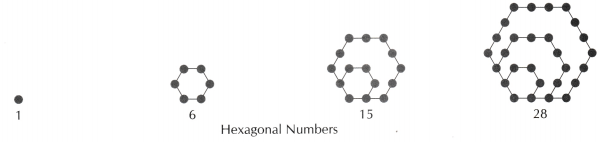
Here dots are arranged in such a way that it forms a hexagon, so these numbers are called hexagonal numbers.

It is another form of hexagonal numbers, it is also called the centered hexagonal number pattern, as one dot is placed in the centre and other dots are created around it.
Question 6.
Observe the dot arrangements In tke following given sequences and draw tke next dot arrangement for eack sequence. Also, write tke number sequence tkey formed. Wkat is tke rule tkat applies in tke sequence?

Answer:
(a) Number sequence:
1, 4, 10, 20, 35
Rule: In the sequence, each nth number is the sum of the first n triangular number starting from 1, as 1, 1 + 3 = 4, 1 + 3 + 6 = 10, 1 + 3 + 6 + 10 = 20,….
(b) Number sequence:
1, 5, 12, 22, 35
Rule: In the sequence, each next number except the first number is obtained by adding 1 and consecutive multiple of 3 to the previous number, starting from 1, as 1, 1 + 3 × 1 + 1 = 5, 5 + 3 × 2 + 1 = 12, 12 + 3 × 3 + 1 = 22
(c) Number sequence:
1, 2, 4, 8, 16,….
Rule: In the sequence, each next number is the double of the previous number starting from 1, as 1 × 2 = 2, 2 × 2 = 4, 4 × 2 = 8, 8 × 2 = 16
Question 7.
Make the dot arrangements of 6th and 9th triangular numbers.

Question 8.
Make the dot arrangements of 8th and 10th square numbers.
Question 9.
Can the number 36 be visualised by dot arrangements differently? Write the name of the arrangements and also draw them to represent 36.
_____________________________________
RELATION AMONG NUMBER SEQUENCES
Sometimes, number sequences can be related to each other.
Question 10.
Observe the following number patterns and write the next two steps in continuation of the patterns.
(a) 1 = 1
1 + 3 = 4
1 + 3 + 5 = 9
1 + 3 + 5 + 7 = 16
1 + 3 + 5 + 7 + 9 = 25
_____________________________________
_____________________________________
(b) 1 = 1
1 + 2 + 1 = 4
1 + 2 + 3 + 2 + 1 = 9
1 + 2 + 3 + 4 + 3 + 2 + 1 = 16
1 + 2 + 3 + 4 + 5 + 4 + 3 + 2 + 1 = 25
_____________________________________
_____________________________________
(c) 1 × 1 × 1 = 1
2 × 2 × 2 = 8 = 3 + 5
3 × 3 × 3 = 27 = 7 + 9 + 11
4 × 4 × 4 = 64 =13 + 15 + 17 + 19
5 × 5 × 5 = 125 = 21 + 23 + 25 + 27 + 29
_____________________________________
_____________________________________
What did you observe from the above patterns? Write in your own words.
(a) _____________________________________
(b) _____________________________________
(c) _____________________________________
(d) _____________________________________
Answer:
(o) 1 + 3 + 5 + 7 + 9 + 11 = 36
1 + 3 + 5 + 7 + 9 + 11+ 13 = 49
(b) 1 + 2 + 3 + 4 + 5 + 6 + 5 + 4 + 3 + 2 + 1 = 36
1 + 2 + 3 + 4 + 5 + 6 + 7 + 6 + 5 + 4 + 3 + 2 + 1 =49
(c) 6 × 6 × 6 = 216 = 31 + 33 + 35 + 37 + 39 + 41
7 × 7 × 7 = 343 = 43 + 45 + 47 + 49 + 51 + 53 + 55
(d) 1 + 3 + 6 + 10 + 15 + 21 = 56
1 + 3 + 6 + 10 + 15 + 21 + 28 = 84
Question 11.
What pattern do you observe? Write the next two steps.
1 × 6 + 1 = 7, 3 × 6 + 1 = 19, 6 × 6 + 1 = 37, 10 × 6 + 1 = 61,…,
_____________________________________
_____________________________________
Which number sequence do you get? Represent it pictorially.
Answer:
Each triangular number is multiplied by 6 and adding 1 to it, the result gives centered hexagonal numbers.
Next two steps:
15 × 6 + 1 = 91
21 × 6 + 1 = 127
The number sequence: 7, 19, 37, 61, 91, 127,…
Think and Answer
What are the possible arrangements in which 16 can be arranged using dots other than square dot arrangement?
Question 12.
What happens when, you add tke centered hexagonal numbers, i.e., 1,1 + 7, 1 + 7 + 19,… Which sequence do you get? Explain it using a pictorial representation of dots.
Answer:
1, 8, 27, 64,125,…. A sequence of cubic number.
Question 13.
Draw a pictorial representation oj a number: 1 + 2 + 3 + 4 + 5 + 6 + 7 + 6 + 5 + 4 + 3 + 2 + 1 when we add counting numbers up and down.
Answer:

Question 14.
The given picture represents the square number 36.

Make similar dot arrangements for the square numbers 49 and 81.
Think and Answer
Observe the following number pattern. What happens when we add up the numbers in each row? Write it. Can you identify the number sequence formed? Write the name of the sequence.
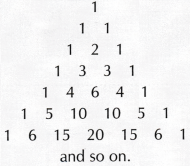
Answer:
When we add up the numbers of each row, we get the numbers: 1, 2, 4, 8, 16, 32,’….
The number sequence is 1, 2, 4, 8, 16, 32,….
In this sequence, next number is the double of the previous number.
PATTERNS IN SHAPE
Ruby: Yesterday! My math teacher taught us about polygons and their shapes. So, I drew some polygons as shown below.

And I found something interesting while drawing them. They represent a shape pattern as well as number pattern.
Father: Yes, some shape patterns also represent number patterns as well. These shapes may be in one, two, or three dimensions (1D, 2D, or 3D) or more dimensions.
What number pattern did you observe? Write it. Also, recognise the name of the pattern.
_____________________________________
_____________________________________
_____________________________________
Question 15.
Recognise the number sequences/or the following patterns. Also, draw the next shape in continuation of the patterns.
(a) Stacked triangles
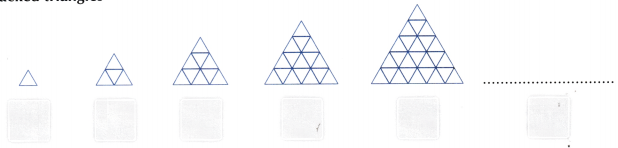
Number sequence: _____________________________________
(b) Stacked squares
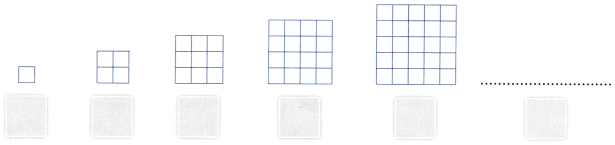
Number sequence: _____________________________________
(c) Complete shapes

Number Sequence: _____________________________________
Answer:
(a) Number sequence: 1, 4, 9, 16, 25, 36,…
(b) Number sequence: 1, 4, 9,16, 25, 36,…
(c) Number sequence: 2, 3,4, 5, 6,…
Question 16.
In the Koch Snowflake sequence, each line segment ‘—’ is replaced by a speed bump

Make the next two shapes in the continuation of the pattern.
Answer:

Think and Answer
Is 1 + 2 + 3 + 4 + 5 + 6 + 7 = 28 a triangular number? Justify your answer.
Answer:
Yes, Triangular numbers 1, 3, 6, 10, 15, … are the sum of the natural numbers up to numbers of the sequence.
Here 28 can be expressed as the sum of the first 7 natural numbers. Thus, 1 + 2 + 3 + 4 + 5 + 6 + 7 = 28 is 7th triangular number.
Math Link
Amoeba reproduces asexually through binary Jission. In this process, an individual divides itself into two daughter cells, two divides into Jour, Jour becomes eight, and so on. These are genetically identical to each other. Here is the amoeba reproduction diagram.
Observe it and draw the next step generation diagram in continuation oj the pattern.
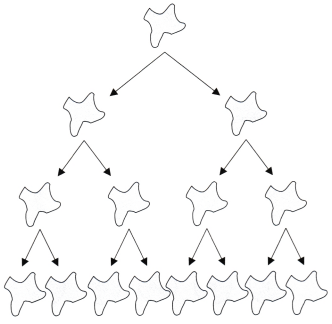
What number sequence does the above diagram represent? Write it.
Answer:
Number sequence: 1, 2, 4, 8,16,….
Fun Time
Which number replaces the question mark?

Answer:
(a) 9
(b) 43
(c) 22