Class 3 English Night Questions and Answers Chapter 10
The Sky Question Answer
Picture Reading (NCERT Textbook Pages 102 and 103)
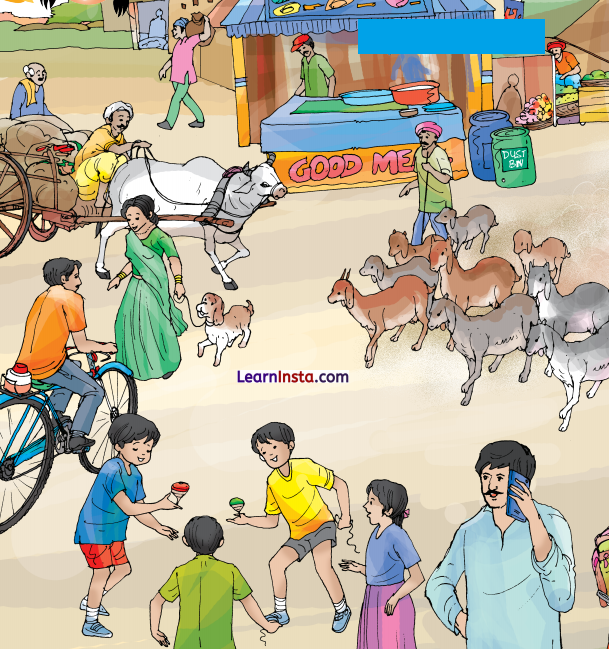
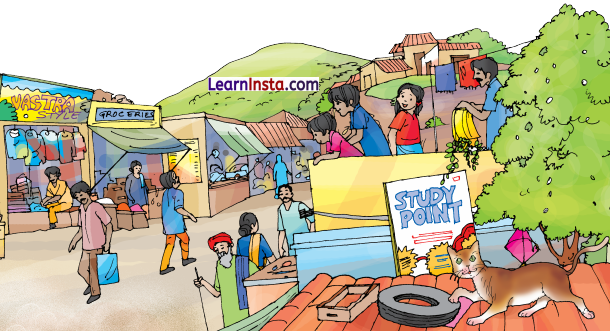
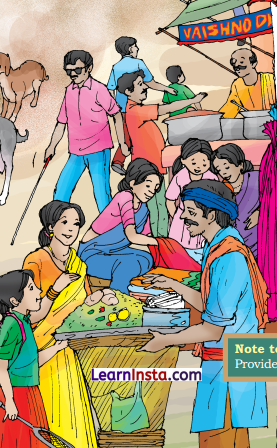
Look at the picture and answer.
Question 1.
What can you see on both sides of the street?
Answer:
We can see shops and houses on both sides of the street.
Question 2.
Why are there two dustbins? Do you know why one is blue and the other is green in colour?
Answer:
There are two dustbins to throw wet and dry wastes separately. Blue dustbin is used for dry wastes and green dustbin is used for wet wastes.
Question 3.
Why is the man in dark glasses holding a white stick?
Answer:
The man in dark glasses is visually impaired. So, he needs the white stick to know his way. It is also an indication of a visually impaired person.

Question 4.
Do you know which toy the boys are playing with?
Answer:
The boys are playing with spinning tops.
Question 5.
How many bullock-carts are there in the picture?
Answer:
There is one bullock-cart in the picture.
Question 6.
Name the different animals in the picture.
Answer:
The animals in the picture are bullock, goats and dog.
Night Question Answer
Let us think (Page No. 105)
A. Answer the following.
Question 1.
Where does the Sun go after the end of the day?
Answer:
The Sun goes behind the hill after the end of the day.
Question 2.
Which among the following needs the Sun? Why?

(a) sunflower
(b) toys
(c) plants
(d) table
(e) children
Answer:
Sunflower, plants and children need the Sun. Sunflower and other plants need sun to make their food. Children need sun to get light to do their daily activities.
Question 3.
The poem talks about the Sun in the sky. What else do you see when you look up at the sky?
Answer:
When we look up at the sky, we see kites, aeroplanes, birds, clouds, etc.
B. Think and Answer.

Question 1.
What different colours do we get to see during sunrise and sunset?
Answer:
We see shades of orange, pink, yellow and purple during sunrise and sunset.
Question 2.
What do you see when you look at the sky at night?
Answer:
When we look at the sky at night, we see the moon and many stars.
Question 3.
How do you feel when you open your eyes in the morning?
Answer:
When I open my eyes in the morning, I feel the Sun is shining down on me.
Question 4.
Imagine a day when the Sun doesn’t come out. Talk about how the day would be.
Answer:
The day when the sun would not come out, there would be darkness everywhere. All activities that are done in days would not take place.
Let us do (Page No. 107)
Let us play a game.
Let’s play a fun game called “I Spy”! We are going to take turns to be Spies. The Spy secretly chooses something in the room and gives everyone a clue. The Spy starts by saying, ‘I spy with my little eye something that is …’ and gives a clue. For example, ‘I spy something that is blue!’ Then, everyone looks around and tries to find something that is blue. Maybe it’s a pen, a chair, or even someone’s shirt!
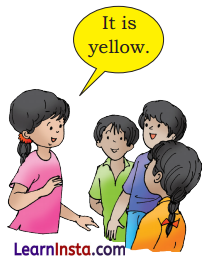
If it’s tricky to guess the object right, the Spy can give more clues. The child who guesses right becomes the new Spy! Keep playing, taking turns being Spies and guessing until everyone gets a chance to be the Spy.

Answer:
Do it yourself.
Let us speak (Page No. 107)
Read the following sentence:
I spy a few stars in the sky.
The word spy begins with sp
The word stars begins with st
The word sky begins with sk

Now say these words aloud.

Answer:
Do it yourself.
Let us learn (Page No. 108)
A. Read the following words and circle the words that are found in the sky.

Answer:

B. Add ‘Sun’ to the following words to make new words. Write them in the space given. One has been done for you.
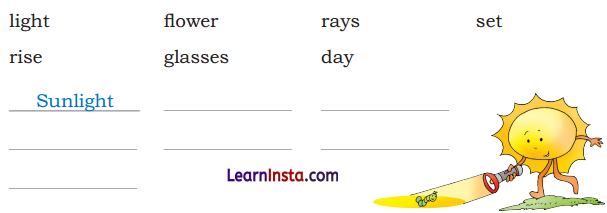
Answer:

Night Class 3 Summary
The children are very inquisitive to know about the Sun. They see the Sun in the sky during daytime. But they don’t see the Sun at night. They become sad and want to know about this sunset. At last, they come to know that the Sun rises in the morning and sets behind the hills in the evening.
Night Class 3 Word Meanings
- Bright (ब्राइट) – shining with light, रोशनी से चमकना।
- Wonder (वंडर) – a feeling of surprise, आश्चर्य की अनुभूति।
- Behind (बिहाइन्ड) – at the back of, के पीछे।
- Distant (डिसटन्ट) – very far away, बहुत दूर।
- Hill (हिल) – a small mountain, एक छोटा सा पहाड़।
- Still (स्टिल) – quite, peaceful, शांत।
- Until (अंटिल) – not before a particular time, किसी विशेष समय से पहले नहीं।
- Begins (बिगिन्स) – to start doing, कुछ शुरु करना।
- Peep (पीप) – to look at something secretly, किसी चीज़ को छिपकर देखना।
- Shining (शाईनिंग) – brightening, चमक रहा है।