Teachers guide students to use Exploring Society India and Beyond Class 7 Solutions and Class 7 Social Science SST Chapter 4 New Beginnings Cities and States Question Answer NCERT Solutions for quick learning.
Class 7 Social Science Chapter 4 Question Answer New Beginnings Cities and States
NCERT Class 7 Social Science Chapter 4 New Beginnings Cities and States Questions and Answers Solutions
New Beginnings Cities and States Class 7 Question Answer (In-Text)
The Big Questions? (Page 67)
Question 1.
What is meant by ‘Second Urbanisation of India’?
Answer:
After the Indus Valley Civilisation had declined around late 2nd millennium BCE, a major historical phase began in the Ganga plains. Numerous towns and cities emerged in north India due to its fertile land. This vital phase is referred as the ‘Second Urbanisation of India’.
Question 2.
Why were the janapadas and mahajanapadas an important develo¬pment in India’s early history?
Answer:
Janapadas and Mahajanpadas are considered an important development in India’s early history because they were a secure and united category of early tribal settlements. They established the development of larger and more powerful political units and encouraged economic activities such as trade and agriculture.

Question 3.
What kind of system of governance did they evolve?
Answer:
There was a significant difference between the governance system of Janapadas and Mahajanapadas. Janapadas had a fragmented system and were ruled by tribal chiefs. They had a council called ‘Sabha or Samiti’ which held the ultimate power, whereas Mahajanapadas had an autocratic governance system, ruled by a king. Though two Mahajanapadas, Vajji and Malla followed a democratic system of governance.
Let’s Explore
Question 1.
The most powerful of these new states were Magadha, Kosala, Vatsa, and Avanti. Looking at the map, can you identify their capitals? Also, how many can you match with Indian cities of today? (Page 70)
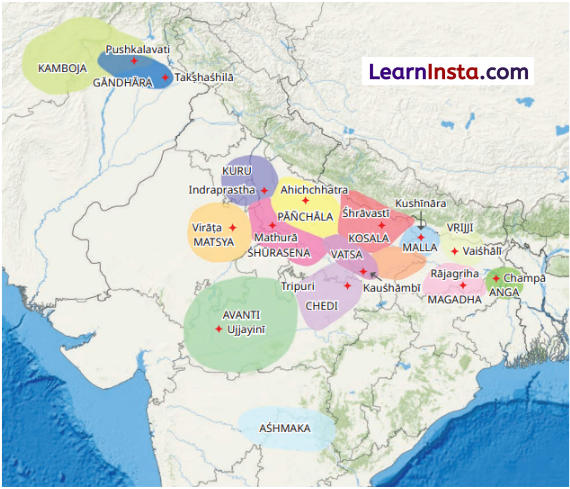
Answer:
| Mahajanapadas | Capitals | Cities now known as |
| Magadha | Rajgriha | Patna, Bihar |
| Kosala | Shravasti | Ayodhya, UP |
| Vatsa | Kaushambi | Kaushambi, UP |
| Avanti | Mahishmati | Ujjain, MP |
Question 2.
Compare this map with the map of regions mentioned in the Mahabharata (see Fig, 5.4 in the chapter ‘India, that is Bharat’ in Grade 6) and list the names common to both maps. What do you think this implies? (Page 70)
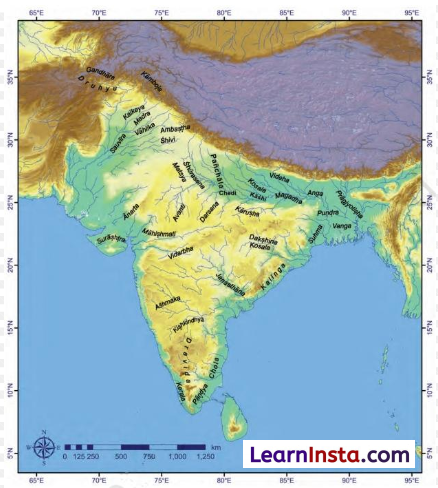
Answer:
The common regions in both the maps are Kamboja, Gandhara, Matsya, Shurasena, Kosala, Chedi, Magadha, Anga, and Ashmlaka. Both the periods had regions with similar names that means, even if geographical features evolved by the time but the names of these remarkable kingdoms persisted.
Question 3.
Fill up the following table with a Yes (or tick mark) or No (or cross mark) in each square, which promdes an interesting comparison between these two phases of Indian civilisation. (Page 74)
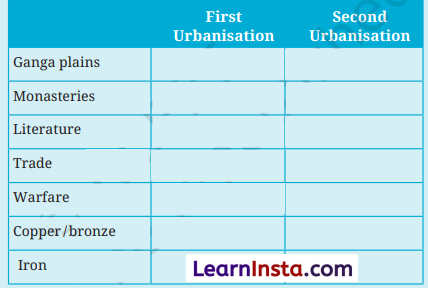
Answer:
| Ganga plains | First Urbanisation | Second Urbanisation |
| Monasteries | No | Yes |
| Literature | No | Yes |
| Trade | Yes | Yes |
| Warfare | Yes | Yes |
| Copper/bronze | Yes | Yes |
| Iron | Yes | Yes |
Question 4.
Why should a complex society divide itself into such groups? Think about several possible factors why this happens. (Page 76)
Answer:
- Specialisation of work – In a society, different people perform different tasks based on their skill and knowledge. Different categories support the kingdom or tribe to function more productively.
- Distribution of responsibilities – Dividing people into groups makes it easier to assign duties such as trade, agriculture, architecture, and pottery etc.
Question 5.
List other such professions you expect in a complex society of the 1st millennium BCE. (Page 76)
Answer:
The professions we expect in a complex society of the 1st millennium BCE include Farmers, Traders, Shepherds, Potters, Stone-carvers, Hunters and Gatherers, Blacksmiths, Priests, and Fisherfolk etc.
Think about it
Question 1.
Notice how many of the mahaja-napadas are concentrated in the Ganga plains. There are setferal possible reasons for this, including the growth of agriculture in the fertile Ganga plains, the aixiilability of iron ore in the mountains and hills (see below about iron), and the formation of new trade networks (Page 70)
Answer:
Yes, the most powerful mahajanapadas were concentrated in the fertile Ganga plains, those were-Magadha, Anga, Kosala, Kashi, Vajji, Malla, Vatsa, Kuru, and Panchala.
Question 2.
Inequalities within society can exist in many forms. Have you encountered any incident where you or anyone you know might have been made to feel different from others? Do you think equality is desirable in a society? If so, why? Have you come across people or initiatives that lessened inequalities? (Page 78)
Answer:
Yes, I have seen inequalities in societies. Once, one of my close friend and I were sitting in a park. We were having a regular conversation. Some people around us made fun of her for having a dark skin tone. She felt really different and left out. I believe we should treat everyone equally with respect and kindness, no matter how they look, what language they speak, or what background they belong to. Yes, there are also groups working to reduce equality. I have attended programs, organised by NGOs to encourage underprivileged children. Sometimes, my school offers scholarships to support these students.
Class 7 SST Chapter 4 New Beginnings Cities and States Question Answer (Exercise)
Questions and Activities (Page 81)
Question 1.
Consider the quotation at the start – of the chapter and discuss in several groups. Compare your observations and conclusions on what Kautilya recommends for a kingdom. Is it very different today?
Answer:
The vision Kautilya had about a secure and self-sustained kingdom, partially aligns with modern goals of a nation.
- Defence and Security: In today’s world, protecting a nation by fortifying its boundaries is not possible. Nowadays, a nation can hardly manage land to fit in the population. In modern days, governments invest a lot to form the best military and army to protect their borders.
- Resource management: Kautilya’s point of view highlights arable lands, mines, forests, and pastures rich in cattle. But modern nations focus on sustainable development, conservation, controlling environmental imbalances and using the natural resources in the most functional ways.
Question 2.
According to the text, how were rulers chosen in early Vedic society?
Answer:
Early Vedic society had a productive and developed governance system. Rulers used to be the chief members of the tribe, and were known as ‘Jana’. The society had an ‘assembly or council’ (Sabha or Samiti) to elect the rulers and sometimes to restrict their powers. In early Vedic society few mahajanapadas had monarchy in which king was the son of the previous ruler or king. The council held the ultimate power. Rulers were not supposed to force any regulation onto the people without discussing it with the council members. The assemblies definitely played an important role in decision-making and establishing democracy in few mahaj anapadas.
Question 3.
Imagine you are a historian studying ancient India. What types of sources (archaeological, literary, etc.) would you use to learn about the mahajanapadas? Explain how each source might contribute to your understanding.
Answer:
If I were a historian studying ancient India, I could use various sources to shape my perspective about social, economic, and religious state of the mahajanapadas:
- Different artefacts like weapons, coins, and tools can inform me about the economy and technology of the mahajanapadas.
- The excavated settlements can give insights into urban planning, architecture, environmental factors and social differences of the mahajanapadas period.
- Inscriptions: Inscriptions on coins, utensils, and pillars are valuable sources of information. They reveal names of the rulers, their social and religious beliefs, and a glimpse of the cultural traditions.
- Religious texts: Vedic, Buddhist and Jain texts offers the most authentic and vivid description of mahajanapadas, providing a list of their names and locations.
Question 4.
Why was the development of iron metallurgy so important for the growth of urbanism in the 1st millennium BCE? You may use points from the chapter but also from your knowledge or imagination.
Answer:
Iron metallurgy marked a remarkable growth in the field of agriculture and defence.
- Iron tools were easier to shape. They offered more durability and were more effective compared to stone or bronze tools. With the help of iron tools, land cleaning and harvesting improved, which enhanced agricultural productivity.
- Iron weapons strengthened and advanced the armies. It helped, kingdoms to expand their territories.
- Increased usage of Iron also cleared the way for the development of new crafts and trade.