Nature’s Treasures Class 6 Extra Questions and Answers Science Chapter 11
Nature’s Treasures Class 6 Very Short Answer Type Questions
Question 1.
Name the main component of air.
Answer:
Nitrogen gas
Question 2.
What is the percentage of nitrogen in air?
Answer:
78%
Question 3.
What is the percentage of oxygen in air?
Answer:
21%
Question 4.
What is the source of oxygen gas in air?
Answer:
Photosynthesis by green plants is source of oxygen gas in air.

Question 5.
Write the name of two objects which are inflated by air.
Answer:
- Balloon
- Bus tyre
Question 6.
What do you understand by the terms wind and breeze?
Answer:
Moving air is called wind and gently moving air is called breeze.
Question 7.
Name the sources of water.
Answer:
Sources of water on the Earth are: seas, oceans, rivers, springs, tubewells, etc.
Question 8.
What is meant by the conservation of water?
Answer:
Careful, economical and wise use of water and avoiding the wastage of water is called conservation of water.
Question 9.
What is saline water?
Answer:
A sample of water that contains more than 2% dissolved salt is known as saline water.
Question 10.
Give any two uses of water.
Answer:
We use water for drinking and bathing.
Question 11.
Is water a limitless source?
Answer:
Yes, water is a limitless source, but by unwise use, sources of water are depleting.
Question 12.
What is rainwater harvesting?
Answer:
In many buildings, rainwater is collected and stored in large Question uantities for later use. This method of conservation of water is called rainwater harvesting.
Question 13.
Which energy is used by plants for making their food?
Answer:
Sun’s energy
Question 14.
Give any twp uses of Sun s energy.
Answer:
Sun’s energy is used to heat water and generate electricity.
Question 15.
What happens when one component is removed from the forests?
Answer:
Every component of forest depends on each other. If we remove one component, all other components would be affected.
Question 16.
How can we recognize the presence of an animal in the forest?
Answer:
We can recognize the presence of an animal in the forest by their droppings and footprints.
Question 17.
Write the name of some useful products obtained from forests.
Answer:
Wax, gum, honey, silk, etc.
Question 18.
What does soil contain?
Answer:
Soil contains sand, insects and worms.
Question 19.
How soil is formed?
Answer:
Soil is formed by the disintegration of rocks by the actions of the Sun, water and living organisms over a long time.
Question 20.
What are rocks made up of?
Answer:
Rocks are made up of minerals.
Question 21.
Give uses of rocks.
Answer:
Rocks are used in the construction of houses, buildings, temples, roads, dams and table tops.
Question 22.
Name two fractions of petroleum which are used as fuel.
Answer:
- Petrol
- Diesel
Question 23.
Expand LPG.
Answer:
Liquefied Petroleum Gas
Question 24.
Write full form of CNG.
Answer:
Compressed Natural Gas
Question 25.
Name various fossil fuels.
Answer:
Coal, petroleum, natural gas
Question 26.
Write the name of any two natural substances.
Answer:
- Air
- Water
Question 27.
Name two human-made substances.
Answer:
- Car
- Bus
Question 28.
Why are air, water and soil called natural resources?
Answer:
Air, water and soil are provided us by nature so they are called natural resources.
Question 29.
Write the name of two non-renewable natural resources.
Answer:
- Coal
- Natural gas
Question 30.
Name any two renewable natural resources.
Answer:
- Air
- Water
Question 31.
Can we use all our natural resources forever?
Answer:
No, we cannot use all our natural resources forever, because these are going to exhaust one day.
Question 32.
Can air, water and soil be exhausted by human activities?
Answer:
No, these cannot be exhausted because these are renewable resources.
Nature’s Treasures Class 6 Short Answer Type Questions
Question 1.
What is the composition of air?
Answer:
The main components of air are nitrogen (78%), oxygen (21%), argon (0.93%) and carbon dioxide (0.03 to 0.04%). Air also contains water vapour, dust particles and smoke particles which have negligible percentage in air.
Question 2.
List three activities that are possible due to presence of air.
Answer:
The activities that are possible due to the presence of air are:
(a) Breathing
(b) Burning
(c) Photosynthesis
Question 3.
What is wind? Mention two uses of air.
Answer:
Blowing air is called wind.
Uses of air are:
- For burning ofany substance air is needed.
- Air is used to generate electricity with the help of windmills.
Question 4.
List three activities that help us to notice the presence of air.
Answer:
We can notice the presence of air when the leaves of a tree rustle, the clothes hanging on a clothes line sway, or the pages of an open book begin to flutter once a fan is switched on.
Question 5.
Why is ocean water not suitable for domestic use?
Answer:
Sea and ocean water contains large amounts of various salts. It is due to these salts, the ocean water is salty and cannot be used for drinking, washing and for irrigation purposes.
Question 6.
What is rainwater harvesting?
Answer:
Rainwater harvesting is the collection of rainwater and storing for future use. In this system, rainwater is collected from the rooftops by means of pipes into a tank for later use.
Question 7.
What are some activities for which we need Sun’s heat?
Answer:
We can use Sun’s heat and light for:
- Drying clothes
- Producing electricity
- Cooking food in a solar cooker.
Question 8.
What are the main reasons for disappearance of forests?
Answer:
These are following main reasons for disappearance of forests:
- Construction of roads
- Construction of buildings
- Development in industries
- Increasing demand of wood day by day.
Question 9.
What do you mean by soil erosion? How is it prevented?
Answer:
The removal of top fertile layer of soil by the action of wind and water is called soil erosion.
It is prevented by:
- By growing more and more plants
- By avoiding deforestation.
Question 10.
What is Van Mahotsav?
Answer:
Van Mahotsav is a weeklong event celebrated across the country during the ‘ month of July. It is a forest festival during which new plants and trees are planted, and awareness about respecting forests is raised. The aim of the event is to increase the green cover.
Question 11.
Why should we worry about the conditions and issues related to forests far from us?
Answer:
We should be worried about deforestation as it would lead to floods, increase in Earth’s temperature, decreasing animals’ habitats and soil erosion. Damage to forests directly or indirectly affects human habitat and environment so it must be a matter of concern among us.
Question 12.
What are fossil fuels? Name the main fossil fuels.
Answer:
The remains of dead plants and animals are called fossils. The fuels formed by the remains of dead plants and animals are called fossil fuels. Main fossil fuels are: coed petroleum and natural gas.
Question 13.
What is coal? Write its uses?
Answer:
Coal is a fossil fuel.
Uses:
- Coal is used to cook food.
- It is used in thermal power plants to produce electricity.
- It is also used as an industrial fuel.
Question 14.
Why is natural gas called a very important fossil fuel in these days?
Answer:
Natural gas is a very important fossil fuel because it is easy to transport through pipes. It is used in the form of CNG as fuel and generation of power.
Question 15.
Why is CNG called a clean fuel?
Answer:
CNG is called a clean fuel because it does not produce any pollution as it bums completely v in the air without leaving any residue.
Question 16.
What are the harmful effects of using fossil fuels?
Answer:
Harmful effects of burning fossil fuels are as following:
- Burning of fossil fuels cause’air pollution.
- They also cause global warming because they produce greenhouse gas like carbon dioxide on burning.
Question 17.
What are natural resources? Explain with examples.
Answer:
The resources provided by nature are called natural resources. For example, air, water, soil and Sunlight, etc.
Question 18.
Classify the natural resources on the basis of their availability.
Answer:
On the basis of the availability various, natural resources in nature can be classified in the following two groups: ‘
- Renewable natural resources: Air, Water, Sunlight, etc.
- Non-renewable natural resources: Natural gas, Petrol and Coal, etc.
Question 19.
What are renewable natural resources? Explain with example.
Answer:
The resources which are present in unlimited Question uantity in nature and are not likely to be exhausted by human activities are called renewable natural resources. For example: air, Sunlight, etc.
Question 20.
What are non-renewable natural resources? Explain with example.
Answer:
The resources which are present in limited Question uantity in nature and can be exhausted by human activities are called non-renewable natural resources. For example: forests, wildlife and minerals, etc.
Question 21.
Explain why fossil fuels are non-renewable natural resources.
Answer:
Fossil fuels are present in limited Question uantity in the nature. They can be exhausted by human activities. So, fossil fuels sire called non-renewable natural resources.
Nature’s Treasures Class 6 Long Answer Type Questions
Question 1.
What is air? Name the major constituents of air. Also give their volume proportions in air.
Answer:
Air is a mixture of gases. The major constituents of air are nitrogen, oxygen, carbon dioxide and argon. Air also.contains water vapour, dust particles and smoke particles which have negligible percentage in air. The percentage composition of constituents of air are as given below:

Composition of air
| Name of Constituents | % Composition |
| Nitrogen gas | 78% |
| Oxygen gas | 21% |
| Carbon dioxide | 0.03 – 0.04% |
| Argon | 0.93% |
Question 2.
What is meant by conservation of water? Suggest three methods to conserve water.
Answer:
Careful and economical use of water and avoiding its wastage is called conservation of water.
Suggestions for conserving water:
- Use only Jhe reQuestion uired Question uantity of water.
- Trees and forests help in causing rainfall. So to conserve water, we should plant more and more trees.
- By collecting rainwater in tanks, ponds or . by constructing check dams.
Question 3.
Make a list of any three products that we get from forests. What would happen if forests disappear?
Answer:
Products that we get from forests:
- Wood: It is one of the most important materials that we get from the forests. It is used for making furniture, kitchen cupboards, wall panels, etc.
- Paper: The paper that that we use to make books, notebooks, etc., is also obtained from the forest. It is made from the pulp of some special kind of trees that are found in the forest.
- Medicines: There are many plants in the forests that have medicinal properties and their parts like leaves, roots, stems, etc., contain such chemicals that help to cure diseases.
Effect of Deforestation
- If forests disappear, the amount of carbon dioxide in air will increase, resulting in the increase of global temperature and suffocating atmosphere.
- In the absence of trees and plants, the animals will not get food and shelter.
- In the absence of trees, the soil will not hold water which will cause floods and erosions.
- Deforestation will endanger our life and environment.
Question 4.
Make a list of various materials used by us in daily life and classify them as natural and human-made materials.
Answer:
| Natural material | Human-made material |
| 1. Air | 1. Table |
| 2. Soil | 2. Chair |
| 3. Water | 3. Car |
| 4. Sunlight | 4. Bus |
| 5. CNG | 5. TV |
| 6. LPG | 6. Plastic |
| 7. Coal | 7. Pen |
| 8. Petrol | 8. Food |
| 9. Fruits | 9. Bed |
| 10. Minerals | 10. Blackboard |
Question 5.
Give an account of activities in which we need Sun’s heat.
Answer:
We use Sun’s heat for the following activities:
- We use Sun’s energy for plant growth.
- We use the heat from the Sun to dry clothes.
- We capture Sun’s energy with the help of the solar panels and use this energy to produce electricity.
- Energy from the Sun is used for cooking food in a solar cooker.
- Sun’s energy is also used for heating water in a solar water heater.
Question 6.
What are the differences between renewable and non-renewable natural resources?
Answer:
| Renewable natural resources | Non-renewable natural resources |
| 1. These natural resources do not get depleted or exhausted even after their continuous consumption. | 1. These natural resources get depleted or exhausted with continuous human consumption. |
| 2. They get replenished through natural processes during a finite amount of time. | 2. They do not get replenished through natural processes during a finite amount of time. |
| 3. For example, air, water and forest. | 3. For example, minerals, soil, rocks, coal, petroleum and natural gas. |
Nature’s Treasures Class 6 Skill-Based Questions
Question 1.
See the following figure and answer the following Questions:
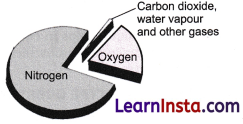
(i) What does this figure show?
Answer:
This figure shows the composition of air.
(ii) Name two gases which mainly form the air.
Answer:
Nitrogen and oxygen.
(iii) What is the composition of air?
Answer:
The main components of air are nitrogen (78%), oxygen (21%), argon (0.93%) and carbon dioxide (0.03 to 0.04%). Air also contains water vapour, dust particles and smoke particles which have negligible percentage in air.
Question 2.
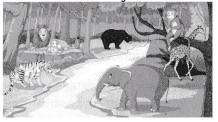
Observe the following figure and answer the following Questions:
(i) Identify the figure.
(ii) Name the animals found in it.
Answer:
(i) This figure shows forest as habitat of various types of animals.
(ii) There are some animals in this figure like monkey, birds, elephant, giraffe, tortoise, etc.
Question 3.
Observe the following figure and answer the following Questions:
(i) Which technique is shown in the figure?
(ii) What is the advantage of using this techniQuestion?

Answer:
(i) Rainwater harvesting is shown in the figure.
(ii) This technique helps in conservation of water by collecting rainwater and using it in future.
Nature’s Treasures Class 6 Case Based Questions
Question 1.
Soil is an important natural resource which is formed by disintegration of rocks. It may have different things like sand, insects and worms. There may be many small organisms that we cannot see with our naked eyes. Plants and animals also become part of the soil as they decompose and decay. The soil samples collected from different places may be of different colours because they may contain different materials.
I. What is soil?
II. Name the things that may be present in a soil sample.
III. Why do soil samples collected from different places have different colours?
Answer:
I. Soil is an important natural resource which is formed by disintegration of rocks.
II. Soil may have different things like sand, insects, small organisms like worms and decomposed plants and animals.
III. Soil samples collected from different places have different colours because they contain different composition of minerals.
Question 2.
Natural resources can be broadly classified into two types – renewable natural or non-renewable natural resources. Resources which get renewed, replenished or restored within a reasonable period of time are called renewable resources. Examples of renewable natural resources are sunlight, water and air. Non-renewable resources are present in limited Question uantities in nature. They can be exhausted by human activities. Examples of these resources are minerals, coal, petroleum, natural gas, etc. Some of non-renewable natural resources like coal, petroleum and natural gas were formed from the dead remains of living organisms (fossils). So, these are all known as fossil fuels.
I. What are non-renewable natural resources?
II. What are natural resources? Give examples.
III. What are fossil fuels and how they are formed?
Answer:
I. Non-renewable natural resources are those resources which are present in limited Question uantities in nature and can be exhausted by human activities.
II. The resources which we get from nature are called natural resources. For example, forest, wildlife, wind and natural gas.
III. Petroleum along with natural gas and coal are commonly called fossil fuels. They are formed from the remains of microorganisms and plants that got buried deep inside the Earth, and were converted to petroleum, natural gas and coal.