These Class 6 Science Curiosity Worksheet and Class 6 Science Chapter 3 Mindful Eating A Path to a Healthy Body Worksheet with Answers are excellent for board exam practice.
Class 6 Science Chapter 3 Mindful Eating A Path to a Healthy Body Worksheet
Class 6 Mindful Eating A Path to a Healthy Body Worksheet
Worksheet On Mindful Eating A Path to a Healthy Body Class 6 – Mindful Eating A Path to a Healthy Body Worksheet Class 6
A. Objective Type Questions
Multiple Choice Questions
Question 1.
Which of the following is not the characteristic of fats?
(a) Fats is a source of stored energy
(b) They are also known as roughage
(c) Common food rich in fats include milk, cheese, butter, cream, ghee
(d) None of the above
Answer:
(b) They are also known as roughage
Question 2.
What is the primary role of fats in the human body?
(a) To provide immediate energy for physical activity
(b) To help build muscles
(c) To store energy for long-term use and protect organs
(d) To aid in digestion of proteins
Answer:
(c) To store energy for long-term use and protect organs

Question 3.
Which of the following is considered as body building food?
(a) Proteins
(b) Vitamins
(c) Fats
(d) Carbohydrates
Answer:
(a) Proteins
Question 4.
Swelling of thyroid glands goitre occurs due to the deficiency of
(a) iron
(b) potassium
(c) phosphorus
(d) iodine
Answer:
(d) iodine
Question 5.
Which of these is not true for vitamin-C?
(a) It helps in fighting against diseases like common cold, scurvy, throat infections
(b) It is present in oranges, tomatoes, lemon and guava
(c) Deficiency of it delays wound healing
(d) It promotes growth, vision
Answer:
(a) It helps in fighting against diseases like common cold, scurvy, throat infections
Question 6.
Our body prepares which type of vitamin in the presence of sunlight?
(a) Vitamin-D
(b) Vitamin-A
(c) Vitamin-B
(d) Vitamin-K
Answer:
(a) Vitamin-D
Question 7.
Rickets is caused by the deficiency of
(a) vitamin-A
(b) vitamin-D
(c) vitamin-C
(d) vitamin-B
Answer:
(b) vitamin-D
Question 8.
Disease caused due to lack of iron is
(a) rickets
(b) anaemia
(c) beri – beri
(d) scurvy
Answer:
(b) anaemia
Question 9.
Clacium is required for
(a) strengthening of bones and teeth
(b) good vision and healthy skin
(c) fighting the diseases
(d) performing physical and mental activities
Answer:
(a) strengthening of bones and teeth
Question 10.
Choose the incorrect option with respect to the detection of starch, proteins and fats
(a) Iodine solution is required for testing the presence of starch
(b) Copper sulphate and caustic soda is required to test the presence of proteins
(c) Sodium solution is required for testing the presence of fats
(d) None of the above
Answer:
(c) Sodium solution is required for testing the presence of fats
Question 11.
Given below are the steps to detect the presence of proteins in a food item.
(i) Take a small quantity of food sample in a test tube, add ten drops of water and shake it
(ii) Make a paste of food or powder of food item to be tested.
(iii) Add ten drops of caustic soda solution to the test tube and shake well.
(iv) Add two drops of copper sulphate solution.
Choose the correct answer.
(a) (i), (iv), (ii), (iii)
(b) (ii), (i), (iv), (iii)
(c) (ii), (iii), (iv), (i)
(d) (iv), (ii), (i), (iii)
Answer:
(b) (ii), (i), (iv), (iii)
Question 12.
The FSSAI stands for
(a) Food Safety and Supply Authority of India
(b) Food Standards and Security Association of India
(c) Food Service and Sanitation Agency of India
(d) Food Safety and Standard Authority of India Read the following statements.
Answer:
(d) Food Safety and Standard Authority of India Read the following statements.
Question 13.
Read the following statements.
(i) Millets can be easily cultivated in different climatic conditions.
(ii) Millets are good sources of minerals like calcium.
(iii) Jowar, bajra and sanwa are native crops of India
(iv) Millets are large-sized grains
Choose the correct option regarding millets.
(a) (i) and (ii)
(b) (ii) and (iv)
(c) (iii) and (iv)
(d) (i) and (iii)
Answer:
(a) (i) and (ii)
Fill in the Blanks
Fill in the blanks by choosing the appropriate word from the box given below.
goitre, starch, vitamin-A, sugar, vitamin-C, obesity, roughage, balanced diet, carbohydrates, Rickets, Vitamin-Bi, Scurvy, Vitamin-A
Question 1.
Eating too much of foods rich in fats may lead to a condition called _____.
Answer:
obesity
Question 2.
Vitamin-C deficiency causes a disease known as ____.
Answer:
scurvy
Question 3.
______ is caused by vitamin-D deficiency.
Answer:
rickets
Question 4.
Deficiency of ____ causes a disease known as beri-beri.
Answer:
vitamin-B1
Question 5.
Night blindness is influenced due to ____ deficiency in our food.
Answer:
vitamin-A
Question 6.
The component of food, which does not provide any nutrients to the body yet it is essential in our food is ____.
Answer:
roughage
Question 7.
The vitamin, which gets easily destroyed by heating during cooking is ____.
Answer:
vitamin-C
Question 8.
Deficiency diseases can be countered by taking ____.
Answer:
balanced diet
True/False
Viraj has concluded some statements after reading the chapter. His friend find that few of them were false. Identify whether the given statements are true or false.
Question 1.
In various regions of India, the choice of food does not vary according to the cultivation of food crops.
Answer:
False. In different regions of lnda, the choice of food may vary according to the cultivation of food crops in that particular region, taste preferences, culture and traditions.
Question 2.
Cooking practices are also called culinary practices.
Answer:
True
Question 3.
Carbohydrates are not of the primary source of energy in our diet.
Answer:
False, Carbohydrates are one of the primary source of energy in our diet.
Question 4.
The right amount of protein must be included in the diet of growing children for their proper growth and development.
Answer:
True
Question 5.
Vitamins (A, B1, C and D) and minerals (calcium, iodine, and iron) are two groups of food components that protect our body from various diseases.
Answer:
True
Question 6.
Vitamins and minerals are not called protective nutrients.
Answer:
False. Vitamins and minerals are called protective nutrients as they protect the body from diseases and keep us healthy.
Question 7.
Coluthur Gopalan (1918-2019) did not initiated nutrition research in India.
Answer:
False. Coluthur Gopalan (1918-2019) initiated nutrition research in India.
Question 8.
Packaged food items must have information about the nutrients on their cover.
Answer:
True
Match the Following
Question 1.
Match the Column I with Column I
tablee 1
Column I Column II
(a) Sources of fats (i) Soft and bent bones
(b) Rickets (ii) Wheat and rice
(c) Sources of proteins (iii) Bleeding of gums
(d) Sources of carbohydrate (iv) Milk products and pulses
(e) Scurvy (v) Ghee and oil
(a) ______
(b) ______
(c) ______
(d) ______
(e) ______
Answer:
(a) (v)
(b) (i)
(c) (iv)
(d) (ii)
(e) (iii)
Question 2.
Match each vitamin from Column I with its primary source listed in Column II.

Answer:
(a) (iii)
(b) (a)
(c) (iv)
(d) (ii)
Assertion-Reason Questions
In the following questions, two statements are given- one is labelled as Assertion (A) and the other is labelled as Reason (R). Read the given statements carefully and choose the correct answer.
(a) Both A and R are true, and R is the correct explanation of the A.
(b) Both A and R are true, but R is not the correct explanation of the A.
(c) A is true, but R is false.
(d) A is false, but R is true.
Question 1.
Assertion (A) Protein is obtained from both plant and animal sources.
Reason (R) Protein are called energy-giving foods.
Answer:
(c) A is true, but R is false, R can be corrected as Proteins are called body building foods.
Question 2.
Assertion (A) In night blindness, vision is poor or completely lost in low light condition. Reason (R) Night blindness occurs due to the deficiency of vitamin-B1.
Answer:
(c) A is true, but R is false. R can be corrected as Night blindness occurs due to the deficiency of vitamin-A.
Question 3.
Assertion (A) Roughage and water are rich in essential nutrients.
Reason (R) A balanced diet must contain roughage and water.
Answer:
(d) A is false, but R is true. A can be corrected as Roughage and water do not provide any nutrients directly to our body, but are essential components of our food.
Question 4.
Assertion (A) A balanced diet maintains health.
Reason (R) A balanced diet contains all the components of food in right proportion.
Answer:
(a) Both A and R are true and R is the correct explanation of A.
Question 5.
Assertion (A) Millets are small-sized, highly nutritious grains.
Reason (R) Millets are good source of vitamins, minerals like iron and calcium.
Answer:
(a) Both A and R are true and R is the correct explanation of A.
Case Based Questions
Medu was having difficulty seeing things in dim light. The doctor tested his eyesight, and prescribed a particular vitamin supplement. He also advised Medu to include a few food items in his diet regularly.
Question 1.
Which component of food is Medu advised to take in his diet?
(a) Vitamin-A
(b) Vitamin-C
(c) Vitamin-D
(d) Calcium
Answer:
(a) Vitamin-A
Question 2.
Which food item should he include in his diet?
(a) Seaweed
(b) Papaya
(c) Amla
(d) Fish
Answer:
(b) Papaya
B. Subjective Type Questions
Very Short Answer Type Questions
Question 1.
Why do labourers need more carbohydrates?
Question 2.
Name two sources of carbohydrates.
Question 3.
Write the two components of food that provide energy.
Question 4.
Which component of food is called a source of instant energy?
Question 5.
Write two sources of proteins in our food.
Question 6.
Why proteins are known as building foods?
Question 7.
What are the main symptoms of the disease scurvy?
Question 8.
Name the disease caused due to the deficiency of vitamin-B1.
Question 9.
Which food item provides both protein and iodine?
Question 10.
Observe the diagrams (a) and (b), and answer the following questions.
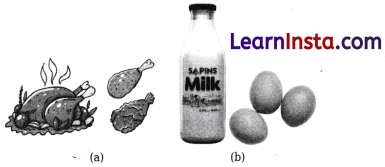
(i) Provide appropriate caption for (a) and (b).
(ii) Mention the role of the minerals they provide.
Question 11.
Which of the following food items does not provide any nutrient? Milk, water, orange juice, tomato soup
Question 12.
why roughage is considered an important component of diet, even though it do not provide any nutrient.
Question 13.
A food item gives blue-black colour with iodine. Which nutrient is present in food?
Question 14.
Name some nutri-cereals.
Question 15.
why there is a need to reduce food miles?
Short Answer Type Questions
Question 1.
Why home-made laddoos are preferred as a part of our traditional diet in winters?
Question 2.
Excess intake of fats is harmful for the body because it causes obesity. Would it be harmful for the body to take too much of proteins or vitamins in the diet?
Question 3.
Observe the given figures and answer the following questions.

(i) Which nutrient is mainly provided by these items?
(ii) Name the sources of the nutrient other than the ones given in figures.
Question 4.
Which type of food components do the sports persons need? Why do they need them in large quantities?
Question 5.
Mention two reasons why protein is important in our diet?
Question 6.
Goitre is caused by the deficiency of which nutrient? Mention its symptom.
Question 7.
Identify the disorders shown in the figure. Also, specify the name of the nutrients, whose deficiency leads to this disorder.
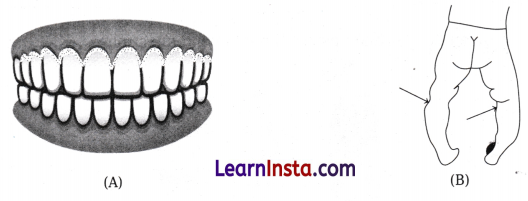
Question 8.
Medu got a fracture in his leg. His doctor aligned the bones, put on a plaster and gave him calcium tablets. On the second visit, the doctor gave him Vitamin-D syrup along with calcium tablets. Answer the following questions:
(i) Why did the doctor give calcium tablets to Medu?
(ii) On the second visit, why did the doctor give vitamin-D syrup along with calcium tablets?
Question 9.
What is the main function of roughage?
Question 10.
While using iodine in the lab, a few iodine drops fell on Paheli’s socks, and a few on her teacher’s saree. The iodine drops on the saree turned blue-black, but there was no colour, change on the socks. What can be the possible reason?
Question 11.
Why does our body need balanced diet?
Question 12.
‘Minerals and vitamins are needed in very small quantities by our body as compared to other components, yet, they are an important part of a balanced diet.’ Explain the statement.
Question 13.
Mishti avoids eating vegetables but likes to eat biscuits, noodles and white bread. She frequently complains of stomach ache and constipation. What are the food items that she should include in her diet to get rid of the problems?
Question 14.
How would eating local food help in reducing food miles?
Long Answer Type Questions
Question 1.
Medu & Mishti peeled some potatoes and cut them into small pieces. They washed and boiled the potatoes in water. Then they threw away the excess water and fried the potatoes in oil, adding spices and salt. Although the potato dish tasted very good, it had fewer nutrients. Suggest a cooking method for potatoes that will not lower their nutrients.
Question 2.
‘Water does not provide nutrients, but it is an essential component of food’. Explain. Also, mention some food sources that provide water to our body.
Question 3.
Sugar is an example of carbohydrates. Sugar is tested with iodine solution but it does not change to blue-black colour. What can be a possible reason?
Question 4.
What is the step – by – step method to test the presence of protein?
Skill Based Activities
Question 1.
Complete the crossword with the help of clues provided.
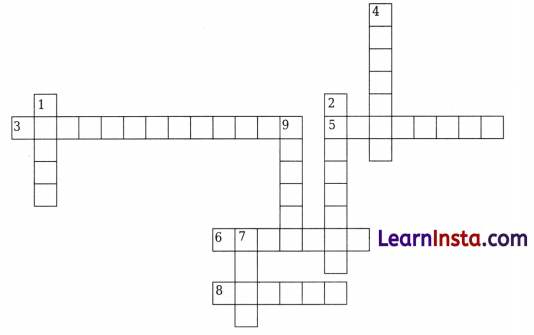
Across
3. They are one of the primary sources of energy in our diet.
5. They are also known as dietary fibres.
6. They are protective nutrients that help in maintaining a healthy body.
8. They are required for the proper functioning of thyroid gland.
Down
1. It helps to remove waste from the body through urine and sweat.
2. They act as building blocks and serve as materials helping in growth and repair of the body cells and tissues.
4. A mineral that keep our bones and teeth healthy.
7. It is an important component of blood.
9. Mineral found in salt.
Question 2.
Unscramble the following words related to food components and write them in the space provided.
(a) reinpot _____
(b) menliars _____
(c) tivanmi _____
(d) bocatradhyer _____
(e) nitesturn _____
(f) tfa _____
Question 3.
Observe the items given in figure carefully and answer the questions that follow.

(a) Food rich in carbohydrates is _____.
(b) ____ and _____ provide us energy for performing various activities.
(c) ____ is a rich source of fat.
(d) Milk provides ____, vitamin-D and ____ (Mineral)
(e) _____ (fruit) is rich source of vitamin-A.
(f) Spinach is a good source of the mineral ____.
(g) Both eggs and ___ are rich in ____.
Question 4.
Vegetables or fruits that grow naturally in the forest or nearby fields without being cultivated by farmers are considered wild varieties. Traditionally, many tribal groups in India depend on these wild varieties, which form a part of their food. Read about ranbhajis from Maharashtra and edible mushrooms from Himachal Pradesh. Are you aware of any such wild varieties of food from your region? Describe in short.
Question 5.
The Apatani tribe of Arunachal Pradesh produces a salt called tapyo to fulfil their dietary requirements. Collect more information from the internet about their salt making process and the need to make their own salt. Write a paragraph about the process of making this salt and its usefulness.
Question 6.
Find out the variation in diet of different individuals. Write and analyse the nutritional requirement of different individuals based on age.
Question 7.
Prepare a diet chart to provide a balanced diet to a twelve-year-old child. The diet chart should include food items that are not expensive and are commonly available in your area.