These Class 6 Science Curiosity Worksheet and Class 6 Science Chapter 6 Materials Around Us Worksheet with Answers are excellent for board exam practice.
Class 6 Science Chapter 6 Materials Around Us Worksheet
Class 6 Materials Around Us Worksheet
Worksheet On Materials Around Us Class 6 – Materials Around Us Worksheet Class 6
A. Objective Type Questions
Multiple Choice Questions
Question 1.
Which object is made from glass?
(a) Toy
(b) Shoes
(c) Tumbler
(d) Book
Answer:
(c) Tumbler
Question 2.
Some materials have an irregular and uneven surface with bumps or ridges and are not smooth to touch, these materials are called
(a) smooth material
(b) opague
(c) hard material
(d) rough material
Answer:
(d) rough material

Question 3.
Select the object from the following which can shine?
(a) Cotton shirt
(b) Steel spoon
(c) Newspaper
(d) Book
Answer:
(b) Steel spoon
Question 4.
Select a lustrous material out of the following substances.
(a) Chair
(b) Paper
(c) Aluminium
(d) Rubber
Answer:
(c) Aluminium
Question 5.
Pick-up a non-metal that has luster.
(a) Diamond
(b) Iron
(c) Wood
(d) Gold
Answer:
(a) Diamond
Question 6.
Arrange the following objects in order of its softest to hardest nature.
I. Cotton ball
II. Diamond
III. Rubber
IV. Sponge
The correct order will be
(a) I, II, IV, III
(b) III, IV, II, I
(c) I, IV, III, II
(d) II, IV, III, I
Answer:
(c) I, IV, III, II
Question 7.
Which of the following statements is incorrect?
(a) Man-made materials are also known as synthetic materials
(b) Materials which are difficult to scratch or compress are called soft materials
(c) Non- lustrous substances have a dull appearance
(d) Diamond is known as the hardest natural material
Answer:
(b) Materials which are difficult to scratch or compress are called soft materials
Question 8.
There are some materials through which we are not able to see. These materials are called
(a) transparent
(b) opaque
(c) translucent
(d) soluble
Answer:
(b) opaque
Question 9.
Shopkeepers prefers to keep sweets or biscuits in a glass or plastic container. This is due to
(a) transparent nature of glass/plastic
(b) translucent nature of glass/plastic
(c) opaque nature of glass/plastic
(d) None of the above
Answer:
(a) transparent nature of glass/plastic
Question 10.
While doing an activity in class, the teacher asked Paheli to hand over translucent material. Which among the following materials will Paheli pick and give it to her teacher?
(a) Glass tumbler
(b) Butter paper
(c) Cellophane paper
(d) Aluminium foil
Answer:
(b) Butter paper
Question 11.
The term used for the substance incapable of being dissolved in a liquid is
(a) translucent
(b) insoluble
(c) opaque
(d) soluble
Answer:
(b) insoluble
Question 12.
Some substances have completely disappeared or dissolved in water. We say that these substances are
(a) insoluble
(b) soluble
(c) transparent
(d) translucent
Answer:
(b) soluble
Question 13.
Take 10 mL of water in 6 test tubes each and add different samples of substances to each test tube as shown in the given figure. Shake the test tubes vigorously for a couple of seconds and leave them undisturbed. In which of these test tubes, sample substances will remain insoluble in water?
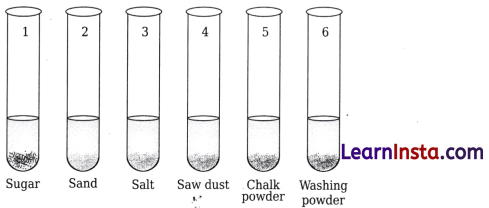
(a) 1, 2 and 3
(b) 2, 4 and 5
(c) 2, 3 and 4
(d) 4, 5 and 6
Answer:
(b) 2, 4 and 5
Question 14.
You are provided with the following gases.
(i) Carbon dioxide
(ii) Methane
(iii) Oxygen
(iv) Nitrogen
Which of the above gases will be soluble in water?
(a) (i) and (ii)
(b) (i) and (iii)
(c) (ii) and (iv)
(d) (iii) and (iv)
Answer:
(b) (i) and (iii)
Fill in the Blanks
Fill in the blanks using the correct word and complete the statement.
Photosynthesis, iron, soluble, matter, floats, classification, properties, transparent, hard, insoluble, translucent, metals, material
Question 1.
A substance which is used in making different objects is called ______
Answer:
material
Question 2.
Grouping things together with similar properties is called ______
Answer:
classification
Question 3.
Materials are grouped on the basis of similarities or dissimilarities in their ______
Answer:
properties
Question 4.
______ is a metal that has lustre.
Answer:
Iran
Question 5.
______ usually shows lustrous property when they are freshly cut ______
Answer:
Metals
Question 6.
A piece of stone is a ______ material.
Answer:
hard
Question 7.
Oily patch on a piece of paper is ______
Answer:
translucent
Question 8.
Water is a ______ liquid.
Answer:
transparent
Question 9.
All solids are not ____ in water.
Answer:
insoluble
Question 10.
Oxygen gas is _____ in water.
Answer:
soluble
Question 11.
The underwater plants require dissolved CO2 for carrying the ____
Answer:
photosynthesis
Question 12.
Dried leaf ____ on the surface of water.
Answer:
floats
Question 13.
Anything that occupies space and has mass is called ______
Answer:
matter
True/False
Shubham is provided with certain statements. After reading them he has to colour the shape with green colour if the statement is true and with red colour if the statement is false.
Question 1.
All gases are non-lustrous.
Answer:
True
Question 2.
Diamonds, gems and pearls are lustrous.
Answer:
True
Question 3.
Diamond is the hardest natural occurring substance
Answer:
True
Question 4.
Iron is harder than sponge.
Answer:
True
Question 5.
Soft materials can be compressed or scratched.
Answer:
True
Question 6.
Air is transparent.
Answer:
True
Question 7.
Opaquess is a property of material through which you are not able to see.
Answer:
True
Question 8.
Brick is opaque, while butter paper is translucent.
Answer:
True
Question 9.
Insoluble substances mix in water.
Answer:
False
Question 10.
Alcohol is immiscible with water.
Answer:
False
Question 11.
Oil mixes with water.
Answer:
False
Question 12.
Salt does not dissolve in water.
Answer:
False
Question 13.
Vinegar does not mix with water.
Answer:
False
Question 14.
Glycerin is not soluble in water.
Answer:
False
Question 15.
Honey floats on the surface of water.
Answer:
False
Question 16.
Stone settles down in water.
Answer:
True
Match the Following
Question 1.
Match the definition given in Column I with the terms associated with it in the Column II.
| Column I | Column II |
| (a) Amount of substance that makes up an object. | (i) Space |
| (b) Amount of area an object occupies. | (ii) Mass |
| (c) Amount of space occupied by a liquid. | (iii) Non-lustrous materials |
| (d) Materials that have a dull appearance. | (iv) Soft materials |
| (e)’ Materials which can be easily compressed. | (v) Volume |
(a) _____
(b) _____
(c) _____
(d) _____
(e) _____
Answer:
(a)-(ii);
(b)-(i),
(c)-(v);
(d)-(iii);
(e)-(iv)
Question 2.
Match the phrases given in Column I with the best suited examples given in Column II.
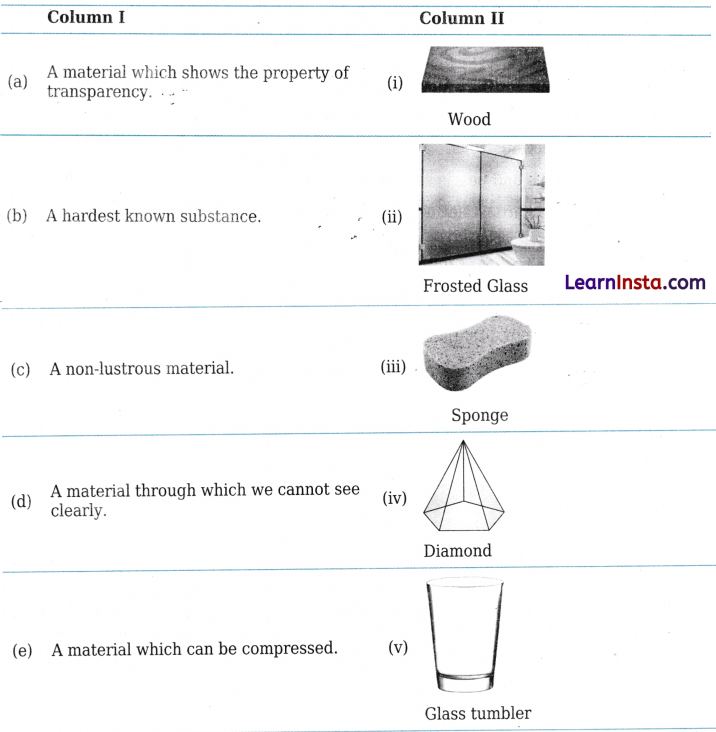
(a) _______
(b) _______
(c) _______
(d) _______
Answer:
(a)-(v);
(b)-(iv);
(c)-(i);
(d)-(ii);
(e)-(iii)
Assertion-Reason Questions
In the following questions, two statements are given, one is labelled as Assertion (A) and the other is labelled as Reason (R). Read the statements carefully and choose the correct alternative (a), (b), (c) and (d) as given below.
(a) Both A and R are true and R is correct explanation of the A.
(b) Both A and R are true, but R is not the correct explanation of the A.
(c) A is true, but R is false.
(d) A is false, but R is true.
Question 1.
Assertion (A) Diamond is a hard material.
Reason (R) The materials which cannot be compressed or scratched easily are called hard materials.
Answer:
(a) Both A and R are true and R is the correct explanation of A.
Question 2.
Assertion (A) The materials which can be compressed or scratched easily are called soft.
Reason (R) Iron is a hard material.
Answer:
(b) Both A and R are true, but R ¡s not the correct explanation of A.
Question 3.
Assertion The materials through which objects can be seen but not clearly are known as translucent materials.
Reason The oily patch on paper is translucent.
Answer:
(a) Both A and R are true and R is the correct explanation of A.
Question 4.
Assertion (A) If we add some ammonium chloride (a solid) to a glass of water and stir it for sometime, we find that solid disappears.
Reason (R) Ammonium chloride is soluble in water.
Answer:
(a) Both A and R are true and R is the correct explanation of A.
Question 5.
Assertion (A) Some liquids are immiscible in water.
Reason (R) Vinegar in water is one of its example.
Answer:
(c) A is true, but R is false, R can be corrected as Vinegar in water is an example of a miscible liquid.
Case Based Questions
Anything that can be seen and touched is called an object. The objects could be of different shapes, colours and sizes. Some objects may be living like animals and plants while some may be non-living like chairs and tables. The matter of which an object is made is called material, for example, chair is made of wood, book is made of paper. The placing of objects into groups according to certain features is called classification. Classification of objects into groups is important as it helps us in:
- Finding an object from a large group,
- Understanding some basic properties of an object,
- Giving a clarity about similarities and differences amongst the various groups.
Question 1.
Which of the following is a matter?
(a) Air
(b) Steel
(c) Water
(d) All of these
Answer:
(d) All of these
Question 2.
Anything that has a mass and occupies space is called
(a) classification
(b) volume
(c) matter
(d) air
Answer:
(c) matter
Question 3.
A good example of grouping can be seen in a
(a) playground
(b) supermarket
(c) store room
(d) hospital
Answer:
(a) playground
Question 4.
The object that can be made from wood material is
(a) coins
(b) chair
(c) window Pane
(d) Both (a) and (c)
Answer:
(b) chair
B. Subjective Type Questions
Define the following terms
Question 1.
Material
Question 2.
Living objects
Question 3.
Transluency
Question 4.
Insoluble materials
Very Short Answer Type Questions
Question 1.
Name the materials that can be used to make a plate.
Question 2.
How are the various objects classified?
Question 3.
Why do we require object grouping?
Question 4.
Why do some metals dull and lose their lustre?
Question 5.
Name two non-lustrous materials.
Question 6.
Name two materials which are soft.
Question 7.
Why do shopkeepers prefer to keep eatables in transparent containers?
Question 8.
What is a translucent material?
Question 9.
Name three liquids that are not soluble in water.
Question 10.
Sort the materials that mix well and those that do not mix well with water. Vinegar, lemon juice, mustard oil, diesel, wheat flour
Question 11.
Name two gases that are soluble and insoluble in water.
Question 12.
Mixtures of chalk powder in water, oil in water and washing soda in water were given to Sunita, Rekha and Neelam, respectively. Whose mixture is in the solution form?
Question 13.
What are the SI units of mass and volume?
Short Answer Type Questions
Question 1.
“Object grouping benefits the shopkeeper.” Justify your claim.
Question 2.
Why are different materials used for making balls for various sports? Can a cricket ball be used to play tennis?
Question 3.
Are there any properties which can be shown by all materials? If yes, what are those?
Question 4.
Can you think about what changes the invention of plastic brought to humans? Is it a boon or a bane?
Question 5.
Would it be a good idea to use paper-like materials for making cooking utensils?
Question 6.
Why cannot a tumbler made of cloth be used for storing water?
Question 7.
Describe a technique for demonstrating that water is a transparent material.
Answer:
Question 8.
Describe an experiment that demonstrates that the palm is translucent.
Question 9.
Water is a universal solvent. Does everything you put in water disappear?
Question 10.
Demonstrate that while common salt, sugar, and baking soda are soluble in water, sawdust, chalk powder, and sand are not.
Question 11.
You are given three materials: water, sand, and oil. Pouring the three liquids at the same time without disturbing them, how will these liquids be arranged from top to bottom?
Question 12.
Kerosene, coconut oil, mustard oil does not dissolve in water, even on shaking. They separate after sometime forming two different layers. Explain why?
Answer:
Question 13.
What is ORS? How can you make your own ORS?
Question 14.
Why do some substances sink while others float?
Long Answer Type Questions
Question 1.
The following are some examples of objects and materials: Water, orange, sugar, globe, apple, watermelon and earthen pitcher. Sort the materials on the basis of below criteria.
(a) Round and irregular shapes
(b) Consumables and non-consumables
Question 2.
Discuss important properties of materials that can be used to classify them.
Question 3.
Imagine you have two mysterious materials, X and Y. When you try to press material X, it feels rigid and does not change its shape easily. On the other hand, material Y easily changes its shape when you press it. Now, when you mix both materials in water, only material X dissolves completely, while material Y remains unchanged. What can materials X and Y be? Can you identify whether material X is hard or soft? What about material Y? Justify your answer.
Question 4.
How does the appearance of an object assist us in distinguishing between different materials? Use an activity to demonstrate.
Question 5.
How are materials classified according to their transparency?
Question 6.
You need to have containers for collection of
- food waste,
- broken glass and
- wastepaper.
Which materials will you choose for containers of these types of waste? What properties of materials do you need to think of?
Skill Based Activities
Question 1.
Solve the following crossword puzzle with the help of clues given below.

Across
2. Cotton is a _____ material.
4. The materials which are difficult to compress are known as ____,
5. Iron, copper and aluminium is called ______,
6. The materials through which objects can be seen, but not clearly, are known as _____,
8. Shiny appearance is termed as ______.
Down
1. Opaque material which we got from trees is _____.
3. Water is a _____ liquid.
7. Vinegar is _____ in water.
Question 2.
A list of jumbled words are given here. Write the correct form of each word.
- tcenlstrnau _____
- esubolsnil _____
- onitraisper _____
- tnetnarrpsa _____
- eouaqp _____
Question 3.
Collect 20-30 objects from your household and classify them based on the properties of the materials they are made up of. Were you able to put them in separate groups?
What relationship do you see between the properties of the materials and the use of the objects?
Question 4.
There are certain specific symbols which we use to denote hazardous material. Use these symbols to classify hazardous materials. Find out the material for which these symbols can be used.
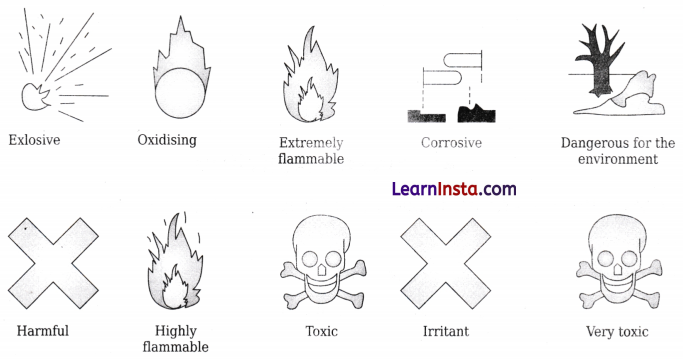
Question 5.
Recyclers buy old objects based on properties of the materials and do not bother even if an object is broken. Conduct a survey with recyclers near you and find out what properties of materials they check before buying objects from households. Which materials do they not buy and why?
Question 6.
Gather information on different materials which can be recycled. You can take help from various sources such as newspapers, magazines, talking to elders in your community, and the internet.