Living Creatures: Exploring their Characteristics Class 6 Extra Questions and Answers Science Chapter 10
Living Creatures: Exploring their Characteristics Class 6 Very Short Answer Type Questions
Question 1.
What is breathing?
Answer:
The process of taking in oxygen-fich air and giving out carbon dioxide-rich air (inhalation and exhalation of air) is called breathing.
Question 2.
What is respiration?
Answer:
The process in which oxygen is used by the living bodies to break down food to get energy is called respiration.
Question 3.
What is stimuli?
Answer:
The changes in our surroundings that make us respond to them are called stimuli.
Question 4.
What is excretion?
Answer:
The process of getting rid of the waste by the living organisms is known as excretion.
Question 5.
Do plants also excrete?
Answer:
Yes, plants also excrete.
Question 6.
What is reproduction?
Answer:
The process by which living organisms produce more of their own kind is called reproduction.
Question 7.
Do animals move?
Answer:
Yes, animals move from one place to another.

Question 8.
Do plants also move?
Answer:
Plants are generally fixed in the soil so they do not move from one place to another. They show certain types of movements.
Question 9.
Name the conditions on which seed germination depends. –
Answer:
Germination of seed depends upon the availability of water, air and suitable light and/or dark conditions.
Question 10.
Name any two seeds that require light to germinate.
Answer:
Coleus and Petunia
Question 11.
Name any two seeds that do not require light to germinate.
Answer:
Calendula and Zinnia
Question 12.
In which direction, root and shoot of a germinating seed grow?
Answer:
During germination of a seed, root grows downwards, while shoot grows upwards.
Question 13.
What do you understand by the term life cycle of a plant?
Answer:
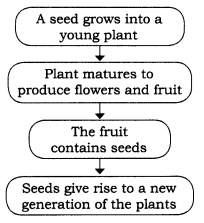
The entire process from a seed to a plant, and then, to the next generation of seeds is called the life cycle of a plant.
Question 14.
When a plant is considered dead?
Answer:
When a plant stops growing and all activities of life gradually comes to an end, even after the availability of all the necessary conditions, the plant is considered dead.
Question 15.
What are thfe different stages in the life cycle of a plant?1′
Answer:
Seed germination, appearance of leaves, flowers, fruits and pods with seed on plant are the different stages in the life cycle of plants.
Question 16.
Name a bloodsucking insect.
Answer:
Female mosquitoes
Question 17.
Name the diseases transmitted by mosquitoes.
Answer:
Mosquitoes transmit several diseases like malaria, dengue and chikungunya.
Question 18.
Why it is not advised to allow water to stagnate anywhere in our surroundings?
Answer:
This is because mosquitoes lay eggs in stagnant water.
Question 19.
What are the two worm-like stages in the life cycle of mosquitoes?
Answer:
Pupa and larvae
Question 20.
Why do mosquito larvae and pupae repeatedly come to the water surface?
Answer:
Mosquito larvae and pupae live in water and require air to respire. They move to the surface of the water for air.
Question 21.
Name the different stages present in the life cycle of silk moth.
Answer:
The silk moth passes through four life stages—egg, larva, pupa and adult.
Question 22.
What is spawn?
Answer:
The cluster of frog’s eggs, surrounded by a jelly-like substance is known as spawn.
Question 23.
What are the different stages in the life cycle of a frog?
Answer:
Egg, tadpole, froglet and frog
Question 24.
Which stage in the life cycle of frog has the shortest duration?
Answer:
Egg
Question 25.
Is there a change in the habitat during the various stages in the life cycle of a frog?
Answer:
Yes, development of egg, embryo, tadpole, froglet takes place inside water while, adult frog can live both on land as well as in water.
Question 26.
Name any two animals which show significant changes in the various stages of their life cycle.
Answer:
Mosquito and frog
Living Creatures: Exploring their Characteristics Class 6 Short Answer Type Questions
Question 1.
Which of the things in the following list are non-limng?
Plough, Mushrooms, Sewing machine, Radio, Boat, Water hyacinth, Earthworm
Answer:
Plough, Sewing machine, Radio, Boat are non-living things.
Question 2.
Give an example of a non-living thing which shows any two characteristics of living thing.
Answer:
Example of non-living thing is cloud. It shows following two characteristics of living things:
- It grows in size.
- It shows movement.
Question 3.
Which of the non-living things listed below were once part of a living thing?
Butter, Leather, Soil, Wool, Electric bulb, Cooking oil, Salt, Apple, Rubber.
Answer:
Butter, Leather, Wool, Cooking oil, Apple and Rubber are the non-living things which were once part of a living thing.
Question 4.
List the common characteristics of living things.
Answer:
Some common characteristics of living things are:
- Growth
- Movement
- Reproduction
- Respiration
- Responsiveness
- Excretion
Question 5.
Give any two examples of movements in plants.
Answer:
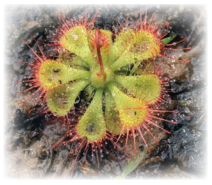
Opening of flowers is one of the examples of movement in plants. Another example of movement in plants is seen in insectivorous plants. Drosera, which is an insectivorous plant, has saucer-shaped leaves with many hair-like projections of unequal length with sticky ends. Whenever an insect enters the saucer, hairs move inward and trap the insect with their sticky ends.
Question 6.
Why do living beings need food? List five living beings that require food to grow.
Answer:
Living beings need food for their growth and development. Mango tree, sunflower, rabbit, ants and human being need food to grow.
Question 7.
What do you understand by the term breathing? Name the biological process of which breathing is part? Do all living beings breathe?
Answer:
Breathing is the process in which oxygen-rich air is inhaled and carbon dioxide-rich air is released out.
Breathing is part of a process called respiration.
Yes, all living beings breathe.
Question 8.
What are stomata? What is their importance to plants? How can we see stomata?
Answer:
Stomata are tiny pores present on the surface of leaves. Stomata help plants in taking air in and out. We can see stomata using a microscope.
Question 9.
What is excretion? Name the products of excretion.
Answer:
Removal of waste products from the body is called excretion. In animals, product of excretion is urine while plants excrete excess water and minerals in the form of small droplets on leaves.
Question 10.
With the Ifelp of an example, explain the term stimulusf.
Answer:
Any thing or any event that prompts living beings to respond is called a stimulus. For example, if a person accidentally touches a hot cup of tea, he immediately withdraws his hand from the hot cup. Here, touching a hot object is stimulus and withdrawal of the hand is the response.
Question 11.
Do plants respond to stimuli? Justify your answer giving an example.
Answer:
Yes, plants respond to stimuli. For example, touch-me-not plants fold their leaves when we touch them. Here touch is stimuli and folding of leaves is response of the plants.
Question 12.
What is the importance of waterfor germinating seeds?
Answer:
Seeds require water for germination. Water enables the seeds to carry out the processes necessary for their growth. The outer covering of the seed is called seed coat. Water softens the seed coat and helps the tiny embryo inside it to develop into a plant.
Question 13.
With the help of a flow chart describe the life cycle of a plant.
Answer:
Question 14.
Draw a larva and pupa of mosquito.
Answer:

Question 15.
Why do people spray kerosene oil on stagnant water?
Answer:
Kerosene oil forms a thin layer over the water surface. This layer separates water from air, and does not allow larvae and pupae of mosquitoes to inhale air. As a result, they die.
Question 16.
What are tadpoles? Give their two characteristics.
Answer:
Tadpole is a stage in the life cycle of frog. A tadpole hatches from an egg. Characteristics of tadpole:
- It has a tail which helps it in swimming,
- Hind legs develop in the advanced stages.
Living Creatures: Exploring their Characteristics Class 6 Long Answer Type Questions
Question 1.
Explain the characteristics of living organisms.
Answer:
The following are the characteristics of living organisms:
(i) All living organisms require food. The food gives energy for growth and to maintain other life processes.
(ii) All living organisms show growth. Young ones of animals grow into adults. Plants also grow.
(in) All living organisms respire. In respiration, oxygen is used for the oxidation of food and carbon dioxide is produced.
(in) All living organisms respond to stimuli.
(v) All living organisms show excretion. The process of getting rid of waste product by the living organisms is called excretion. Plants also remove their wastes.
(vi) All living organisms reproduce. The process by which plants and animals produce their own kind is called reproduction.
Question 2.
Write the differences between living and non-living things.
Answer:
| Living things | Non-living things |
| 1. Living things need food, air and water. | 1. Non-living things do not need food, air and water. |
| 2. Living things grow. | 2. Non-living things do not grow. |
| 3. Living things can move on their own. | 3. Non-living things cannot move on their own. |
| 4. Living things are sensitive. They respond to changes around them. | 4. Non-living things are not sensitive. They do not respond to changes around them. |
| 5. Living things reproduce themselves. | 5. Non-living things do not reproduce. |
| 6. Living things respire to release energy from food. | 6. Non-living things do not respire. |
| 7. Living things excrete. They get rid of waste materials from their body. | 7. Non-living things do not excrete. |
| 8. Living things have a definite life span after which they die, i.e., they have a definite life cycle. | 8. Non-living things do not have a definite life cycle. |
Question 3.
List a few body’s instant responses and their stimuli.
Answer:
Body’s instant responses and their stimuli:
- Watering of mouth when we see delicious food
- Closing of eyes when we see anything coming towards it
- Moving our hands away on touching a hot object
Question 4.
With the help of a labelled diagram explain the life cycle of mosquito. Which stage does the adult mosquito develop from? What is the life span of an adult mosquito?
Answer:
Mosquitoes pass through four stages in their life cycle— egg, larva, pupa and adult. A mosquito begins its life as an egg, the egg develops into a larva, the larva grows into pupa, and the pupa transforms into an adult mosquito. The adult female mosquito lays eggs directly on or near water, and the cycle continues.
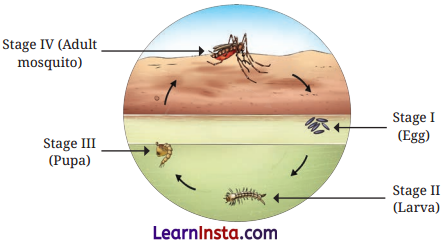
Life cycle of a mosquito
The adult mosquito emerges from the pupa. The adult mosquito may survive for 10 to 15 days.
Question 5.
How many stages does the life cycle of the frog have? Discuss how a tadpole develops into an adult frog.
Answer:
There are four stages in the life cycle of a frog—the egg stage, which progresses to the embiyo stage; the tadpole stage, consisting of an early stage with a tail and no legs, and a late stage with hind legs; the froglet stage, and the adult frog stage.
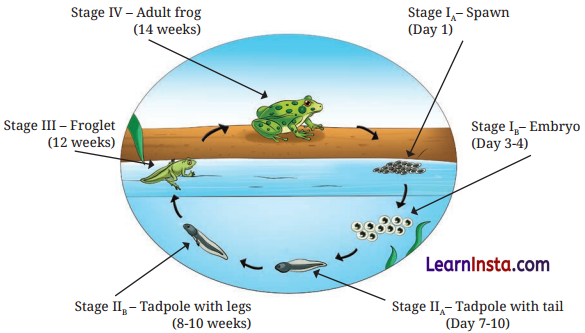
Life cycle of frog
Tadpoles in the early stage have tails but no legs. Tails help them swim in water. Gradually legs of tadpoles begin to develop. They start look like little frogs called froglets. They still live in water but begin to spend some time on land. They continue to grow and lose their tails completely. Their legs become strong to help them jump and land. They become fully developed adult frogs living both in water and on land.
Living Creatures: Exploring their Characteristics Class 6 Skill-Based Questions
Question 1.
Identify the plant shown in the picture. Why this plant is known as insectivorous plant?
Answer:
Drosera plant is shown in the picture. This plant is known as insectivorous plant as it depends on insects for the nutrition.
Question 2.
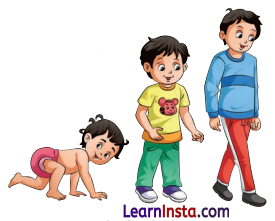
(a) Observe the following figure and state what does it show.
(b) Do plants also show this process?
Answer:
(a) The figure shown in picture shows the growth of a baby into an adult.
(b) Yes, plants also show growth.
Question 3.
Draw a diagram to show various stages present in the life cycle of a plant.
Answer:
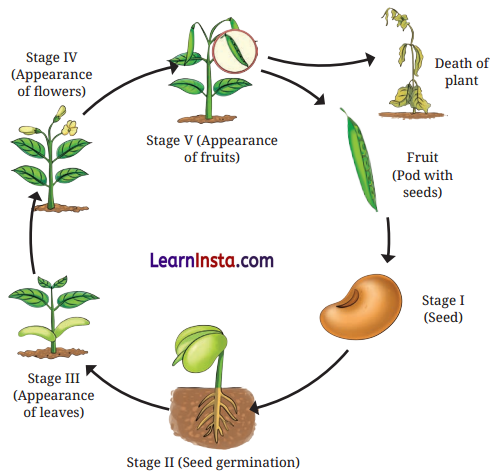
Life cycle of a bean plant
Question 4.
Draw a diagram to show that plants respond to light.
Answer:
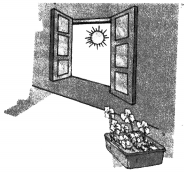
Plants respond to light
Living Creatures: Exploring their Characteristics Class 6 Case-Based Questions
Question 1.
Knowing the different stages of the mosquito’s life can help in preventing mosquitoes around our home. Mosquitoes have four distinct stages during their life cycle:
Egg: It hatches when exposed to water.
Larva: It lives in water and sheds its skin several times. It comes to surface to breathe air.
Pupa: Adult mosquito emerges from this stage.
Adult: It flies after emerging and after its body parts have hardened.
Out of the four stages, the first three stages occur in water, but the adult is an active flying insect.
I. From which stage of the mosquito’s life cycle does adult mosquito emerge?
II. What is the advantage of studying different stages of the mosquito’s life?
III. Name the stages in the life cycle of mosquito which occur in water.
IV. Which stage in the life cycle of mosquito does not occur in water?
Answer:
I. Adult mosquito emerges from pupa.
II. Studying the different stages of the mosquito’s life can help in preventing mosquitoes around our home.
III. Three stages of the life cycle of mosquito, i.e., egg, larva and pupa occur in water.
IV. Adult mosquito does not occur in water.
Question 2.
Our earth in which we live is made up of several things. These things can be divided into two different categories – living things and non-living things. All living things can move, grow, respire to obtain energy, excrete harmful wastes, respond to stimuli and reproduce. They possess life and hence they are called .alive. Examples of living things are plants, birds, insects and other animals.
Non-living things do not show the characteristic shown by living things. They neither grow nor show any movement. They do not respire, excrete, respond to stimuli or reproduce. Non-living things are not alive because they do not possess life. Examples of non-living things are books, pens, bottles, etc.
I. Give any two differences between living and non-living things.
II. Find the odd one out.
Bottle, Wooden log, Mango tree, Laptop
III. Why do living beings excrete?
IV. Why do living beings respire?
Answer:
I. Differences between living and non-living things
| Living things | Non-living things |
| 1. Living things can move, grow, respire, excrete, respond to stimuli and reproduce. | 1. Non-living things cannot move, grow, respire, excrete, respond to stimuli and reproduce. |
| 2. They are alive. | 2. They are not alive. |
II. Mango tree is a living thing while rest are non-living things.
III. Living beings excrete to remove harmful wastes from the body.
IV. Living beings respire to obtain energy.