Experts have designed these Class 7 Science Notes Chapter 11 Light Shadows and Reflections Class 7 Notes for effective learning.
Class 7 Science Chapter 11 Light Shadows and Reflections Notes
Class 7 Light Shadows and Reflections Notes
Class 7 Science Chapter 11 Notes – Light Shadows and Reflections Notes Class 7
→ Light is a form of energy that produces the sensation of sight in our eyes.
→ A source of light can be either natural or artificial (man-made). The sun is the major natural source of light that emits light of its own. Stars are also known to emit light of their own. Sources of light, like the sun or stars, which emit light of their own, are called natural sources.
→ Humans have also been able to design and develop a number of sources of light, like LED electric bulbs, tube lights, CFL and candles, which are called man¬made, or artificial sources of light.
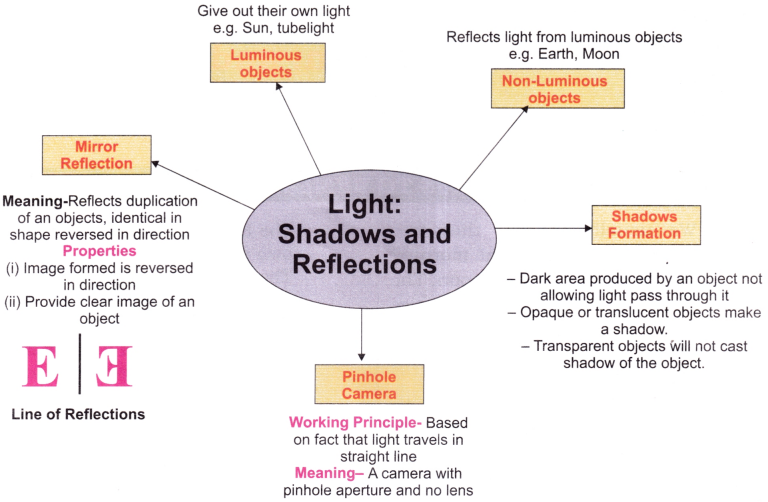
→ Luminous object: An object that emits its own light, such as: The sun, light bulb, candle, star.
→ Non-luminous object: An object that does not emit its own light and is visible only when it reflects light from a luminous source, such as: The moon, book, tree etc.
→ Objects can be classified as ‘transparent’, ‘translucent’ and ‘opaque’ objects.
→ Transparent objects allow almost all light to pass through them (like a glass), translucent objects allow light to pass through them partially (like frosted glass), and opaque objects block light completely (like a wall).
→ Opaque objects form darker shadows.
→ Translucent objects make lighter shadows.
→ Some transparent objects can create faint shadows.

→ Blocking the source of light, such as a candle flame, with an object demonstrates that light travels in a straight line. Also, this is evident when we attempt to observe the flame through a straight pipe and then with a bent pipe.
→ Shadows are formed when the path of light gets blocked by some opaque objects.
For shadow formation, we require three (essential) things:
- a source of light
- an opaque object
- the screen (ground/wall) to obtain the shadow.
Characteristics of Shadows
(a) Shape: Shadows have a shape similar to the object blocking the light.
(b) Size: The size of a shadow can vary depending on the position of the light source and the object.
(c) Direction: Shadows are for¬med in the direction opposite to the light source.
→ When light falls on (a polished) surface, it is seen to change its direction of propagation. This is just like a ball bouncing back when hit on a floor or a wall. This phenomenon is called reflection of light.
→ A mirror can be made up of any polished surface.
→ The characteristics of the image formed by a plane mirror are:
(a) Virtual: The image cannot be projected onto a screen.
(b) Erect: The image is upright and has the same orientation as the object.
(c) Same size: The image is the same size as the object.
(d) Distance of the image from the mirror is the same as the distance of the object from the mirror. OR the image is as far behind the mirror as far the object is in front of the mirror.
(e) Laterally inverted:The image is flipped horizontally (left becomes right and vice versa).
→ Pin hole camera produces an inverted and diminished image of an object. It works on the principle that light travels in a straight line.
→ Periscope: Light from the object higher than the eye level enters the periscope through the top mirror or prism. The light is reflected down the tube by the mirrors. The light exits the periscope through* the bottom mirror or prism, forming an image at the eye level.
→ Periscopes are used in sub¬marines and tanks to observe surroundings without being detected.
It can also be used to observe objects or areas that are difficult to access.
→ Light enters the kaleidoscope through a rotating cylinder containing pieces of broken coloured bangles or beads inside three mirrors fixed triangularly. The glass mirrors reflect off bangle pieces inside the kaleidoscope, and create symmetrical patterns as the cylinder rotates.
→ Luminous Objects: Luminous objects are objects that emit their own light. Examples of luminous objects include: Sun, Stars, Light bulbs, Fire etc.
→ Non-Luminous Objects: Non- luminous objects are objects that do not emit their own light. These objects reflect light from other sources, making them visible. Examples of non-luminous objects include: Moon (it reflects sunlight), planets, most objects on Earth (e.g., books, chairs, etc.)
→ Transparent Objects: Materials, or objects, like the glass sheet, water and some forms of plastic, that allow light to pass through them (almost) completely are known as transparent objects.
→ Opaque Objects: Materials, or objects, like the cardboard piece, wood and metal, that do not allow light, to pass through them (almost) at all, are known as opaque objects.
→ Translucent Objects: Materials or objects, like butter paper, tissue paper and oil, that allow light to pass through them partially, are known as translucent objects.
→ Rectilinear Propagation of Light: Light always (ordinarily) propagates along a straight path. This property is called ‘Rectilinear Propagation of Light.
→ Shadow: A shadow is a dark area or shape that appears on a surface when an object blocks light from the source to reach that surface.
→ Reflection of Light: When light falls on a shiny surface, it is observed to change its direction. This phenomenon is called ‘Reflection of light’.
→ Image: An image is a represen-tation of an object formed by light rays after reflection.
→ Erect Image: An erect image is an image that is upright and has the same orientation as the object.
→ Lateral Inversion: When an object is placed in front of a plane mirror, the left-side of the object appears as the right- side of the image and vice-versa. This property is called lateral inversion.
→ Pinhole Camera: A pinhole camera is a simple camera that uses a small hole (pinhole) to project an inverted image of an object onto a screen or film.
→ Periscope: A periscope is an optical instrument that allows us to see objects that are not in our direct line of sight. It uses mirrors or prisms to reflect light. ‘ and form an image.
→ Kaleidoscope: A kaleidoscope is an optical instrument that uses mirrors and pieces of broken coloured bangles or beads to create colourful, symmetrical patterns.
→ Mind Map