Students rely on Class 8 Science Extra Questions and Class 8th Curiosity Chapter 11 Keeping Time with the Skies Extra Question Answer to improve their grades.
Class 8 Science Chapter 11 Keeping Time with the Skies Extra Questions
Class 8 Science Chapter 11 Extra Questions on Keeping Time with the Skies
Keeping Time with the Skies Class 8 Very Short Question Answer
Question 1.
What are the Indian names for the waxing and waning periods of the Moon?
Answer:
In India, the waxing period is called Shukla Paksha, and the waning period is called Krishna Paksha.

Question 2.
What happens to the Moon’s position in the sky when observed at the same time on successive days?
Answer:
The Moon appears in a different part of the sky each day, shifting closer to the Sun after a full Moon.
Question 3.
How much later does the Moon rise each day?
Answer:
The Moon rises about 50 minutes later each day.
Question 4.
What is the relationship between tides and the Moon?
Answer:
Tide levels are closely related to the Moon’s position and phase.
Question 5.
What are some uses of artificial satellites?
Answer:
Artificial satellites help in communication, navigation, weather monitoring, disaster management, and scientific research.
Question 6.
What is Uttarayan?
Answer:
Uttarayan is the Sun’s apparent northward movement from December to June.
Question 7.
What is Dakshinayan?
Answer:
Dakshinayan is the Sun’s apparent southward movement from June to December.
Question 8.
Name a Moon-inspired Indian raga.
Answer:
Chandrakauns.
Question 9.
Who is called the Father of Indian Space Programme?
Answer:
Vikram Sarabhai.
Question 10.
What is Mangalyaan?
Answer:
India’s Mars mission.
Keeping Time with the Skies Class 8 Short Question Answer
Question 1.
What is the difference between a sidereal and a tropical year?
Answer:
A tropical year is the time taken by the Earth to go from one spring equinox to the next. It is the basis of the Gregorian calendar.
A sidereal year is the time it takes for the same stars to rise again at sunset. It is used to define a solar calendar. The sidereal year is longer than the tropical year by about 20 minutes.
Question 2.
What actually causes the phases of the Moon?
Answer:
The phases of the Moon are caused by the relative change in orientation of the Sun, Moon, and Earth as the Moon revolves around the Earth.
Question 3.
Why does the Moon appear to shift its position in the sky at sunrise or sunset on successive days?
Answer:
This happens because the Moon moves ahead in its orbit around the Earth while the Earth completes one rotation about its axis in 24 hours, causing the Moon to appear in a slightly different position each day
Question 4.
What is a mean solar day?
Answer:
The mean solar day is the average time the Sun takes to go from its highest point in the sky on one day to the highest point the next day, which is 24 hours.
Question 5.
What natural phenomenon defines a solar year?
Answer:
A solar year is defined by the Earth’s revolution around the Sun. It takes nearly 365 and a quarter days for the Earth to complete one orbit. During this time, the Earth goes through a cycle of seasons. This repeating cycle of seasons every year defines the length of a solar year.
Question 6.
How did ancient people develop lunar calendars?
Answer:
Ancient people noticed that during one cycle of seasons, there are nearly 12 cycles of the Moon’s phases. Each of these cycles, called a lunar month, lasts about 29.5 days. They used this observation to create lunar calendars. In these calendars, one month is equal to one lunar cycle. A lunar year is made up of 12 lunar months.
Keeping Time with the Skies Class 8 Long Question Answer
Question 1.
How are the months structured in the Indian National Calendar compared to the Gregorian calendar?
Answer:
In the Gregorian calendar, the months have different numbers of days: some months have 30 days, others have 31 days, and February has 28 days (29 in a leap year). In the Indian National Calendar, the months are structured differently. The year begins on 22 March and has 365 days. Its months have either 30 or 31 days.
In a regular year, the second to sixth months have 31 days, while the rest have 30 days. In a leap year, an extra day is added to Chaitra, the first month, and the new year begins on 21 March instead of 22 March. Both calendars are solar and have 365 days (366 in a leap year), but they differ in how the days are distributed among the months.
Question 2.
Describe how ancient Indian astronomers tracked solstices using constellations like Capricorn and Cancer.
Answer:
Ancient Indian astronomers tracked solstices by observing the stars that rose at sunset. They noticed that during the winter solstice, the Sun appeared in front of the constellation Capricorn (called Makar in India), which marked the beginning of Uttarayan, the Sun’s apparent northward movement.
Similarly, during the summer solstice, the Sun appeared in front of the constellation Cancer, marking the start of Dakshinayan, the Sun’s apparent southward movement. These observations helped them develop calendars and determine the timing of important festivals.
Question 3.
What role does the intercalary month play in tuni-solar calendars?
Answer:
In luni-solar calendars, 12 lunar months add up to 354 days, which is 11 days shorter than the solar year of 365 days. Because of this difference, the lunar months gradually shift out of sync with the cycle of seasons. To fix this, every 2-3 years, when the difference accumulates to nearly a full month, an extra month, called Adhika Maasa or intercalary month, is added to the calendar. This adjustment helps to keep the lunar months aligned with the solar year.
Keeping Time with the Skies Class 8 Skill-Based Questions
Question 1.
If moonrise times are 7:00 PM, 7:50 PM, and 8:40 PM on three consecutive days. What is the average delay, and what does it show?
Answer:
The delay between 7:00 PM and 7:50 PM is 50 minutes, and the delay between 7:50 PM to 8:40 PM is also 50 minutes. So, the average delay in moonrise time each day is 50 minutes. This shows that the Moon rises about 50 minutes later each day. This happens because the Moon moves forward in its orbit while the Earth completes one rotation on its axis in 24 hours.
Question 2.
Below are various positions of the Moon observed from Earth. Identify and label the phase of the Moon at each position.
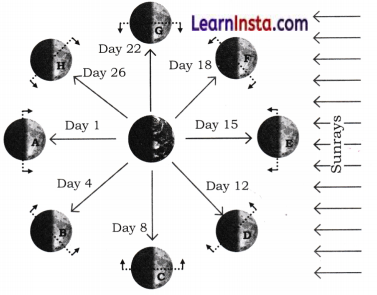
Answer:
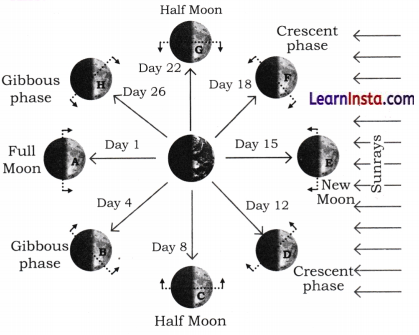
Keeping Time with the Skies Class 8 Quiz Questions
Question 1.
Which organisation publishes the Rashtriya Panchang?
Answer:
The Positional Astronomy Center of the Government of India.
Question 2.
Who was Meghnad Saha?
Answer:
Meghnad Saha was a pioneering Indian astrophysicist known for developing the Saha equation and chairing the Calendar Reform Committee.
Question 3.
What type of calendar begins a new month after the full Moon?
Answer:
Purnimant
Question 4.
Name the first month of the Indian National Calendar.
Answer:
Chaitra
Question 5.
Which organisation has launched the Cartosat series of satellites?
Answer:
Indian Space Research Organisation (ISRO)
Question 6.
Which Indian classical dance uses mudras like Chandrakala and Ardhachandran?
Answer:
Bharatanatyam.
Question 7.
Name two traditional Indian painting styles that depict the Moon and Sun.
Answer:
Madhubani and Warli.
Question 8.
How many days are there in a lunar year?
Answer:
354 days.
Question 9.
What is the full Moon day called in India?
Answer:
Purnima.
Question 10.
What do we call the period when the bright portion of the Moon continues to shrink until it is no longer visible?
Answer:
Waning period.
Keeping Time with the Skies Class 8 Case Based Questions
Question 1.
The Moon is Earth’s natural satellite. Besides the Moon, many man-made satellites also orbit Earth. These artificial satellites look like tiny moving stars in the night sky. They usually fly about 800 km above Earth and take around 100 minutes to complete one orbit. ISRO, India’s space agency, launches many satellites to help with communication, weather forecasting, and disaster management. Some satellites take pictures of Earth, which help in making maps and planning cities. ISRO also sends missions to study the Moon, the Sun, and Mars. Students in India even get chances to build and launch small satellites.
I. What do you see moving like tiny stars in the night sky?
II. How long does it take for a satellite to go around the Earth once?
III. Name two things satellites help us with.
OR
Name any two ISRO space missions and what they study.
Answer:
I. The tiny moving stars in the night sky are artificial (human-made) satellites.
II. It takes about 100 minutes for a satellite to complete one orbit around the Earth.
III. Satellites help us with communication and weather forecasting.
(They also navigation, disaster management, and scientific research).
OR
Two ISRO space missions are:
a. Chandrayaan (to study the Moon)
b. Mangalyaan (to study Mars)
Keeping Time with the Skies Extra Questions for Practice
Multiple Choice Questions
Question 1.
Artificial satellites orbit Earth at about:
(a) 800 km height
(b) 8,000km height
(c) 80 km height
(d) 80,000km height
Question 2.
Which organisation in India calculates festival dates?
(a) ISRO
(b) BARC
(c) Positional Astronomy Centre
(d) IIT
Question 3.
The Gregorian calendar adds an extra day every $\qquad$ years.
(a) 2
(b) 4
(c) 6
(d) 8
Question 4.
Read the given statements and select the correct option:
Assertion (A): Artificial satellites are natural satellites.
Reason (R): Artificial satellites revolve around Earth.
(a) Both A and R are true and R is the correct explanation of A
(b) Both A and R are true but R is not the correct explanation of A
(c) A is true but R is false.
(d) A is false but R is true.
Question 5.
Match the following terms with their correct descriptions:
Column A — Column B
(i) AstroSat — (p) Moon mission by ISRO
(ii) Cartosat — (q) Mars mission by ISRO
(iii) Mangalyaan — (r) Study of celestial objects
(iv) Chandrayaan — (s) Student-built satellite
(v) AzaadiSat — (t) Maps Earth’s surface
(a) (i)-(q), (ii)-(p), (iii)-(s), (iv)-(r), (v)-(t)
(b) (i)-(r), (ii)-(t), (iii)-(q), (iv)-(p), (v)-(s)
(c) (i)-(p), (ii)-(q), (iii)-(r), (iv)-(s), (v)-(t)
(d) (i)-(s), (ii)-(p), (iii)-(r), (iv)-(q), (v)-(t)
Very Short Answer Type Questions
Question 1.
Name any two Indian satellites.
Question 2.
What type of calendars adjust both solar and lunar cycles?
Question 3.
Name one festival that falls on a new Moon day.
Question 4.
Which calendar system uses leap years?
Question 5.
Who developed the Saha equation?
Short Answer Type-I Questions
Question 1.
Name the traditional month names in Indian luni-solar calendars.
Question 2.
Define phases of the Moon.
Question 3.
What is a sidereal year?
Question 4.
What is the new moon day called in India, and how does the Moon appear on that day?
Question 5.
What is the gibbous phase of the Moon?
Short Answer Type-II Questions
Question 1.
Why is it incorrect to assume that the Moon always rises at sunset? Explain using observations.
Question 2.
Write true (T) or false (F) against the following statements.
(i) Solar eclipses can happen only on a new Moon day.
(ii) The side of the Moon that faces the Sun is non-illuminated.
(iii) The sunrise occurs earlier in Eastern India and later in Western India.
Question 3.
What is the Rashtriya Panchang? Why does the Government of India use the Rashtriya Panchang?
Question 4.
Describe the difference between Amant and Purnimant calendars used in Indian communities.
Question 5.
What is space junk? How is it harmful?
Long Answer Type Questions
Question 1.
Describe how to identify an artificial satellite in the night sky.
Question 2.
What is the difference between lunar, solar, and luni-solar calendars?
Question 3.
What role does the Positional Astronomy Center play in deciding national festival dates, and how is this important for the country?
Suggested Projects And Activities
Question 1.
Create a festival tracker journal by selecting any five festivals from different cultures or religions (for example, Diwali, Eid, Christmas, Chinese New Year, Vaisakhi). Record their Gregorian calendar dates for the past 3 to 5 years. Identify whether each festival follows a solar, lunar, or luni-solar calendar pattern. At the end, write a few short sentences about your findings and conclusions on how the dates change or remain the same each year.
Question 2.
Use Internet resources to find dates of solar and lunar eclipses over the past five years. Prepare a report on when they occurred, where they were visible, and the phase of the Moon during the eclipse.