Students can use Our Wondrous World Class 5 Solutions Chapter 2 Journey of a River Class 5 Questions and Answers as a quick reference guide.
Class 5 EVS Chapter 2 Journey of a River Question Answer
Journey of a River Class 5 EVS Question Answer
Our Wondrous World Class 5 EVS Chapter 2 Question Answer – Class 5 EVS Journey of a River Question Answer
A. Look at the image given below and answer the following. (Page 22)
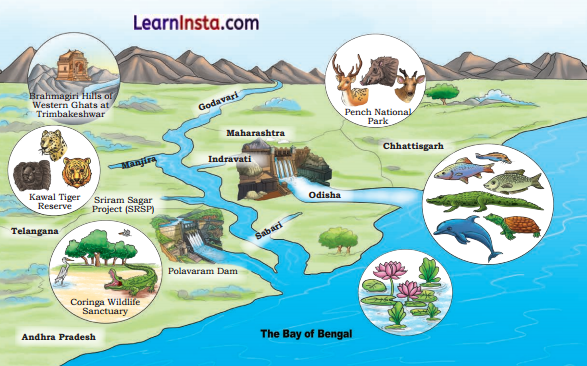
Question 1.
Name the states that Godavari flows through.
Answer:
Maharashtra, Telangana, and Andhra Pradesh.

Question 2.
Name a dam and a wildlife sanctuary along the length of Godavari.
Answer:
Polavaram Dam, and Coringa Wildlife Sanctuary.
Question 3.
Which other small rivers join Godavari in its journey?
Answer:
Sabari, Indravati and Manjira.
The Many Ways I Support Lives (Page 24)
Since ancient times, people have always built their homes near rivers or water bodies. Can you guess why?
Answer:
People have built homes near rivers or water bodies since ancient times because they provide water for drinking, farming and daily needs. Rivers help community life, thrive as they support fishing, transportation and fertile soil for growing crops.
B. (Pages 25-26)
Question 1.
List three ways in which people are dependent on the river Godavari.
Answer:
- People are dependent on the river Godavari for drinking water.
- People use the water of the river Godavari to grow crops for food.
- People rely on the river Godavari for fishing and trade.
Question 2.
In which occupations are people engaged near the river Godavari?
Answer:
People are engaged in fishing, farming, trade or boating near the river Godavari.
Question 3.
Which crops do you see growing near the Godavari?
Answer:
I often see rice, sugarcane and cotton growing near the Godavari.
Question 4.
Which crops grow in your region? Where does the water for irrigation come from?
Answer:
(Suggested answer) Wheat, rice, pulses, maize, vegetables and fruits grow in my region, and the water for irrigation comes from a nearby river or canal.
Activity 1 (Page 26)
Make a poster in your classroom showing all the ways rivers help people. Include drawings of homes, farms, boats, fishermen and more.
Answer:
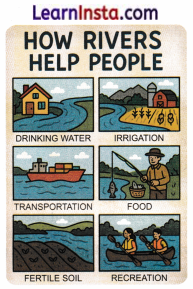
Write (Page 27)
A. What problems can arise after a dam is built. How can they be solved?
Answer:
A dam could cause several problems such as flooding of homes and forests, which displaces people and animals. The dam would block the river’s natural flow, affecting the ecosystem. These issues can be solved by relocating affected people with fair compensation, creating new habitats for displaced animals, and managing water release to maintain the river’s flow and support the environment.
Write (Page 28)
Question 1.
Where do the plastic wrappers and bags that we litter end up?
Answer:
The plastic wrappers and bags that we litter often end up in rivers, oceans, or landfills, where they harm animals, block water flow, and pollute the environment.
Question 2.
What kinds of soaps, shampoos or floor cleaners (natural or readymade) are used in your home? Where does the unclean water mixed with these cleaners go?
Answer:
In my home, we use readymade soaps, shampoos like Dove, and floor cleaners like Lizol; the unclean water mixed with these cleaners usually goes into drains or sewage systems, which may flow into rivers if not treated properly.
Discuss (Page 28)
Question 1.
Ask your parents or elders, about the condition of water bodies near your home when they were your age. What is the status of those water bodies today?
Answer:
(Suggested answer) When my parents were my age, they said the small river near our home was very clean, with lots of fish and clear water that they used for bathing and drinking. Today, that river has dirty water with plastic bags and foam, and there are fewer fish because of pollution from nearby houses. My parents also said the water level is lower now, maybe because of less rain or people using too much water.
Activity 2 (Page 29)
Make a list of things that we throw into the waste bin at home or school. If these things were thrown into a river or a pond, how would each of these items harm the animals, plants and people who live nearby, and use this water?
Answer:
| 1. | Plastic bags | Animals may eat them and get sick; they block water, damaging plants; people get unsafe water. |
| 2. | Food scraps | Attract germs, harming fish; cause bad smells, affecting plants; unsafe for drinking. |
| 3. | Paper | Clogs water, hurting fish; uses oxygen plants need, making water dirty for people. |
| 4. | Batteries | Leak chemicals, poisoning animals; kill plants; make water unsafe for drinking. |
| 5. | Soapy water | Harms fish with chemicals; stops plant growth; causes illness in people. |
Activity 3 (Page 29)
Take two clear glasses of water. Add a spoonful of sugar in one and a spoonful of cooking oil in the other. Stir both well and observe.
What do you observe? Which one appears clear?
Answer:
- My observation: The sugar mixes completely with water, while oil floats on top in droplets form.
- The sugar-water glass appears clear while the oil-water glass looks cloudy.
Activity 4 (Page 30)
Look at the two images given below. Which river looks healthy and why? How do so many plants grow in water? What do you think happens when too many plants grow in a river?
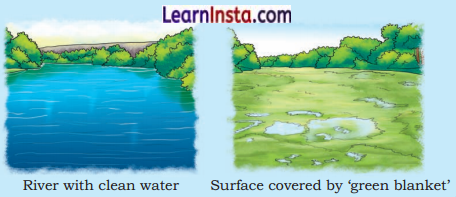
Answer:
The river with clean water looks healthy because it has no trash or extra plants, so fish and people can use it safely.
Plants grow in water because water provides them with nutrients, sunlight reaches the surface, and the flowing river carries seeds that settle and grow.
When too many plants grow, they block the flow of water, reduce the amount of oxygen in it, and may harm fish and other aquatic animals. It can also cause flooding by slowing down the river’s movement.
Write (Page 31)
Can you list three things you can do to protect the water bodies near you?
Answer:
To protect the water bodies near us, we should:
- Avoid throwing trash like plastic bags and garbage into the river or pond.
- Protect wastewater from our houses from entering water bodies.
- Help clean up the banks of the water bodies with the help of our family, friends and NGOs to keep it healthy.
Activity 5 (Page 32)
Match the Columns
Note: One problem could affect more than one thing.
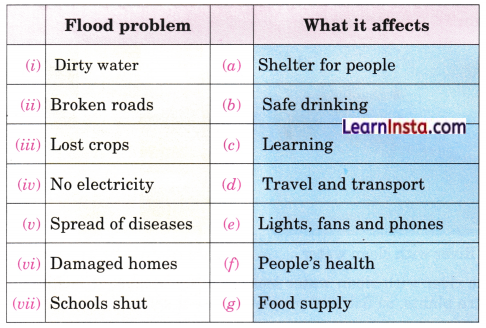
Answer:
| Flood problem | What it affects | ||
| (i) | Dirty water | (b) | Safe drinking |
| (ii) | Broken roads | (b) | Travel and transport |
| (iii) | Lost crops | (g) | Food supply |
| (iv) | No electricity | (e) | Lights, fans and phones |
| (v) | Spread of diseases | (f) | People’s health |
| (vi) | Damaged homes | (a) | Shelter for people |
| (vii) | Schools shut | (c) | Learning |
Activity 6 (Page 33)
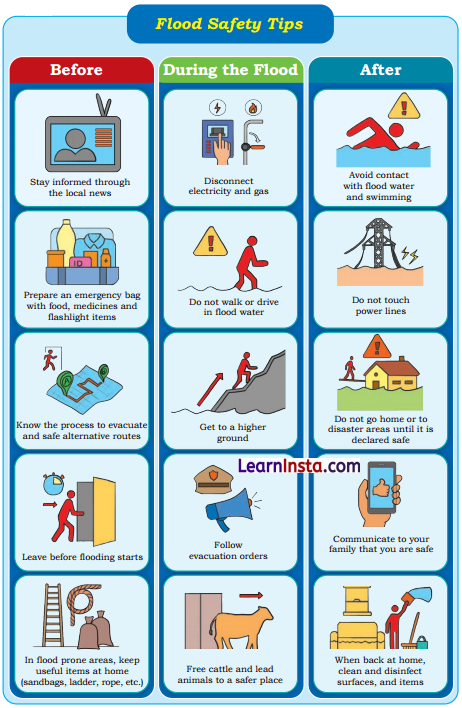
Activity 7 (Page 34)
Read the flood safety tips given in Activity 6 and organise a roleplay where you are the Sarpanch or Municipal Corporator of your village or city.
Discuss what actions you will take to –
- prevent flooding
- prevent damage caused by flooding
- keep elderly people and people with disability safe
- keep animals safe

Answer:
Scene: The Sarpanch stands before the community, holding a meeting to plan flood safety.
“Hello, everyone! I am your Sarpanch, and we need to work together to keep our village safe from floods. First, to prevent flooding, I will ask the workers to clear the drains and rivers of trash and debris so water can flow easily. We will also build small walls or raise roads in low areas to stop water from entering homes.
Scene: A villager raises his hand and asks, “What should we do to prevent damage caused by flooding”?
The Sarpanch (smiling) replies.
Prevent damage caused by flooding, I will ensure we tie down outdoor items like chairs and bins before heavy rain, and I will ask families to move valuable things to higher places. We will also check our dams, like the ones on the Godavari, and request them to release water slowly to avoid sudden floods.
Scene: An old lady (coming forward) asks
“Respected Sarpanch ji, what arrangements will you make for people like me? I am old and cannot move quickly during floods.”Amma ji, don’t worry, to keep elderly people and those with disabilities safe, I will set up a special team to help them move to higher ground or a safe shelter when floods come. We will also provide wheelchairs or support to reach safe spots quickly.
Finally, to keep animals safe, I will ask farmers to move cows and goats to higher fields before floods. We will also set up a safe area with food and water for stray dogs and other animals, and I also request everyone to watch out for snakes that might come near homes.
Let’s practice this plan together and stay safe! Thank you!”
(Villagers Clapping)
(Page 35)
Take a moment to imagine your day without water. Not easy, right?
Question 1.
What would you do if you had no water in your home for an entire day?
Answer:
(Suggested answer) If there is no water in my home for an entire day, I would be very unsettled as I could not cook food, take a bath, use toilet or clean my house properly.
I would use stored water carefully without wasting, look for a nearby hand pump or tanker for water.
- I would buy bottled water from a shop, if needed.
Question 2.
What if there was no water for a week? How would you bath, drink, cook or clean? Where would you go to find water?
Answer
If there is no water for a week, I would drink stored water or buy it and cook with very little water using dry food.
- I would skip bathing, use a wet cloth to clean myself, and wipe things with a dry cloth instead of washing.
- I would go to a water ATM, a nearby well, or wait for a government water tanker to get water.
Let us reflect (Page 37)
Question 1.
Find out which river(s) flow through your state.
(a) What are they used for?
(b) Are there any dams on them?
Answer:
(Suggested answer) In Delhi, the Yamuna River is the main river.
(a) It is used for drinking water, farming, and washing clothes.
(b) Yes, there are barrages on the Yamuna, like the Wazirabad barrage, ITO barrage, Okhla barrage which help store water for Delhi.
Question 2.
Ask your grandparents or parents to share any story or festival related to rivers in your region and present it in the class.
Answer:
(Suggested answer) I asked my grandmother about the Yamuna river, and she told me a beautiful story. She said that long ago, the water was so clean that people would drink it directly from the river and celebrate festivals like Chhath Puja on its banks. They would offer prayers to the Sun God and float diyas (lamps) in the river. She also shared that Lord Krishna played near the Yamuna as a child, making it a sacred river. Today, we must keep it clean like in the old days!
Question 3.
Ask an elder in your family:
(a) What was the condition of rivers when you were a child?
(b) What has changed since then?
Answer:
(a) My grandfather said when he was a child, the Yamuna River was clean and full of water. People took bath in it, drank its water, and children played near the banks.
(b) Now he says the water is dirty because of pollution from waste and factories. Many areas have less water, and some places smell bad.
Question 4.
Why do you think people built houses and cities near rivers in the past? Are rivers still important today in the same way?
Answer:
In the past, people-built cities near rivers because rivers provided fresh water for drinking, farming, and cooking. The fertile soil around rivers helped grow crops, and boats on rivers made travel and trade easier. Rivers also gave people fish to eat. Today, rivers are still important but people also get water from wells, borewells, pipelines and other modern sources.
Question 5.
If you could create one new rule to protect rivers in your city or village, what would it be?
Answer:
I would make a rule that no factory or house should throw dirty water or waste into the river.
Anyone who breaks this rule must pay a fine. This will keep the river clean and safe for people, animals and plants.
Question 6.
Think about a time when you wasted water. What could you have done differently?
Answer:
(Suggested answer) Once, I left the tap running while brushing my teeth, wasting lots of water. I could’ve turned it off, used a mug and saved water. These are very small steps that help us save a lot of water over time.
Question 7.
Can you design a simple water filter using everyday materials? What would you include and why?
Answer:
(Suggested answer) I would make a simple DIY water filter, using a plastic bottle, cotton, sand, gravel and charcoal. These protective layers removes dirt, bad smell, making water cleaner and safer.
Question 8.
Imagine you are planning a new city near a river. What steps would you take to:
(a) keep the river clean.
(b) prevent floods during heavy rains.
(c) ensure there is always enough water for everyone, even during summers.
Answer:
(Suggested answer)
(a) To keep the river clean: I would set up proper waste treatment plant so dirty water does not go into the river and would ban throwing plastic and garbage into it.
(b) To prevent floods during heavy rains: I would plant more trees, build rainwater drains and strong embankment.
(c) To ensure there is always enough water: I would certainly encourage people to use water wisely like to keep the taps off when not in use and a regular check for dripping taps and water pipes.