Teachers guide students to use Exploring Society India and Beyond Class 7 Solutions and Class 7 SST Part 2 Chapter 2 India and Her Neighbours Question Answer NCERT Solutions for quick learning.
India and Her Neighbours Questions and Answers Class 7 SST Chapter 2
India and Her Neighbours Class 7 Question Answer (In-Text)
The Big Questions? (Page 29)
Question 1.
What defines a ‘neighbour’? Is it just shared land borders?
Answer:
A neighbour is not defined only by shared land borders. Countries that are connected through seas are also neighbours and are called maritime neighbours. Geography, history, trade, culture, and cooperation also define neighbours, not only land boundaries.

Question 2.
How do geography and history influence the nature of India’s relationships with her neighbours?
Answer:
Geography influences India’s relationships through land borders, mountains, rivers, seas, and trade routes. The Himalayas connect India with Nepal and Bhutan, and the seas connect India with Sri Lanka, the Maldives, and Southeast Asia.
History has shaped relationships through ancient trade routes, cultural exchanges, the spread of Buddhism and Hinduism, and events like the Partition. These have created spiritual, cultural, political, and economic ties.
Question 3.
In what ways are India and her neighbours interconnected today?
Answer:
India and her neighbours are interconnected through trade, transport, tourism, education, religion, defence cooperation, disaster relief, regional organisations, cultural exchanges, and people-to-people contact.
Let’s Explore
Question 1.
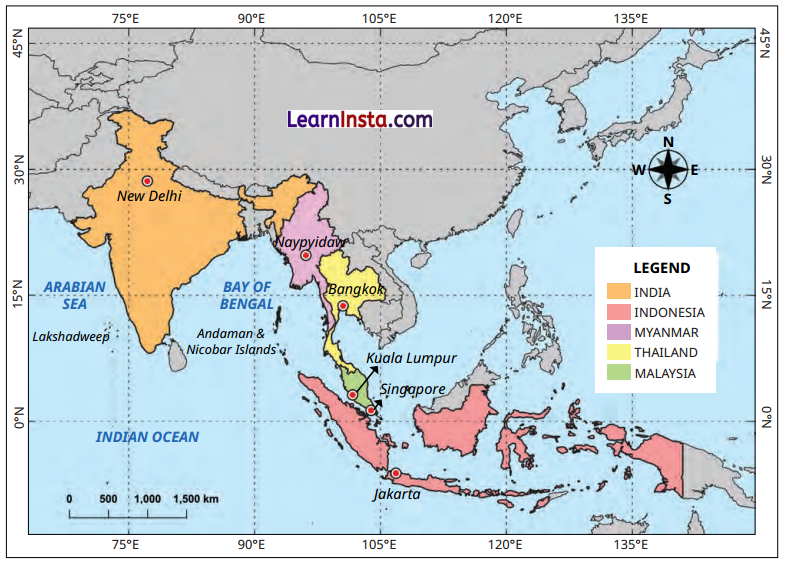
Identify the three large water bodies that surround India in the map given on the next page. (Page 30)
Answer:
The three large water bodies surrounding India are:
- The Arabian Sea
- The Bay of Bengal
- The Indian Ocean
Question 2.
The scene in the picture given below, depicts the well-known Hindu myth of samudra manthana or the churning of the ocean. The devas (gods, on the right here) and the asuras (demons, on the left) decided to join forces to churn the cosmic ocean in search of amrita or the nectar of immortality, with the serpent Vasuki as the churning rope and Vishnu (above) presiding over the operation-he will eventually deceive the asuras to make sure that the amrita goes to the devas alone. Note also the airport’s official name of ‘Suvarnabhumi Airport’ does it remind you of something? (Page 51)

Answer:
Yes, the name ‘Suvarnabhumi’ reminds us of the ancient Indian name ‘Suvarnabhumi’, which means ‘the golden land’. Indian traders used this name for Southeast Asian regions that were rich in gold and trade, showing ancient cultural links between India and Thailand.
Question 3.
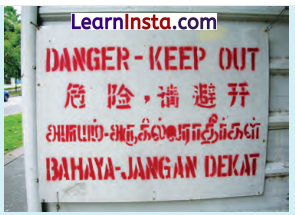
Seeing that Tamil is one of Singapore’s official languages, what does this suggest to you about the relationship between south India and Singapore? (Page 53)
Answer:
This suggests that there is a strong historical, cultural, and social relationship between south India and Singapore. Many people from south India migrated to Singapore in the past, and their language, culture, food, and traditions became an important part of Singapore’s society.
India and Her Neighbours Class 7 Solutions (Exercise)
Question 1.
Explain who a maritime neighbour is with two examples with respect to India.
Answer:
A maritime neighbour is a country that is connected to another by a shared sea or ocean, even without a land border. Sri Lanka and the Maldives are two maritime neighbours of India.
Question 2.
How has Buddhism created links with India’s neighbours? Give examples to explain your answer.
Answer:
Buddhism spread from India to many neighbouring countries through monks and traders. It reached Sri Lanka through Mahendra and Sanghamitra. It spread to China through Indian monks like Bodhidharma and Kumarajiva. Bhutan, Myanmar, Thailand, and Indonesia also follow forms of Buddhism. This created strong cultural and spiritual links.
Question 3.
What does ‘open-door’ policy mean? How does the India-Nepal ‘open border’ policy affect the lives of people living along the border?
Answer:
An open-door or open border policy allows people of two countries to cross the border without a passport or visa. The India-Nepal open border helps people travel easily for work, education, trade, healthcare, and family visits. It strengthens friendship and cooperation between the two countries.
Question 4.
The chapter says, “Being neighbours is not just about geography.” Explain this statement with an example.
Answer:
This means that being neighbours depends not only on location but also on shared culture, history, religion, trade, and cooperation. For example. India and Thailand are connected by sea but share deep cultural ties through religion, trade, and traditions.
Question 5.
What are the different ways in which India has helped smaller countries in her neighbourhood? Explain with examples.
Answer:
India has helped smaller neighbouring countries through disaster relief, healthcare, infrastructure development, education, defence, and energy projects. For example, India supported the Maldives during the tsunami and water crisis, helped build the Afghan Parliament, and built hydroelectric projects in Bhutan.
Question 6.
How do shared challenges become opportunities for cooperation? Were there examples in this chapter to illustrate this?
Answer:
Shared challenges like climate change, earthquakes, tsunamis, and security threats encourage countries to work together. For example, after the 2004 tsunami, India worked with neighbouring countries to create the Tsunami Early Warning System. India also helped the Maldives during natural disasters.
Question 7.
If borders were drawn only by culture and connections, how would the map look different?
Answer:
The map would look very different because countries would be grouped based on shared religion, languages, festivals, food, and traditions rather than political lines. Southeast Asian countries like Thailand, Indonesia, and Malaysia would appear more closely connected to India.
Question 8.
On blank maps:
- Label India’s neighbours.
- Draw arrows showing cultural flows (e.g., food, festivals, languages) between India and her neighbours.
- Imagine and redraw new “borders of friendship” that connect neighbours through rivers, trade routes. or cultural zones.
- Collect pictures of the flags of the countries listed in this chapter and write your observations.
Answer:
Do it yourself.