Experts have designed these Class 8 Science Notes Chapter 3 Health: The Ultimate Treasure Class 8 Notes for effective learning.
Class 8 Science Chapter 3 Health: The Ultimate Treasure Notes
Class 8 Health: The Ultimate Treasure Notes
Class 8 Science Chapter 3 Notes – Health: The Ultimate Treasure Notes Class 8
→ Health is a state of complete well-being of a person.
→ Disease is a condition that prevents the body or mind from working normally, causing discomfort.
→ World Health Organisation (WHO): It is a global group that works to improve health and fight diseases worldwide. As per WHO, health is defined as a ‘state of complete physical, mental, and social well-being, and not merely the absence of disease’.

→ Ayurveda: It is an ancient Indian system of medicine that uses natural herbs, diet, and lifestyle practices to keep the body and mind healthy. It teaches us that true health is a balance of body, mind, and surroundings.
→ Staying Healthy: To stay healthy, we should follow good habits and a daily routine. We should maintain a healthy lifestyle by following simple points:
- Keep ourselves clean and maintain personal hygiene.
- Eat a healthy and balanced diet, avoiding junk and processed food.
- Exercise regularly for staying physically active.
- Make time to relax or meditate every day.
- Limited screen time, saying no to smoking and getting enough sleep.
→ Air Quality Index (AQI): It tells us how clean or polluted the air is and if it is safe to breathe or not.
→ Pathogens: These are the tiny organisms like bacteria, virus, fungi, worms, and protozoa that enter the body and cause diseases. Pathogens spread through air, water, food, or contact with infected people or animals.
→ Two Major Types of Diseases: Diseases can be divided into two types based on their causes and how they spread.
- Non-Communicable Diseases (NCDs): These diseases are caused by lifestyle, diet and environmental factors. They are not caused by pathogens and do not spread from one person to another. For example, cancer, asthma, diabetes, etc.
- Communicable Diseases: These diseases are caused by pathogens like bacteria, viruses, or worms, etc. They spread from one person to another. For example, common cold, dengue, flu, chickenpox, typhoid, COVID-19, etc.
→ Non-communicable diseases like diabetes and heart disease are rising in India due to unhealthy lifestyles and longer lifespans. Today, most deaths in India are caused by NCDs.
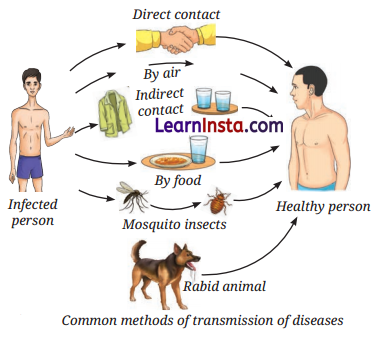
→ Transmission of Communicable Diseases: Communicable diseases are caused by pathogens that enter our body through air, contaminated food or water, or contact with infected people. They spread through coughing, sneezing, direct touch like handshakes, or by sharing personal items. Some pathogens also spread by insects like mosquitoes and houseflies, these insects are called vectors.
→ Precautions to Prevent the Spread of Diseases:
- Keep yourself and your surroundings clean.
- Control mosquito breeding in and around your home, avoid going to areas with still water.
- Wash hands regularly with soap.
- Cover your mouth and nose when coughing or sneezing.
- Wear a mask in crowded places.
- Do not share personal items.
- Keep food, water, and home clean.
- Stay home and rest when sick.
- Keep yourself vaccinated.
- Consume properly cooked food.
- Avoid close contact with infected people.
→ Parasites: Some diseases are caused by parasites. These worms live inside the bodies especially in the digestive system and feed on nutrients. They spread through contaminated food, water, soil, or contact with infected people or animals.
→ Deficiency Diseases: The diseases that are caused by the lack of specific nutrients in the diet. For example, goitre, anaemia, scurvy, etc.

→ Chronic Diseases: Diseases such as cancer, diabetes, and asthma that persist for a long time (more than 3 months) are referred to as chronic diseases.
→ Dr. Kamal Ranadive showed how tobacco, diet, and pollution can raise the risk of cancer, highlighting the importance of a healthy lifestyle.
→ Immune System: It is the special system of our body that helps fight against diseases. The natural ability of a body to fight diseases is known as immunity.
→ Acquired Immunity: It refers to the protection our body that develops against diseases after exposure to pathogens or through vaccination.
→ Vaccine: It is a substance that helps the body build protection (immunity) against specific diseases without causing the illness. Vaccines protect people of all ages by preventing serious diseases and reducing the spread of infections. For example, a tetanus shot is usually given after an injury. It uses a harmless form of the toxin to train the immune system to protect against the disease. The process of giving a vaccine to a person to protect them from certain diseases is called vaccination.
→ Vaccines can be made from:
- Weakened or dead pathogens (like viruses or bacteria)
- Inactive or harmless parts of a the pathogen
→ Smallpox Vaccine: Smallpox was a deadly discase that caused blisters and killed millions. In the late 1700s, Edward Jenner, a doctor, noticed that people who had cowpox did not get smallpox. He used this idea to create the first vaccine, which protected people from smallpox.
→ Dr. Maharaj Kishan Bhan, an Indian doctor and scientist, played a key role in developing the Rotavirus vaccine, which protects children from diarrhoea.
→ Antibiotics: These are the medicines used to kill bacteria that cause diseases. These are only effective against bacterial infections, because they target parts of bacterial cells that are different from human or other animal cells. Antibiotics do not work against the diseases caused by viruses (flu or common cold) or protozoa (malaria).
→ Discovery of the First Antibiotic: Penicillin, the first antibiotic, was discovered by Alexander Fleming in 1928. He found that a mould on a petri dish killed harmful bacteria. This accidental discovery helped develop a powerful medicine to treat bacterial infections.
→ Antibiotic Resistance: Antibiotics are effective in fighting bacterial infections, but using them carelessly makes some bacteria resistant. Antibiotic resistance means that these bacteria survive and multiply even after treatment, making infections harder to cure.
→ Spread of Antibiotic Resistance: Antibiotic resistance can spread in the community through exposure to animal products from animals that have developed resistant bacteria. It can also spread through crops grown using manure from these animals. Additionally, people who have developed antibiotic resistance can pass it on to others in the community.
→ Traditional medicine systems like Ayurveda, Siddha, and Unani have been used in India for a long time. They use natural ingredients like herbs and oils, and focus on a healthy lifestyle and diet. While helpful for some health problems and general well-being, they may not work for all diseases or in every situation.
→ Early diagnosis, therapies and continuous care are key to controlling the discase progression and preventing complications.