Teachers guide students to use Exploring Society India and Beyond Class 7 Solutions and Class 7 Social Science SST Chapter 11 From Barter to Money Question Answer NCERT Solutions for quick learning.
Class 7 Social Science Chapter 11 Question Answer From Barter to Money
NCERT Class 7 Social Science Chapter 11 From Barter to Money Questions and Answers Solutions
From Barter to Money Class 7 Question Answer (In-Text)
The Big Questions? (Page 229)
Question 1.
How did exchange take place before money?
Answer:
Before money, exchange took place through the barter system, where goods and services were directly exchanged without using money. Commodities like cowrie shells, salt, tea, tobacco, cattle, and grains were commonly used as the earliest form of exchange.
Question 2.
Why did money come into existence?
Answer:
Money emerged to overcome the limitations of barter, such as the double
coincidence of wants, lack of a common measure of value, and problems with divisibility, portability, and durability.
Question 3.
How has money transformed into various forms over time?
Answer:
Money evolved from commodities (e.g., shells, grains and cattle) to metallic coins, then paper currency, and now digital money (e.g., UPI, credit cards). Each form addressed the needs of trade and convenience.
Think about it
Question 1.
What are the different types of difficulties you encountered in the situation above? (Page 232)
Answer:
- Double coincidence of wants: Finding someone who needs an ox and offers shoes, medicine and cloths.
- Lack of divisibility: Cannot split the ox for different purchases.
- Perishable goods: Wheat being perishable and may lose quality by time so it has to be disposed off at the earliest.
- Storage issues: Wheat spoils over time.
- Transport problems: Carrying heavy goods like wheat demands more time and energy.
Question 2.
(a) What are the instances of double coincidence of wants in the above example?” (Page 233)
Answer:
The farmer needs shoes, a sweater, and medicine but only has an ox to trade.
• He must find someone who:
- Needs an ox.
- Has all the three items.
(b) “In the situation given above, what are the cases where you could encounter the lack of a common standard measure of value?”
Answer:
- No fixed value for an ox vs. shoes, wheat and medicine, etc.
- Subjective negotiations lead to unfair exchanges (e.g., “Is one ox worth 10 bags of wheat or 15?”).

Question 3.
What are the different ways in which money would make the above situation easier for the farmer?” (Page 234)
Answer:
- Medium of exchange: Buy items directly without bartering.
- Store of value: Save money without goods spoiling.
- Divisibility: Use small denominations for small purchases.
- Portability: Carry lightweight currency instead of bulky goods.
Question 4.
Suppose you need to buy a book. You have ₹50 in your pocket. You msit the bookshop in your neighbourhood where the shopkeeper tells you that the book is worth ₹100. What options do you have to buy the book today? Will you request the shopkeeper to allow you to make the rest of the payment later? (Page 237)
Answer:
Yes, I would request the shopkeeper to give me the book and that I will pay him the balance amount the next day as the book is important for me to be bought that day.
Let’s Explore
Question 1.
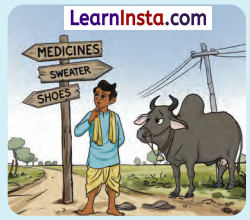
Imagine that you are a farmer and that people use a barter system where you live. You need a whole variety of things a pair of new shoes, a sweater, and medicines for your grandmother. But you only have an ox that you can spare. How would you be able to exchange the ox for all the different things you need from different people or places? What difficulties are you likely o face?

For one, you would have to find someone who needed an ox. Now, swapping your ox for a pair of shoes would hardly be a fair exchange! You may have had to go through a series of exchanges – for example, find someone to exchange your ox for several bags of wheat. You would then have to transport all that wheat w several places; first, find someone willing to exchange a part of the wheat for shoes, another person for the sweater, and yet another for the medicines.

In each of these cases, a discussion would take place to arrive at the fair amount of wheat that you could exchange for shoes or for the sweater.
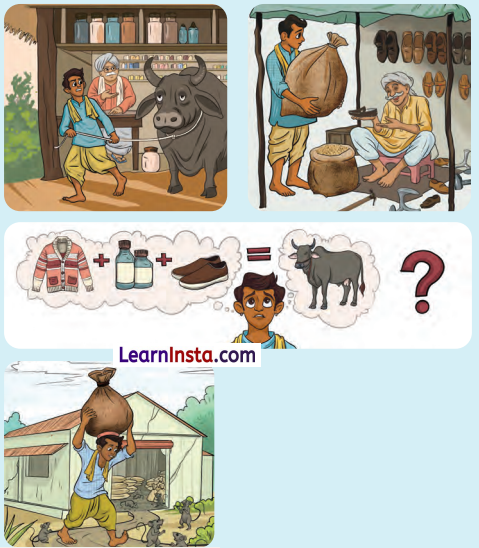
You would have to take the leftover bags of wheat and find a place to store them safely. The next time you needed something, you would have to carry the bags of wheat with you again!
Answer:
We would need to find someone who wants an ox and has exactly what we need, it would be very difficult to find such a person.
Difficulties include: Finding matching wants (double coincidence), determining fair exchange rates, transporting goods, storing partial exchanges, and the ox being indivisible for smaller purchases.
Question 2.
The illustration show you some of the ways in which people practise barter today. Have you observed similar practices in your locality? What are the types of experiences people have in this process?n(Page 236)

Answer:
1. Local Barter Practices (Examples may include):
- Exchange of old clothes for utensils.
- Farmers trading crops for tools or services.
2. Experiences People Might Have:
- Positive: Saves money, builds community trust, reuses items sustainably.
- Challenges: Finding matching needs (double coincidence), agreeing on fair exchange values, logistical issues (transport/storage).
3. Modern Adaptations:
- Online barter platforms or local exchange groups.
- Skill-sharing (e.g., tutoring for repairs) as a form of non-monetary trade.
Question 3.
Look at the timeline given below. What are the changes in money that you observe? (Page 238)
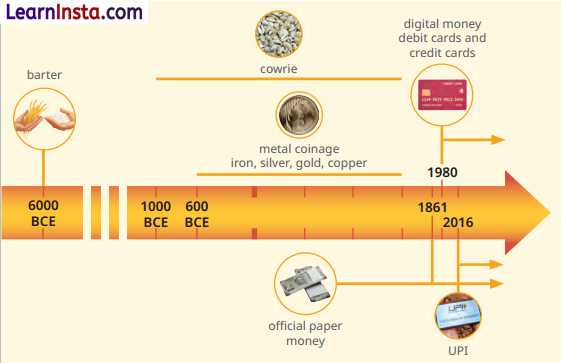
Answer: The timeline shows the key stages of money’s evolution in India. It begins with the barter system around 6000 BCE, transitions to commodity money like cowrie shells around 1000 BCE onwards, then to metal coins made of iron, silver, gold, and copper around 600 BCE. Paper money was officially introduced in 1861, followed by debit/credit cards (1980) and UPI digital payments (2016). This progression highlights shifts from tangible to intangible forms, reflecting technological advancements and changing economic needs. The timeline emphasises how money evolved to solve problems like portability, durability, and convenience in trade.
Question 4.
“The coins shown in Fig. 11.12 were found during excavations in Pudukkottai in Tamil Nadu. Their heads embossed are those of Roman kings. What conclusions can we draw from such a finding?”(Page 239)

Answer:
- It indicates strong trade connections between ancient India and Rome most probably through the Arabian sea (maritime trade).
- Shows cultural and economic exchanges between civilisations.
- Suggests Roman coins were used in Indian transactions or vice versa.
Question 5.
“Organise yourselves into groups of five students each. Take up a group project to collect old coins from family members, neighbours, shopkeepers, and so on. Document their various features— what are they made of, what is the year inscribed on the coins, what do you observe on the obverse and reverse sides of the coins. What can you guess from your observations? How would you know if your guesses are true?” (Page 241)
Answer:
1. Documentation Tasks:
- Material: Identify metal (copper, silver, nickel, etc.)
- Year: Note mint year if visible
- Obverse (Front): Usually features rulers’ faces/national symbols
- Reverse (Back): Often shows value, cultural motifs, or historical events
2. Observations to Analyse:
- Economic conditions (e.g., precious metals indicate wealth)
- Political history (rulers/eras depicted)
- Cultural values .(religious/nature symbols)
3. Verification method:
- Cross-check with RBI archives/numismatic books
- Visit museum experts or coin collectors
- Use credible online databases like RBI’s “Museum of Coins”
Example: A 1947 Indian coin with King George Vi’s portrait (obverse) and the Lion Capital (reverse) reflects India’s colonial transition.
Question 6.
“What do you think happened as coins began to be used for all types of exchanges, whether to buy vegetables or to buy some land? What problems could have come up?” (Page 241)
Answer:
As coins became universal for transactions, several issues arose. Transporting large quantities for major purchases like land proved cumbersome, while small daily purchases required excessive counting. Storage and security became problematic with accumulated coins. Variations in metal purity and counterfeit coins created trust issues. These practical challenges in portability, divisibility and security eventually led to the development of paper money as a more efficient and alternative method for larger transactions.
Question 7.
(a) Look at a 50 and a 100-rupee note. Can you identify the motifs depicting India’s cultural heritage on the reverse side of the notes? Find out more about them. (Page 242)

Answer:
The ₹50 note features Hampi’s Stone Chariot (Vijayanagara Empire), while the ₹100 note displays Rani ki Vav (Gujarat’s stepwell, a UNESCO site). These motifs celebrate India’s architectural heritage. Students should examine the notes’ intricate details and research their historical significance – the chariot represents temple art, while the stepwell showcases ancient water management systems and sculptural excellence from medieval India.
(b) Feel the surface of the notes. What special features of currency notes help visually impaired persons to identify the notes’ denominations? (Page 243)
Answer:
- Tactile markings (raised lines or shapes)
- Different sizes for different denominations
- Intaglio printing (raised ink) that can be felt by touch. These distinct features in each denomination helps a visually impaired person to identify any currency note (?10, 20, 50, 100, 200 and 500).
Class 7 SST Chapter 11 From Barter to Money Question Answer (Exercise)
Questions and Activities (Page 244-245)
Question 1.
How does the barter system take place and what kinds of commodities were used for exchange under the system?
Answer:
The barter system involves the direct exchange of goods or services without using money.
For example:
- A farmer could trade a bag of rice for a pot from a potter.
- A weaver might exchange cloth for tools with a blacksmith.
Commodities Used for Exchange Included:
- Natural items: cowrie shells, salt, tea, tobacco, etc.
- Agricultural goods: grains, livestock (cows, goats, sheeps, horses etc.)
- Crafted items: cloth, carnelian beads.
Question 2.
What were the limitations of the barter system?
Answer:
The barter system had four key limitations:
- Double Coincidence of Wants: Both parties needed to have exactly what the other desired (e.g., a farmer with wheat must find someone who wants wheat and has the shoes he needs).
- Lack of Common Measure: No standard to compare values (e.g., How much wheat equals one cow?).
- Indivisibility: Some goods couldn’t be split (e.g., You can’t divide a live goat to buy small items).
- Storage/Transport Issues:
- Perishable goods (e.g., grain) could be spoiled.
- Heavy/bulky items (e.g., stones) were hard to move.
Question 3.
What were the salient features of ancient Indian coins?
Answer:
Ancient Indian coins had these key features:
1. Materials:
- Made of metals like silver, copper, gold, and alloys (e.g., pana coins).
2. Designs:
- Obverse (Front): Rulers’portraits (e.g., Gupta kings) or symbols (e.g., Chola dynasty’s tiger emblem).
- Reverse (Back): Religious motifs (e.g., Varaha avatar), nature (e.g., trees, animals), or trade items (e.g., ships).
3. Inscriptions:
- Names of kings (e.g., Samudragupta) or dynasties in Brahmi/Sanskrit script.
- Mint marks, indicating production locations.
4. Shapes & Sizes:
- Irregular punch-marked coins (6th BCE) → standardized round coins (Mauryan era).
5. Purpose:
- Showed royal authority and facilitated trade across empires.
- Example: The Chalukyan coins featured Vishnu’s Varaha avatar on one side and a royal parasol on the other.
Question 4.
How has money as a medium of ‘ exchange transformed over time?
Answer:
Money has evolved through five key phases:
- Barter: Direct goods/services exchange (e.g., crops for tools).
- Commodity Money: Standardized valuables (cowrie shells, salt).
- Metallic Coins: Minted coins (silver, gold) with rulers’ marks (6th BCE).
- Paper Currency: Lightweight notes (introduced in India in 1861).
- Digital Money: Cashless transactions (UPI, cards, QR codes).
Each phase solved prior limitations: portability (coins → paper), divisibility (digital payments), and universal acceptance.
Example: A farmer once traded wheat for shoes; today, they scan a QR code to sell crops digitally.
Question 5.
What steps might have been taken in ancient times so that Indian coins could become the medium of exchange across countries?
Answer:
In ancient times, several strategic steps would have been taken to establish Indian coins as international currency:
- Standardisation: Ensuring uniform weight, size, and metal purity (e.g., Gupta period gold coins).
- Recognisable Designs: Minting coins with widely accepted symbols (e.g., royal portraits, deities like Goddess Lakshmi).
- High-Value Metals: Using gold and silver, which held universal appeal.
- Trade Alliances: Circulating coins along major routes (e.g., Silk Route, maritime trade).
- Royal Guarantees – Backing currency with the reputation of powerful empires (e.g., Mauryan punch-marked coins).
- Clear Denominations – Marking values for easy conversion in foreign markets. Example. Roman coins found in South India prove cross-border acceptance.
Question 6.
Read the following lines from the Arthas hastra: “An annual salary of 60 panas could be substituted by an adhaka of grain per day, enough for four meals…” (One adhaka is equal to about 3 kg) what does this indicate about the value of one pana?
The fine for failing to help a neighbour was 100 panas. Compare this with the annual salary. What conclusion can you draw about the human values being en¬couraged through this?
Answer:
Here Annual Salary = 60 panas = Adhaka of grain per day.
1 Adhaka = 3 kg of grains
Total Grains required in a year = 365 x
3 = 1095 kg.
Hence, 1095 Kg of Grains = 60 panas.
1 Pana = 1095/60 =18.25 Kg. of grains. It means, during that time one Panna could bought 18.25 kg worth of grains, equivalent to around 6 days of meal.
The fine for not helping a neighbour was 100 panas, which is equivalent to around 18 months of salary, which shows that rules were quite strict at that time.
The rulers were kind and wanted their citizens to help each other in time of crisis.
The law prioritized collective welfare, reflecting ancient India’s emphasis on dharma (duty) and mutual aid.
Key Value: “Society’s needs outweigh personal neglect.”
Question 7.
Write and enact a skit to show how people may have persuaded each other to use cowrie shells (or other such items) as the medium of exchange.
Answer:
Title: “The Shell Solution” Characters: Farmer, Potter, Trader, Village Elder
Scene 1: The Barter Problem
- Farmer: “I need pots, but the potter wants cloth, not my wheat!”
- Potter: “I need cloth to make sacks, not more wheat!”
Scene 2: The Proposal
- Trader: “Why not use these cowrie shells? Everyone values them!”
- Elder: “They’re durable, countable, and easy to carry!”
Scene 3: Demonstration
- Farmer gives shells to Potter for pots.
- Potter uses shells to buy cloth from Weaver.
Key Message:
- Solves double coincidence of wants.
- Highlights durability, portability, and universal acceptance of shells.
Props: Baskets (wheat/pots), cowrie shells, cloth.
Duration: 3-5 minutes.
Learning Outcome: Students experience barter challenges and money’s advantages through role-play.
(Learners will perform the skit)
Question 8.
The RBI is the only legal source that prints and distributes paper currency in India. To prevent illegal printing of notes and their misuse, the RBI has introduced many security features. Find out what some of these measures are and discuss them in class.
Answer:
Key Security Features:
- Watermark: A translucent image (e.g., Gandhi portrait) visible when held to light.
- Security Thread: A silver strip with “RBI” and denomination (changes color when tilted).
- Latent Image: Hidden numerical value visible at an angle.
- Micro-Lettering: Tiny “RBI” text readable under magnification.
- Fluorescent Ink: Glows under UV light (e.g., number panels).
- See-Through Register: Aligned patterns on front/back form a complete denomination number.
- Intaglio Printing: Raised ink (e.g., “Reserve Bank of India”) for tactile identification.
Class Discussion Points:
- How these features deter counterfeiting (e.g., micro-printing requires advanced tech).
- Compare old vs. new notes (e.g., pre- 2016 vs. post-2016 ₹500 notes).
- Why security evolves (e.g., ₹2000 note introduced after demonetization).
Question 9.
Interview a few of your family members and local shopkeepers, and ask them their preferences in making and receiving payments do they prefer cash or UPI? Why?
Answer:
(Students will conduct an interview) Sample findings:
1. Older Generations (60+ years):
- Prefer cash due to:
- Familiarity
- No smartphone dependency
- Tangible transaction feel
2. Younger/Urban Users:
- Prefer UPI (PhonePe, Google Bay) because:
- Instant transfers
- No change issues
- Digital records available for tracking
3. Shopkeepers:
- Mixed responses:
- UPI preferred (avoids counterfeit cash, convenience)
- Cash still used for small purchases (<₹100)
- Rural shops may favour cash due to connectivity issues
- Some payment banks charge 5-10% on each payment.