Each of our Ganita Prakash Class 6 Worksheet and Class 6 Maths Chapter 7 Fractions Worksheet with Answers Pdf focuses on conceptual clarity.
Class 6 Maths Chapter 7 Fractions Worksheet with Answers Pdf
Fractions Class 6 Maths Worksheet
Class 6 Maths Chapter 7 Worksheet with Answers – Class 6 Fractions Worksheet
A. Choose the correct option.
Question 1.
In mixed fraction the fractional part is
(a) less than
(b) greater than 1
(c) equal to 1
(d) none of these
Answer:
(a) less than
Question 2.
Equivalent fraction of \(\frac{12}{13}\) with denominator 169 is
(a) \(\frac{1}{169}\)
(b) \(\frac{144}{169}\)
(c) \(\frac{156}{169}\)
(d) \(\frac{12}{169}\)
Answer:
(c) \(\frac{156}{169}\)
Question 3.
A proper fraction is always
(a) greater than 1
(b) equal to 1
(c) less than 1
(d) not possible
Answer:
(c) less than 1
Question 4.
Fraction of 35 cm of 1 metre is
(a) \(\frac{2}{20}\)
(b) \(\frac{7}{20}\)
(c) \(\frac{7}{100}\)
(d) \(\frac{5}{100}\)
Answer:
(b) \(\frac{7}{20}\)
Question 5.
The simplest form of \(\frac{128}{192}\) is
(a) \(\frac{3}{4}\)
(b) \(\frac{2}{3}\)
(c) \(\frac{3}{8}\)
(d) \(\frac{3}{2}\)
Answer:
(b) \(\frac{2}{3}\)

Question 6.
\(\frac{2}{3}\) is equivalent to then what value will come in the blank box?
(a) 12
(b) 36
(c) 24
(d) 18
Answer:
(b) 36
Question 7.
Which of the following fractions is smallest?
(a) \(\frac{2}{9}\)
(b) \(\frac{5}{12}\)
(c) \(\frac{1}{18}\)
(d) \(\frac{11}{36}\)
Answer:
(c) \(\frac{1}{18}\)
Question 8.
The Sum of \(\frac{1}{12}\) and \(\frac{1}{6}\) is
(a) \(\frac{1}{6}\)
(b) \(\frac{1}{4}\)
(c) \(\frac{2}{12}\)
(d) \(\frac{2}{72}\)
Answer:
(b) \(\frac{1}{4}\)
Assertion (A) & Reason (R) Questions.
Directions.: In the following questions, a statement of Assertion (A) is followed by a statement of Reason (R). Choose the correct option as:
(a) Both Assertion (A) and Reason (R) are true and Reason (R) is the correct explanation of Assertion (A).
(b) Both Assertion (A) and Reason (R) are true but Reason (R) is not the correct explanation of Assertion (A).
(c) Assertion (A) is true but Reason (R) is false.
(d) Assertion (A) is false but Reason (R) is true.
Question 1.
Assertion (A): \(\frac{7}{10}\) is a mixed fraction.
Reason (R): A fraction contains a whole number part and a fractional part is called a mixed fraction.
Answer:
(d) Assertion (A) is false but Reason (R) is true.
Question 2.
Assertion (A) : \(\frac{4}{7}\) and \(\frac{24}{42}\) are equivalent fractions.
Reason (R): When two or more fractions represent the same share/number, they are called equivalent fractions.
Answer:
(a) Both Assertion (A) and Reason (R) are true and Reason (R) is the correct explanation of Assertion (A).
B. Fill in the blanks.
1. A fraction is a number representing a part of a ______.
Answer:
whole
2. To write a fraction, it must be ensured that all parts are ______.
Answer:
equal
3. In \(\frac{3}{8}\), 3 is called the numerator and ______ is called the denominator.
Answer:
8
4. In a proper fraction, the numerator is _____ than the denominator.
Answer:
less
5. A fraction is said to be in the simplest form if its numerator and the denominator have no _____ except 1.
Answer:
same
C. Solve the following questions.
Question 1.
In a class, Arun, Swastik, Vansh, and Dipika are friends. A same storybook was issued to each of them and had to be submitted after three days. Arun read \(\frac{3}{10}\), Swastik read \(\frac{5}{8}\), Vansh read \(\frac{2}{5}\), and Dipika read \(\frac{1}{3}\) of the storybook in three days. Arrange the following fractions in descending order. Who read most part of the book?
Answer:
\(\frac{2}{5}\); Swastik
Question 2.
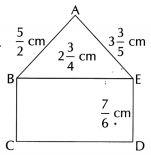
Find the perimeters of (i) AABE (ii) and the rectangle BCDE in the given figure. Whose perimeter is greater?
Answer:
(i) 8\(\frac{17}{20}\) cm
(ii) 7\(\frac{5}{6}\) cm; triangle ABE
Question 3.
Rahul spent \(\frac{1}{4}\) of his pocket money on Monday, \(\frac{1}{8}\) on Tuesday, and \(\frac{5}{24}\) on the remaining days of the week. What fraction of his pocket money is left with him?
Answer:
\(\frac{5}{12}\)
Question 4.
Roma gave a wooden board of length \(\frac{201}{4}\) cm to a carpenter for making a shelf. The carpenter sawed off a piece of \(\frac{151}{5}\) cm from it. What is the length of the remaining piece?
Answer:
\(\frac{401}{20}\) cm
Question 5.
Jeenat takes \(\frac{2}{5}\) hours to take a complete round of the park and her friend Niya takes \(\frac{3}{7}\) hours to do the same. Who takes less time and by how much?
Answer:
Jeenat, \(\frac{1}{35}\) hours
Hots Question
Mr Sharma divided his property among his four children. He gave half of his property to his eldest child, a quarter of his property to his second child, one-eighth of his property to his third child, and the remaining of his property was given to the youngest child. What fraction of his property was given to the youngest child?
Answer:
\(\frac{1}{8}\)
Sumit’s mother is making pizza for him and his younger sister.
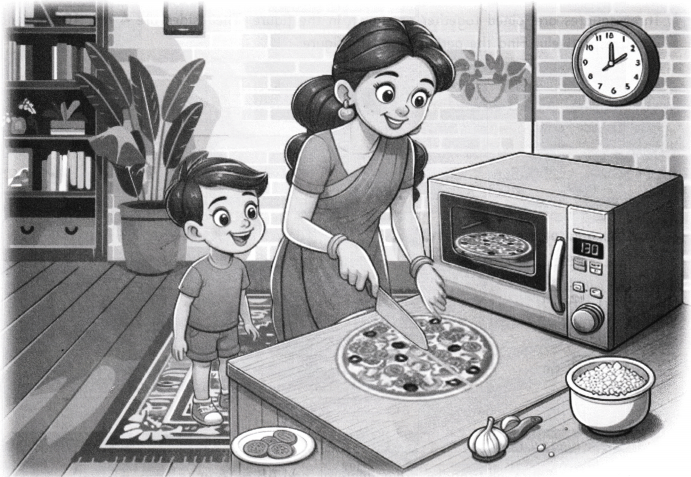
Sumlt: Mummy! You are cutting the pizza into two equal parts.
Mother: Yes, one part is for you and the other is for your sister.
Sumlt: It means both of us will get half of the pizza.
Mother: Yes, each piece is equal to half of the whole pizza. And when I cut the half pieces further into two equal pieces, each one is one-fourth. Do you know? A part of a whole object is called a fraction.
Sumlt: Yes, my maths teacher taught us about the fractions.
We can write the fraction ‘one half’ as ______ and the fraction ‘one fourth’ as ______
Question 1.
Match the correct fractional parts with the correct given picture.

Answer:
(a) – (iv), (b) – (iii), (c) – (i), (d) – (v), (e) – (ii)
Question 2.
Tick (✓) the shapes where half of the whole is shaded.

In the fraction, the upper number is called the ‘numerator’ which represents the number of equal parts chosen/collected, and the lower part is called the ‘denominator’ which represents the total number of parts in which an object, number, or figures is divided.
Answer:
(a), (b), (d)
Question 3.
Identify the numerator and denominator of the given fractions.
(a) \(\frac{2}{7}\)
Numerator = ______
Denominator = ______
Answer:
Numerator = 2,
Denominator = 7
(b) \(\frac{4}{9}\)
Numerator = ______
Denominator = ______
Answer:
Numerator = 4,
Denominator = 9
(b) \(\frac{3}{10}\)
Numerator = ______
Denominator = ______
Answer:
Numerator = 3,
Denominator = 10
FRACTION AS A PART OF WHOLE
Riddhi, Siddhi, Shyam, and Gyan participated in an activity, ‘Sharing and Caring’ with their bench mates. Each of them has a chocolate bar and has to share a fractional part with their benchmate. Riddhi breaks her chocolate bar into 3 pieces and gives a piece to her benchmate.

What fraction of the whole chocolate does Riddhi’s benchmate get? ______
What fraction of the whole chocolate is left with Riddhi’s? ______
Siddhi breaks her chocolate bar into 4 equal pieces and gives a piece to her benchmate.
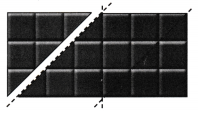
What fraction of the whole chocolate does Siddhi’s beachmate get? ______
What fraction of the whole chocolate is left with Siddhi? ______
Shyam breaks his chocolate bar into 6 equal pieces and gives a piece to his benchmate.
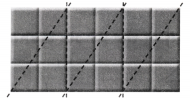
What fraction of the whole chocolate does Shyam’s benchmate get? ______
What fraction of the whole chocolate is left with Shyam? ______
Gyan breaks his chocolate bar into 18 equal pieces and gives a piece to his benchmate.
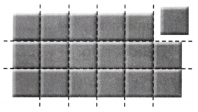
What fraction of the whole chocolate does Gyans berchmate get? ______
What fraction of the whole chocolate is left with Gyan? ______
Question 4.
The figures given below show different fractional units of a whole chocolate. How much of a whole chocolate is each piece?
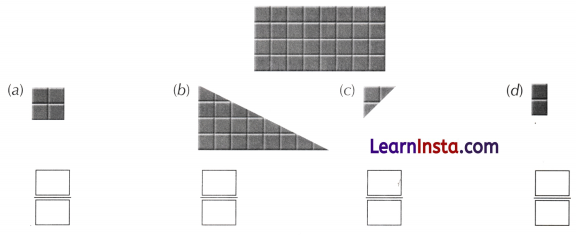
Answer:
(a) \(\frac{1}{8}\)
(b) \(\frac{1}{2}\)
(c) \(\frac{1}{16}\)
(d) \(\frac{1}{16}\)
Question 5.
What type of fractions do the chocolate parts of the Q.1 represent? Write five more such type fractions here.
_______________________________________________
_______________________________________________
Abhay has 15 marbles, and he has to divide this collection into 5 equal parts and take 1 part out of it.

Clearly, 1 part out of 5 equal parts contain ______ marbles.
Therefore, \(\frac{1}{5}\) of 15 marbles = ______ marbles.
Answer:
Unit fractions; \(\frac{1}{3}, \frac{1}{5}, \frac{1}{10}, \frac{1}{11}, \frac{1}{12}\) (Answer may vary)
Question 6.
Express the following as a fraction:
(a) 4 hours of a day — ____
(b) a quarter of a year — _____
(c) ₹ 17 of a 50-rupee note = ____
(d) 11 days of the month of Feb (excluding leap year) = ____
Answer:
(a) \(\frac{4}{24}=\frac{1}{6}\)
(b) \(\frac{1}{4}\)
(c) \(\frac{17}{50}\)
(d) \(\frac{11}{28}\)
Question 7.
Mukut divided one fruit cake equally among eight friends.
What part of the cake did he give to each friend? ____
Answer:
\(\frac{1}{8}\)
Think and Answer
What fractional of a straight angle is a right angle?
Answer:
\(\frac{1}{2}\)
MARKING FRACTION LENGTHS ON THE NUMBER LINE
Question 8.
Here, the unit Length on a number Line is divided into 7 equal parts. Write the fraction that gives the Length of the grey Lines in the respective boxes.

Answer:
\(\frac{2}{7}, \frac{4}{7}, \frac{6}{7}\)
Question 9.
Here, the unit length on a number line is divided into 8 equal parts. Draw the lines of lengths respective to the marked fraction length.

Answer:
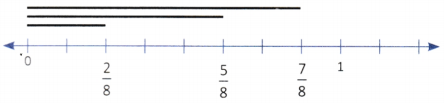
TYPES OF FRACTIONS
Proper fraction – A fraction whose numerator is less than the denominator is called a proper jraction.
For example: \(\frac{4}{11}, \frac{33}{111}, \frac{7}{9}, \frac{45}{123}, \frac{15}{57}\)etc.
Improper fraction – A fraction whose numerator is greater than the denominator is called an improper fraction.
For example: \(\frac{46}{3}, \frac{55}{24}, \frac{128}{17}, \frac{57}{24}, \frac{185}{82}\)etc.
Mixed fraction – A fraction which consists a whole number and a fractional part less than 1
(a proper fraction) is called a mixed fraction.
For example: 1\(\frac{3}{4}\), 2\(\frac{2}{7}\) etc
Question 10.
From the given fractions, identify the proper, improper and mixed fractions.
(a) \(\frac{1}{6}\)
(b) \(\frac{3}{7}\)
(c) \(\frac{7}{2}\)
(d) \(\frac{8}{5}\)
(e) 2\(\frac{1}{4}\)
(f) 3\(\frac{1}{3}\)
(g) \(\frac{11}{10}\)
(h) \(\frac{11}{13}\)
Proper fractions: _______________________________________________
Improper fractions: _______________________________________________
Mixed fractions: _______________________________________________
Draw the lines of lengths respective to the marked fraction length.

Answer:
Proper fractions: (a), (b), (h)
Improper fractions: (c), (d), (g)
Mixed fractions: (e), (f)
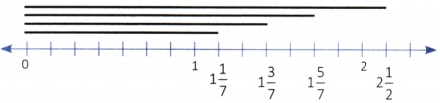
Question 11.
Here, the unit length on a number line is divided into 7 equal parts. Write the fraction that gives the length of the grey lines in the respective boxes.

Conversion of mixed fractions into improper fractions: A mixed fraction can be converted into an improper fraction as:
Mixed fraction = \(\frac{(\text { Whole part } \text { × } \text { Denominator })+\text { Numerator }}{\text { Denominator }}\) = Improper fraction
Question 12.
Write the following mixed fractions as improper fractions.
(a) 3\(\frac{1}{5}\)
(b) 2\(\frac{3}{7}\)
(c) 1\(\frac{9}{10}\)
(d) 4\(\frac{2}{3}\)
(e) 2\(\frac{7}{8}\)
Conversion of improper fractions into mixed fractions: An improper fraction can be written into a mixed fraction, as follows:
- Divide the numerator of the fractions with its denominator to get the quotient and the remainder.
- The quotient and the remainder become the whole part and the numerator of required mixed fraction, respectively with the same denominator. As, \(\frac{13}{5}=2 \frac{3}{5}\)

Question 13.
Write the following improper fractions as mixed fractions.
(a) \(\frac{10}{7}\)
(b) \(\frac{13}{8}\)
(c) \(\frac{19}{11}\)
(d) \(\frac{15}{4}\)
Answer:
(a) 1\(\frac{3}{7}\)
(b) 1\(\frac{5}{8}\)
(c) 1\(\frac{8}{11}\)
(d) 3\(\frac{3}{4}\)
EQUIVALENT FRACTIONS
The fractions who represents the same value irrespective of their numerators and denominators are called equivalent fractions
Question 14.
(a) Take a paper strip and make folds to represent various fractions. Write the respective fraction unit in the boxes given below.

(b) These fractions represent the ______ length of the strip.
(c) These fractions are called ____
To find the equivalent fractions for the given fraction, multiply or divide the numerator and the denominator by the same number (except 0).
Answer:
(a) \(\frac{1}{2}, \frac{2}{4}, \frac{4}{8}\)
(b) equal
(c) equivalent fraction
Question 15.
Fill the boxes with the correct number to make the fractions equivalent.

Answer:
(a) 18
(b) 30
(c) 12
Question 16.
Write three equivalent fractions for each of the following fractions:
(a) \(\frac{3}{4}\)
(b) \(\frac{4}{7}\)
(c) \(\frac{9}{11}\)
Answer:
(a) \(\frac{6}{8}, \frac{9}{12}, \frac{12}{16}\)
(b) \(\frac{8}{14}, \frac{12}{21}, \frac{16}{28}\)
(c) \(\frac{18}{22}, \frac{27}{33}, \frac{36}{44}\)
We can also find the equivalent fractions for the given pair of fractions having different fractional units (i.e., different denominators) by converting them the same fractional units (i.e., same denominator). For this first, find the LCM of their denominatorss and multiply the LCM to both numerator and denominator of each fraction.
Question 17.
Find equivalent fractions for the given pairs of fractions such that the fractional units are the same.
(a) \(\frac{9}{10}\) and \(\frac{2}{9}\)
(b) \(\frac{6}{7}\) and \(\frac{3}{4}\)
Answer:
(a) \(\frac{81}{90}\) and \(\frac{20}{90}\)
(b) \(\frac{24}{28}\) and \(\frac{21}{28}\)
FRACTION IN ITS SIMPLEST FORM OR LOWEST FORM
- A fraction is said to be in its simplest form if the numerator and denominator have no common factor except 1.
- To reduce a fraction in its simplest form, we have to divide both the numerator and the denominator by their highest common factor.
Question 18.
Express the following fractions in its lowest terms.
(a) \(\frac{36}{48}\)
(b) \(\frac{81}{96}\)
(c) \(\frac{135}{300}\)
(d) \(\frac{248}{360}\)
Answer:
(a) \(\frac{3}{4}\)
(b) \(\frac{27}{32}\)
(c) \(\frac{9}{20}\)
(d) \(\frac{31}{45}\)
COMPARING FRACTIONS
Suman, Nutan, arid Raunak are classmates. Every Thursday they have a storytelling period in their class. Last Thursday, their teacher gave them storybooks to read andfor preparing for the storytelling period.
Suman: I read \(\frac{3}{4}\) of the storybook.
Nutan: I read \(\frac{4}{5}\) of the storybook.
Raunak: Who read more parts of the storybooks among them?
That is which is qreater: \(\frac{3}{4}\) or \(\frac{4}{5}\) ?
We compare both the fractions by finding fractions equivalent to both fractions.
For this, find the smallest common multiple of denominators 4 and 5.
The smallest common multiples of 4 and 5 is _____.
Write the equivalent fractions for the given fractions with the same denominators which is equal to the smallest common multiple of 4 and 5.
\(\frac{3}{4}\) = _____ and \(\frac{4}{5}\) = ____
Now, compare the equivalent fractions by simply comparing the numerators, i.e., the number of fractional units each has.
Clearly, ______ > ______ Therefore, \(\frac{3}{4}\) ____ \(\frac{4}{5}\)
Thus, ____ read more part than ____ of the storybook.
Question 19.
Which is greater?
(a) \(\frac{2}{5}\) or \(\frac{3}{4}\)
(b) \(\frac{3}{13}\) or \(\frac{5}{39}\)
(c) \(\frac{5}{12}\) or \(\frac{3}{4}\)
Answer:
(a) \(\frac{3}{4}\)
(b) \(\frac{3}{13}\)
(c) \(\frac{3}{4}\)
Question 20.
If Raunak read \(\frac{5}{7}\) part of the storybook. Who read the greatest part of the storybook?
Answer:
Nutan
Question 21.
Arrange the fractions \(\frac{3}{4}, \frac{4}{5}\) and \(\frac{5}{7}\) in ascending order.
Answer:
\(\frac{5}{7}, \frac{3}{4}, \frac{4}{5}\)
Question 22.
Write the following frcations in ascending order: \(\frac{3}{8}, \frac{5}{6}, \frac{1}{2}, \frac{7}{12}\)
Answer:
\(\frac{3}{8}, \frac{1}{2}, \frac{7}{12}, \frac{5}{6}\)
Question 23.
Write the following fractions in descending order: \(\frac{16}{21}, \frac{13}{35}, \frac{11}{10}, \frac{5}{14}\)
Answer:
\(\frac{11}{10}, \frac{16}{21}, \frac{13}{35}, \frac{5}{14}\)
Math link
Yoga is a practice that connects the body, breath, and mind. Regular yoga practice creates mental clarity and calmness; increases body awareness. Raunak practices yoga for \(\frac{4}{5}\) of an hour, while Bharat practices for \(\frac{6}{7}\) of an hour. Who practice yoga for a Longer time?
Answer:
Bharat
Addition And Subtraction Of Fractions
Adding Fractions with the Same Fractional Unit or Denominator
While adding fractions with the same fractional unit, just add the number of fractional units from each fraction.

Question 24.
Add the following
(a) \(\frac{11}{18}+\frac{5}{18}\)
(b) \(\frac{7}{11}+\frac{3}{11}\)
(c) \(\frac{9}{14}+\frac{3}{14}\)
Answer:
(a) \(\frac{8}{9}\)
(b) \(\frac{10}{11}\)
(c) \(\frac{12}{14}\) or \(\frac{6}{7}\)
Adding Fraction.s with the Different Fractional Units or Denominators
Write each of the given JractLons into equivalent fractions with the same fractional unit/denominator and then add as above.
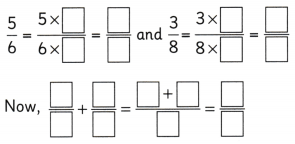
Let us add \(\frac{5}{6}\) and \(\frac{3}{8}\)
Write the equivalent fractions for each of them with the same fractional units.
(The smallest common multiples of 6 and 8 is _____)
Question 25.
Add the following.
(a) \(\frac{2}{3}+\frac{4}{9}\)
(b) \(\frac{5}{7}+\frac{3}{5}\)
(c) \(\frac{5}{10}+\frac{7}{12}\)
Answer:
(a) \(\frac{10}{9}\)
(b) \(\frac{46}{35}\)
(c) \(\frac{65}{60}\)
Question 26.
Sudka mixes \(\frac{2}{3}\) litres of water with \(\frac{3}{4}\) litres of milk. What is the total quantity of the mixture she made?
Answer:
\(\frac{17}{12}\)Litres
Question 27.
Sukeerti bought \(\frac{2}{5}\) metres of ribbon, and Sonia bought \(\frac{3}{4}\) metres of tke same ribbon to put a complete border on a table cloth whose perimeter is 1 metre long. Find the total length of the ribbon they both have bought. Will the lace be sufficient to cover the whole border?
Answer:
\(\frac{23}{20}\) metres, No
Subtraction of Fractions with the Same Fractional Unit or Denominator
Subtraction of fractions with the same fractional units or denominator can be done the same as addition of fractions with the same fractional units.
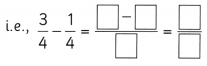
To subtract a fraction from another fraction with the same fractional units, we subtract the numerators and write the difference over the common denominator.
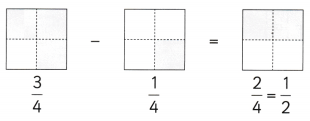
Look at the figures given above, three-fourth – one-fourth = two-fourth (one-half),
Question 28.
Solve the following.
(a) \(\frac{4}{7}-\frac{3}{7}\)
(b) \(\frac{11}{17}-\frac{8}{17}\)
(c) \(\frac{17}{19}-\frac{2}{19}\)
Answer:
(a) \(\frac{9}{28}\)
(b) \(\frac{7}{12}\)
(c) \(\frac{1}{6}\)
Subtracting Fractions with the Different Fractional Units or Denominators
Write each given fraction into equivalent fractions with the same fractional units, then subtract as above.
Let us subtract \(\frac{7}{9}\) from \(\frac{4}{5}\).
Write the equivalent fractions for each of them with the same fractional units.
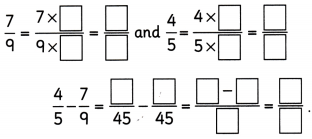
(The smallest common multiple of 9 and 5 ts.)
Question 29.
Subtract the following.
(a) \(\frac{4}{7}-\frac{1}{4}\)
(b) \(\frac{5}{6}-\frac{2}{8}\)
(c) \(\frac{5}{6}-\frac{2}{3}\)
Answer:
(a) \(\frac{9}{28}\)
(b) \(\frac{7}{12}\)
(c) \(\frac{1}{6}\)
Question 30.
An iron pipe of a length \(\frac{26}{9}\) metres long was cut into 2 pieces. If one is \(\frac{1}{2}\) metre long, what is the length of the other piece of the pipe?
Answer:
\(\frac{181}{72}\)