Students often refer to Maths Mela Class 5 Solutions Chapter 2 Fractions Question Answer NCERT Solutions to verify their answers.
Class 5 Maths Chapter 2 Fractions Question Answer Solutions
Fractions Class 5 Maths Solutions
Class 5 Maths Chapter 2 Solutions
Playing with a Grid (Pages 17 – 18)
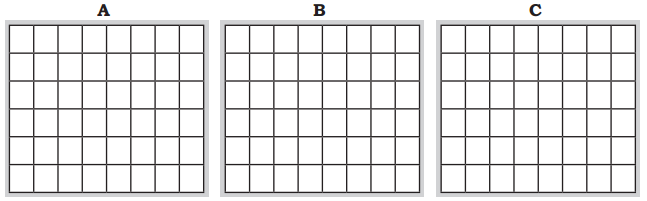
Shade \(\frac{1}{8}\) of Grid A in red.
Shade \(\frac{1}{6}\) of Grid B in blue.
Shade \(\frac{1}{12}\) of Grid C in yellow.
Do you see \(\frac{1}{3}\) in any of the grids? Mark it
Answer:
Here, squares in Grid A = Squares in Grid B = Square in Grid C = 6 × 8 = 48.
and Red squares in Grid A = \(\frac{1}{8}\) × 48 = 6.
and Blue squares in Grid B = \(\frac{1}{6}\) × 48 = 8.
and Yellow square in Grid C = \(\frac{1}{12}\) × 48 = 4.
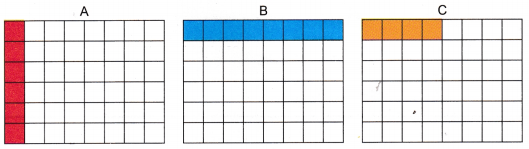
Yes, \(\frac{1}{3}\) is seen in all the grids. The marked portion in the grids below represents \(\frac{1}{3}\).
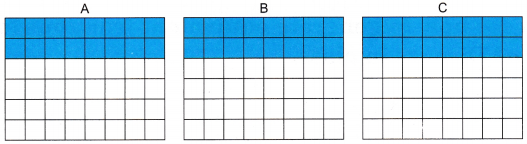
Is \(\frac{1}{3}\) equal to 26 ? Let us find out.
Look at the picture and identify the fractions.

Are there two different ways to write the fraction represented by the shaded part? ___________________
Do you see that \(\frac{1}{3}=\frac{2}{6}\)? Yes. These are called ‘equivalent fractions’.
Let us see how equivalent fractions can be generated.
Answer:
Yes

Fun with Fraction Kit
Gurpreet is playing with his fraction kit (a kit is given at the end of the textbook). Do you remember how to make a whole with pieces of the same size? How many 1
5 pieces will you need to make a whole?
He makes a whole using two different fraction pieces. The whole looks like the following.
One piece of \(\frac{1}{2}\) and two pieces of \(\frac{1}{4}\) make a whole.
What is the relation between \(\frac{1}{2}\) and \(\frac{1}{4}\) ? Discuss in class.
\(\frac{1}{2}\)(\(\frac{1}{4}\) is equivalent to 24).
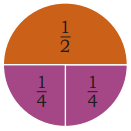
When a \(\frac{1}{2}\) piece is broken into 2 equal parts, each part is a \(\frac{1}{4}\) piece.
2 pieces of \(\frac{1}{4}\) are equal to \(\frac{1}{2}\).
What else is equivalent to \(\frac{1}{2}\).
\(\frac{1}{2}=\frac{2}{4}\) = ____ = ____ = ____
Answer:
\(\frac{1}{2}=\frac{2}{4}=\frac{3}{6}=\frac{4}{8}=\frac{5}{10}\)
Let Us Do (Page 19)
Question 1.
In groups of 3 or 4, find different ways of making a whole with different fraction pieces from your kit. Write the equivalent fractions for the following that you may find in the process.
(a) \(\frac{1}{3}\) = ____ = ____ = ____
(b) \(\frac{1}{4}\) = ____ = ____ = ____
(c) \(\frac{1}{5}\) = ____ = ____ = ____
(d) \(\frac{1}{6}\) = ____ = ____ = ____
Do you see how to generate equivalent fractions for any given fraction? Discuss in class.
Answer:
(a) \(\frac{1}{3}\)
Multiplying both numerator and denominator by 2
= \(\frac{1 \times 2}{3 \times 2}=\frac{2}{6}\)
Multiplying both numerator and denominator by 3
= \(\frac{1 \times 3}{3 \times 3}=\frac{3}{9}\)
Multiplying both numerator and denominator by 4
= \(\frac{1 \times 4}{3 \times 4}=\frac{4}{12}\)
Hence, \(\frac{1}{3}=\frac{2}{6}=\frac{3}{9}=\frac{4}{12}\)
(b) \(\frac{1}{4}\)
Multiplying both numerator and denominator by 2
= \(\frac{1 \times 2}{4 \times 2}=\frac{2}{8}\)
Multiplying both numerator and denominator by 3
= \(\frac{1 \times 3}{4 \times 3}=\frac{3}{12}\)
Multiplying both numerator and denominator by 4
= \(\frac{1 \times 4}{4 \times 4}=\frac{4}{16}\)
Hence, \(\frac{1}{4}=\frac{2}{8}=\frac{3}{12}=\frac{4}{16}\)
(c) \(\frac{1}{5}\)
Multiplying both numerator and denominator by 2
= \(\frac{1 \times 2}{5 \times 2}=\frac{2}{10}\)
Multiplying both numerator and denominator by 3
= \(\frac{1 \times 3}{5 \times 3}=\frac{3}{15}\)
Multiplying both numerator and denominator by 4
= \(\frac{1 \times 4}{5 \times 4}=\frac{4}{20}\)
Hence, \(\frac{1}{5}=\frac{2}{10}=\frac{3}{15}=\frac{4}{20}\)
(d) \(\frac{1}{6}\)
Multiplying both numerator and denominator by 2
= \(\frac{1 \times 2}{6 \times 2}=\frac{2}{12}\)
Multiplying both numerator and denominator by 3
= \(\frac{1 \times 3}{6 \times 3}=\frac{3}{18}\)
Multiplying both numerator and denominator by 4
= \(\frac{1 \times 4}{6 \times 4}=\frac{4}{24}\)
Hence, \(\frac{1}{6}=\frac{2}{12}=\frac{3}{18}=\frac{4}{24}\)
Question 2.
Find the following using your kit. You can also shade and check by shading the following. The first one is partially done for you.
A. How many \(\frac{1}{6}\) s make \(\frac{1}{3}\) ?
The shaded part is \(\frac{1}{3}\). Identify \(\frac{1}{6}\) in the same whole and find how many \(\frac{1}{6}\)s fit into \(\frac{1}{3}\)?

B. How many \(\frac{1}{8}\)s make
(a) \(\frac{1}{4}\)?

Answer:

(b) \(\frac{1}{2}\)?

Answer:

C. How many \(\frac{1}{12}\) s make
(a) \(\frac{1}{2}\)
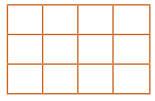
Answer:
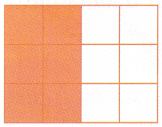
(b) \(\frac{1}{3}\)
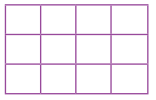
Answer:
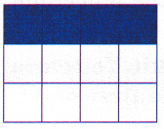
(c) \(\frac{1}{4}\)
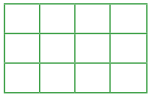
Answer:
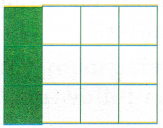
(d) \(\frac{1}{6}\)
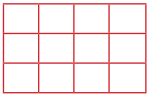
Answer:
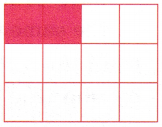
Question 3.
Do as instructed using your fraction kit.
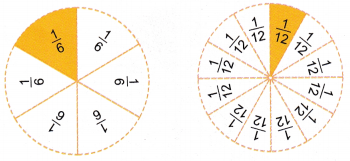
(a) Make a whole using only \(\frac{1}{6}\) and \(\frac{1}{12}\) pieces.
Answer:
Here, \(\frac{1}{6}+\frac{1}{6}+\frac{1}{6}+\frac{1}{6}+\frac{1}{6}+\frac{1}{6}=\frac{6}{6}\)
= 1 (Whole)
6 pieces of \(\frac{1}{6}\) make one whole.
and \(\frac{1}{12}+\frac{1}{12}+\frac{1}{12}+\frac{1}{12}+\frac{1}{12}+\frac{1}{12}+\frac{1}{12}+\frac{1}{12}+\frac{1}{12}+\frac{1}{12}+\frac{1}{12}+\frac{1}{12}=\frac{12}{12}\)
= 1 (Whole)
∴ 12 Pieces of \(\frac{1}{12}\) make one whole.
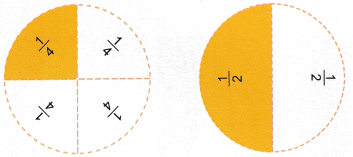
(b) Make a whole using \(\frac{1}{12}\), \(\frac{1}{4}\) and \(\frac{1}{2}\) pieces.
Answer:
\(\frac{1}{4}+\frac{1}{4}+\frac{1}{4}+\frac{1}{4}=\frac{4}{4}\) = 1 (Whole)
∴ four pieces of \(\frac{1}{4}\) make one whole.
\(\frac{1}{2}+\frac{1}{2}=\frac{2}{2}\) = 1 (Whole)
two pieces of \(\frac{1}{2}\) make one whole.
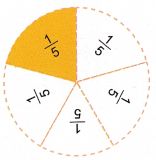
(c) Make a whole using any five pieces of the same size.
Answer:
\(\frac{1}{5}+\frac{1}{5}+\frac{1}{5}+\frac{1}{5}+\frac{1}{5}=\frac{5}{5}\) = 1 (whole)
five pieces of \(\frac{1}{5}\) make one whole.
(d) Make a whole using any seven pieces.
Play in a group with this kit and find other interesting combinations to make a whole. Write or draw your findings.
Answer:
Here \(\frac{1}{7}+\frac{1}{7}+\frac{1}{7}+\frac{1}{7}+\frac{1}{7}+\frac{1}{7}+\frac{1}{7}=\frac{7}{7}\) = 1 (Whole)
∴ seven pieces of \(\frac{1}{7}\) make one whole.
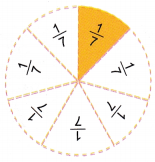
Hence, we found that if each piece is then \(\frac{1}{n}\) pieces will always make a whole.
Making Equivalent Fractions (Page 21)
Divide the wholes given below into more equal parts and find fractions equivalent to \(\frac{1}{3}\). Write them in the boxes below the images.
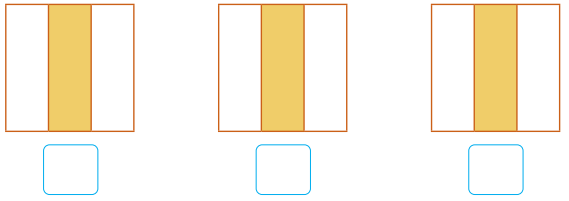
Answer:
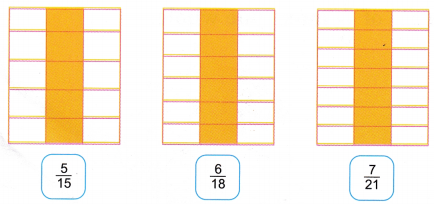
Do you see any pattern in all the equivalent fractions that you found?
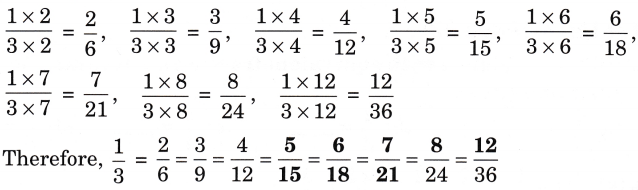
\(\frac{1}{3}=\frac{2}{6}=\frac{3}{9}=\frac{4}{12}\) = ____ = ____ = ____ =____/24 = ____/36
Answer:
Equivalent fractions are made by multiplying both the numerator and denominator of by the same number.
Here, \(\frac{1}{3}\)
How do you know when a fraction is equivalent to another? Discuss in class.
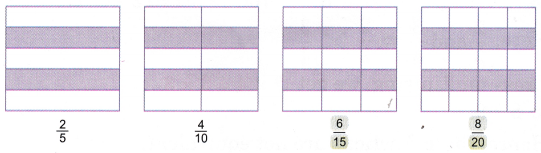
The below pictures show \(\frac{2}{5}\) of a whole. Find the different fractions that are equivalent to \(\frac{2}{5}\) and write your fractions below each image.
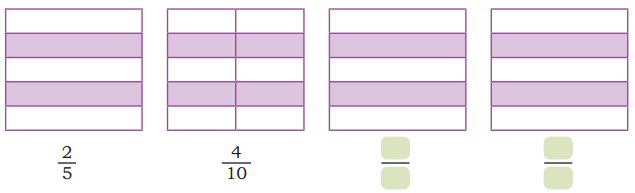
\(\frac{2}{5}=\frac{4}{10}\) = ____ = ____ = ____/50 = ____ / 100
Answer:
Here,

Let us Do (Page 22)
Question 1.
Fill in the blanks with equivalent fractions. There may be more than one answer.
(a) \(\frac{1}{7}\)= _____
Answer:
Here, \(\frac{1}{7}, \frac{1 \times 2}{7 \times 2}=\frac{2}{14}\), \(\frac{1 \times 3}{7 \times 3}=\frac{3}{21}\)
Hence, \(\frac{1}{7}=\frac{2}{14}=\frac{3}{21}\)
(b) \(\frac{2}{3}\) = _____
Answer:
Here, \(\frac{2}{3}, \quad \frac{2 \times 2}{3 \times 2}=\frac{4}{6}\), \(\frac{2 \times 3}{3 \times 3}=\frac{6}{9}\)
Hence, \(\frac{2}{3}=\frac{4}{6}=\frac{6}{9}\)
(c) \(\frac{3}{4}\) = _____
Answer:
Here, \(\frac{3}{4}, \quad \frac{3 \times 2}{4 \times 2}=\frac{6}{8}\), \(\frac{3 \times 3}{4 \times 3}=\frac{9}{12}\)
Hence, \(\frac{3}{4}=\frac{6}{8}=\frac{9}{12}\)
(d) \(\frac{3}{5}\) = _____
Answer:
Here, \(\frac{3}{5}, \quad \frac{3 \times 2}{5 \times 2}=\frac{6}{10}\), \(\frac{3 \times 3}{5 \times 3}=\frac{9}{15}\)
Hence, \(\frac{3}{5}=\frac{6}{10}=\frac{9}{15}\)
Question 2.
Put a tick (✓) against the fractions that are equivalent.
(a) \(\frac{2}{3}\) and \(\frac{3}{4}\)
Answer:
Here, \(\frac{2}{3}\) and \(\frac{3}{4}\)
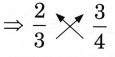
Cross multiplying, we get
2 × 4 = 3 × 3
⇒ 8 ≠ 9
Hence, these fractions are not equivalent
(b) \(\frac{3}{5}\) and \(\frac{6}{10}\)
Answer:
\(\frac{3}{5}\) and \(\frac{6}{10}\)
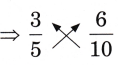
Cross multiplying, we get
3 × 10 = 5 × 6
⇒ 30 = 30
Hence, these fractions are equivalent
(c) \(\frac{4}{12}\) and \(\frac{2}{6}\)
Answer:
\(\frac{4}{12}\) and \(\frac{2}{6}\)

Cross multiplying, we get
4 × 6 = 2 × 12
⇒ 24 = 24
Hence, these fractions are equivalent
(d) \(\frac{6}{9}\) and \(\frac{1}{3}\)
Answer:
\(\frac{6}{9}\) and \(\frac{1}{3}\)

6 × 3 = 9 × 1
⇒ 18 ≠ 9
Hence, these fractions are not equivalent
Question 3.
Fill in the boxes such that the fractions become equivalent.

Answer:
(a) Here, 5 × 2 = 10
∴ Multiplying both numerator and denominator by 2, we get
\(\frac{2 \times 2}{5 \times 2}=\frac{4}{10}\) hence, \(\frac{2}{5}=\frac{4}{10}\)
(b) Here, 4 × 4 = 16
∴ Multiplying both numerator and denominator by 2, we get
\(\frac{3 \times 4}{4 \times 4}=\frac{12}{16}\) hence, \(\frac{3}{4}=\frac{12}{16}\)
(c) Here, 5 × 2 = 10
∴ Multiplying both numerator and denominator by 2, we get
\(\frac{4 \times 2}{7 \times 2}=\frac{8}{14}\) hence, \(\frac{4}{7}=\frac{8}{14}\)
(d) Here, 5 × 2 = 10
∴ Multiplying both numerator and denominator by 2, we get
\(\frac{5 \times 5}{9 \times 5}=\frac{25}{45}\) hence, \(\frac{5}{9}=\frac{25}{45}\)
Let Us Do (Page 23)
Question 1.
Compare the fractions given below using < and> signs.
(a) \(\frac{1}{4}\) ___ \(\frac{3}{4}\)
Answer:
Given \(\frac{1}{4}\) ___ \(\frac{3}{4}\)
⇒ \(\frac{1}{4}\) < 3 \(\frac{1}{4}\)
Hence, \(\frac{1}{4}\) < \(\frac{3}{4}\)
(b) \(\frac{3}{5}\) ___ \(\frac{4}{5}\)
Answer:
Here, \(\frac{3}{5}\) ___ \(\frac{4}{5}\)
⇒ 3 × \(\frac{1}{5}\) < 4 × \(\frac{1}{5}\)
Hence, \(\frac{3}{5}\) < \(\frac{4}{5}\)
(c) \(\frac{5}{7}\) ___ \(\frac{2}{7}\)
Answer:
⇒ 5 × \(\frac{1}{7}\) > 2 × \(\frac{1}{7}\)
\(\frac{5}{7}\) > \(\frac{2}{7}\)
(d) \(\frac{7}{8}\) ___ \(\frac{3}{8}\)
Answer:
⇒ 7 × \(\frac{1}{8}\) > 3 × \(\frac{1}{8}\)
Hence, \(\frac{7}{8}\) > \(\frac{3}{8}\)
(e) \(\frac{5}{10}\) ___ \(\frac{6}{10}\)
Answer:
⇒ 5 × \(\frac{1}{10}\) > 6 x \(\frac{1}{10}\)
Hence, \(\frac{5}{10}\) < \(\frac{6}{10}\)
(f) \(\frac{2}{6}\) ___ \(\frac{1}{6}\)
Answer:
⇒ 2 × \(\frac{1}{6}\) > \(\frac{1}{6}\)
Hence, \(\frac{2}{6}\) > \(\frac{1}{6}\)
Let Us Do (Page 23)
Question 1.
Compare the following fractions using < and > signs.
(a) \(\frac{3}{8}\) ____ \(\frac{3}{7}\)
Answer:
Given \(\frac{3}{8}\) ____ \(\frac{3}{7}\)
Now \(\frac{1}{8}\) < \(\frac{1}{7}\)
⇒ 3 × \(\frac{1}{8}\) < 3 × \(\frac{1}{7}\)
Hence, \(\frac{3}{8}<\frac{3}{7}\)
(b) \(\frac{4}{9}\) ____ \(\frac{4}{10}\)
Answer:
Given \(\frac{4}{9}\) ____ \(\frac{4}{10}\)
Now \(\frac{1}{9}\) > \(\frac{1}{10}\).
⇒ 4 × \(\frac{1}{9}\) > 4 × \(\frac{1}{10}\).
Hence, \(\frac{4}{9}>\frac{4}{10}\).
(c) \(\frac{2}{7}\) ____ \(\frac{2}{5}\)
Answer:
Given \(\frac{2}{7}\) ____ \(\frac{2}{5}\)
Now \(\frac{1}{7}\) < \(\frac{1}{5}\)
⇒ 2 × \(\frac{1}{7}\) < 2 × \(\frac{1}{5}\)
Hence, \(\frac{2}{7}<\frac{2}{5}\)
(d) \(\frac{5}{7}\) ____ \(\frac{5}{6}\)
Answer:
Here, \(\frac{5}{7}\) ____ \(\frac{5}{6}\)
Now, \(\frac{1}{7}\) < \(\frac{1}{6}\).
⇒ 5 × \(\frac{1}{7}\) < 5 × \(\frac{1}{6}\).
Hence, \(\frac{5}{7}<\frac{5}{6}\)
(e) \(\frac{6}{9}\) ____ \(\frac{6}{10}\)
Answer:
Here, \(\frac{6}{9}\) ____ \(\frac{6}{10}\)
Now, \(\frac{1}{9}\) > \(\frac{1}{10}\).
⇒ 6 × \(\frac{1}{9}\) > 6 × \(\frac{1}{10}\).
Hence, \(\frac{6}{9}>\frac{6}{10}\)
(f) \(\frac{7}{9}\) ____ \(\frac{7}{11}\)
Answer:
Here, \(\frac{7}{9}\) ____ \(\frac{7}{11}\)
Now, \(\frac{1}{9}\) > \(\frac{1}{11}\).
⇒ 7 × \(\frac{1}{9}\) > 7 × \(\frac{1}{11}\).
Hence, \(\frac{7}{9}>\frac{7}{11}\)
Fractions Greater Than 1 (Page 25)
Question 1.
Raman’s sister Radhika took 6 pieces of \(\frac{1}{2}\) paratha. How many parathas did she eat?
Answer:

Question 2.
Dadiji had 7 pieces of \(\frac{1}{2}\) paratha. How many parathas did she eat? Find out.
Answer:
Here,
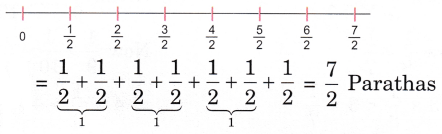
No. of parathas = \(\frac{7}{2}\) Parathas
= 3 + \(\frac{1}{2}\) Parathas
= 3\(\frac{1}{2}\) Parathas.
Question 3.
Raman ate 6 pieces of \(\frac{1}{2}\) paratha, Dadaji ate 7 pieces of \(\frac{1}{2}\) paratha and Baba ate 5 pieces of \(\frac{1}{2}\) paratha. How many parathas did each of them eat?
Use the number line to find the answer.

Answer:
Quantity of Raman’s parathas
= \(\frac{1}{2}+\frac{1}{2}+\frac{1}{2}+\frac{1}{2}+\frac{1}{2}+\frac{1}{2}\) (6 pieces)
= \(\frac{16}{2}\) = 3 parathas

Quantity of Dadaji’s parathas
= \(\frac{1}{2}+\frac{1}{2}+\frac{1}{2}+\frac{1}{2}+\frac{1}{2}+\frac{1}{2}+\frac{1}{2}\) (7 pieces)
= \(\frac{7}{2}\) = 3\(\frac{1}{2}\) parathas

Quantity of Baba’s parathas
= \(\frac{1}{2}+\frac{1}{2}+\frac{1}{2}+\frac{1}{2}+\frac{1}{2}=\frac{5}{2}\)
= 2\(\frac{1}{2}\) parathas

Question 4.
How many parathas were made on this day? Find out.
Answer:
Total No. of parathas = \(\frac{5}{2}+\frac{6}{2}+\frac{7}{2}+\frac{6}{2}+\frac{7}{2}+\frac{5}{2}=\frac{36}{2}\) = 18
Quantity of baba’s parathas = \(\frac{1}{2}+\frac{1}{2}+\frac{1}{2}+\frac{1}{2}+\frac{1}{2}\)(5 pieces)
= \(\frac{5}{2}\)
= 2\(\frac{1}{2}\) Parathas
Question 5.
Raman ate 7 pieces of \(\frac{1}{4}\), Radhika ate 6 pieces of \(\frac{1}{4}\), Maa ate 8 pieces of \(\frac{1}{4}\), Dadiji ate 10 pieces of \(\frac{1}{4}\), and Baba ate 12 pieces of \(\frac{1}{4}\) paratha. Use a number line to find out how many parathas were eaten by each of them.
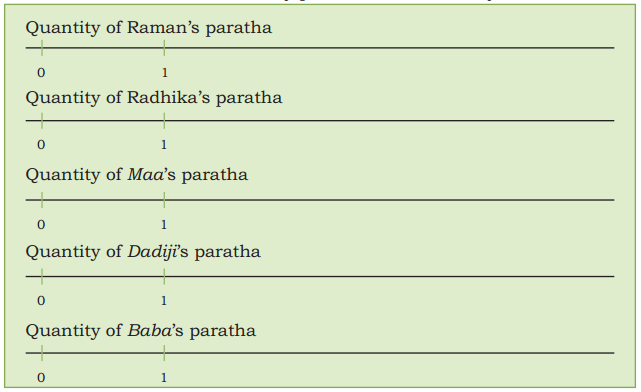
Answer:
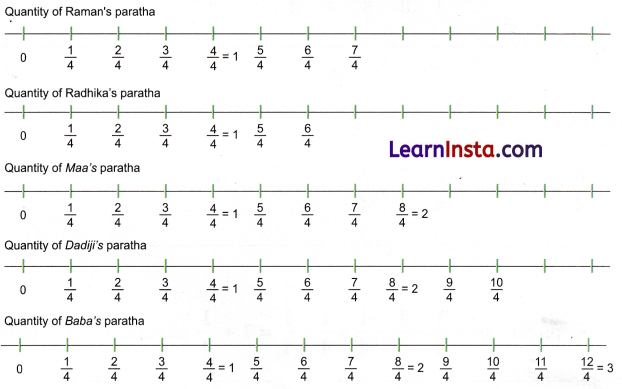
Question 6.
How many parathas were made on this day? Find out.
Answer:
Total parathas = Dadaji’s paratha + Raman’s paratha + Radhika’s paratha + Maa’s paratha + Dadiji’s paratha + Baba’s paratha
= \(\frac{9}{4}+\frac{7}{4}+\frac{6}{4}+\frac{8}{4}+\frac{10}{4}+\frac{12}{4}\)
= \(\frac{9+7+6+8+10+12}{4}=\frac{52}{4}\)
= \(\frac{52}{4}\) Parathas
= 13 parathas
Let Us Do (Page 28)
Question 1.
Use parathas and number lines to show the following fractions in your notebook.
(a) \(\frac{2}{3}\) and \(\frac{5}{3}\)
Answer:
Here, \(\frac{2}{3}\) and \(\frac{5}{3}\)
\(\frac{2}{3}\) Parathas = \(\frac{1}{3}+\frac{1}{3}\)
\(\frac{5}{3}\) Parathas = \(\frac{1}{3}+\frac{1}{3}+\frac{1}{3}+\frac{1}{3}+\frac{1}{3}\)
= 1 + \(\frac{2}{3}\) Parathas
= 1\(\frac{2}{3}\) Parathas
(b) \(\frac{3}{4}\) and \(\frac{5}{4}\)
Answer:
Here, \(\frac{3}{4}\) and \(\frac{5}{4}\)
\(\frac{3}{4}\) Parathas = \(\frac{1}{4}+\frac{1}{4}+\frac{1}{4}\)

\(\frac{5}{4}\) Parathas = \(\frac{1}{4}+\frac{1}{4}+\frac{1}{4}+\frac{1}{4}+\frac{1}{4}\)
= 1 + \(\frac{1}{4}\) Parathas
= 1\(\frac{1}{4}\) Parathas

(c) \(\frac{4}{8}\) and \(\frac{9}{8}\)
Answer:
\(\frac{4}{8}\) Parathas = \(\frac{1}{8}+\frac{1}{8}+\frac{1}{8}+\frac{1}{8}\)

\(\frac{9}{8}\) Parathas = \(\frac{1}{8}+\frac{1}{8}+\frac{1}{8}+\frac{1}{8}+\frac{1}{8}+\frac{1}{8}+\frac{1}{8}+\frac{1}{8}+\frac{1}{8}\)
= 1 + \(\frac{1}{8}\) Parathas
= 1\(\frac{1}{8}\) Parathas

Question 2.
Circle the fractions that are greater than one (whole). How do you know? Discuss your reasoning in the class.

Answer:
\(\frac{7}{9}\) → less than 1 9
\(\frac{3}{9}=\frac{1}{3}\) → less than 1 9 3
\(\frac{7}{11}\) → less than 1
\(\frac{9}{4}\) = 2\(\frac{1}{4}\) → greater than 1
\(\frac{9}{4}\) → greater than 1 4
\(\frac{2}{5}\) → less than 1
\(\frac{5}{4}\) = 1\(\frac{1}{4}\) → greater than 1
\(\frac{7}{3}\) = 2\(\frac{1}{3}\) → greater than 1
\(\frac{5}{7}\) → less than 1
\(\frac{4}{9}\) → less than 1
\(\frac{2}{3}\) → less tan 1
\(\frac{13}{11}\) = 1\(\frac{2}{11}\) → greater than 1
\(\frac{12}{5}\) = 2\(\frac{2}{5}\) → greater than 1
\(\frac{12}{8}=\frac{3}{2}=1 \frac{1}{2}\) → greater than 1
A fraction \(\frac{(\mathrm{a})}{(\mathrm{b})}\) is greater than one (whole) when the numerator (a) is more than the denominator (b).
Let Us Do (Page 29)
Question 1.
Compare the following fractions using 1 as a reference. Share your reasoning in the class.
(a) \(\frac{8}{7}\) ____ \(\frac{9}{15}\)
Answer:
Since, \(\frac{8}{7}\) is more than 1 and \(\frac{9}{15}\) is less than 1.
Hence, \(\frac{8}{7}>\frac{9}{15}\)
(b) \(\frac{13}{20}\) ____ \(\frac{17}{15}\)
Answer:
Since, \(\frac{13}{20}\) is less than 1 and \(\frac{17}{15}\) is more than 1.
Hence, \(\frac{13}{20}<\frac{17}{15}\) .
(c) \(\frac{7}{6}\) ____ \(\frac{8}{8}\)
Answer:
Since, \(\frac{7}{6}\) is more than 1 and \(\frac{8}{8}\) is equal to 1.
Hence, \(\frac{7}{6}>\frac{8}{8}\).
(d) \(\frac{6}{6}\) ____ \(\frac{19}{12}\)
Answer:
\(\frac{6}{6}\) = 1 is equal to 1 and \(\frac{19}{12}\) = 1\(\frac{7}{19}\) is more than 1.
Hence, \(\frac{6}{6}<\frac{19}{12}\).
(e) \(\frac{12}{9}\) ____ \(\frac{4}{5}\)
Answer:
\(\frac{12}{9}=1 \frac{3}{9}\) is more than 1 and \(\frac{4}{5}\) is less than 1.
Hence, \(\frac{12}{9}>\frac{4}{5}\)
(f) \(\frac{15}{5}\) ____ \(\frac{16}{4}\)
Answer:
\(\frac{15}{5}\) = 3, is more than 1 and \(\frac{16}{4}\) = 4 is also more than 1.
Hence, \(\frac{15}{5}<\frac{16}{4}\).
Let Us Do
Question 1.
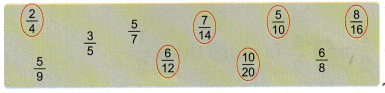
Circle the fractions below that are equal to \(\frac{1}{2}\).

Answer:
Here, \(\frac{2}{4}=\frac{1}{2} ; \frac{7}{14}=\frac{1}{2} ; \frac{6}{12}=\frac{1}{2} ; \frac{5}{10}=\frac{1}{2} ; \frac{10}{20}=\frac{1}{2} ; \frac{8}{16}=\frac{1}{2}\)
Hence
Question 2.
Some fractions are written in the box below. Circle the fractions that are less than half. How do you know? Discuss your reasoning in the class.
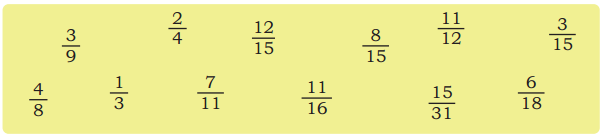
Answer:
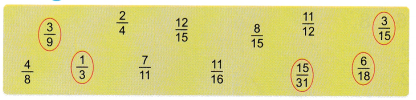
We can compare it to \(\frac{1}{2}\) either by number line or equivalent fractions.
Let Us Do (Page 31)
Question 1.
Compare the following fractions. Where possible, compare the fractions with \(\frac{1}{2}\).

Answer:
(i) Here, \(\frac{2}{9}\) and \(\frac{4}{7}\)
\(\frac{2}{9}\) is less than \(\frac{1}{2}\) and \(\frac{4}{7}\) is more than \(\frac{1}{2}\).
Hence, \(\frac{2}{9}<\frac{4}{7}\)
(ii) Here, \(\frac{11}{14}\) and \(\frac{7}{20}\)
\(\frac{11}{14}\) is more than \(\frac{1}{2}\) and \(\frac{7}{20}\) is less than \(\frac{1}{2}\).
Hence, \(\frac{11}{14}>\frac{7}{20}\).
(iii) Here, \(\frac{5}{7}\) and \(\frac{3}{9}\)
\(\frac{5}{7}\) is more than \(\frac{1}{2}\) and \(\frac{3}{9}\) is less than \(\frac{1}{2}\).
Hence, \(\frac{5}{7}>\frac{3}{9}\).
(iv) Here, \(\frac{6}{7}\) and \(\frac{4}{10}\)
\(\frac{6}{7}\) is more than \(\frac{1}{2}\) and \(\frac{4}{10}\) is less than \(\frac{1}{2}\).
Hence, \(\frac{6}{7}>\frac{4}{10}\).
(v) Here, \(\frac{9}{17}\) and \(\frac{3}{15}\)
\(\frac{9}{17}\) is more than \(\frac{1}{2}\) and \(\frac{3}{15}\) is less than \(\frac{1}{2}\).
Hence, \(\frac{9}{17}>\frac{3}{15}\).
(vi) Here, \(\frac{7}{12}\) and \(\frac{3}{11}\)
\(\frac{7}{12}\) is more than \(\frac{1}{2}\) and \(\frac{3}{11}\) is less than \(\frac{1}{2}\).
Hence, \(\frac{7}{12}>\frac{3}{11}\).
(vii) Here, \(\frac{1}{3}\) and \(\frac{5}{9}\)
\(\frac{1}{3}\) is more than \(\frac{1}{2}\) and \(\frac{5}{9}\) is less than \(\frac{1}{2}\).
Hence, \(\frac{1}{3}<\frac{5}{9}\).
(viii) Here, \(\frac{3}{9}\) and \(\frac{4}{7}\)
\(\frac{3}{9}\) is more than \(\frac{1}{2}\) and \(\frac{4}{7}\) is less than \(\frac{1}{2}\).
Hence, \(\frac{3}{9}<\frac{4}{7}\).
Try this:
If the length of an ant is \(\frac{1}{4}\) cm—then what is the total length of 16 such ants walking in a line? Use the number line given below.

Answer:
Given length of an ant = \(\frac{1}{4}\) cm

Total ants = 16
Hence, length of 16 ants = 16 × \(\frac{1}{4}=\frac{16}{4}\)
= 4 cm