Students often refer to Class 7 Ganita Prakash Solutions and NCERT Class 7 Maths Part 2 Chapter 7 Finding the Unknown Question Answer Solutions to verify their answers.
Class 7 Maths Ganita Prakash Part 2 Chapter 7 Solutions
Ganita Prakash Class 7 Chapter 7 Solutions Finding the Unknown
Class 7 Maths Ganita Prakash Part 2 Chapter 7 Finding the Unknown Solutions Question
7.1 Find the Unknowns
Unknown Weights (Pages 164—165)
Find the unknown weights in the following cases:
(For images refer NCERT Textbook Pages 164—165)
Solution:
InFig.7.1:
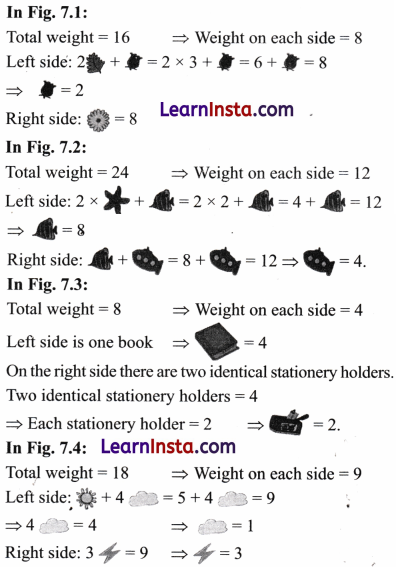
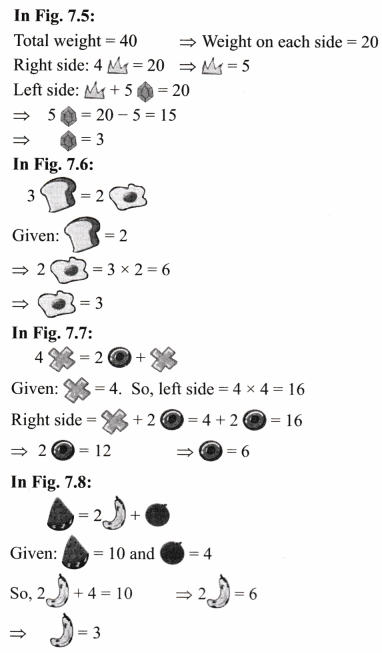
Total weight = 16 Weight on each side 8

(Pages 165-166)
Question.
Find the unknown weight of the sack in the following cases. In Fig. 7.10, all the sacks have the same weight.
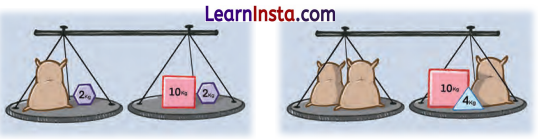
Hint: If we remove equal weights from both the plates, will the weighing scale still be balanced? Remove one sack from each plate for Fig. 7.10.1
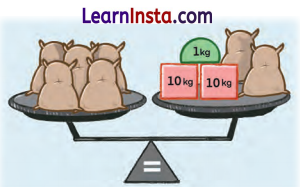
[Hint: Can you remove objects so that the sacks are only on one plate?]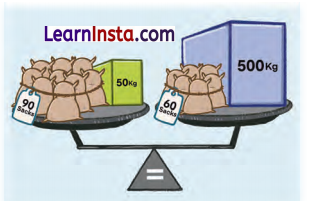
Solution:
In Fig. 7.9:
Removing 2 kg weight from both sides, we get
I sack = 10kg
Thus, weight of each sack =10 kg.
In Fig. 7.10:
Removing 1 sack from both sides, we get
1sack = 14kg
Thus, weight of each sack =14kg.
In Fig. 7.11:
Removing 2 sacks from both sides, we get
3 sacks =21kg=(7+7+7) kg
Thus, weight of each sack =7 kg.
In Fig. 7.12:
Removing 60 sacks and 50 kg weights from both sides, we get
30 sacks =450 kg-30 ×5 kg
Thus, weight of each sack =15kg
Matchstick Pattern (Page 167)
Question.
Can you find ways to get the value of n such that 2n+1-99?
Solution:
Do it yourself.
Question.
Is it possible to make a matchstick arrangement that appears in this sequence using exactly 200 sticks?
Solution:
Number of matchsticks =2n+1
If n is a counting number, then 2 n+1 is always an odd number, but 200 is an even number.
So, it is not possible to make the arrangement using exactly 200 sticks.
(Page 168)
Question.
For the weighing scale problems in figures 7.6, 7.7, 7.8, 7.9,7.10 and 7.11 frame equations by using letter numbers to denote the unknown weight.
Solution:
For the problem in
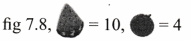
Let us denote the weight of one banana as b, then we have
10=4+2 b
or 2 b+4=10
For the problem in fig 7.9, let us denote the weight of the sack as s, then we have
s+2=10+2
or s+2=12
For the problem in fig 7.10, let us denote the weight of each sack as s, then we have
2s=10+4+s or 2s = 14 + s
For the problem in fig 7.11, let us denote the weight of each sack as s, then we have
5s=10+10+1+2 s or 5 s=21+2s
Question.
Solve the equations that you frame and check if you get the same value for the unknown weight as you got previously.
Solution:
Do it yourself.
Question.
Frame 5 equations. Find methods to solve them.
Solution:
Do it yourself.
7.2 Solving Equations Systematically (Page 168)
Question.
Try solving 5 x-4=7 using trial and error.
Solution:
If we substitute x=1, we get
LHS=5 × (1)-4=1. It is not 7 the RHS.
Substituting x=2, we get
LHS=5×(2)-4=6
It is not 7, the RHS, but 1 less than RHS.
Substituting x=3, we get
LHS =5 × (3)-4=11
It is not 7, the RHS, but 4 more than RHS.
So, the value of x is between 2 and 3 but closer to 2.
Substituting x=2.2, we get
LHS =5×(2.2)-4=7. It is the same as RHS.
Therefore, x=2.2 is the solution.
Figure it Out (Page 172)
Question 1.
Solve these equations and check the solutions.
(a) 3 x-10=35
(b) 5 s=3s
(c) 3 u-7=2 u+3
(d) 4(m+6) – 8 = 2 m – 4
(e) \(\frac{u}{15}\)=6
Solution:
(a) 3x – 10=35
3x = 35 ÷ 10 (Adding 10 on both sides)
3x=45
3x ÷ 3 = 45 ÷ 3 (Dividing both sides by 3)
x= 15
Check: Substituting x = 15, we get
3x 15-10=35
45-1035 or 3535
∴ LHS = RHS
(b) 5s=3s
⇒ 5s – 3s = 0 (Subtracting 33 from both sides)
2s=0
2s ÷ 2 = 0+ 2 (Dividing both sides by 2)
∴ s=0
Check: Substituting s = 0, we get
5 x 0 = 3 x 0
0 = 0
∴ LHS=RHS
(c) 3 u-7 =2u+3
⇒ 3u – 2u = 3+7
(Subtracting 2u and adding 7 on both sides)
u= 10
Check: Substituting u = 10, we get
3 × 10 – 7 = 2 x 10 + 3
30 – 7 = 20 + 3
23 = 23
∴ LHS=RHS
(d) 4(m + 6) – 8 = 2m – 4
⇒ 4m + 24 – 8 = 2m -4 (Removing brackets)
4m + 16 = 2m -4 (Simplifying)
⇒ 4m – 2m = – 4 – 16
(Subtracting 2m and 16 from both sides)
2m = – 20
⇒ 2m ÷ 2 = – 20 ÷ 2
(Dividing both sides by 2)
∴ m = – 10
Check: Substituting m = -10. we get
4(-10+6)-8=2(-10)-4
4(-4)-8= -20-4
-16-8=-24 or -24=-24
LHS=RHS
(e) \(\frac{u}{15}\)
u = 6 × 15 (Multiplying both sides by 15)
∴ u=90
Check: Substituting u = 90. we get
90 ÷ 15 = 6 or 6=6
∴ LHS = RHS
Question 2.
Frame an equation that has no solution.
Solution:
x+4=x+5.
If we subtract x from both sides, we get 4 = 5, which is false. This equation is never true, so it has no solution. (Answer may vary)
Solving Problems (Pages 174-175)
Example 7: Ranjana creates … Step k.
To check whether an arrangement is possible using 100 tiles at some Step k, we can solve the equation: 3 k+1= 100. Find the value of k.
Solution:
We have,
3 k+1 =100 ⇒ 3 k=100-1
3 k =99 ⇒ k=99 ÷ 3
k =33
(Page 178)
Question.
Can you think of a simple rule that you can use to get the starting number from the final answer?
Solution:
Let the original number be x, and the final equation is 4 x-4= Final Answer
⇒ x = (Final Answer +4) ÷4
(Page 179)
Example 12: Ramesh and Suresh ………..2 y+30=60.
Use this to find both the unknowns.
Solution:
We have, 2 y+30=60
∴ 2 y = 30
∴ y = 15
Also, x=y+30=15+30=45
Thus, Suresh has 15 marbles, and Ramesh has 45 marbles.
(Page 180)
Question:
Can you form a chain going from the bottom equation to the top? Compare the operations used when going from the top to the bottom and from the bottom to the top.
Solution:
Do it yourself.
Question:
Without calculating, can you find the value of the unknown in each equation in the chains above?
[Hint: We have seen that the value that satisfies an equation also satisfies the new equation obtained by performing the same operation on both sides of the original equation.]
Solution:
Do it yourself.
Figure it Out (Page 181)
Question 1.
Write 5 equations whose solution is x=-2.
Solution:
The five equations are: x+5=3,2 x=-4,3 x+10=4, x-2=-4,7 x=-14.
(Answer may vary)
Question 2.
Find the value of each unknown:
(a) 2 y=60
(b) -8=5 x-3
(c) -53 w=-15
(d) 13-z=8
(e) k+8=12-k
(f) 7 m=m-3
(g) 3 n=10+n
Solution:

(g) 3 n=10+n ⇒ 3 n-n=10
⇒ 2 n=10 ⇒ n=\(\frac{10}{2}\)=5
Question 3.
I am a 3-digit number. My hundred’s digit is 3 less than my ten’s digit. My ten’s digit is 3 less than my unit’s digit. The sum of all the three digits is 15. Who am I?
Solution:
Let the unit’s digit be u, then ten’s digit is u-3.
If ten’s digit is u-3, then hundred’s digit is (u-3)-3 =u-6
Sum of digits =(u-6)+(u-3)+u=15 (given)
⇒ 3 u-9=15 ⇒ 3 u=15+9
3 u=24 ⇒ u=\(\frac{24}{3}\)=8
Therefore, unit’s digit =8, ten’s digit = 8-3 = 5, hundred’s digit = 8-6 = 2.
Thus, the number is 258.
Question 4.
The weight of a brick is 1 kg more than half its weight. What is the weight of the brick?
Solution:
Let the brick’s weight be w kg.
Given, weight of the brick is 1 kg more than half of w kg, that is \(\left(1+\frac{1}{kg} w\right)\)kg.
Therefore, we have
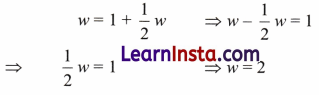
So, the brick weighs 2 kg.
Question 5.
One quarter of a number increased by 9 gives the same number. What is the number?
Solution:
Let the number be n. Then 1 quarter of n increased by 9 is \(\frac{1}{4}\) n+9.
Therefore, we have
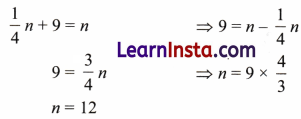
Thus, the required number is 12.
Question 6.
Given 4k + 1 = 13, find the values of:
(a) 8k + 2
(b) 4k
(c) k
(d) 4k – 1
(e) – k – 2
Solution:
Given, 4k+ 1=13
4k=13 – 1=12 =k=12÷4=3
(a) 8k+2=8(3)+2=26
(b) 4k=4(3)=12
(e) k3
(d 4k – 1 =4(3) – 1=12 – 1 = 11
(e) – k – 2= – 3 – 2= – 5
7.3 Mind the Mistake, Mend the Mistake (Pages 181—182)
The following are some equations along with the steps used to solve them to find the value of the letter-number. Go through each solution and decide whether the steps are correct. If there is a mistake, describe the mistake, correct it and solve the equation.
Question 1.
4x+6 = 10
4x=10+6
4x=16
x=4
Solution:
Mistake: +6 on LHS is incorrectly changed to +6 on the R.H S.
Correction: 4x = 10 – 6
⇒ 4x=4 ⇒ x = 1
Question 2.
7-8 z=5
8 z=7-5
8 z=2
z=4
Solution:
Mistake: To find the final value of z, instead of dividing 2 by 8,8 is divided by 2.
Correction: 8 z=2 ⇒ z=2 ÷ 8=\(\frac{1}{4}\)
Question 3.
2 v-4=6
v-4=6-2
v-4=4
v=8
Solution:
Mistake: The 2 in second step is incorrectly subtracted from the RHS.
Correction: 2 v=6+4 ⇒ 2 v=10 ⇒ v=5
Question 4.
5 z+2=3 z-4
5 z+3 z=-4+2
8 z=-2
z=-\(\frac{2}{8}\)
Solution:
Mistake: 3 z moved incorrectly to LHS as +3 z, also 2 from LHS has moved incorrectly to RHS as +2.
Correction: 5 z-3 z=-4-2 ⇒ 2 z=-6 ⇒ z=-3
Question 5.
15 w-4 w=26
15 w=26+4 w
15 w=30
w=2
Solution:
Mistake: 26+4 w is incorrectly simplified 30 on RHS.
Correction: 15 w-4 w=26
⇒11 w=26 ⇒w=\(\frac{26}{11}\)
Question 6.
3 x+1=-12
x+1=-\(\frac{12}{3}\)
x+1=-4
x=-5
Solution:
Mistake: -12 is incorrectly divided by 3 on RHS.
Correction: x+\(\frac{1}{3}=\frac{-12}{3}\) ⇒ x=\(\frac{-12}{3}-\frac{1}{3}\)
⇒ x=-\(\frac{13}{3}\)
Question 7.
4(4 q+2)=50
4(4 q)=50-2
16 q=48
q-3
Solution:
Mistake: When subtracting 2 on RHS in the second step, it should be 4 x 2=8 that is subtracted.
Correction: 16 q+8=50
⇒ 16 q=42
⇒ q=\(\frac{21}{8}\)
Question 8.
-2(3-4 x)=14
-6 v-8 x=14
-8 x=14+6
-8 x=20
x=-\(\frac{20}{8}\)
Solution:
Mistake: Incorrect expansion, i.e.,
-2(3-4x)=-6+8 x, not -6v-8 x
Correction: -6+8 x=14 ⇒ 8 x=20
⇒ x=\(\frac{5}{2}\)
Question 9.
3(7 y+4)=9+5 y
7 y+4=\(\frac{9}{3}\)+5 y
7 y+4=3+5 y
7 y-5 y+4=3
2 y=4-3
y=\(\frac{1}{2}\)
Solution:
Mistake: Cannot divide only one term on the RHS by 3.
Correction: \(7 y+4=\frac{9}{3}+\frac{5 y}{3}\)
7.4 A Pinch of History (Page 184)
Using this formula can you solve this equation 2 x+3=4 x+5 ?
Solution:
The given equation is 2 x+3=4 x+5.
Comparing it with A x+B=Cx+D, we get
A=2, B=3, C=4, D=5
Using the formula, x=\(\frac{\mathrm{D}-\mathrm{B}}{\mathrm{A}-\mathrm{C}}\), we get
x=\(\frac{5-3}{2-4}=\frac{2}{-2}\)=-1
Figure it Out (Pages 185-189)
Question 1.
Fill in the blanks with integers.
(a) 5 × _ -8 = 37
(b) 37-(33-_) = 35
(c) -3×(-11+_) = 45
Solution:
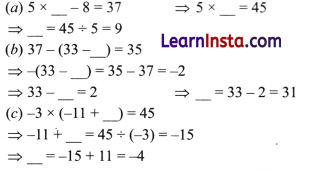
Question 2.
Ranju is a daily wage labourer. She earns ₹ 750 a day. Her employer pays her in 50 and 100 rupee notes. If Ranju gets an equal number of 50 and 100 rupee notes, how many notes of each does she have?
Solution:
Let the number of each type of note be n. According to the given conditions,
50 n+100 n=750 ⇒ 50 n=750
⇒ n=5
Therefore, she has 5 notes of ₹50 and 5 notes of ₹ 100.
Question 3.
In the given picture, each black blob hides an equal number of blue dots. If there are 25 dots in total, how many dots are covered by one blob? Write an equation to describe this problem.
Solution:
Let each blob hide n number of dots, then the total number of dots covered by 3 blobs is 3n.
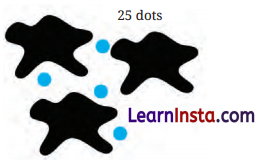
Since 4 dots are not covered. So, the required equation is
3n+4 =25 ⇒ 3n=25-4=21
⇒ n=21 ÷3=7
Therefore, 7 dots are covered by each blob.
Question 4.
Here are machines that take an input, perform an operation on it and send out the result as an output.
(a)
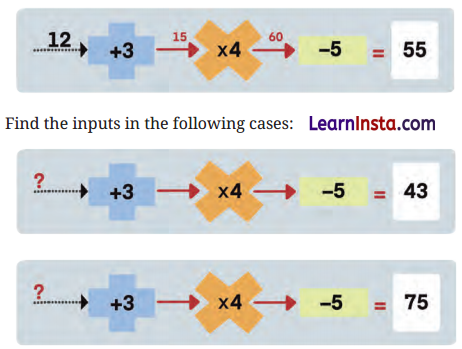
Solution:
Let the input is x.
(x+3) × 4-5 =43 ⇒ 4 x+12-5=43
4 x+7 =43 ⇒ 4 x=36
x =9
(x+3) × 4-5 =75 ⇒ 4 x+12-5=75
4 x+7 =75 ⇒ 4 x=68
x =17
(b)
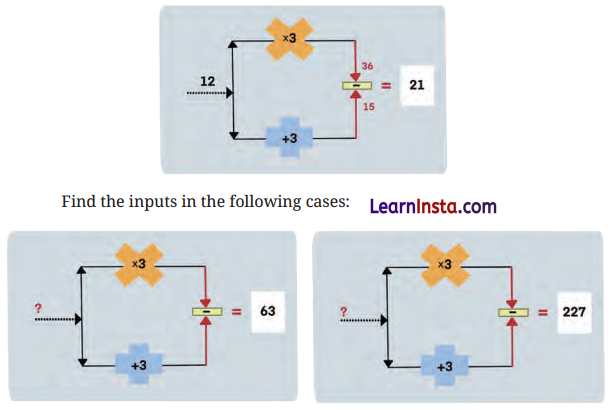
Solution:
Let the input is x.
x × 3-(x+3)=63 ⇒ 3 x-x-3=63
2x=66 ⇒ x=33
x × 3-(x+3)=227 ⇒ 3 x-x-3=227
2 x=230 ⇒ x=115
Question 5.
What are the inputs to these machines?
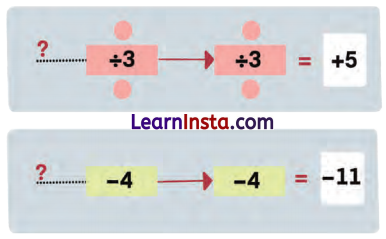
Solution:
Let the input is x. Then as per the given diagram, we get
(x ÷ 3) ÷ 3 =5
⇒ (x ÷ 3) =5 ×3
x – 4 – 4 = – 11
⇒ x -8 = – 11
⇒ x = – 11 + 8 = – 3
Question 6.
A taxi driver charges a fixed fee of ₹ 800 per day plus ₹ 20 for each kilometre travelled. If the total cost for a taxi ride is ₹2200, determine the number of kilometres travelled.
Solution:
Let kilometres travelled be k, then we have
800+20 k =2200
⇒ 20 k =2200-800=1400
⇒ k =1400 ÷ 20=70
Thus, the taxi travelled 70 km.
Question 7.
The sum of two numbers is 76. One number is three times the other number. What are the numbers?
Solution:
Let the smaller number be x.
Then, the larger number is 3x.
Therefore, we have
x+3 x =76 ⇒ 4 x=76
x=19 and 3 x =19 × 3=57
Thus, the numbers are 19 and 57.
Question 8.
The figure shows the diagram for a window with a grill. What is the gap between two rods in the grill?
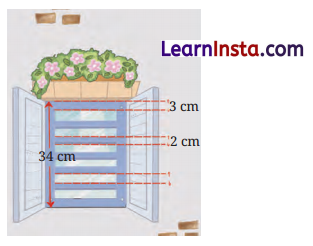
Solution:
Let the gap between the two rods of the window be x cm.
Inside height =34 cm.
There are 6 gaps. So, the total gap is 6 x cm
There are 5 rods, each of thickness 2 cm
So, total rods thickness =5 × 2=10 cm
Top and bottom margins =3 cm each
⇒ Total margin = 6 cm.
Total thickness of rods and margins =10 cm+6cm= 16 cm
Therefore, we have
6 x+16 =34 ⇒ 6 x=34-16=18
⇒ x =18 ÷ 6=3
Thus, the gap between the two rods is 3 cm.
Question 9.
In a restaurant, a fruit juice costs ₹ 15 less than a chocolate milkshake. If 4 fruit juices and 7 chocolate milkshakes cost ₹600, find the cost of the fruit juice and milkshake.
Solution:
Let the price of a chocolate milkshake (in ₹) = m.
∴ Cost of fruit juice (in ₹) =m-15.
Given, 4 fruit juices and 7 chocolate milkshakes cost ₹600. Therefore, we have
4(m-15)+7 m = 600 ⇒ 11 m=660
⇒ m =60
Cost of chocolate milkshake = ₹ 60
∴ Cost of fruit juice =₹ 60 – ₹15 = ₹45
Question 10.
Given 28 p-36=98, find the value of 14 p-19 and 28 p-38.
Solution:
Given, 28 p-36=98.
⇒ 28 p=134 ⇒ p=\(\frac{67}{14}\) ⇒ 14 p=67
⇒ 14 p-19=67-19=48
⇒ 28 p-38=134-38=96
Question 11.
The steps to solve three equations are shown below. Identify and correct any mistakes.
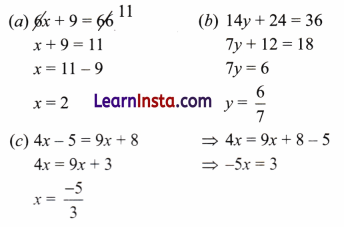
Solution:
(a) Mistake: 66 on the RHS cannot be divided directly by 6; first, we need to move 9 from LHS to RHS, then divide the RHS by 6.
Correction: 6 x+9=66
⇒ 6 x=66-9=57 ⇒ x=57 ÷ 6=\(\frac{19}{2}\)
(b) No error
(c) Mistake: Taking-5 to RHS as -5 (it should become +5). Also, in the final step, instead of dividing 3 by -5, -5 is divided by 3.
Correction: 4 x-5=9 x+8
4 x-9 x =8+5 ⇒ 4 x =-\(\frac{13}{5}\)
⇒ x = \(-\frac{13}{5}\)
Question 12.
Find the measures of the angles of these triangles.
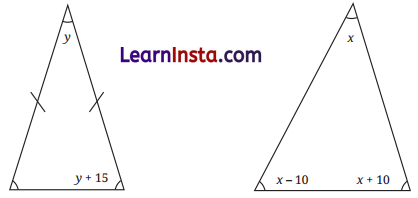
Solution:
First triangle: Apex angle (top angle) = y°; each base angle (y+ 15)°
y+2(y+15)=180 ⇒ y+2y=180 – 30
⇒ 3y=150 ⇒ y=50
∴ Base angles = 500 + 150 = 65°
Thus, the measures of the angles of this triangle are 50°, 65°, 65°.
Second triangle: Base angles =(x-10)° and (x+10°), top angle =x°. Therefore,
(x-10)+(x+10)+x=180 ⇒ 3 x=180 ⇒ x=60°
Base angles =50° and 70°
Thus, the measures of the angles of this triangle are 60°, 50°, 70°.
Question 13.
Write 4 equations whose solution is u=6.
Solution:
u+2=8,3 u=18,2 u-4=8,5+u=11 (Answer may vary)
Question 14.
The Bakhshali Manuscript (300 CE) mentions the following problem.
The amount given to the first person is not known. The second person is given twice as much as the first. The third person is given thrice as much as the second; and the fourth person four times as much as the third. The total amount distributed is 132. What is the amount given to the first person?
Solution:
Let the first person get x.
Second: 2 x, Third: 6 x, Fourth: 24 x.
Therefore, we have
x+2 x+6 x+24 x=132 ⇒ 33 x=132 ⇒ x=4
Thus, the first person got 4 units.
Question 15.
The height of a giraffe is two and a half metres more than half its height. How tall is the giraffe?
Solution:
Let the height of the giraffe be h metres. Therefore, we have
h =2.5+\(\frac{1}{2}\) h ⇒ h-\(\frac{1}{2}\) h=2.5
⇒\(\frac{1}{2}\) h =2.5 ⇒ h=5
Thus, the giraffe is 5 metres tall.
Question 16.
Two separate figures are given below. Each figure shows the first few positions in a sequence of arrangements made with sticks. Identify the pattern and answer the following questions for each figure:
(a) How many squares are in position number 11 of the sequence?
(b) How many sticks are needed to make the arrangement in position number 11 of the sequence?
(c) Can an arrangement in this sequence be made using exactly 85 sticks? If yes, which position number will it correspond to?
(d) Can an arrangement in this sequence be made using exactly 150 sticks? If yes, which position number will it correspond to?
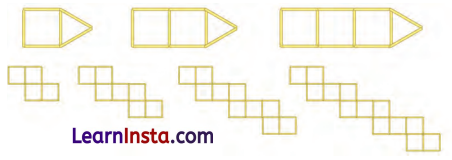
Solution:
For the first pattern:
(a) The patterns of squares are as follows: 1,2,3,………. At nth position, there will be n squares.
Therefore, in position number 11, there will be 11 squares.
(b) The sequence of number of sticks is 6,9,12,……………..
For nth position, number of sticks =3(n+1).
So, number of sticks required for the position number 11 in the sequence is
3(n+1)=3(11+1)=36 sticks.
(c) For nth position number of sticks =3(n+1)
Here, number of sticks =85. So,
3(n+1)=85
⇒ 3 n+3=85 ⇒ 3 n=85-3
⇒ 3 n=82 ⇒ n=\(\frac{82}{3}\)=27.33
So, in this sequence an arrangement cannot be made using exactly 85 sticks.
(d) Here, 3(n+1)=150
⇒ 3 n+3=150 ⇒ 3 n=147
⇒ n=\(\frac{147}{3}\)=49
Thus, the arrangement is possible in position 49 of this sequence with exactly 150 sticks.
For the second pattern:
(a) The patterns of squares are as follows: 4,7,10,13……….
At nth position, there will be 3 n+1 squares.
So, in position 11, there will be 3 × 11+1=34 squares.
(b) The pattern for number of sticks is 13,22,31,40,……
For nth position, number of sticks =9 n+4.
Therefore, number of sticks required for position number 11 of the sequence is
9 × 11+4=99+4=103 sticks
(c) For nth position, number of sticks = 9n+4.
Here, number of sticks =85
So, 9 n+4=85 ⇒ 9 n=81 ⇒ n=9
Thus, the arrangement is possible in position 9 of this sequence.
(d) Here, 9 n+4=150 ⇒ 9n=146
⇒ n=\(\frac{146}{9}\)=16.22
Thus, the arrangement is not possible with exactly 150 sticks.
Question 17.
A number increased by 36 is equal to ten times itself. What is the number?
Solution:
Let the number be n.
Therefore, we have
n+36=10 n ⇒ 9 n=36 ⇒ n=4
Thus, the number is 4.
Question 18.
Solve these equations:
(a) 5(r+2)=10
(b) -3(u+2)=2(u-1)
(c) 2(7-2 n)=-6
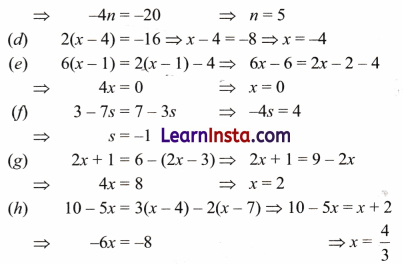
(d) 2(x-4)=-16
(e) 6(x-1)=2(x-1)-4
(f) 3-7 s=7-3 s
(g) 2 x+1=6-(2 x-3)
(h) 10-5 x=3(x-4)-2(x-7)
Solution:
(a) 5(r+2)=10 ⇒ r+2=2 ⇒ r=0
(b) -3(u+2) & =2(u-1) ⇒ -3 u-6=2 u-2
⇒ -4=5 ⇒ u=\(\frac{-4}{5}\)
(c) 2(7-2 n)=-6 ⇒ 14-4 n=-6
Question 19.
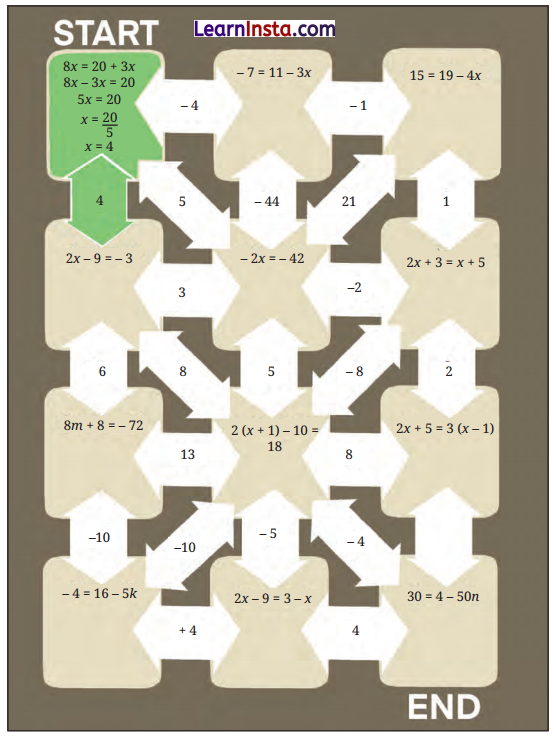
Solve the equations to find a path from Start to the End. Show your work in the given boxes provided and colour your path as you proceed.
Solution:
Question 20.
There are some children and donkeys on a beach. Together they have 28 heads and 80 feet. How many donkeys are there? How many children are there?
Solution:
Let the number of donkeys =x.
Then the number of children =28-x (since the total heads =28)
Each donkey has 4 feet, and each child has 2 feet.
So, total feet =4 x+2(28-x)=80
⇒ 4 x+56-2 x =80
⇒ x =12
⇒ 2 x=24
So, number of donkeys =12 and number of children = 28-12=16.
Therefore, there are 16 children and 12 donkeys.
A Magic Trick (Page 190)
Question.
Think of any number.
Now multiply it by 2
Add 10
Divide by 2.
Now subtract the original number you thought of.
Finally, add 3.
I predict that you now have 8 . Am I correct?
Try the trick on your friends and family!
Can you explain why the trick works?
[Hint: Denote the first number thought of by x.]
Can you make your own such tricks?
Solution:

Explanation: The trick works because the original number x is eliminated through the operations, always leaving the final result of 8, regardless of the starting number.
Do it yourself.