Students can use Poorvi Book Class 8 Solutions Unit 5 Science and Curiosity Chapter 13 Feathered Friend Questions and Answers as a quick reference guide.
Feathered Friend Class 8 Questions and Answers
Feathered Friend Class 8 Question Answer
NCERT Class 8 English Poorvi Chapter 13 Feathered Friend Question Answer
Feathered Friend Question Answer – Let us do these activities before we read. (Pages 205-206)
I. Work in pairs and discuss the questions given below. Share your answers with your classmates and teacher.
Question 1.
Who can a “feathered’ friend be?
Answer:
A ‘feathered’ friend can be a bird, such as a parrot, canary, or sparrow, characterised by having feathers.
Question 2.
Which ‘feathered’ friend do you like? Why?
Answer:
I like parrots because they are colourful, can mimic sounds, and are intelligent, making them interesting companions.
Question 3.
If you have a choice between a ‘feathered’ and a ‘furiy’ friend, who would you choose? Why?
Answer:
I would choose a feathered friend, like a bird, because they require less space, are easier to care for, and their singing is soothing.
Question 4.
Do you think a ‘feathered’ or a ‘furry’ friend can accompany astronauts to space? If yes, why? If no, why not?
Answer:
Yes, a feathered friend like a canary could accompany astronauts as they are lightweight and require little food. A furry friend, on the other hand might be less suitable due to shedding fur or needing more space and care.

II. Complete the words given below by inserting vowels. Refer to their meanings given alongside. Share your answers with your classmates and teacher.
1. official rule that controls how something is done: R _ G _ L _ T _ _ N
2. to not allow something: F _ R B _ D
3. join or blend to form a single entity: F _ S _
4. suddenly: _ B R _ P T L Y
5. admit one’s mistake: C _ N F _ S S
6. a person who advises what to eat to keep healthy: D_ _ T _ T _ _ N
Answer:
1. official rule that controls how something is done: REGULATION
2. to not allow something: FORBID
3 join or blend to form a single entity: FUSE
4. suddenly: ABRUPTLY
5. admit one’s mistake: CONFESS
6. a person who advises what to eat to keep healthy: DIETITIAN
I. Answer the following questions briefly.
Question 1.
Why did the narrator think Sven had sneaked a bird aboard? What was Sven’s scientific reason?
Answer:
The narrator thought Sven sneaked Claribel aboard due to his curiosity or personal attachment, as pets weren’t explicitly allowed. Sven’s scientific reason was to observe how a bird would function in zero gravity.
Question 2.
How did Claribel adjust to the new surroundings?
Answer:
Claribel adapted well, performing graceful backward loops with minimal wing effort, showing how she has mastered movement in zero gravity.
Question 3.
What made the narrator mistake the musical whistle for a sound from the intercom?
Answer:
The whistle’s musical quality and suddenness mimicked an intercom announcement, causing the narrator to initially assume it came from the station’s communication system.
Question 4.
Do you think the presence of the canary would lead the spacers into trouble? If yes, why? If no, why not?
Answer:
No, the presence of the canary would not lead the spacers into trouble. In fact, the canary helped them avoid danger. Claribel, the canary, sensed the drop in oxygen levels before the humans did and fainted, which alerted the spacers to the problem. This early warning allowed them to take quick action and fix the air supply, possibly saving their lives. So, the canary was helpful, not harmful.
Feathered Friend Class 8 Question Answer – Let us discuss (Pages 211-212)
I. Identify whether the following statements from parts I and II are true or false. Share your answers with your classmates and teacher.
1. The alarm at the space station failed to work properly because they were not connected.
Answer:
False.
Reason: The primaiy alarm failed due to a malfunction, and the second alarm circuit was not connected, but the statement oversimplifies the reason.
2. Claribel was brought to the space station for an official experiment on animal behaviour in space.
Answer:
False.
Reason: Sven brought Claribel out of personal curiosity, not for an official experiment.
3. The canary’s suffering helped the crew discover a problem with the air purifier.
Answer:
True.
Reason: Claribel’s fainting alerted the narrator to a problem with the air, leading to the discovery of the frozen air purifier.
4. The air purifier froze because there was a rare eclipse.
Answer:
True.
Reason: The air purifier froze due to a rare eclipse by Earth’s shadow.
5. Claribel could fly gracefully in the space station, performing loops in the air.
Answer:
True.
Reason: Claribel adapted to zero gravity, performing a “curious kind of backward loop” and moving with “leisurely flicks” of her wings, indicating graceful flight.
6. The space station crew was uninterested in Claribel and hardly noticed her presence after she was discovered.
Answer:
False.
Reason: After her discovery, Claribel became a “general pet” loved by the crew, who enjoyed her presence and worked together to hide her from VIPs.
7. Claribel had fainted and had to be revived with oxygen supply.
Answer:
True.
Reason: Claribel fainted due to bad air and was revived using an oxygen mask.
Class 8 English Feathered Friend Question Answer – Let us Think and reflect (Pages 212-213)
I. Read the given extracts and answer the questions that follow.
1. Sven was one of our best construction men, and excelled at the tricky and specialised work of collecting assorted girders as they floated around in free fall, making them do the slow-motion, three¬dimensional ballet that would get them into their right positions, and fusing the pieces together when they were precisely dovetailed into the intended pattern: it was a skilled and difficult job, for a space suit is not the most convenient of garbs in which to work.

(i) What can be inferred about Sven’s abilities from his job description?
A. He is good at following instructions but lacks creativity.
B. He possesses a strong understanding of working in space.
C. He struggles with the complexities of construction in space.
D. He prefers working on simpler tasks rather than complex jobs.
Answer:
B. He possesses a strong understanding of working in space.
(ii) How can we conclude that Sven was working in zero gravity?
Answer:
Sven was working in zero gravity, as the girders he used to make, that floated around in free fall required a “three-dimensional ballet” for precise positioning.
(iii) Select the option that is correct for both (Assertion) A and (Reason) R.
(A): Sven’s job required him to make girders perform a ‘three-dimensional ballet’ in space.
(R): Working in zero gravity allows objects to float, making precise positioning more challenging.
A. Both (A) and (R) are true, and (R) is the correct explanation of (A).
B. Both (A) and (R) are true, but (R) is not the correct explanation of (A).
C. (A) is true, but (R) is false.
D. (A) is false, but (R) is true.
Answer:
A. Both (A) and (R) are true, and (R) is the correct explanation of (A)
Explanation:
Girders are the prime necessity to work seamlessly in zero gravity.
(iv) Replace the underlined word with a word similar in meaning from the extract.
During the festival, people wore colourful outfits that represented their culture.
Answer:
During the festival people wore colourful garbs that represented their culture.
2. “Jim!” There’s something wrong with the air! That’s why Claribel’s passed out. I’ve just remembered that miners used to carry canaries down to warn them of gas. ”
“Nonsense!” said Jim. “The alarms would have gone off. We’ve got duplicate circuits, operating independently. ”
“Er—the second alarm circuit isn’t connected up yet, ” his assistant reminded him. That shook Jim; he left without a word, while we stood arguing and passing the oxygen bottle around like a pipe of peace.

(i) Fill in the blank by selecting the correct option from those given in the brackets.
The narrator references canaries and miners in order to __________. (highlight the historical use of canaries as warning systems/explain the reason that caused Claribel to faint suddenly)
Answer:
The narrator references canaries and miners in order to highlight the historical use of canaries as warning systems.
(ii) Complete the following sentence with a suitable reason.
Jim initially dismisses the warning about the air because __________.
Answer:
Jim initially dismisses the warning about the air because he believed the duplicate alarm circuits would have detected an issue.
(iii) What does the phrase ‘shook Jim’ mean in the context of the information in the extract?
Jim was __________.
A. physically pushed by someone
B. startled by unexpected information
C. cold and needed to warm up
D. trying to shake off sleepiness
Answer:
B. startled by unexpected information.
(iv) What does the crew’s action of passing the oxygen bottle around * like a pipe of peace’ suggest about their response to the situation?
Answer:
Passing the oxygen bottle “like a pipe of peace” suggests the crew was calmly cooperating and sharing resources to stay safe during the crisis.
II. Answer the following questions.
Question 1.
What was the purpose of the alarm? What had caused its failure?
Answer:
The alarm was meant to detect air purifier malfunctions. It failed because a part of the purifier froze during an eclipse, and the second alarm circuit wasn’t connected.
Question 2.
How does the crew’s reaction to Claribel change over the course of the story?
Answer:
After Claribel’s discovery, she became a beloved general pet. The crew would hide her from VIPs to avoid trouble and her fainting because of the purifier malfunction made them value her as a life-saving asset.
Question 3.
What does the last part of the story tell us about the significance of unusual ways of problem solving?
Answer:
Claribel’s fainting revealed a critical issue, showing that unconventional methods like a bird’s sensitivity can solve problems technology might miss.
Question 4.
Justify the appropriateness of the title of the story.
Answer:
“Feathered Friend” is apt because Claribel, a feathered bird, came out as a true friend by saving the crew, blending affection with her crucial role.
Question 5.
‘Without Claribel, we should soon have been slightly dead. ’ What does this line suggest about uncertainty of life in space?
Answer:
The line “Without Claribel, we should soon have been slightly dead” highlights the fragility of life in space, where small oversights can be fatal.
Question 6.
Explain how has the writer presented science fiction with a touch of humour.
Answer:
Clarke uses humour in describing Claribel’s loops, the crew’s efforts to hide her, and the irony of a bird outsmarting advanced technology.
Question 7.
How would Sven reflect on his experience of almost losing Claribel and for saving the lives of the entire crew?
Answer:
Sven would feel relieved and proud that his curiosity saved the crew, though he might regret the risk of bringing Claribel, and giving her near-death experience.
Feathered Friend Class 8 Questions and Answers – Let Us Learn (Pages 214-217)
I. Choose the appropriate adjectives from the box given below to match with the words 1-8 that follow.
| nagging vague delighted narrow sluggish hushed inexplicable sheepish |
1. ________________ path
2. ________________ worry
3. ________________ plan
4. ________________ look
5. ________________ reason
6. ________________ traffic
7. ________________ voices
8. _______________ expression
Answer:
1. narrow path
2. nagging worry
3. vague plan
4. sheepish look
5. inexplicable reason
6. sluggish traffic
7. hushed voices
8. delighted expression
Now, underline the sentences that use these adjectives in the text.
- “There were a couple of narrow escapes…”
- “I had a nagging headache…”
- “Vague memories of fitful, disturbed dreams.”
- “He came back… with a sheepish expression.”
- “Don’t be surprised if you hear an inexplicable snatch of birdsong…”
- “My mind seemed to be very sluggish that morning…”
- “We all waited in hushed silence.”
- “To our delighted surprise, she revived at once.”
II. The word ‘intercom’ is used in the text. It is called a merged word as it is made by combining the parts of two words ‘internal’ and ‘communication’. Merged words are made by combining two words.
Combine the words in Column 1 with the words in Column 2 to make merged words. Write the merged word and its meaning. One example has been done for you.
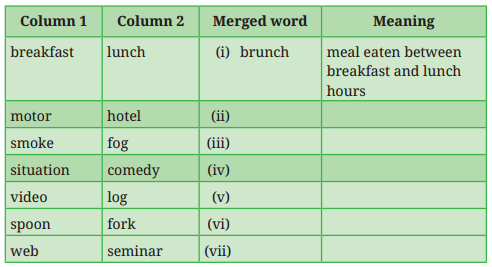
Answer:
| Column 1 | Column 2 | Merged word | Meaning |
| breakfast | lunch | (i) brunch | meal eaten between breakfast and lunch hours |
| motor | hotel | (ii) motel | a hotel for motorists |
| smoke | fog | (iii) smog | polluted air combining smoke and fog |
| situation | comedy | (iv) sitcom | a humorous TV show based on everyday situations |
| video | log | (v) vlog | a video- based blog |
| spoon | fork | (vi) spork | a utensil combining a spoon and fork |
| web | seminar | (vii) webinar | an online seminar |
III. Read the following sentence from the text and fill in the blank.
It will mean that you‘re being doubly safeguarded.
In the given sentence, ‘will’ denotes __________ (past/present/future) time.
Answer:
In the given sentence, ‘will’ denotes future (past/present/future) time.
There are several ways to use verbs to talk about the future in English.
| Tense | Usage | Examples |
| 1. ‘will’ [Note: also common in offrs, promises, and orders expressing willingness, certainty or obligations] | When we provide information about future events or discuss possible future occurrences. | I think the Kailash House will win. |
| 2. Simple Present Tense | When we talk about the future only in situations that are a part of a regular schedule or planned action. | My school reopens on 03 January. |
| 3. Present Progressive Tense | When we use for future actions and events mostly for personal arrangements and fixed plans. |
|
| 4. ‘Going to’ | Present Progressive Tense of ‘go’— This is common in informal style, especially in speech or conversation. | We’re going to get a new motorbike soon. |
| 5. Future Perfect (will have + Past Participle) | When we say that something will be finished or completed by a certain time in future. | The teacher says, she will have completed the portions by next month. |
| 6. Future Progressive (will + be + -ing) | When we say that something will be in progress at a particular moment in the future. | This time tomorrow I will be relaxing at home. |
| 7. Future in the Past | Sometimes, when we talk about the past, we need to mention something that was still in the future at that time— something that had not happened yet. |
|
IV. Fill in the blanks with the correct form (Simple Present, Present Progressive, ‘will’, or ‘going to’) to indicate future time.
1. Our flight __________ (leave) at 10.00 a.m. tomorrow.
2. They __________ (finish) the project by the end of this week.
3. The weather forecast says it __________ (rain) later today.
4. We __________ (move) into our new house next month.
5. I __________ (start) my new hobby class next Monday.
6. She __________ (go) to the mall this afternoon.
7. The team __________ (have) a meeting at 3.00 p.m. tomorrow.
8. I __________ (help) you with your homework after dinner.
Answer:
1. Our flight leaves (leave) at 10.00 a.m. tomorrow.
2. They will finish (finish) the project by the end of this week.
3. The weather forecast says it will rain (rain) later today.
4. We are moving (move) into our new house next month.
5. I will start (start) my new hobby class next Monday.
6. She is going (go) to the mall this afternoon.
7. The team is having (have) a meeting at 3.00 p.m. tomorrow.
8. I will help (help) you with your homework after dinner.
V. Fill in the blanks with the suitable forms of verbs given in brackets to express future time reference.

By 2040, artificial intelligence 1. ________ (revolutionise) medical treatments. Researchers 2.________ (develop) AI-powered diagnostic tools that 3. ________ (transform) healthcare by the end of this decade. Next week, the International Science Congress 4. _______ (open) to showcase advancements in AI and robotics. In the coming years, robots 5. _______ (assist) surgeons in performing complex operations. Years ago, experts had predicted that AI would reshape our world, and now, as we approach the future, this 6. _______ (be) our new reality.
Answer:
By 2040, artificial intelligence 1. will have revolutionised (revolutionise) medical treatments. Researchers 2. are going to develop (develop) Al-powered diagnostic tools that 3. will transform (transform) healthcare by the end of this decade. Next week, the International Science Congress 4. is opening (open) to showcase advancements in AI and robotics. In the coming years, robots 5. will assist (assist) surgeons in performing complex operations. Years ago, experts had predicted that AI would reshape our world, and now, as we approach the future, this 6. will be (be) our new reality.
Feathered Friend Question Answer Class 8 – Let us listen (Pages 217-218)
I. You will listen to a conversation between Monika and Toby. Toby is a Martian and is stranded on Earth. He has become Monika’s friend. As you listen, put a tick mark (S) against the correct statements and a cross against the wrong ones. (Transcript for teacher on page 249)

1. Toby misses his school.
2. Monika accepts Toby as her friend.
3. Monika asks Toby about one of his facial features.
4. Toby tells Monika that she had a banana for breakfast.
5. Toby shares that he can see much clearer with a closed eye.
Answer:
1. Toby misses his school. [✗]
2. Monika accepts Toby as her friend. [✓]
3. Monika asks Toby about one of his facial features. [✓]
4. Toby tells Monika that she had a banana for breakfast. [✗]
5. Toby shares that he can see much clearer with a closed eye. [✓]
II. Listen to the conversation again and fill in the blanks with the exact words you hear.
1. Toby: I miss my _________________ and home.
2. Toby: Well, we _________________ don’t need to eat anything. We get our _________________ from the Sun.
3. Monika: Oh! Don’t you ever feel like having ice-creams and _________________!
4. Monika: Okay, tell me one thing. How are you able to see only with _________________ eye?
5. Toby: I can see beyond mountains and _________________, woods and even ____________.
Answer:
1. Toby: I miss my people and home.
2. Toby: Well, we Martians don’t need to eat anything. We get our energy from the Sun.
3. Monika: Oh! Don’t you ever feel like having ice-creams and chocolates.
4. Monika: Okay, tell me one thing. How are you able to see only with one eve?
5. Toby: I can see beyond mountains and clouds, woods and even metals.
Class 8 English Chapter 13 Question Answer – Let us speak
I. Read the following words from the text aloud and circle the letters that are not pronounced (silent letters).
ballet (ba-lay) [ba pronounced as in bat] whistle (wi-sl)
alarm (uh-laam) psychologist (sai-ko-luh-juhst)
Now, read some more words with silent letters. As you read, circle the letters that are not pronounced.
| receipt debris pneumonia almond foreign island wreck aisle campaign fasten |
Answer:

II. Work in pairs. Use the given situations to ask for and give suggestions.
- You need to make a model of the solar system for the Science Exhibition but don’t know what materials to use. Ask your friend for suggestions.
- You need to prepare for the inter-class quiz on the topic Chandrayaan-3.
Ask your friend for advice on how to prepare.
You may use the prompts given below.
| Asking for Advice | Giving Advice |
| What should I do… ? | I feel you should… |
| How can I… ? | You should ensure… |
| What are the best ways…? | It’s good to prepare yourself… |
| How can I make sure… ? | If you have an issue…, try… |
| What should I… ? | It is best to use… |
Answer:
Solar System Model:
Student A: How can I make a model of the solar system for the Science Exhibition?
Student B: It is best to use Styrofoam balls for the planets and paint them to represent each planet’s colour.
Chandrayaan-3 Quiz:
Student A: What are the best wrays to prepare for the Chandrayaan-3 quiz?
Student B: You should ensure you read ISRO’s official website and watch documentaries on the Chandrayaan-3 mission.
NCERT Class 8 English Poorvi Chapter 13 Question Answer – Let us Write (Page 219)
I. Complete the social media web given below with the uses of the internet.

Now, write an article titled ‘The Importance of Internet’ with the help of the social media web.
Points to remember:
Heading/Title
Name of the writer
Paragraph 1: Give a general introduction to the topic.
Paragraph 2: Explain the uses of the internet and why it is important.
Give examples to support your view.
Paragraph 3: End with a comment and leave the reader with a thoughtful idea or quote.
Answer:
Social Media Web
1. Music Note Icon- To listen to music or stream audio.
2. Instagram Icon- You share photos, videos and stories with followers.
3. Facebook Icon- To connect with friends or use social networking sites.
4. X (Twitter) Icon- To post updates or microblog.
5. Email Icon- To send and receive emails.
6. Profile Icon- To create and manage user profiles.
7. Location Icon- To use maps or share location.
Now, write an article titled ‘The Importance of Internet’ with the help of the social media web.
Points to remember:
|
GOLDEN WRITING TIPS 1. Title / Heading 2. Byline 3. Introduction / Opening Paragraph
4. Body Paragraphs
5. Conclusion Summarise the key points
|
IMPORTANCE OF INTERNET
Aarushi Mishra
The internet has become an integral part of modem life, transforming how we communicate, learn, and access information. It connects people across the globe, making the world a smaller place. From education to entertainment, the internet serves as a powerful tool that shapes our daily lives.
The internet is crucial for various purposes. It enables communication through emails, social media, and video calls, allowing people to stay connected with friends and family worldwide. In education, it provides access to online resources, e-books, and courses, helping students learn beyond traditional classrooms. For example, platforms like NCERT’s e-learning portal offers updated study materials for students. The internet also supports businesses through online shopping and digital marketing, boosting economic growth. Additionally, it offers entertainment via streaming services and gaming, enriching leisure time. Its role in providing instant access to news and information keeps people informed about global events.
In conclusion, the internet is a vital tool that enhances communication, education, and economic opportunities. As Bill Gates said, “The internet is becoming the town square for the global village of tomorrow.” Let us use it wisely to foster knowledge and connectivity, ensuring it remains a force for positive change.
Class 8th English Chapter 13 Feathered Friend Question Answer – Let us Explore (Pages 219-221)
‘A canary in the coal mine’ is a popular phrase to describe early signs of potential danger.
I. Coal miners in places like Arunachal Pradesh used canary birds to detect the presence of carbon monoxide. Such gases are a potential risk to the life of the miners. These little birds are particularly sensitive to carbon monoxide and can prevent mining accidents.
II. Astronauts living in space stations have to do things differently. Read how they manage the routine tasks in the absence of gravity. You may find out more information about it from the internet.
1. Write: Astronauts use a special Space Pen which has a cartridge with ink combined with resin. The ink remains solid until friction with the ball at the point of the pen liquefies it. It works in all positions, in extreme heat and cold, and in atmospheres ranging from pure oxygen to vacuum.
2. Exercise: Astronauts use resistance exercise equipment. Weight training is done by applying a load using vacuum cylinders. Running on the treadmill is made possible with the bodies held down using rubber straps.
3. Eat:Astronauts eat preserved foods which is dried, canned, vacuum-packed, and frozen. These can be prepared by adding cold or hot water, and some can be heated in an oven. They also eat ready-to-eat items, such as nuts, breads, and fruits.
4. Sleep: Astronauts can sleep on a floor, wall, or ceiling as there’s no distinction between up and down but they may gradually float away while sleeping. Therefore, they need to restrain their bodies in small sleeping compartments or sleeping bags.
III. Did you know that animals can save humans from natural calamities?
Animals can sense natural calamities. Read the following examples and decide if this is true.
- In 2004, before a tsunami could hit the coastline of Indonesia, some animals made efforts to flee—elephants ran for higher ground, flamingos abandoned low-lying nesting areas, and dogs refused to go outdoors.
- Minutes before the Naples quake of 1805, oxen, sheep, dogs, and geese started making alarm calls in unison.
- Migratory birds crossing the Pacific are able to dodge storms and other hazards.
- In the Gulf of Mexico, sharks sense the drop in barometric pressure that precedes hurricanes and tend to swim to deeper waters as a result. Dolphins have also been observed swimming away from storm-prone areas.
Scientists have studied this behaviour and found that when severe stresses arise in deep rock before the earthquake, ultra-low frequency electromagnetic waves are generated that animals can sense.
IV. Salim Ali, the ‘Birdman of India’, was an Indian ornithologist (a person who studies birds). He was the first Indian to conduct systematic bird surveys across India and wrote several books on birds. He was awarded the Padma Bhushan in 1958 and the Padma Vibhushan in 1976.
V. We need to conserve our ‘feathered’ friends. Work in groups of four.
Look at the pictures and make a bird feeder with cardboard, chart paper, etc.
Answer:
Students to read the text from NCERT textbook page nos. 219-221.