Exploring Magnets Class 6 Extra Questions and Answers Science Chapter 4
Exploring Magnets Class 6 Very Short Answer Type Questions
Question 1.
Which materials are attracted to a magnet?
Answer:
Magnetic materials such as iron, nickel, cobalt, and certain combinations of these metals with others are attracted towards magnets.
Question 2.
Write the name of the source of natural magnetic.
Answer:
Lodestone
Question 3.
How can you separate a magnetic substance from a mixture?
Answer:
By using a bar magnet, the magnetic substance is separated from mixture.
Question 4.
At which place on a magnet, its magnetic force is maximum?
Answer:
At poles
Question 5.
In which direction does a suspended magnet come to rest?
Answer:
Magnet comes to rest in N-S (north-south) direction.
Question 6.
What happens when N-pole of a magnet is brought near the N-pole of a suspended magnet?
Answer:
There is repulsion between these two magnets as like poles repel each other.
Question 7.
How many poles are there in a magnet name them?
Answer:
Two poles
- North Pole
- South Pole
Question 8.
How many types of magnets are there?
Answer:
- Natural magnet
- Artificial magnet

Question 9.
Name the device that is similar to magnetic compass which was used by Indians for naingation at sea.
Answer:
Matsya- Yantra or Machchh- Yantra
Question 10.
Why are iron, nickel, and cobalt classified as magnetic materials?
Answer:
Because they get magnetised.
Question 11.
If a bar magnet is cut lengthwise into three parts, how many poles will form?
Answer:
Six
Exploring Magnets Class 6 Short Answer Type Questions
Question 1.
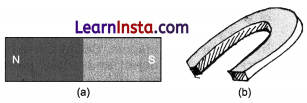
Draw the diagram of
(a) Bar magnet
(b) Horse-shoe magnet.
Answer:
Question 2.
Identify magnetic and non-magnetic substances from the list given below:
Iron, Steel, Nickel, Plastic, Wood, Gold, Copper, Glass, Silver.
Answer:
| Magnetic substance | Non-magnetic substance |
| Iron, steel, cobalt, nickel | Plastic, wood, paper, copper, glass, gold, silver |
Question 3.
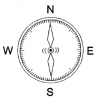
Draw a diagram of a magnetic compass.
Answer:
Question 4.
Write main properties of a magnet.
Answer:
- Magnet has two poles—south pole and north pole.
- Poles of magnet cannot be isolated.
- Like poles repel each other and unlike poles attract each other.
- Freely suspended magnet aligns in N-S direction.
Question 5.
What defines a material as magnetic?
Answer:
A material is considered magnetic if it is attracted to a magnet. Metals like iron, nickel, and cobalt, along with some of their alloys, exhibit this property.
Question 6.
Where do few or no iron filings (or pins) stick on a magnet?
Answer:
Few or no iron filings stick to the middle part of the magnet. The magnetic effect is least in this part.
Question 7.
Few iron nails and screws got mixed with the wooden shamngs while a carpenter was working with them. How can you help him in getting the nails and screws back from the scrap without wasting his time in searching with his hands?
Answer:
With the help of a magnet we can attract all iron nails and screws and can separate them from the wooden shavings. As iron nails and screws are magnetic materials and will get attracted to the magnet, whereas wooden shavings are. non-magnetic.
Question 8.
It is said that repulsion is a sure test for magnetism. Why is it so?
Answer:
To identify the magnet, repulsion (like poles of two magnets repel) is the only test which will let you know whether the given rod is an iron rod or a bar magnet. Because a magnet attracts an iron object and unlike poles of magnets also attract each other.
Question 9.
A given bar magnet was broken into pieces as shown in the figure. Where will be its North and South pole?

Answer:
If you cut a bar magnet into pieces then the end labelled as North remains north and the other end formed will be south. Similarly, the end that was pointing south will be south pole and its opposite end will be the new north pole.

Question 10.
You are given two rods. Out of these, one is an iron rod and the other one is magnet, how will you identify these rods?
Answer:
Take both the rods and suspend them separately. Bring one end of a bar magnet close to both the ends of the suspended rod. If it shows attraction at both the ends, then it is an iron rod. If it shows attraction at one end and repulsion at the other end then it is a bar magnet.
Question 11.
What are magnetic materials? Give three examples.
Answer:
The materials which get attracted by magnets are called magnetic materials.
Examples:
- Iron
- Cobalt
- Nickel
Question 12.
What are non-magnetic materials? Give three examples.
Answer:
The materials which are not attracted by magnets are called non-magnetic materials.
Examples:
- Plastic
- Rubber
- Wood
Question 13.
Choose magnetic substances from given items:
(i) Rubber (ii) Alpin (iii) Nail (iv) Cotton cloth (v) Cobalt (vi) Copper (vii) Iron (viii) Gold
Answer:
Magnetic substances – (i) Alpin (ii) Nail (v) Cobalt (vii) Iron
Exploring Magnets Class 6 Long Short Answer Type Questions
Question 1.
Show that a magnet has two poles. What are the properties of the poles of a magnet?
Answer:
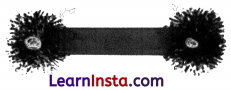
We know that pole is the point where the strength of the magnet is maximum. So, more and more iron particles will be attracted at poles of a magnet when we bring a magnet near the iron particles. We will observe the crowdness of particles at the ends of magnet. This indicates the presence of two poles in a magnet. Hence, poles are present in a magnet in pair. If a magnet is divided into two parts, each part also possesses a pair of poles.
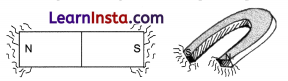
Crowdness of iron particles around poles
Question 2.
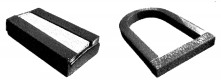
What are artificial magnets? Draw diagrams to show the different shapes of magnets.
Answer:
The magnets formed from the pieces of iron are called artificial magnets. The following are the different shapes of magnets:

Exploring Magnets Class 6 Skill-Based Questions
Question 1.
Observe which of the given objects stick to the magnet and explain with the reason?

Answer:
Iron nails, safety pin, key, paperclips, scissors, stick to the magnet, whereas materials that do not stick to the magnet are glass, matchboxes, candle, pencil, sharpener, plastic scale, rubber. The reason behind this is that materials made of iron, cobalt or nickel are attracted to magnets.
Question 2.
Observe the diagram given below in which heating and hammering of a bar magnet is shown.

Answer the following Question:
What would be the result of these activities?
Answer:
The bar magnet will loose its magnetic properties.
Question 3.
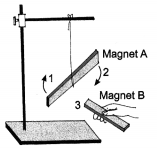
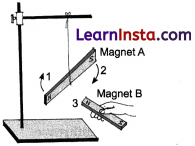
Observe the following figure and name the poles of magnet A marked as 1 and 2, and magnet B marked as 3.
Answer:
Magnet A : 1 – N (North pole), 2 – S (South pole)
Magnet B : 3 – N (North pole)
Question 4.
How can bar magnets be kept safe? Explain with figures.
Answer:
To keep bar magnets safe, we should-store them in pairs with their unlike poles on the same side. We should separate them by a piece of wood.
Exploring Magnets Class 6 Case-Based Questions
Question 1.
Manish dipped a bar magnet in a heap of iron filings and pulled it out. He found that iron filings got stuck to the magnet as shown in the figure. Suddenly magnet get slipped from his hands and broken in three pieces.
I. Which regions of the magnet have more iron filings sticking to it?
II. What are these regions called?
III. Is broken pieces have some magnetic property?
IV. How many poles three pieces have all together?
Answer:
I. The magnet has more iron filings attached to its two ends.
II. Magnets have two poles, namely the North Pole (N) and the South Pole (S). Hence, these regions are called ‘poles’ of the magnet.
III. Yes, all the three pieces have magnetic property.
IV. Each piece has two poles as before the broken of magnet, so there are ‘Six’ poles.
Question 2.
Magnets are fascinating objects that attract certain materials like iron, nickel, and cobalt. They have two ends called poles: a North Pole and a South Pole. These poles have opposite effects on each other—opposite poles attract, while like poles repel.
The Earth itself acts like a giant magnet with its magnetic north pole located near the geographic north pole. This natural magnetism plays a crucial role in navigation, helping sailors and explorers find their way using compasses.
I. What are the two ends of a magnet called?
II. Do opposite poles of a magnet attract or repel each other?
III. How does natural magnetism of the Earth help navigators?
IV. Name two materials that magnets attract.
Answer:
I. The two ends of a magnet are called the North Pole and South Pole.
II. Opposite poles of a magnet attract each other.
III. The natural magnetism of the Earth helps navigators to find directions using compasses.
IV. Magnets attract materials such as iron and cobalt.