Students can use Our Wondrous World Class 5 Solutions Chapter 7 Energy How Things Work Class 5 Questions and Answers as a quick reference guide.
Class 5 EVS Chapter 7 Energy How Things Work Question Answer
Energy How Things Work Class 5 EVS Question Answer
Our Wondrous World Class 5 EVS Chapter 7 Question Answer – Class 5 EVS Energy How Things Work Question Answer
What is Energy? (Pages 114-115)
Question 1.
In a kitchen, we can see a variety of activities.
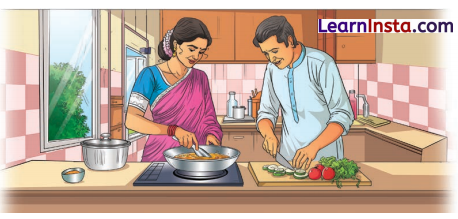
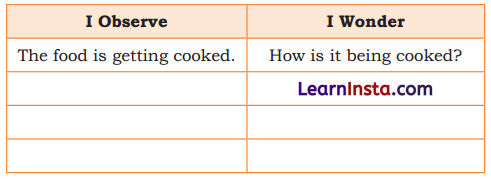
Let us observe a kitchen for some time. Write your observations and the questions that come to your mind in the table given below.
Answer:
| I Observe | I Wonder |
| 1. The food is getting cooked. | How is it being cooked? |
| 2. The bulb is glowing in the kitchen. | How the bulb is glowing? |
| 3. The microwave is heating and grilling the food. | How microwave heats and grills the food? |
| 4. The refrigerator is cooling the water and food. | How fridge is cooling? |

Question 2.
From your observation write down at least three things that you have noticed:
Answer:
Moving
- Fan rotating
- Birds flying
- Car running
Providing light
- Sun
- Bulb
- Candle
Making a sound
- Mixer making a sound
- Bell ringing
- TV or radio playing music
Making things cool
- Refrigerator keeps food and drinks cool.
- Fan makes you feel cool.
- Ice cubes makes drinks cold.
Making things hot
- Gas stove for cooking food
- Electric iron for pressing clothes
- Burning candles gives heat and light
Discuss (Page 115)
What makes these things move, shine, make a sound or get warm and cold?
Answer:
A fan, birds, mixer, refrigerator and bell work when they get energy. Electricity makes them work, while food gives energy to birds. This energy helps them to move, make sound, shine, or become hot and cold.
Activity 1 (Page 116)
Refer to page 116 of the NCERT for this activity.
Answer:
Students should do it themselves, as directed.
Think (Page 116)
What would you change in the activity to make the toy move faster or slower?
Answer:
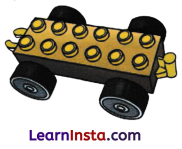
To make the toy move faster, I would,
- Push it harder.
- Use a smoother surface.
- Use a slope to move it.
To make the toy move slower, I would,
- Push it gently
- Use a rough surface.
- Add some weight to the toy.
Activity 2 (Page 117)
Refer to page 117 of the NCERT for this activity.
Answer:
Students should do it themselves, as directed.
Think (Page 117)
Question 1.
What happens if you use thinner or thicker rubber bands? Do they sound different?
Answer:
Yes, they sound different.
- A thinner rubber band makes a high-pitched sound.
- A thicker rubber band makes a low-pitched sound.
This happens because the thickness affects how the rubber band vibrates.
Activity 3 (Page 117)
Refer to page 117 of the NCERT for this activity.
Answer:
Students should do it themselves, as directed.
Think (Page 119)
What do cars and scooters need to keep running?
Answer:
Cars and scooters need fuel like petrol, diesel, CNG or electricity to keep running. Fuel gives energy to their engines so that they can move.
Write (Page 119)
How is food cooked in your house?
Answer:
In our house, food is cooked mainly on a LPG (Liquified Petroleum Gas) gas stove. Sometimes, we also use an induction stove, oven, or microwave, which run on electricity. Nowadays, many houses use PNG (Piped Natural Gas) instead of LPG. Cooking with these fuels is easy and saves time compared to using firewood or coal.
Discuss (Page 120)
Question 1.
What kind of fuel do you use at home for cooking?
Answer:
At home, we use LPG (Liquified Petroleum gas) for cooking. Some people also use electricity for cooking with ovens or induction stoves. In some villages people may use wood, coal or cow dung cakes as well.
Question 2.
What are the problems using too much wood or coal?
Answer:
Using too much wood or coal for cooking causes air pollution. The smoke can make people sick and cause breathing problems. It also harms the environment by cutting down trees and adding harmful gases to the air.
Activity 4 (Page 120)
Understanding How Fuel Works
1. Place two diyas (lamps) on a flat surface.
2. In Diya 1 – place a cotton wick without any oil, and in Diya 2 – place a cotton wick and pour some oil around it.
3. Light the wicks in both the diyas under adult supervision.
4. Observe what happens to the diyas.
(a) Which diya burns longer? Why?
Answer:
The diya with oil burns longer because the oil acts as fuel for the flame.
(b) What is acting as a fuel here?
Answer:
Oil is acting as a fuel here.
Electricity (Page 121)
What are the things in your home that need electricity to work?
Answer:
Most of the things in our home need electricity to work. Some of them are fans, lights, TV, refrigerator, washing machine, microwave, mobile charger and water heater etc.
Activity 5 (Page 121)
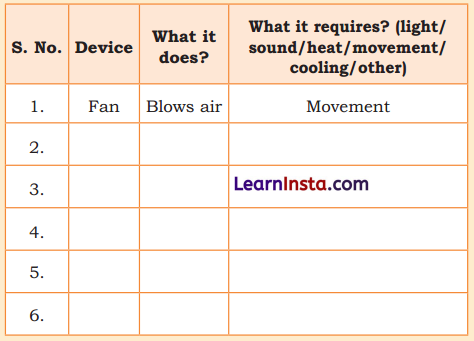
Walk around your home or classroom. Identify five things that run on electricity. Fill in the following table.
Answer:
| S. No. | Device | What it does? | What it requires? (light/sound/heat/ movement/cooling/ other) |
| 1. | Fan | Blows air | Movement |
| 2. | Light | Allows us to see things | Light |
| 3. | TV | Display content | Sound |
| 4. | Refrigerator | Keeps food cool | Cooling |
| 5. | Mixer | Blending | Sound |
| 6. | Water heater | Heat the water for use | Heating |
From the above examples, did you notice that electricity can be used for movement, and producing sound, light and heat?
Answer:
Yes, we have noticed that electricity can be used for many useful activities like, movement, and producing sound, light and heat.
Think (Page 122)
What would your day be like if there was no electricity at all?
Answer:
If there was no electricity at all, the day would be very different- no lights, fans, TV, Fridge, or phone charging. We would have to use daylight, hand fans and do many tasks by hand. It might feel quiet but also difficult, especially at night.
Think (Page 123)
Place a small damp cloth in the Sun. Keep another damp cloth in the shade. Which one do you think will dry first? Why?
Answer:
The damp cloth kept in the Sun will dry first. This is because the Sun gives heat energy, which helps the water in the cloth to evaporate faster. The cloth in the shade gets lesser heat, so it dries more slowly.
Activity 6 (Pages 123-124)
Pinwheel
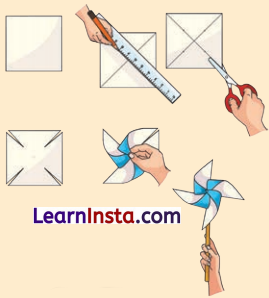
1. Take a square piece of paper.
2. Draw its two diagonals with the help of a ruler.
3. Now, you have four equal parts.
4. Cut halfway along each of the four lines.
5. Fold each corner and pin it to the stick as shown in the image.
6. Now, hold your pinwheel in the wind. If there is no wind, hold it up and run with it. What happens to your pinwheel?
Answer:
When we run with the pinwheel the air pushes against its folded corners, making it spin quickly. This happens because moving it through the air creates wind that turns the blades.
Activity 7 (Page 124)
Sunlight in Focus
1. Take a piece of paper and a magnifying glass.
2. Place the paper in direct sunlight and use the magnifying glass to focus the light on it.
Tip: The activity has to be done under adult supervision.
Question 3.
What happens to your paper?
Answer:
When we focus sunlight on paper with a magnifying glass, the light gathers into a small spot, making it very hot. After some time, the paper starts to turn brown and may even burn.
Activity 8 (Page 124)
Water Wheel
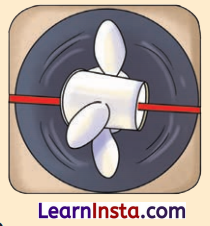
1. Take an empty paper cup and five spoons.
2. Make five holes around the cup and insert the spoons.
3. Then, insert a pencil or straw through the bottom of the cup.
4. Observe that the cup moves around the pencil like a wheel.
5. Balance your wheel on a container as shown in the image.
6. Now, pour water onto your wheel.
7. Does the water make the wheel move?
Answer:
Yes, the water makes the wheel move because its force pushes against the spoons, causing the cup to spin around the pencil like a wheel.
Think (Page 125)
Have you ever seen papads being dried in the sunlight and clothes hung out to dry?
Answer:
Yes, I have seen papads being dried in the sunlight. They are placed on mats or sheets in open areas. I have also seen clothes hung on a clothesline to dry in the Sun. The Sun’s heat help remove the water and makes them dry faster. Drying things in the Sun is a natural and easy way to use solar energy.
Write (Page 125)
Can you think of more examples where we use the Sun, the wind or the flowing water?
Answer:
Sun: Drying clothes, solar cookers, making electricity with solar panels.
Wind: Flying kites, sailing boats, generating electricity with windmills.
Flowing water: Watermills for grinding grains, hydroelectric dams for making electricity and turning turbines in factories.
Generating Energy from the Sun, Wind and Water (Pages 123-127)
Did you know that even our vehicles can run on electricity? (Page 127)
Answer:
Yes, absolutely! Many vehicles nowadays run on electricity-they’re called electric vehicles (EVs). Instead of using petrol or diesel, they use batteries to store electricity, which powers electric motors. EVs are becoming super popular because they produce no tailpipe emissions and help reduce pollution.
Write (Page 127)
Energy All Around Us
List actions that you see in the picture on page 127 of NCERT textbook and fill in the following table.

Answer:
| Activity | Source of Energy |
| 1. A child carrying a school bag. | Food |
| 2. A man carrying a sack of grain. | Food |
| 3. Drying clothes on clothline. | Solar Energy |
| 4. A woman pumping a hand pump. | Food |
| 5. A boy flying a kite. | Wind Energy |
| 6. Wind Mills in fields. | Wind Energy |
| 7. Solar Panels on the roof. | Solar Energy |
| 8. A man charging his cellphone. | Electric Energy |
| 9. Car and Scooter moving. | Fuel Energy |
| 10. A woman grinding wheat. | Food |
Activity 9 (Page 128)
Refer to page 128 of the NCERT for this activity.
Answer:
Students should do it themselves, as directed.
Let us reflect (Page 130)
Question 1.
What will happen if there is no electricity in your house for a day?
Answer:
If there is no electricity in the house for a day, many things will stop working. Fans, lights, TV, fridge and chargers won’t work. It may get hot and dark inside the house. We won’t be able to charge the phone, food in the fridge may spoil and daily chores will be affected.
Question 2.
Why is it better to use solar or wind energy instead of coal?
Answer:
It is better to use solar energy or wind energy because they are clean and renewable. They do not cause air pollution like coal does. Burning coal releases smoke and harmful gases, which are bad for our health and environment.
Question 3.
Give two examples where you have seen energy being stored.
Answer:
Two examples of energy being stored are:
- Charged battery – A battery stores chemical energy, which can be released later to power devices.
- Stretched rubber band – When you stretch a rubber band, it stores potential energy due to its elasticity.
Question 4.
What is the one thing you can do at home to save energy?
Answer:
One thing I can do to save energy at home is to switch off lights and fans when not in use. This helps reduce electricity waste and saves energy.
Question 5.
Find out how many kilometres a vehicle travels per litre of petrol or diesel. Ask about different vehicles. How will you compare them?
Answer:
| Vehicle type | Fuel type | Kilometres per litre km/1 |
| Scooter/Bike | Petrol | 50-70 km/1 |
| Small car (like Alto) | Petrol | 18-22 km/1 |
| Sedan car (like Swift) | Petrol | 15-18 km/1 |
| SUV (like Innova) | Diesel | 12-15 km/1 |
| Auto rickshaw | Petrol/CNG | 25-30 km/1 (Petrol) |
| Bus (Public transport) | Diesel | 4-6 km/1 |
| Truck | Diesel | 3-5 km/1 |
Comparison:
- Scooters and bikes are the most fuel efficient.
- Buses and trucks use more fuel but carry many people or goods.
- Cars vary-smaller cars usually use lesser fuel.
Question 6.
Look around your home or classroom. List any three objects that use energy and mention their source of energy.
For example: Object; Fan → Energy Source: Electricity
Answer:
- Fan → Electricity
- Tube light/Bulb → Electricity
- Projector/Smart Board → Electricity
Question 7.
Create and share:
(a) Draw or make a simple plan of a ‘clean energy home’ that uses solar, wind or any such source of energy.
Answer:

(b) Make ‘my energy diary’ for one day, record the number of times you have used the electricity fuel and so on.
Answer:
My Energy Diary
| Time | Activity | Energy Source | Number of Times uses | Notes |
| 7:00 AM | Turned on the lights | Electricity | 1 | Used for 30 minutes |
| 7:30 AM | Used electric kettle | Electricity | 1 | Boiled water for tea |
| 8:00 AM | Used stove for cooking | LPG (FUEL) | 1 | Cooking breakfast |
| 12:30 PM | Used Fan | Electricity | 1 | For 1 hour |
| 6:00 PM | Used TV | Electricity | 1 | Watched for 2 hours |
| 7:30 PM | Used electric light | Electricity | 2 | Evening and night light |
| 9:00 PM | Used mobile charger |
Electricity | 1 | Charged phone for an hour |