Teachers guide students to use Exploring Society India and Beyond Class 7 Solutions and Class 7 SST Part 2 Chapter 3 Empires and Kingdoms: 6th to 10th Centuries Question Answer NCERT Solutions for quick learning.
Empires and Kingdoms: 6th to 10th Centuries Questions and Answers Class 7 SST Chapter 3
Empires and Kingdoms: 6th to 10th Centuries Class 7 Question Answer (In-Text)
The Big Questions? (Page 61)
Question 1.
What major changes characterised this period?
Answer:
This period saw the decline of large empires like the Guptas and the rise of many regional kingdoms such as the Palas, Pallavas, Chalukyas, Rashtrakutas, and Cholas. Political power became decentralised, with kings ruling through subordinate rulers called samantas.
Trade and agriculture expanded due to better irrigation systems and land grants. Education flourished with the rise of universities like Nalanda and Vikramashila. Temple building, sculpture, and architecture developed rapidly across different regions. The Bhakti movement also spread widely, bringing major social and religious changes.

Question 2.
How did the political, cultural, and religious developments shape India during this period?
Answer:
Politically, India was divided into many strong regional kingdoms that often fought each other for power and territory. Administratively, village assemblies and local governance became stronger, especially under the Cholas. Culturally, great progress was made in art, architecture, literature, and education with the building of temples, universities, and sculptures.
Sanskrit and regional languages like Tamil, Kannada, and Telugu flourished together. Religiously, Hinduism, Buddhism, and Jainism coexisted, and rulers supported all faiths. The Bhakti movement promoted devotion, equality, and social harmony across caste and gender divisions.
Question 3.
What was the impact of foreign invasions and interactions on Indian society and polity during this period?
Answer:
Foreign invasions such as those of the Hunas and the Arabs caused political instability in some regions.
The Hunas weakened the Gupta Empire but were later defeated and absorbed into Indian society.
The Arab invasion of Sindh under Muhammad bin Qasim introduced Islam to India but had limited
long-term political control.
Trade relations between India and Arab lands increased through sea routes. Scientific knowledge, especially in mathematics and astronomy, spread from India to the Arab world. Despite conflicts, cultural exchange between India and foreign regions continued through trade, learning, and religion.
Let’s Explore
Question 1.
Do you recall where the capital of the earlier Maurya and Gupta empires was located? How do you think this shift may have shaped the sub-continent’s politics in the years to come‘?(Page 64)
Answer:
The capital of both the Maurya and the Gupta empires was Pataliputra. It is located near present- day Patna in Bihar. The shift of the capital from Pataliputra to places like Kannauj changed the political centre of power in India. It led to the rise of new regional kingdoms in different parts of the subcontinent. Control over north India became more competitive, causing frequent wars. This change encouraged the growth of many independent regional powers instead of one large empire.
Question 2.
If you know the Devanagari script, with the help of your teacher try to identify some of the letters in Harsha’s signature given below. (Page 64)

Answer:
Harsha’s signature is written in NagarT script, which is the early form of Devanagari. Some letters that can be identified are श (sha), ह (ha), र (ra), and स (s) from the word “श्री घर्ष ” . The inscription reads “svahasto mama maharajadhiraja srl harshasya”, which means “By my own hand, the great king of kings, Shri Harsha.” This shows that Harsha personally approved royal documents.
Question 3.
Looking at the map given below and answer the following questions:
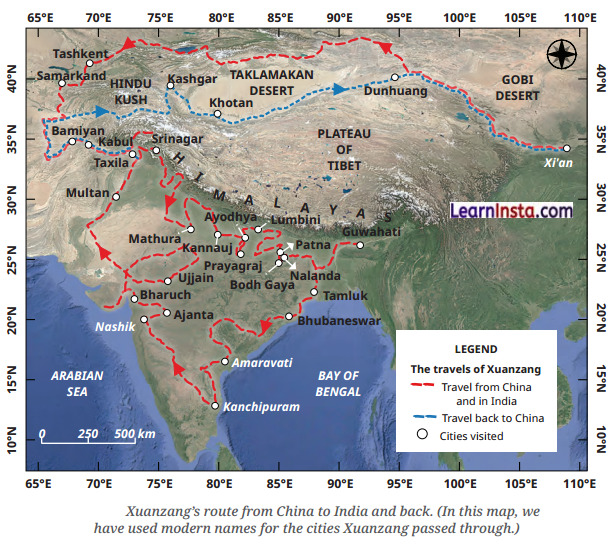
(i) Can you identify a few mountain passes or desert areas that Xuanzang had to cross while travelling between China and India?
Answer:
Xuanzang crossed the Taklamakan Desert and the Gobi Desert during his journey. He also crossed the Hindu Kush mountain range. The Tibetan Plateau was another difficult region he travelled through. These areas made his journey long, dangerous, and challenging.
(ii) Can you also identify a few important Buddhist centres of learning that Xuanzang visited in India? Do you know something of their significance?
Answer:
Xuanzang visited Nalanda. Vikramashila, Bodh Gaya, and Taxila. Nalanda and Vikramashila were famous Buddhist universities with thousands of students. Bodh Gaya is the place where Buddha attained enlightenment. These centres played a major role in spreading Buddhist education across Asia.
Question 4.
Why was Kannauj so attractive to those powerful dynasties? Observe its location on the map given below and discuss in class. (Page 68)

Answer:
Kannauj was located in the fertile Gangetic plains, which made it rich in agriculture. It was also situated on major trade routes, connecting eastern and western India. This gave economic and political importance to the city. Controlling Kannauj meant controlling a large part of north India. Therefore, the Palas, Prattharas, and Rashtrakutas fought for it.
Question 5.
Form groups in your class to discuss the following questions, then compare the groups’ answers.
(Page 74)
(i) What qualities does Kalhana think a historian should have?
Answer:
Kalhana believes that a historian should be honest, careful, and fair. He feels that a historian must study earlier records properly and avoid telling incomplete or incorrect stories. He also stresses that a historian should judge the past without personal bias. According to him, the purpose of history is not only to record events but also to draw moral lessons from them.
(ii) What do the lines “Those who are intent on harassing their subjects perish with their families; on the other hand, fortune waits on even the descendants of those who reinstate order where there is chaos”. Reveal about his method of gathering information? In what ways does it resemble or differ from the way history is currently written?
Answer:
These lines show that Kalhana did not just list events, but studied past rulers carefully and judged their actions. His method of gathering information involved examining earlier texts, inscriptions, temple records, and local traditions, and then drawing moral conclusions from them. Fie tried to connect cause and effect showing how bad rule led to downfall and good governance brought stability.
This resembles modem history because historians today also collect evidence from multiple sources, compare facts, and try to remain free from personal bias. However, it differs because Kalhana openly added moral lessons and personal judgement, while modem historians usually avoid moral conclusions and focus more on objective analysis rather than teaching ethical lessons.
(iii) Kalhana also writes, “That noble-minded poet is alone worthy of praise whose words, like that of a judge, remain free from love or hatred in relating the facts of the past.” What does he mean by ‘free from love or hatred’? How would meeting this condition make a historian more reliable?
Answer:
By ‘free from love or hatred’. Kalhana means that a historian should not be emotionally attached to or prejudiced against anyone. A historian should not praise rulers he likes or criticise rulers he dislikes unfairly. This prevents distortion of historical facts. When a historian remains neutral, the writing becomes more truthful and trustworthy. Therefore, such a historian becomes more reliable for future generations.
Question 6.
According to tradition, Adi Shankaracharya the 8th- century scholar and teacher of the advaita vedanta school of philosophy, visited the hill shown in the below sketch; the stone temple at the top is known as Shankaracharya temple or Jyeshteshwara temple. (Page 74)

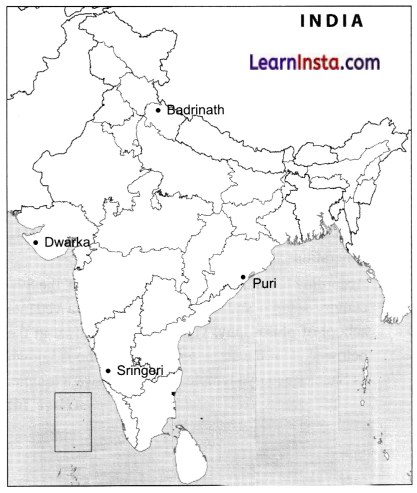
Shankaracharya taught that brahman is the ultimate reality or the pure consciousness, and that the world as we perceive it is maya or illusion. He established four mathas (monasteries and centres of learning) at Badrinath, Puri, Dwarka and Sringeri. Mark the location of these cities on a map; why do you think he chose four different comers of India rather than more central locations?
Answer:
Adi Sahkaracharya chose four different corners of India—Badrinath (north), Dwarka (west), Puri (east), and Sringeri (south) – to establish his mathas so that his teachings could spread across the entire subcontinent. By selecting distant regions rather than one central place, he ensured:
- Wider reach of Advaita Vedanta to people in all parts of India
- Cultural and religious unity, linking diverse regions through a shared philosophy
- Long-lasting centres of learning, each influencing its surrounding region. This helped create a pan-Indian intellectual and spiritual network.
Question 7.
Note this panel’s given below highly dynamic three-dimensional composition, expressing Durga’s confident assault on the demon. (Page 79)

(i) Can you identify some of Durga’s many weapons? And her vahana?
Answer:
Durga is shown holding weapons such as the trident (trisula), sword, bow, and shield. These weapons symbolise her divine power and strength. Her vahana (vehicle) is a lion, which represents courage and authority. The lion charging forward shows her fearless attack on evil.
(ii) What are the main differences between her attendants and the demon’s attendants?
Answer:
Durga’s attendants appear calm, graceful, and well- organised, showing divine discipline. They look confident and powerful. In contrast, the demon’s attendants appear violent, disturbed, and chaotic. Their expressions and movements show fear, confusion, and defeat.
(iii) What does the demon’s slanted posture and general attitude indicate?
Answer:
The demon’s slanted posture shows loss of balance and defeat. His body language suggests that he is falling back under Durga’s powerful attack. His facial expression and movement show fear and helplessness. This clearly symbolises the victory of good over evil.
Question 8.
What details do you observe in the coins given below? Why do the coins of Toramana and Skandagupta appear so similar? What conclusions can you draw? (Page 90)

Answer:
Both the coins of Toramana and Skandagupta show similar designs, symbols, and royal style. The Huna ruler Toramana’s coin even uses Brahmi script and follows the Gupta style of coinage. The coins appear similar because the Hunas adopted Indian administrative and cultural practices after settling in India. They also used Gupta-style royal titles, religious symbols, and coin designs. This shows that instead of remaining outsiders, the Hunas were gradually absorbed into Indian society and culture.
Question 9.
The Chachnama records that when King Dahar was killed, his widowed queen put up a brave resistance, and when the situation became hopeless, she immolated herself along with other ladies. Another queen ordered her treasure to be distributed among the brave soldiers and inspired them to stand against the invaders. (Page 91)
(i) What does this suggest about the way the indigenous people responded to invasions? .
Answer:
This shows that the indigenous people resisted the invaders bravely and did not surrender easily. Even after the king’s death, they continued to fight against the Arab forces. The response reveals a strong spirit of courage, patriotism, and sacrifice among the local rulers and people.
(ii) Why do you think the queen chose to give away her treasure?
Answer:
The queen gave away her treasure to encourage and reward the soldiers who were fighting bravely. It was meant to raise their morale and motivate them to continue resisting the invaders. This also shows that wealth was considered less important than the defence of the kingdom.
(iii) What does this reveal about the role of women in warfare?
Answer:
This reveals that women played a courageous and active role during times of war. They were not only symbols of sacrifice but also sources of inspiration for soldiers. The queens showed leadership, bravery, and determination in defending their land.
Think About It
Question 1.
Does Harshavardhana’s grand ceremony at Prayaga—where he performed sacred rites and distributed wealth—remind you of a similar event discussed in Part 1 of this textbook?
Answer:
Yes, this ceremony reminds us of Ashoka’s Dhamma assemblies and donations discussed in Part 1. Like Ashoka, Harshavardhana gave away wealth for public welfare. Both rulers showed religious tolerance and charity. Their actions were meant to promote harmony and moral values in society.
Question 2.
Some historians state that Dharmapala was Buddhist; he certainly patronised Buddhist learning and institutions. But we should keep in mind that in ancient India, the concept of religion was more fluid than it is today, and except perhaps for monks and nuns, people could feel at ease with various belief systems and practise different modes of worship at the same time.
Indeed, people often did not regard belief systems involving Hinduism, Buddhism, and Jainism as separate, but rather as branches of a common philosophical tree. Besides, rulers often took pride in patronising several schools of thought; we saw the case of the Guptas in Part 1 of this textbook, and Harsha gives us one more example of such broad-mindedness. Similarly, several successors of Dharmapala, though still patronising Buddhist institutions, were said to be devotees of Shiva. The Rashtrakutas and other rulers will provide more examples of this. (Page 69)
Answer:
The paragraph shows that religion in ancient India was flexible and tolerant. People followed more than one belief system at the same time. Hinduism, Buddhism, and Jainism were seen as branches of one philosophical tradition. Rulers often supported different religions regardless of their personal faith. Dharmapala and even his successors followed this tradition of religious tolerance.
Question 3.
Al-MasudI, a 10th-century Arab historian and traveller from Baghdad, gave high praise to a Rashtrakuta ruler; “His troops and elephants are innumerable. … There is none among the rulers of Sindh and Hind who in his territory respects the Muslims [as he does]. In his kingdom, Islam is honoured and protected. And, for them, mosques and congregational mosques, which are always full, have been built for offering prayers five times.” (Page 72)
Answer:
Al-Masudi’s account shows that the Rashtrakuta ruler was powerful and had a strong army. He respected and protected Muslims living in his kingdom. Mosques were built and prayers were allowed freely. This shows that he followed a policy of religious tolerance. It also highlights that India was connected to the Arab world through travel and trade.
Question 4.
How does a professional group transform into a jati? Such a process was complex and could vary from region to region. Let us look at one example. The Kayasthas, historically known as scribes or clerks, were initially a professional group open to different varnas. In the 10th century, they became a distinct jati. In parts of Bengal, certain Brahmana surnames such as Vasu, Ghosha, Datta, and Dama, later came to be associated with Kayasthas, indicating a fusion of Brahmana and non-Brahmana families. Over time, they married mainly within their group, forming the Kayastha jati. (Page 85)
Answer:
According to the chapter, a professional group can transform into a jati through a slow social process over time. The Kayasthas were originally scribes and clerks and were open to people from different varnas. By the 10th century, they became a separate jati as they began to form a distinct social identity.
In parts of Bengal, several Brahmana surnames like Vasu, Ghosha, Datta, and Dama became associated with the Kayasthas, showing a fusion of Brahmana and non-Brahmana families. Gradually, they began to marry within their own group, which finally led to the formation of the Kayastha jati.
Question 5.
Sulaiman, a 9th-century Arab merchant and traveller, makes this comment on a Gurjara-PratThara ruler: “This king maintains numerous forces, and no other Indian prince has so fine a cavalry. He is unfriendly to the Arabs … there is no greater foe of the Muhammadan faith than he; … He has riches, and his camels and horses are numerous. … There is no country in India safer from robbers.” Why do you think the author calls the ruler a ‘foe to the Muslim faith’? (Page 92)
Answer:
The author calls the Gurjara-PratThara ruler a ‘foe to the Muslim faith’ because this ruler strongly resisted the Arab invasions into India. According to the chapter, Nagabhata I of the Gurjara-Pratlharas crushed the Arab forces, preventing them from expanding further into north India.
Since the Arabs were expanding their rule in the name of Islam, this resistance was seen as opposition to the spread of the Islamic political power. Therefore, from the Arab writer’s point of view, the Pratlhara ruler appeared as a strong enemy of Muslim political expansion, and hence he was called a ‘foe to the Muslim faith’.
Question 6.
The table lists common everyday words, highlighting their similar pronunciation across the three languages. By comparing these sounds, you can identify words that are closely related or share common roots in all three languages. With the help of your teacher, use this observation to complete the table. (Page 93). Completed Table (Sanskrit-Arabic-English)

Answer:
| Sanskrit | Arabic | English |
| candana | sandal | sandalwood |
| tambula | tanbul | betel |
| karpura | kafur | camphor |
| pippalt | filfil | pepper |
This shows how everyday words travelled across regions through trade and cultural contact, keeping similar sounds in different languages.
Question 7.
We have met some 12 dynasties in this chapter. During the same period, many more existed in India: the Bhanjas, Chapas (or Chavadas), Guhilas, Kalachuris, Kadambas, Maitrakas, Maukharis, Saindhavas, Shilaharas, Somavamshis, Tomaras, Utpalas, Paramaras, Chahamanas, Gangas, most of them with several branches. You need not remember them (except that we will meet the last three in the next chapter). The list is merely to give a sense of the depth and richness of our country’s history. (Page 94)
Answer:
This long list of dynasties shows that India had a very rich and complex political history during this period. Apart from the major dynasties discussed in detail, many smaller regional dynasties also ruled different parts of the country.
This proves that power was not limited to just a few rulers but was widespread across regions. The list is not meant to be memorised but is given to show the great depth, diversity, and richness of India’s past. It also helps students understand that history is much broader than just a few famous kingdoms.
Empires and Kingdoms: 6th to 10th Centuries Class 7 Solutions (Exercise)
Question 1.
If you lived in Kannauj during the struggle between the Palas, the PratTharas and the Rashtrakutas, how would it change your daily life and your estimate of the rulers? Write a letter on this to your friend living in Kanchipuram.
Answer:
Letter to a friend living in Kanchipuram.
Dear Friend,
Life in Kannauj has become very uncertain because of the constant wars between the Palas, PratTharas, and Rashtrakutas. Soldiers move through the city often, and people live in fear of attacks. Trade is disturbed and prices of food grains keep rising. Though the rulers are powerful, I feel they care more about conquering Kannauj than about the suffering of the people. I now understand how dangerous political rivalry can be for common citizens.
Yours lovingly,
Your friend from Kannauj
Question 2.
Emperors and kings during this period controlled only core regions and governed other regions through subordinate vassals. What would be the advantages and the challenges of such a system?
Answer:
Advantages of such a system are:
- Kings could control large areas without directly administering every region.
- Samantas helped in collecting revenue and maintaining armies.
- Local rulers understood regional problems better.
Challenges of this system are:
- Samantas could become rebellious and disloyal.
- Central authority often became weak.
- Many samantas later overthrew their masters, like the Rashtrakutas did to the Chalukyas.
Quetion 3.
In what ways were the invasions of the Hunas and the Arabs different in their aims, methods, and impact on the Indian subcontinent? Prepare a write up, discuss and present it in the class.
Answer:
Write-Up:
The Hunas entered India mainly for power and territory, and they weakened the Gupta Empire. They were eventually defeated and later absorbed into Indian society, adopting Indian culture and religion. The Arabs came with both political and religious’motives, especially under Muhammad bin Qasim in Sindh. They destroyed temples in the beginning and introduced Islam into India. However, their political control remained limited to
Sindh. Thus, the Hunas merged into Indian society, while the Arab invasion led to a new religious and cultural influence.
Question 4.
Imagine you are a common citizen watching the Prayaga assembly. How would you react to Harsha giving away most of his wealth?
Answer:
As a common citizen, I would feel deeply amazed and grateful on seeing Harsha donate his wealth. His generosity toward Buddhists, Brahmins, and the poor would fill me with respect for him. I would feel proud to live under such a ruler. It would also give me hope that the king truly cares for his people.
Question 5.
Forming groups, let each group choose one Alvar and one Nayanar and prepare a biography poster or booklet. Include their life stories and a sample poem or two (in translation).
Answer:
Alvar: Andal
- She was a female devotee of Lord Vishnu.
- She composed beautiful devotional hymns in Tamil.
- Her poems express deep personal devotion to God.
Nayanar: Karaikal Ammaiyar
- She was a female devotee of Lord Shiva.
- Her poems describe her complete surrender to Shiva.
- She is honoured as one of the 63 Nayanars.
Question 6.
You will notice that our maps show only ancient names for the kingdoms’ capitals and main cities. Using a pencil, mark the modem names next to their original names. Refer the current map of India and try to locate those cities on it.
Answer:
Do it yourself.
Question 7.
Match the ruler or the dynasty with the city.

Answer:
| Column A | Column B |
| 1. Rashtrakutas | (c) Manyakheta |
| 2. Gurjara- Pratiharas | (d) Ujjayint |
| 3. Cholas | (b) Tanjavur |
| 4. Harshavardhana | (e) Kanyakubja |
| 5. Pallavas | (a) Kanchi |