Students can use Our Wondrous World Class 5 Solutions Chapter 10 Earth Our Shared Home Class 5 Questions and Answers as a quick reference guide.
Class 5 EVS Chapter 10 Clothes Earth Our Shared Home Question Answer
Earth Our Shared Home Class 5 EVS Question Answer
Our Wondrous World Class 5 EVS Chapter 10 Question Answer – Class 5 EVS Earth Our Shared Home Question Answer
Activity 1 (Page 162)
We all live in this planet and each of us has an address. Fill up your address below.
Question 1.
My Address
Name: ………..
House number/building name: ………..
Street name: ………..
Village/Town/City: ………..
District: ………..
State/Union Territory: ………..
Country: ………..
Planet: ………..
Answer:
Students to fill in their own name and address, by themselves.

Question 2.
Use a globe and find out:
(a) Are all the oceans on Earth connected with each other?
Answer:
Yes, all the oceans on Earth are connected with each other. Together, they form one large, continuous body of salt water known as the global ocean.
(b) Where is India on the globe?
Answer:
India is located in the southern part of Asia, in the Northern and Eastern Hemispheres. It lies between the Arabian Sea (to the west) and the Bay of Bengal (to the east).
Write (Page 164)
Question 1.
Does the rosy starling visit your area? What is it called locally?
Answer:
Yes, the rosy starling visits our area during the winter season. It is known locally as “gulgulepakshi” or “gulaabimaina” because of its pink and black feathers.
Question 2.
What does this story tell us about nature?
Answer:
This story shows how nature is beautifully connected across the world. Birds like the rosy starling travel long distances and help farmers by eating harmful insects. It teaches us that even small animals play an important role in maintaining the environment’s balance.
Activity 2 (Page 165)
Question 1.
Make a poster of 5 birds that visit your place in winter. Try to find out where they come from.
Answer:
Students to do it themselves.
Question 2.
Using a string, trace the journey on a globe showing the paths rosy starlings take (Russia/Mongolia → India).
Answer:
For this answer refer to the map on page no. 106.
Question 3.
Imagine you are a bird travelling the world. Write a short postcard or note about what you see and what helps you on your journey (wind, ocean currents, warm weather). Share it with your classmates.
Answer:
Dear Friends,
I’m flying high above the Earth seeing tall mountains, deep blue oceans, lush green forests, and bustling cities below. The wind helps me fly far, while the warm Sun keeps me happy. I follow the ocean currents and enjoy the breeze on my wings. What a beautiful planet we live on!
With love,
Birdie, the Traveller
Write (Page 165)
What does it mean when we say ‘nature has no boundaries’?
Answer:
It means that nature does not follow human-made borders or countries. Air, water, animals, and plants move freely across the Earth without caring about countries they are entering.
Discuss (Page 167)
Why do you think yoga became popular in so many countries?
Answer:
Yoga helps people feel calm, stay healthy, and become strong. That’s why it has become popular all over the world.
Write (Page 167)
Can you name a yoga pose you have tried or seen? What do you think it helps with?
Answer:
I have tried the tadasana (Tree Pose). It helps me learn how to balance and makes my legs strong.
Write (Page 168)
Question 1.
What would happen if chillies disappeared from our kitchens for a week?
Answer:
If chillies disappear from our kitchens for a week, our food would taste bland. Some people might enjoy the mild taste, while others would miss the hot, tangy flavour.
Question 2.
Ask your parents and write down the name of any recipe in which they have used black pepper and not red chillies.
Answer:
After asking my parents, I found out that they make black pepper paneer and pepper rasam using only black pepper.
Activity 3 (Page 168)
Question 1.
Using a coloured string, trace the journey of chillies from South America to India on the globe.
Answer:
For this answer refer to the map on page no. 106.
Question 2.
Potatoes, tomatoes, peanuts, cashews, and many other foods have similar stories. They all travelled a long way to reach India and now we enjoy these every day in our food. Find out and write the story of any one of them.
Answer:
Potatoes originally come from South America, where they were first grown by people many years ago. When European explorers travelled to these lands, they brought potatoes back to Europe. Later, travellers and traders brought potatoes to India. At first, people in India were not familiar with potatoes, but soon they began to enjoy them very much. Today, Indians love potatoes and use them in many popular dishes like aloo paratha, samosas, and curries. Potatoes have become an important part of Indian food, showing how foods from far away can become loved and eaten every day.
Discuss (Page 169)
Question 1.
If you could choose one Indian food to share with the world, what would it be?
Answer:
I would share biryani because it’s full of flavour and combines rice, spices, and vegetables or meat.
Question 2.
What kind of new food items do you think will travel in the future?
Answer:
In the future, I think healthy snacks like millet cookies or fruit laddoos will become popular and travel around the world!
Write (Pages 170-171)
Question 1.
Why do you think both Indian and Mexican cultures use marigolds during their festivals?
Answer:
I think both Indian and Mexican cultures use marigolds because the flowers are bright and cheerful. Their colours bring joy and warmth, making them perfect for celebrations.
Question 2.
Why do you think people in different countries include flowers in their celebrations?
Answer:
People include flowers in their celebrations because flowers brighten up the place and create a joyful atmosphere. They are a way to show love and respect.
Write (Page 171)
What does this story tell us about animals moving from one place to another?
Answer:
This story shows that animals can travel long distances and settle in new places. The Indian cows taken to Brazil adapted well, increased in number, and became an important source of milk. It shows how animals can be helpful to people in different parts of the world.
Activity 4 (Page 172)
Question 1.
With help of your teacher or an elder find out the names of at least 5 different breeds of cows.
Answer:
There are many breeds of cows. Here are five common ones from India:
- Gir
- Sahiwal
- Red Sindhi
- Tharparkar
- Ongole
Question 2.
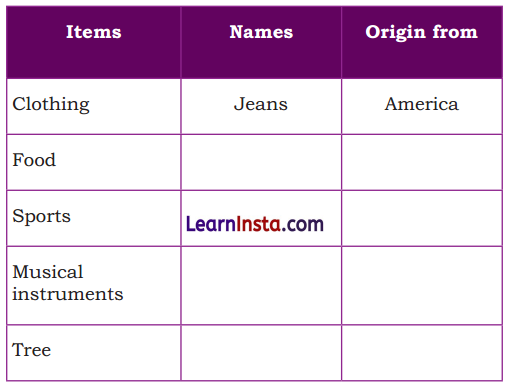
Make a list of a few things in your house or school that may have come from another part of the world. Find out where they originally came from.
Answer:
| Items | Names | Origin from |
| Clothing | Jeans | America |
| Food | Chocolate | South America |
| Sports | Football | England |
| Musical instruments | Guitar | Spain |
| Tree | Maple | North America |
Activity 5 (Page 173)
Question 1.
Interview a grandparent or neighbour: Ask them about a food items, song or custom that was not there in their childhood but is common today. Find out where did it come from?

Answer:
I asked my grandmother about a food that was not common when she was young. She said pasta was not eaten much then, but now many people enjoy it. Pasta comes from Italy and became popular as people began exploring and sharing food from different cultures.
Question 2.
From the stories you have read: List different things that came to India from other countries and those that travelled from India to the world. Then, using two different coloured strings, trace their journeys on a map.
Answer:

– Came to India
(a) Rosy starlings from Russia
(b) Rosy starlings from Mongolia
(c) Marigold from Mexico
(d) Chilli from South America
– Went from India
(e) Yoga and Sugar from India to the world.
Write (Page 176)
Question 1.
What does ‘Vasudhaiva Kutumbakam’ teach us?
Answer:
It teaches us that the entire world is one family.
Question 2.
Write the meaning of ‘Vasudhaiva Kutumbakam’ in your own words.
Answer:
It means that everyone, wherever they live, belongs to one big family.
Question 3.
How can we live like one big family, even when we are different?
Answer:
We can live like one big family by respecting each other’s differences, being kind and helpful, sharing what we have, and learning from each other’s cultures.
Let us reflect (Page 176)
Question 1.
Pick one of the ideas. Write a short story about how this idea might have travelled from one place to another long ago. Think about how it helped people change their lives or the way they think.
Answer:
Long ago in India, people practised yoga to stay healthy and calm. A wise teacher travelled to other countries to share yoga. He taught many people how it helped their mind and body. Slowly, yoga spread far and wide. It helped people live peacefully with themselves and nature. Today, millions around the world enjoy yoga because of that teacher’s journey.
Question 2.
Write one way you can care for the Earth.
Answer:
One way we can care for the Earth is by planting trees to keep the air clean and fresh.
Question 3.
Identify of an item that can travel from India to other parts of the world and write about it.
Answer:
The Indian sitar is a musical instrument that can travel from India to other countries. It has a beautiful sound and can help people in other places learn about India’s music and culture.