These Class 7 Science Curiosity Worksheet and Class 7 Science Chapter 12 Earth Moon and the Sun Worksheet with Answers are excellent for board exam practice.
Class 7 Science Chapter 12 Earth Moon and the Sun Worksheet
Class 7 Earth Moon and the Sun Worksheet
Worksheet On Earth Moon and the Sun Class 7 – Earth Moon and the Sun Worksheet Class 7
A. Multiple-Choice Questions
Question 1.
What causes day and night on Earth?
(a) Earth’s revolution around the Sun
(b) Moon’s rotation
(c) Earth’s rotation on its axis
(d) Sun’s movement
Question 2.
Which of the following is a safe way to observe a solar eclipse?
(a) Looking directly at the Sun with the naked eye
(b) Using sunglasses
(c) Attending a viewing event organised by a planetarium
(d) Using binoculars
Question 3.
Why do the stars appear to move across the sky from East to West?
(a) Because the stars orbit around the Earth.
(b) Because the Earth rotates from West to East.
(c) Because the Earth revolves around the Sun.
(d) Because of the Moon’s movement.

Question 4.
This question consists of an Assertion (A) and a Reason (R). Read the Assertion and Reason and choose the appropriate answer.
Assertion (A): The Sun appears to rise in the east and set in the west.
Reason (R): The Earth rotates from West to East.
(a) Both A and R are true and R is the correct explanation of A.
(b) Both A and R are true, but R is not the correct explanation of A.
(c) A is true but R is false.
(d) A is false, but R is true.
Question 5.
This question consists of an Assertion (A) and a Reason (R). Read the Assertion and Reason and choose the appropriate answer.
Assertion (A): The Earth’s axis of rotation is not upright relative to its orbit, but is tilted.
Reason (R): Seasons occur because of the tilt of the Earth’s axis of rotation.
(a) Both A and R are true and R is the correct explanation of A.
(b) Both A and R are true, but R is not the correct explanation of A.
(c) A is true but R is false.
(d) A is false, but R is true.
B. State True (T) or False (F).
1. The shortest day and longest night in the Northern Hemisphere occur around 22 December.
2. On the equator, there are always 12 hours of sunlight and 12 hours of darkness.
3. When the Sun, Moon and Earth are not exactly aligned, a total lunar eclipse takes place.
4. It is safe to view a solar eclipse directly with the naked eye.
5. Aryabhata estimated the Earth’s rotation as about 22 hours 56 minutes and 4.1 seconds.
C. Fill in the blanks.
1. The Earth rotates in a/an _____________ direction when viewed from the top of the North Pole.
2. _____________ demonstrated Earth’s rotation for the first time using a long pendulum.
3. The _____________ Hemisphere experiences winter in December due to the tilt of the Earth’s axis.
4. The _____________ Observatory in Tamil Nadu has provided data about the Sun for over 100 years.
5. The _____________ app can be used to find information about upcoming solar and lunar eclipses visible from your location.
D. Assign one word to the following terms.
1. A photograph in which apparent motion of star is recorded as arcs of a circle. _____________
2. The cycle caused by Earth’s orbit around the Sun. _____________
3. The event when the Moon blocks the Sun. _____________
4. An eclipse is called in the Sanskrit language. _____________
5. The father of modern Indian astronomy. _____________
E. Match the Columns.
Question 1.
Match the pictures given in Column I with the terms given in Column II.
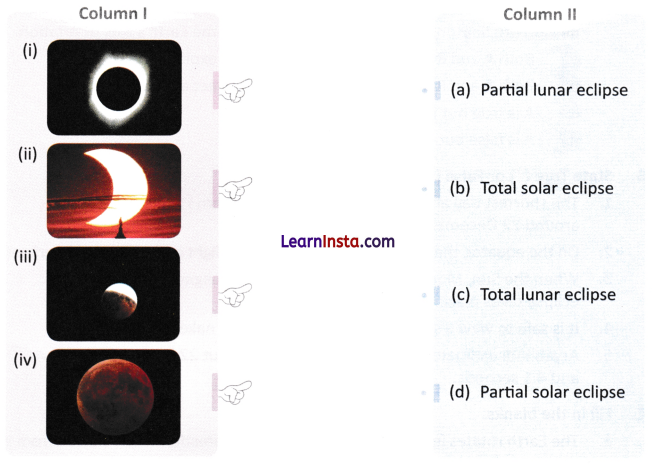
Question 2.
Unjumble the letters given in Column I and write them in the space provided, and then match them with their correct descriptions given in Column II.
| Column I | Column II |
| (i) TORNOTIAN | (a) Occurs when the Moon blocks sunlight from reaching Earth. |
| (ii) UOTNLOIVER | (b) The Earth’s shadow falls on the Moon. |
| (iii) ORSLA CEPLISE | (c) The path an object follows as it revolves around another object. |
| (iv) NUALR CELPSEI | (d) Causes the day-night cycle on the Earth. |
| (v) TOBIR | (e) Causes changes in seasons on Earth. |
Wonder Why?
A. Give reasons for the following.
Question 1.
The Southern Hemisphere experiences winter in June.
_________________________________________________________
_________________________________________________________
Question 2.
Directly viewing a solar eclipse must be strictly avoided.
_________________________________________________________
_________________________________________________________
Question 3.
The Moon and the Sun appear to be about the same size in the sky when viewed from Earth.
_________________________________________________________
_________________________________________________________
Question 4.
The polar regions experience six months of continuous daylight followed by six months of darkness.
_________________________________________________________
_________________________________________________________
Question 5.
In a Transit of Venus, the planet appears as a tiny black dot on the Sun.
_________________________________________________________
_________________________________________________________
B. Look at the given diagram and answer the following questions.
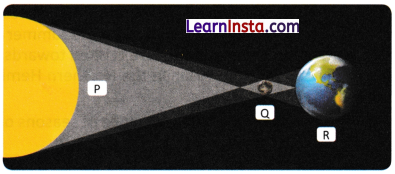
Question 1.
Identify the type of eclipse shown in the diagram.
_________________________________________________________
Question 2.
Name the celestial objects labelled P, Q, and R in the diagram.
_________________________________________________________
_________________________________________________________
Question 3.
What is the name of the other type of eclipse?
_________________________________________________________
Question 4.
Differentiate between the two types of eclipses. Also, draw a diagram of the other type of eclipse.
_________________________________________________________
_________________________________________________________
_________________________________________________________
_________________________________________________________
C. Read the paragraph and answer the following questions.
We go through a cycle of seasons every year. I have also noticed that days are longer in summer than in winter. The Earth’s axis of rotation is not upright relative to its orbit, but is tilted. As the Earth revolves around the Sun, its axis stays tilted in the same direction. The tilt of the Earth’s axis and the spherical shape of the Earth give rise to the seasons. In June, the Northern Hemisphere is tilted towards the Sun, while the Southern Hemisphere is tilted away from it. As a result, the Northern Hemisphere receives more direct sunlight for a longer duration, about 12 hours or more, leading to the summer season. In December, the situation is reversed. The Southern Hemisphere is tilted towards the Sun and receives more sunlight, resulting in summer there, while the Northern Hemisphere is tilted away and experiences winter.
Question 1.
What are the two main reasons for the occurrence of seasons on Earth?
_________________________________________________________
_________________________________________________________
Question 2.
How does the tilt of the Earth’s axis affect the amount of sunlight received in each hemisphere?
_________________________________________________________
_________________________________________________________
Question 3.
What would happen to the seasons if the Earth’s axis were not tilted?
_________________________________________________________
_________________________________________________________
Learn By Doing
A. Perform the following activity to demonstrate how to observe the solar eclipse without looking directly at the Sun.
Materials Required: Small mirror (For example, an embroidery mirror), hollow ball with a small hole, sand, circular ring (For example, an adhesive tape ring), flat surface (For example, a table), wall or screen (for projection)

Steps to follow:
- Half-fill the hollow ball with sand through the small hole to make it stable.
- Attach the small mirror securely to the surface of the ball.
- Place the ball on the circular ring (For example, an adhesive tape ring) on a flat surface, allowing the ball to be rotated easily.
- Under the teacher’s supervision, place the setup outdoors on a day when a solar eclipse, ensuring the mirror faces the Sun.
- Adjust the ball by rotating it until the mirror reflects the Sun’s image onto a wall or screen.
- Observe the projected image of the Sun on the wall or screen during the solar eclipse, and note any changes such as partial or total coverage by the Moon.
- Also, take a photo of your setup and paste it in the space provided below.

Precaution: This activity should be conducted strictly under the teacher’s supervision.
B. Perform the activity to show how the apparent size of an object, like the Moon, can block the Sun’s light during a solar eclipse and answer the following questions.
Steps to follow:
- Ask your friend to stand 5 metres away from you. Imagine their head represents the Sun.
- Close one eye and hold a small object (For example, a coin or a small ball) in your outstretched hand towards your friend’s head.
- Adjust the position of the small object until it appears to completely cover your friend’s head when viewed with one eye.
- Note whether you were able to cover your friend’s head with the small object.
- Measure and record the distance between your eye and the small object.
- Repeat the experiment by having your friend stand at a closer distance (For example, 3 metres) and then at a farther distance (For example, 7 metres).
- Each time, try to cover their head with the same small object and record whether it was possible and the distance between your eye and the object.
Question 1.
Were you able to cover your friend’s head with the small object in each trial? Why or why not?
_________________________________________________________
_________________________________________________________
Question 2.
Explain how this experiment relates to the phenomenon of a solar eclipse, where the Moon blocks the Sun even though it is much smaller.
_________________________________________________________
_________________________________________________________
C. Observe the pictures and tick (✓) those objects that can rotate on their axis.
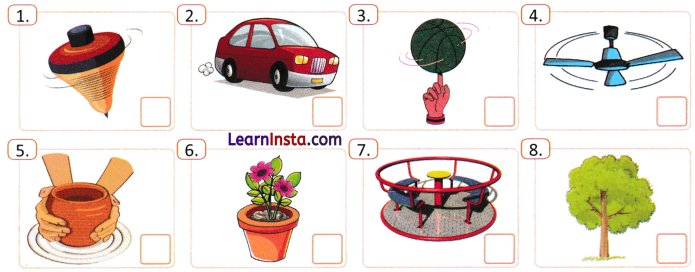
Explore With Curiosity
A. Rashmika noticed that the shadows of coconut trees are longer in the morning and shorter in the afternoon. Why do you think this happens?
_________________________________________________________
_________________________________________________________
_________________________________________________________
_________________________________________________________
B. Take a globe and a torch. Use them to show how the Earth’s rotation causes day and night. What do you notice when you tilt the globe?
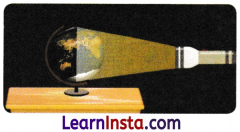
_________________________________________________________
_________________________________________________________
_________________________________________________________
_________________________________________________________
C. Draw the position of the Big Dipper in the sky relative to the Pole Star in the space provided below. Mark the time of your observation along with your sketch. (If the Pole Star is not visible, you can use a fixed tree or building on the ground in the direction of the Big Dipper to help with your observation.)
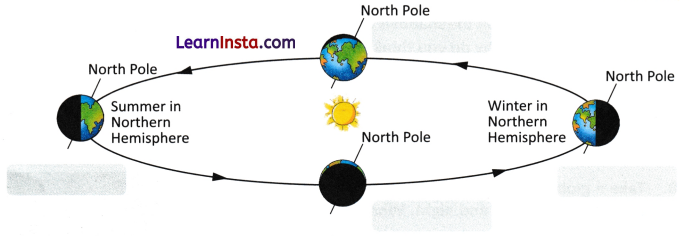
D. Observe the diagram showing the Earth’s revolution around the Sun. Fill in the boxes with the correct labels.
Word Puzzle
Complete the crossword with the help of the given clues.
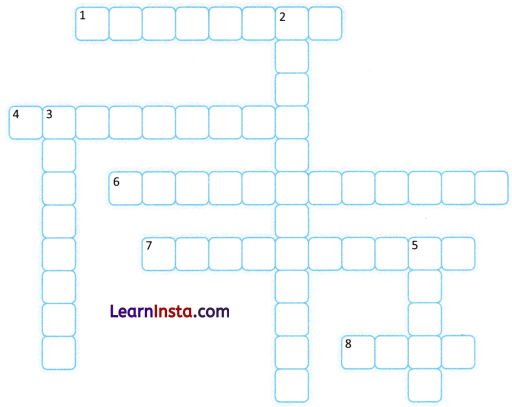
Across
1. A scientist who demonstrated Earth’s rotation with a pendulum
4. An ancient Indian astronomer who explained star motion
6. When the Moon blocks the Sun’s light from reaching Earth
7. Causes changes in seasons
8. The imaginary line through Earth’s North and South Poles
Down
2. When the Earth’s shadow falls on the Moon
3. The spinning of the Earth on its axis, causing day and night
5. The fixed path Earth takes around the Sun
Activities
A. Explore how indigenous communities, like the Bhil and Pawara, used star patterns to mark seasonal events. Discuss the points with your friends.
B. Create a paper model to visualise the Sun’s apparent path across the sky due to Earth’s rotation, connecting to the description of the Sun’s motion. This can be done by using a large sheet of paper, a pencil, a ruler, a protractor, a compass, blue and yellow crayons, and a notebook.
C. A Foucault pendulum of 22 metres has been hung from a skylight in the Constitution Hall of the new Parliament building in New Delhi, India. Can you create a simple pendulum to explore this concept? Give a brief description and compare your pendulum with the Foucault pendulum.