Students can use Curiosity Class 8 Science Book Solutions Chapter 2 The Invisible Living World: Beyond Our Naked Eye Class 8 Question and Answer as a quick reference guide.
Class 8 Science Chapter 2 The Invisible Living World: Beyond Our Naked Eye Question Answer
Science Class 8 Chapter 2 Question Answer The Invisible Living World: Beyond Our Naked Eye
The Invisible Living World: Beyond Our Naked Eye Class 8 Question Answer (InText)
Question 1.
Probe and Ponder (Page 8)
- Have you ever wondered what you might see if the invisible world around you became visible?
- How do you think your observation of this hidden world might change the way you think about size, complexity, or even what counts as ‘living’?
- Have you thought how these tiny living beings interact with each other?
- Share your questions:
……………………………………………………..
…………………………………………………….. ?
Answer:
(Questions may vary)
- How do scientists study things that are too small to see? What tools do they use?
- How do you think microorganisms survive in places where humans cannot, such as hot springs or deep oceans?

Question 2.
What would have happened if microorganisms did not exist on Earth? (Page 20)
Answer:
Microorganisms are tiny organisms, but they are very important for life on Earth. If they did not exist, many natural processes would stop, and life would become difficult. For example:
- Dead plants, animals, and leftover food would not rot or break down. Therefore, cleaning our environment by breaking down waste would not happen.
- Microorganisms like yeast and Lactobacillus would not help in making foods like bread, curd, idlis, and bhatura.
- Helpful bacteria in the soil (like Rhizobium) would not be there to fix nitrogen.
- Microbes would not help turn waste into biogas (used as fuel) and manure (used in farming).
Question 3.
What are the other problems which you think can be solved with the help of microorganisms? (Page 20)
Answer:
Microorganisms can help solve many problems, such as:
- Waste management: Some microorganisms break down garbage and help in composting.
- Purifying water: Some microorganisms help clean dirty water in sewage treatment plants.
- Cleaning oil spills: Some bacteria can break down oil and help clean polluted water.
- Making medicines: Microorganisms like fungi and bacteria are used to make vaccines and antibiotics.
- Improving soil fertility: Microbes like Rhizobium help fix nitrogen in the soil for better crop growth.
NCERT Class 8 Science Chapter 2 Question Answer The Invisible Living World: Beyond Our Naked Eye (Exercise)
Keep the curiosity alive (Pages 25-26)
Question 1.
Various parts of a cell are given below. Write them in the appropriate places in the following diagram.
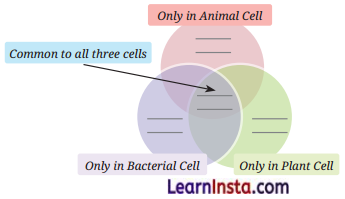
Answer:

Question 2.
Aanandi took two test tubes and marked them A and B. She put two spoonfuls of sugar solution in each of the test tubes. In test tube B, she added a spoonful of yeast. Then she attached two incompletely inflated balloons to the mouth of each test tube. She kept the set-up in a warm place, away from sunlight.

(i) What do you predict will happen after 3-4 days? She observed that the balloon attached to test tube B was inflated. What can be a possible explanation for this?
(a) Water evaporated in test tube B and filled the balloon with the water vapour.
(b) The warm atmosphere expanded the air inside the test tube B , which inflated the balloon.
(c) Yeast produced a gas inside the test tube B which inflated the balloon.
(d) Sugar reacted with warm air, which produced gas, eventually inflating the balloon.
(ii) She took another test tube, 1/4 filled with lime water. She removed the balloon from test tube B in such a manner that the gas inside the balloon did not escape. She attached the balloon to the test tube with lime water and shook it well. What do you think she wants to find out?
Answer:
(i) (c) Yeast produced a gas inside the test tube B which inflated the balloon.
(ii) Aanandi wants to find out whether the gas produced in test tube B is carbon dioxide. When carbon dioxide passes through lime water, it turns the lime water milky. By attaching the balloon (containing the gas) to the test tube with lime water and shaking it, she is testing if the gas causes the lime water to turn milky. If it does, it confirms that carbon dioxide is produced during fermentation.
Question 3.
A farmer was planting wheat crops in his field. He added nitrogen-rich fertiliser to the soil to get a good yield of crops. In the neighbouring field, another farmer was growing bean crops, but she preferred not to add nitrogen fertiliser to get healthy crops. Can you think of the reasons?
Answer:
The second farmer was growing bean crops, which are legumes. Legume plants such as beans, peas, and lentils have special structures called nodules that contain Rhizobium bacteria. These bacteria can trap nitrogen from the air and convert it into a form that the plant can use. So, the bean plants get enough nitrogen naturally and do not need nitrogen-rich chemical fertilisers. This is the reason why the first farmer added nitrogen fertiliser for wheat (a non-legume), but the second farmer growing beans did not need to add nitrogen fertiliser.
Question 4.
Snehal dug two pits, A and B, in her garden. In pit A, she put fruit and vegetable peels and mixed it with dried leaves. In pit B, she dumped the same kind of waste without mixing it with dried leaves. She covered both the pits with soil and observed after 3 weeks. What is she trying to test?
Answer:
Snehal is trying to test how the presence of dried leaves affects the decomposition of organic waste. In pit A, she mixed fruit and vegetable peels with dried leaves, while in pit B, she added the same waste without dried leaves. After 3 weeks, she observed the difference. In pit A, waste had partially or fully decomposed, forming a dark, crumbly material similar to compost or manure. It had an earthy smell and fewer pests or foul odours.
In pit B, the waste was less decomposed, sticky, and had a strong, unpleasant smell. It may have attracted insects or flies and looked slimy. This experiment shows that dried leaves (carbon-rich) balance the wet waste (nitrogen-rich), improve aeration, and help microorganisms break down the waste faster.
Question 5.
Identify the following microorganisms:
(i) I live in every kind of environment, and inside your gut.
(ii) I make bread and cakes soft and fluffy.
(iii) I live in the roots of pulse crops and provide nutrients for their growth.
Answer:
(i) Bacteria
(ii) Yeast
(iii) Rhizobium
Question 6.
Devise an experiment to test that microorganisms need optimal temperature, air, and moisture for their growth.
Answer:
This can be explained by doing the given experiment.
- Aim: To show that microorganisms require optimal temperature, air, and moisture to grow.
- Materials Required: Four clean transparent jars or containers, cooked rice or bread slices, lids or covers (with/without holes), water, refrigerator, labels
- Theory: Microorganisms require optimal temperature, air (oxygen) and moisture to grow. Removing any one of these factors slows or prevents their growth.
Procedure:
(i) Label the containers as A, B, C, and D.
(ii) Place equal amounts of moist cooked rice or bread in containers A, B, and C: Add same amount of dry bread in container D.
(iii) Treat each container as follows:
- A: Keep at room temperature, uncovered (exposed to air and moisture).
- B: Keep at room temperature but covered tightly (no air).
- C: Keep uncovered in a refrigerator (cold temperature).
- D: Use dry bread at from temperature, uncovered (no moisture).
(iv) Observe the containers for 3-5 days.
Observation: Container A will show mould or microbial growth, indicating suitable temperature, air, and moisture. B will show little or no growth due to a lack of air. C will show little or no growth due to low temperature. D will show little or no growth due to a lack of moisture.
Conclusion: Microorganisms grow best in conditions with the right temperature, air (oxygen), and moisture. Removing any one of these factors slows or prevents their growth.
Question 7.
Take 2 slices of bread. Place one slice in a plate near the sink. Place the other slice in the refrigerator. Compare after three days. Note your observations. Give reasons for your observations.
Answer:
Observation (after 3 days):
- A bread slice kept near the sink shows fungal or mould growth, usually green, white, or black patches. It may have a foul smell.
- The bread slices placed in the refrigerator do not show any mould growth or fungus and remain almost unchanged.
Reason:
- The area near the sink is warm and moist, creating favourable conditions for microorganisms, especially fungi (mould), to grow.
- The refrigerator is cold, and low temperature slows down microbial activity and prevents mould from growing quickly.
Question 8.
A student observes that when curd is left out for a day, it becomes more sour. What can be two possible explanations for this observation?
Answer:
The two possible reasons for the curd becoming more sour when left out for a day are:
- At room temperature, Lactobacillus (curdforming bacterial continue to grow and multiply. They produce more lactic acid by breaking down the milk sugars, which increases the sourness of the curd.
- As the curd is left out for a day, fermentation continues. Over time, more acidic compounds build up, making the curd taste even more sour.
Question 9.
Observe the set-up given in Fig. 2.15 and answer the following questions.
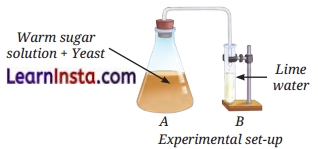
(i) What happens to the sugar solution in flask A?
(ii) What do you observe in test tube B after four hours? Why do you think this happened?
(iii) What would happen if yeast was not added in flask A?
Answer:
(i) The yeast in flask A ferments the sugar solution, breaking down the sugar and releasing carbon dioxide gas.
(ii) After four hours, the lime water in test tube B turns milky. This happens because the carbon dioxide gas produced during fermentation passes into the lime water. Carbon dioxide reacts with lime water, forming calcium carbonate, which turns the lime water milky. This confirms the presence of carbon dioxide.
(iii) If yeast was not added to flask A, then no fermentation would occur, and no carbon dioxide gas would be produced. As a result, the sugar solution would remain unchanged, and the lime water in test tube B would stay clear.
Class 8 The Invisible Living World: Beyond Our Naked Eye Question Answer (Activities)
Activity 2.1: let us observe (page 9)
Aim: To observe how the flask filled with water behave as a magnifying glass.
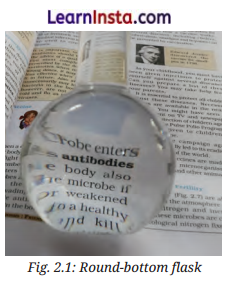
Observation: The letters appear larger when seen through the flask.
Conclusion: The letters appeared larger because the flask filled with water acts like a magnifying glass.
Activity 2.2: let us study a cell (teacher demonstration activity) (page 11)
Aim: To study the structure of onion peel cell under the microscope.
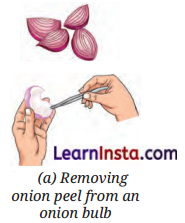
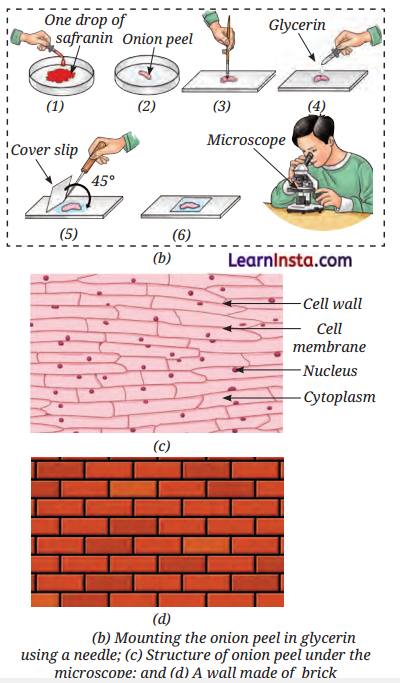
Observation:
- Rectangular-shaped cells arranged in a row, like bricks in a wall.
- The cells are closely packed with no gaps between them.
- Each cell has a thin outer boundary (cell wall), cytoplasm, and a small round nucleus.
- There are similarities in Fig. 2.3 (c) and Fig. 2.3 (d) based on their shape and arrangement. Both, the onion cells and bricks are rectangular. They are closely packed in a neat, regular pattern without any space between them.
Conclusion:
- The onion peel is made up of plant cells that are closely arranged. Each cell has a cell wall, cytoplasm, and a nucleus, which are the main parts of a cell.
- If the similar activity is performed using the peels of the leaves of different plants, it shows that all plants are made up of cells, and it helps us understand the structure of plant cells.
Activity 2.3: Let Us Investigate (Page 12)
Aim: To investigate the structure of human cheek cells under the microscope.
Observation:
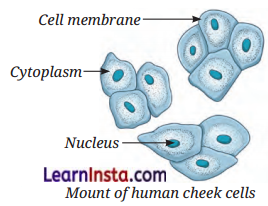
- Under the microscope, the cheek cells appear polygon-shaped.
- Each cell has a thin outer boundary (cell membrane), a central jelly-like substance (cytoplasm), and a nucleus inside.
- No cell wall is seen in cheek cells.
- The cells of the onion peel (plant) and human cheek (animal) share common basic parts (cell membrane, cytoplasm, nucleus).
The differences between these cells are given below:
| S. No. | Feature | Onion Peel Cells (Plant Cells) | Human Cheek Cells (Animal Cells) |
| 1. | Cell wall | Present | Absent |
| 2. | Shape | Rectangular and regularly arranged | Irregular or polygonshaped |
| 3. | Chloroplasts | May be absent in onion peel (nongreen part) | Not present |
| 4. | Vacuole | Large and visible | Very small or not visible |
| 5. | Arrangement | Tightly packed without space | Loosely arranged |
Conclusion: Human cheek cells are animal cells. They have a cell membrane, cytoplasm, and nucleus, but do not have a cell wall or chloroplasts like plant cells. This shows that plant and animal cells have some common parts, but they also have some differences.
Activity 2.4: let us observe pond water/ stagnant water (page 15)
Aim: To observe the tiny organisms found in pond or stagnant water under the microscope.
Do it yourself.
(Hint: You may observe some tiny organisms found in the pond or stagnant water, record your observations.)
Activity 2.5: let us observe soil suspension (pages 15-16)
Aim: To observe the tiny organisms present in soil suspension under the microscope.
Observation:
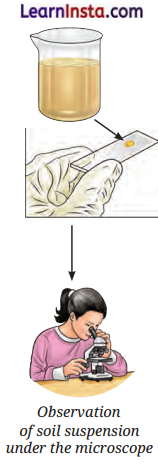
Small moving organisms could be seen under the microscope in the soil suspension.
Conclusion: Soil suspension contains a variety of tiny creatures or microorganisms that cannot be seen with the unaided eye. These microorganisms are living beings and are present even in a drop of soil suspension.
Activity 2.6: Let Us Study (Pages 16-17)
Aim: To study and record the organisms that are present in pond water and soil suspension.
Do it yourself.
Activity 2.7: Let Us Do (Pages 18-19)
Aim: To find out the changes that occur in fruit and vegetable peels kept under the soil for 2-3 weeks.
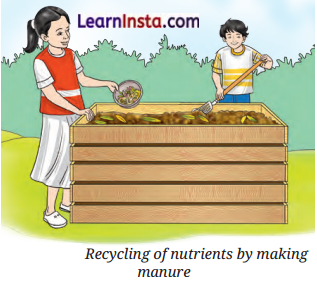
Observation: After 2-3 weeks, the fruit and vegetable peels in the container were found to be partially or fully decomposed. The contents had turned into a dark-coloured, crumbly material.
Conclusion: This activity shows that microorganisms (such as fungi and bacteria) present in the soil act on
plant waste and slowly break it down into simpler, dark-coloured, nutrient-rich manure. This manure helps improve the fertility of the soil. We can also conclude that microorganisms not only help in plant growth but also clean our environment by breaking down waste.
Activity 2.8: Let Us Perform (Pages 20-21)
Aim: To find out the effect of yeast in the volume, smell, or texture of the dough.
Observation:
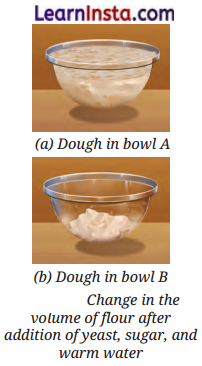
The dough in bowl A, in which yeast was added, has risen slightly, become fluffy, and has a different smell compared to the dough kneaded without yeast (bowl B).
Conclusion: Yeast is a type of microorganism that performs fermentation. When mixed with flour and kept in a warm place, it respire and produces carbon dioxide gas. The gas forms bubbles, causing the dough to rise and become soft and fluffy. Sugar acts as the food for the yeast, helping it grow and become active. Warm water provides the right temperature for yeast to carry out fermentation.
Activity 2.9: Let Us Prepare (Page 21)
Aim: To test the formation of curd from milk in different conditions.
| Change in the appearance of milk | Change in the colour of milk | Possible reason | |||
| Bowl A | Bowl B | Bowl A | Bowl B | ||
| Prediction | Yes | Yes | Yes | Yes | In both bowls, the milk turned into curd as the milk was not hot. |
| Observation | Yes, opaque than milk | No | Slightly off white | No | Curd is formed in bowl A (luke-warm milk). Lactobacillus grow well in warm conditions. |