Students can use Curiosity Class 8 Science Book Solutions Chapter 13 Our Home: Earth, A Unique Life Sustaining Planet Class 8 Question and Answer as a quick reference guide.
Class 8 Science Chapter 13 Our Home: Earth, A Unique Life Sustaining Planet Question Answer
Science Class 8 Chapter 13 Question Answer Our Home: Earth, A Unique Life Sustaining Planet
Our Home: Earth, A Unique Life Sustaining Planet Class 8 Question Answer (InText)
Question 1.
Probe and Ponder (Page 210)
- What do you think Earth would look like if there were no life on it at all?
- Life on Earth has survived for billions of years. What allows it to keep going despite major changes and disasters?
- Why don’t dogs lay eggs? Or hens give birth to live chicks?
- If a spaceship carried soil and water to Mars, could plants start growing there?
- Share your questions
………..
……….. ?
Answer:
(Questions may vary)
(i) What happens if the balance between plants, animals, and microorganisms is disturbed?
(ii) What if gravity on Earth suddenly got weaker?

Question 2.
Is the temperature or distance from the Sun, the only factor that makes the Earth habitable? (Page 215)
Answer:
No, temperature and distance from the Sun are not the only reasons Earth is habitable. Earth’s size helps it hold the right amount of gravity to keep the atmosphere in place. It also has a magnetic field that protects us from harmful solar radiation. In addition, Earth’s atmosphere contains oxygen and other gases needed for life. All these factors work together to make Earth a suitable place to live.
Question 3.
What would happen if the size of the Earth were too small or too big? (Page 215)
Answer:
If Earth were much smaller, its gravity would be too weak to hold on to the atmosphere, and gases could escape into space. But if Earth were much larger, its stronger gravity might press down on us so hard that it could even crush our bones.
Question 4.
Does the magnetic field of the Earth have any role in sustaining life on Earth? (Page 217)
Answer:
Yes, the Earth’s magnetic field acts like a protective shield. It pushes many harmful particles like cosmic rays and solar winds away from Earth, helping to protect the atmosphere and making it possible for life to exist.
Question 5.
But, how is life supported and sustained on Earth? (Page 217)
Answer:
There are many key elements that help life sustaining and supporting on the Earth such as air, water, sunlight, soil, and minerals. Living beings depend on one another. Plants make food through photosynthesis, animals eat plants or other animals, and decomposers break down dead matter and return nutrients to the soil. Nature works together as a system to support life.
Question 6.
How do bamboo and sugarcane grow into new plants? I have never seen their seeds. (Page 221)
Answer:
Bamboo and sugarcane grow into new plants through vegetative propagation. In this method, new plants grow from parts like the stem, leaf, or root, instead of seeds.
Question 7.
What are the advantages and disadvantages of giving birth to young ones vs. laying eggs? (Page 223)
Answer:
Animals that give birth to young ones provide more protection and care, so the chances of survival are higher, but they usually have fewer babies. Animals that lay eggs can produce many at once, but the eggs are more exposed to danger, so fewer may survive.
Question 8.
Do you think animals like dogs, cows, or humans could lay eggs like birds? Why or why not? (Page 223)
Answer:
No, animals like dogs, cows, or humans cannot lay eggs like birds. In birds, the fertilised egg develops outside the mother’s body after it is laid, and the egg contains food for the growing embryo. But in mammals like dogs, cows, and humans, the embryo develops inside the mother’s body. The mother provides food and oxygen to the baby until it is born. This is why mammals do not lay eggs like birds.
NCERT Class 8 Science Chapter 13 Question Answer Our Home: Earth, A Unique Life Sustaining Planet (Exercise)
Keep the curiosity alive(Pages 226-227)
Question 1.
What is one major reason Mars cannot currently support life like Earth?
(i) It has too many volcanoes.
(ii) It is too close to the Sun.
(iii) It lacks a thick atmosphere and liquid water.
(iv) Its magnetic field is too strong.
Answer:
(iii) It lacks a thick atmosphere and liquid water.
Question 2.
Which of these is an example of geodiversity?
(i) Variety of bird chirping in a forest.
(ii) Different landforms like mountains, valleys, and deserts.
(iii) Changing weather during monsoons.
(iv) Number of different types of fish in a pond.
Answer:
(ii) Different landforms like mountains, valleys, and deserts.
Question 3.
If the Earth were smaller with the same density, what might happen to its atmosphere?
(i) It would become thicker and hotter.
(ii) It would escape into space due to weaker gravity.
(iii) It would become frozen.
(iv) It would cause stronger winds.
Answer:
(ii) It would escape into space due to weaker gravity.
Question 4.
In sexual reproduction, why are offspring different from their parents?
(i) They grow in different climates.
(ii) They eat different food.
(iii) They acquire new instructions after birth.
(iv) They get mixed instructions (genes) from both parents.
Answer:
(iv) They get mixed instructions (genes) from both parents.
Question 5.
You notice tiny green plants growing in cracks on your school wall after the monsoon. Where do you think the seeds came from? What conditions helped these plants grow there?
Answer:
The seeds most likely came from birds or animals. Birds often eat fruits and later drop or excrete the seeds in different places, such as cracks in walls. After the monsoon, the conditions become suitable for the seeds to grow. The rain provides water, which is essential for germination. Once the seeds get water, air, and suitable temperature, they use their stored nutrients to grow roots and shoots.
Question 6.
A city has recently cut down a large patch of forest to build new roads and buildings. Discuss the possible effects this could have on the local climate and biodiversity? How might this affect water availability or quality in the area?
Answer:
Cutting down forests can lead to less rainfall and higher temperatures, as trees help cool the air and add moisture. It also affects biodiversity because animals lose their natural homes and may die. Water availability and quality may decrease.
Without trees, rainwater runs off quickly, causing soil erosion and reducing the amount of water that soaks into the ground. This runoff can also carry dirt and waste into water bodies, making the water dirty. Even a small change like cutting a forest can impact the climate, soil, water, and living things around it.
Question 7.
A friend says, “The Earth has always had climate changes in the past, so today’s global warming is nothing new.” How would you respond using what you’ve learnt in this and other chapters of your science book?
Answer:
It is true that the Earth has had natural climate changes in the past also, so today’s global warming is different and more dangerous. Earth has a balance that makes life possiblethe right size, a protective atmosphere, a magnetic field, and just enough air, water, and sunlight. Today’s global warming is not natural like in the past.
It is caused by human activities that are damaging the atmosphere by increasing greenhouse gases. This is disturbing the balance of nature that supports plants, animals, and even microorganisms. If this balance is disturbed completely, the survival of living things, will be at risk.
Question 8.
Imagine Earth’s magnetic field suddenly disappeared. What kinds of problems could arise for life on Earth? Explain.
Answer:
If Earth’s magnetic field disappeared, harmful particles from space like cosmic rays and solar wind (particles from the Sun) would reach the Earth more easily. These can damage the atmosphere, reduce the ozone layer and let in more harmful UV rays, which can harm humans, animals and plants.
The magnetic field protects us like a shield. It would also affect animals like birds and turtles that use the magnetic field to find their way during migration. Satellites and power systems could also be damaged by solar storms.
Question 9.
You are tasked with designing a new settlement for humans on Mars. Name three things you would need to recreate from Earth to support human life there. Which of these do you think is the hardest to replicate, and why?
Answer:
To support human life on Mars, we would need to recreate from Earth are:
- Oxygen to breathe
- Water for drinking and growing food
- A suitable temperature and air pressure (like Earth’s atmosphere)
The hardest thing to replicate is Earth’s atmosphere because Mars is very cold, has very thin air, and no natural protection from harmful space radiation. On Earth, our atmosphere keeps us warm, protects us from UV rays, and maintain the right pressure to survive. Building a safe and stable artificial atmosphere on Mars would be very difficult.
Question 10.
In a village, the temperature has been increasing and rainfall has become unpredictable over the past few years. What could be causing this change? Suggest two ways the village could adapt to these new conditions.
Answer:
The changes in temperature and rainfall could be due to climate change caused by pollution and deforestation. Two ways the village could adapt are:
- Collecting and storing rainwater to use during dry periods.
- Growing crops that need less water and can survive heat.
Question 11.
If there were no atmosphere on the Earth, would it affect life, temperature, and water on the planet? Explain.
Answer:
Yes, without the atmosphere, life on Earth would not be possible. The atmosphere gives us oxygen to breathe, protects us from harmful UV rays, and helps keep the temperature stable.
Without it, days would be extremely hot, and nights would be freezing. Also, without air pressure from the atmosphere, liquid water would quickly evaporate or freeze, making it hard for plants, animals, and humans to survive.
Question 12.
Discuss five examples of vegetative propagation.
Answer:
(i) Bamboo: Bamboo reproduces by underground stems called rhizomes. These rhizomes spread underground and give rise to new bamboo shoots that grow into full plants.
(ii) Sugarcane: New sugarcane plants grow from stem cuttings. Farmers cut the stem into pieces, each having a bud, and plant them in the soil. Each piece grows into a new plant.
(iii) Potato: Potatoes reproduce through the underground part that stores food and has eye like spots. Each potato has buds called “eyes” that sprout and grow into new plants.
(iv) Ginger: Ginger also reproduces using its underground stem (pieces of the ginger) when planted, grow into new ginger plants.
(v) Onion: Onions grow from its underground part, which are underground storage organs made of layers of fleshy leaves. When this part is planted in soil, it grows into a new onion plant.
Class 8 Particulate Our Home: Earth, A Unique Life Sustaining Planet Question Answer (Activities)
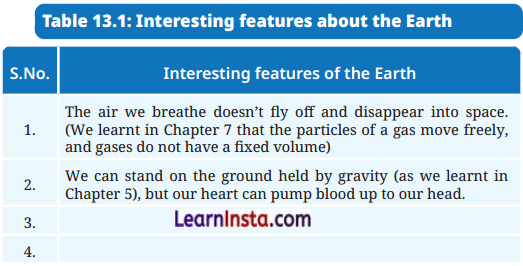
Activity 13.1: Let Us Find Out (Page 212)
Aim: To find and list out the interesting features about the Earth.
Answer:
| S. No. | Interesting features of the Earth |
| 1. | The air we breathe doesn’t fly off and disappear into space. (We learnt in Chapter 7 that the particles of a gas move freely, and gases do not have a fixed volume) |
| 2. | We can stand on the ground held by gravity (as we learnt in Chapter 5), but our heart can pump blood up to our head. |
| 3. | Earth has iust the right amount of oxveen. enough for us to breathe, but not so much that it becomes dangerous. |
| 4. | Soil on Earth contains nutrients that sunnort plant growth, which provides food and oxvgen for us. |
| 5. | The Earth has a protective ozone laver that blocks harmful ravs from the Sun. like ultraviolet (UV) radiations. |
Activity 13.2: let us find out (page 213)
Aim: To find out the information about the temperature and size of the planets in the solar system, and check if they have an atmosphere.

Answer:
| S. No. | Planet | Average temperature (°C) | Radius, compared to the Earth | Has an atmosphere? |
| 1. | Mercury | 170 | 3.8 | No |
| 2. | Venus | 450 | 0.95 | Yes |
| 3. | Earth | 15 | 1 | Yes |
| 4. | Mars | -65 | 0.53 | Yes |
| 5. | Jupiter | -110 | 11 | Yes |
| 6. | Saturn | -140 | 9.5 | Yes |
| 7. | Uranus | -195 | 4 | Yes |
| 8. | Neptune | -200 | 4 | Yes |
Activity 13.3: let us find out (page 221)
Aim: To observe vegetative propagation in ginger or potato.
Do it yourself.